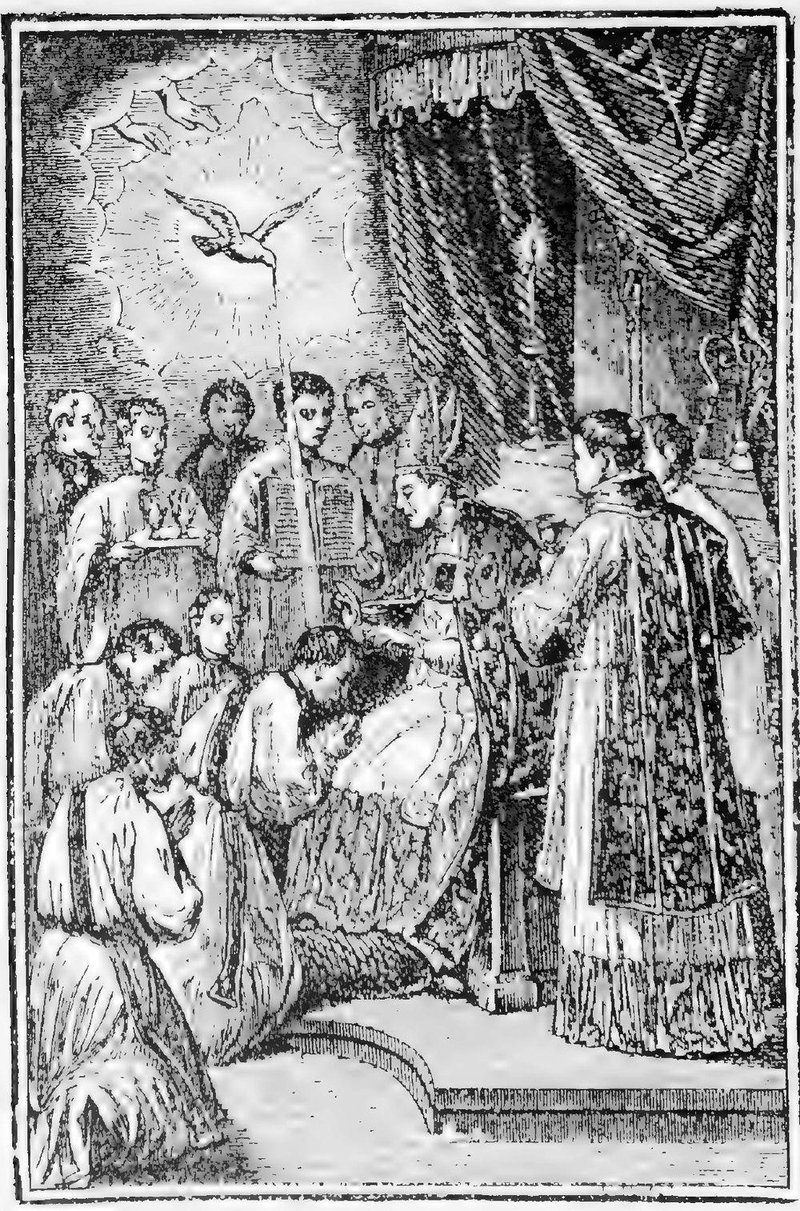
Plate XXXV. The sacrament of Orders. The Holy Ghost pouring out his graces on the one being ordained. The Bishop in the act of conferring Orders.
My son, you know well that Popes, Bishops and priests are subject to death like other men. So, in order that the hierarchy of the Church and the sacred ministry, which are to last to the end of the world, might not be interrupted, Jesus Christ instituted the sacrament of Orders. By means of it he provides an unbroken succession of Pontiffs and priests until the consummation of the world. In the plate you will see the administration of this Sacrament by the Bishop. The dove at the very top represents the divine Spirit. The two hands signify that by the laying on of the Bishop’s hands on the head of the one being ordained an abundance of grace is communicated to him. A thousand times happy is he who, called by God, as Aaron was (Heb. 5:4), answers his vocation and worthily administers the treasures the Lord has entrusted to him! He will be saved, and very many souls will be saved through his ministry.
It is true, my son, that God could, had he wished, have led men along the way of salvation either by himself or by an invisible ministry made up of or carried out by the Angels. But since men are generally guided by what they see, he chose to adapt himself to their nature. Accordingly he instituted a visible ministry, the priesthood, so that priests should be the ones to guide men along that way. This sacred ministry, or ecclesiastical hierarchy, is made up of ministers, priests, Bishops, and one Bishop of Bishops, who is the one we call the Sovereign Pontiff or Pope. To sanctify it further he instituted this Sacrament, which imprints a character on those ordained and empowers them for the holiest and most sacred things there are in heaven and on earth.
Oh, if you knew and understood, my son, how great and wonderful the priestly dignity is! You would be astonished, and would not know how to praise God and honor his ministers. If you understood the boundless trust God places in his priests, you would see how reasonable is the veneration that you and other well-brought-up children show them. You kiss their consecrated hands and exclaim: “Blessed be the most holy Sacrament!” or “Praised be Jesus Christ!”, since they represent the one and make present the other. Could any veneration paid to the priest be excessive? St. Francis of Assisi used to say that between an Angel and a priest he would kiss the priest’s hand before the Angel’s. St. Anthony knelt before priests, and St. Catherine of Siena venerated their footprints. So high was the idea these Saints, enlightened by heaven, had of priests! Ah, if some men looked at priests with the eyes of faith, they would not look at them with the contempt, or at least indifference, with which unfortunately we see them do so in our day!
For, as faith teaches us, the dignity of the priest is so great that, by virtue of the words of consecration he utters, that same Jesus Christ who took human flesh in the most pure womb of the most holy Virgin takes on in his hands a real and sacramental being. He submits to the priest just as he was subject to most holy Mary and St. Joseph, as the holy Gospel tells us (Luke 2:51). So if the priest shuts him up in the tabernacle, he does not resist. If the priest exposes him to public veneration, he consents. If the priest carries him through the streets and squares, and even to the houses of the poorest, to hospitals, prisons and the plague-stricken, he approves this too. And not only has God put himself at the disposal of priests; he has also communicated and entrusted to them his power to forgive sins, handing over to them without reserve the keys of heaven. Oh wonderful dignity! Oh great and wonderful power of priests!… Ah! God has placed in their hands all his spiritual and eternal treasures. All the merits of Jesus Christ, the whole work of the sanctification and salvation of men, is entrusted to the care of priests.
My son, I should like you to reflect a little on the great benefits the public good receives from priests. Prayer is the first. Jacob saw in a dream a mysterious ladder by which Angels went up and down (Gen. 28:12), and all this was a figure of the priests of the new law, the law of grace. As mediators between God and men by virtue of their ministry, they take charge of the needs and petitions of the people. By the prayer proper to their ministry they raise them to the throne of the Most High, and make the remedy for the people’s needs and a favorable answer to their petitions come down, when it is fitting, through the merits of Jesus Christ, whose ministers they are. No, my son, the prayers of priests are not like those of the people or simple faithful, which are always made in their own name, without public title or character. They are the prayers of ministers of the Religion established by Jesus Christ for our benefit: of men who pray by office and in the name of the whole Church, and who intercede as commissioned agents or plenipotentiaries of the Son of God, whose prayer his eternal Father always hears kindly. Oh, how many evils the prayers of priests prevent, and how many blessings they draw down! Out of a million examples that prove it, I will tell you only the one we read in chapter 16 of the book of Numbers. Fourteen thousand seven hundred men had already fallen victim to the dreadful fire with which God was punishing the rebellion of the Hebrews against Moses and Aaron. When Moses understood that so great a slaughter was a punishment from heaven, he said to Aaron: Take the censer… and go quickly… to pray for them… When Aaron had done this… and standing between the dead and the living, he prayed for the people, and the plague ceased (Num. 16:46–48). So great is the efficacy of the prayer of priests! And if it was so great under the old law, the shadow and figure of the law of grace, how much greater will its power be in the priests of the new? It is no wonder, then, that Catholic Kings and Emperors, relying on faith and experience, have turned and still turn to priests, as Moses turned to Aaron. In the troubles and needs of their kingdoms and empires, or when threatened by grave evils, they ask the priests to appease the Lord’s anger by their prayers and make his mercies rain down. So noble, so holy an example, so worthy of those who in God’s name direct the destinies of peoples, has not gone unimitated. So the peoples too have turned and still turn to priests whenever they wish to obtain some mercy or grace from the Lord. In this way they confess publicly and in practice that priestly prayer is of itself more effective than that of private persons, since priests pray by office, as deputed for it by Jesus Christ and by the Church. So it is plain that even if priests had no other task than that of praying, their usefulness to the public could not be more evident.
But this usefulness, marked as it is, is slight compared with what the public good receives from priests through the sacrifices they offer for it to the eternal Father. Every religion has its sacrifices, and therefore its ministers, who under the new law are the Catholic priests. They represent Jesus Christ, in whose name they offer the eternal Father the same victim that was offered on Calvary. In return for so precious an offering they ask for the forgiveness of the people’s sins; for the peace and prosperity of the Church; for the rooting out of errors and heresies; for union and concord among Christian princes; for zeal and wisdom for those who govern; for the peace of the world; and for the sanctification of all men. It is the priests who, presenting the Victim of Calvary to God every day, stay the arm of divine Justice, send the souls in purgatory their chief relief, and open the door to all graces. Peoples! All nations! See whether the benefit you receive from priests is great.
But that is not all. Besides being deputed to present prayers and sacrifices to God every day, priests are also Jesus Christ’s fellow workers in the salvation of souls. They provide and distribute to the faithful the bread of the divine word. With it they civilize them and teach them the duties of a perfect citizen, and show them the one sure way to attain true happiness, spiritual and bodily, in time and in eternity. With catechisms, talks and sermons they guide minds and enlighten them with the infallible torch of faith. They teach the mysteries; they explain the one worship pleasing to God; the commandments imposed by the Lord and by the Church, which are the pattern and rule of public and private conduct; and the Sacraments to be received for the sanctification of peoples and individuals alike. By preaching, priests strengthen the just, call sinners to amendment, rouse drowsy and lethargic consciences and confound the impious. Besides winning souls for society and for heaven, they strengthen in Jesus Christ, for society and for the Church, those already won.
But where above all the benefit the public good receives from priests appears is in the administration of the holy Sacraments, especially that of Penance. By this Sacrament they draw sinners out of the tomb of guilt, of spiritual death, raising them to the life of grace and destroying error and vice. By means of this Sacrament they prevent disorders and check evils, public as well as domestic, stifling them at their birth. In this tribunal of heaven set up on earth the priests, its judges, renew forgotten friendships among the faithful, after quenching the deadly hatreds and grudges that were devouring them. In it the exact fulfilment of their respective duties is urged on and required of everyone, from the lowest of the common people to the highest in rank: their duties toward God, and those imposed on them with regard to their neighbor and themselves. In it a man is required and compelled to give society what he owes it, and not to hinder his neighbors from seeking happiness under the protection of the laws society has established. By means of this Sacrament, finally, priests labor tirelessly to sweeten the bitterness of the sorrows with which the world is strewn, to dry the tears of misfortune, and to make this vale of tears less sad, so far as the nature of things allows under the designs of
God. Would that men understood these benefits and hastened to profit from them! Would that those charged by God with the public good gave this holy ministry, as far as lies in them, its due importance! Caring less for other means of checking disorders, would that they favored all that the Church has arranged to make the administration of the Sacraments more wholesome for man as an individual and for man in society! So great, my son, and so plain is the difference between peoples who, not being Catholic, do not have the sacrament of Penance and those who frequent it, that the customs of the former always tend to degrade man, and those of the latter to make him godlike. Who, then, will not thank God for so great a good, and give priests, as its dispensers, all due honor and reverence?
Respect them, my son, and venerate them. Do so because their dignity as representatives of Jesus Christ requires it; because this is the will of our Redeemer, who, referring to the Apostles and disciples and to their successors the priests, said: He that despiseth you, despiseth me (Luke 10:16); and finally because of the great benefit the public good receives from them through their ministry of prayer, sacrifice, preaching and administration of the Sacraments, as I have explained to you.
If you should learn or perhaps hear that some priest has fallen into some wretchedness or frailty, do not be surprised or scandalized at it. As there was a Judas among the first priests, the Apostles, it is no wonder that among those of our day too there should be some who forget that they must be holy. Being a priest does not stop anyone from being a descendant of Adam and, as such, subject to the same miseries and frailties as other men. But understand that because one is bad it does not follow that all the rest are. And even with regard to the bad one, I want you to know that you must pity the frailty he has shown as a man, and venerate the priestly dignity Christ has marked on him. If you see a bad priest placed at the head of a people, you must grieve and fear, and think that perhaps our sins have deserved so horrible a punishment. For holy Scripture teaches us that the greatest and most terrible scourge God sends a people is to give it bad priests. When the Lord’s anger has not yet reached its height, he permits nations to take up arms against one another, the fields to be barren, and famine, desolation and death to hold sway over the earth. But when his just indignation passes all bounds, he sends the last and most dreadful of his punishments, permitting faithless ministers, stained priests and scandalous pastors to be set among men. Then it comes true that the abominations of the people are the cause of bad priests, and bad priests are the greatest punishment with which God afflicts the people. To avoid such terrible harm the Church, ever zealous for the good of the peoples and for the honorable dignity of the ministers of the altar, has established as law twelve fasts a year, three at the beginning of each of the four seasons. We call them the Ember days, and they are the time appointed for the ordination of priests. By them she obliges all the faithful to join her in begging the Lord not to punish us by giving us bad priests. Rather, may he pity our miseries and send us worthy ministers and zealous pastors to guide us through the desert of this world until we reach happily the promised land, eternal glory. Amen.
Q. What is the sacrament of Orders?
A. It is a Sacrament instituted to give ministers to the Church.
Q. Are priests, then, ministers of God and of his Church?
A. Yes; they are the ministers of Christ, and the dispensers of the mysteries of God (1 Cor. 4:1).
Q. What effects does the sacrament of Orders cause?
A. It gives power and grace to priests and the other ministers of the Church to do their offices well.
Q. What powers does the sacrament of Orders give priests?
A. Two very great powers.
Q. What is the first?
A. That of consecrating the body of Jesus Christ and giving it to the faithful.
Q. What is the second?
A. That of baptizing, preaching and forgiving sins.
Q. Could there be a Christian society without priests?
A. No, because there would be no one to administer the Sacraments and exercise the authority of God.
Q. Since priests are ministers of the Lord, is their dignity very great?
A. It is the greatest dignity on earth. And Jesus Christ has said that whoever hears his ministers hears him, and whoever despises them despises him.
Q. What, then, do we owe priests?
A. Respect, obedience and gratitude.
Q. Are there different grades in holy Orders?
A. Yes; there are Bishops, priests and other lower ministers.1
Q. Who instituted this hierarchy?
A. Jesus Christ our Lord.
Q. Does holy Orders increase grace?
A. Yes, because it is a Sacrament of the living.
Q. Does it imprint a character?
A. Yes; it imprints the character of a minister of God.
Q. What should be the purpose of embracing the clerical state?
A. The desire to promote more and more the glory of God and the salvation of souls; and for this one must be called by God to take that state.
Footnotes
-
Ministeria quaedam. ↩