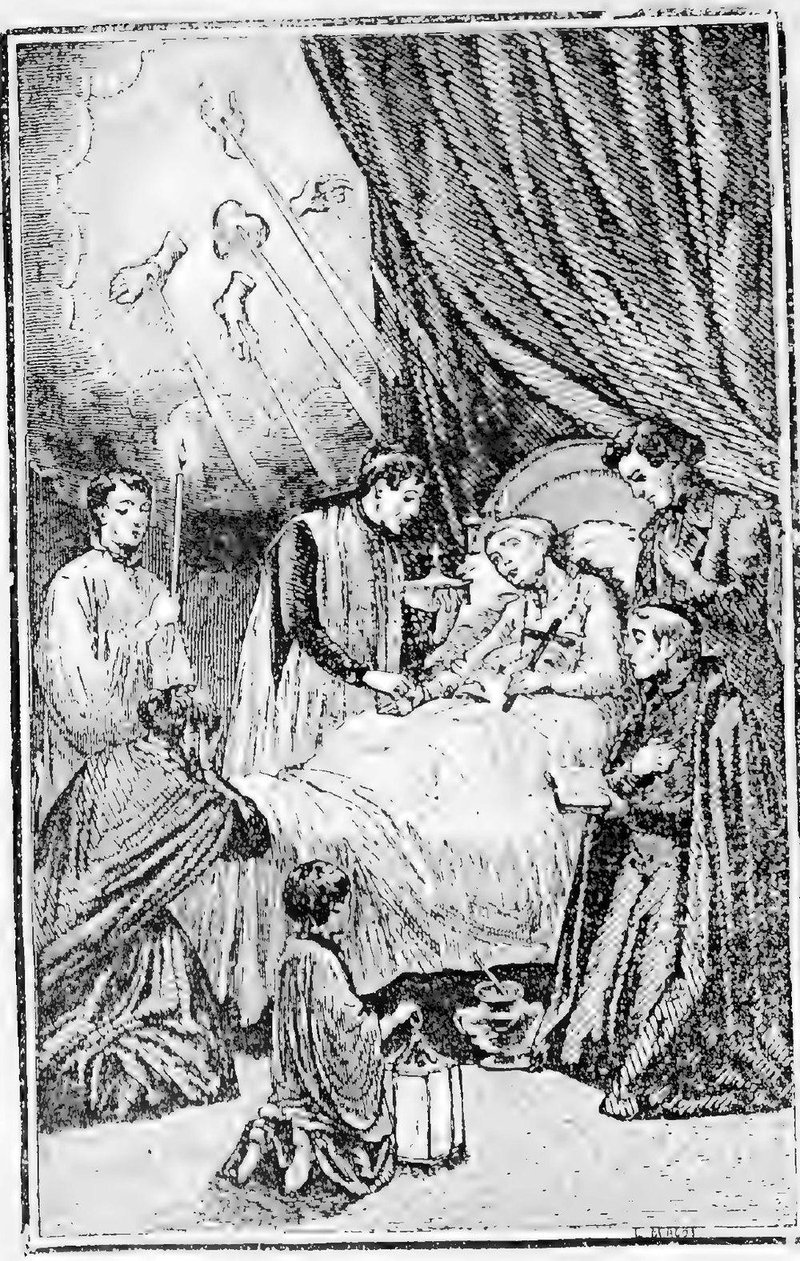
Plate XXXIV. The sacrament of Extreme Unction. The five wounds of Jesus. A dying man. A priest who has anointed him. A priest making the commendation of the soul.
Do you see, my son, that sick man in the plate receiving the sacrament of Extreme Unction? Know that the love of Jesus Christ was not content with instituting the sacrament of Penance as a most effective remedy for healing the diseases of the soul. He also instituted that of Extreme Unction to arm the dying. For he knew that in that last period of life a most powerful help would be needed to come off victorious in the struggle which the evil spirit and the other enemies of the soul then wage against us with greater fury. In this Sacrament the outward senses are anointed because, as the Prophet says, during life they are the windows through which death enters our soul (Jer. 9:21), that is, sin.
The effects this Sacrament causes in the soul of the sick person who receives it with the proper disposition and at the right time are several, and I will declare some of them to you. It increases grace. It takes away the remnants of the bad past life. It strengthens the weakness and frailty that remain in the soul after sin has been forgiven, like what remains in the body after coming through a serious illness, which is called convalescence. It forgives not only venial sins, if there is sorrow for them, but also mortal ones when the sick person is unaware of them or could not confess them. It relieves and consoles the soul, filling it with great confidence in the merits of Jesus Christ; to give you to understand this, you see his five wounds pictured there. It gives strength to resist the temptations of the devil, which at that time are very violent, because he sees that his time for seducing that soul is running out. It gives helps to
bear the anguish of death patiently. It eases not only the fear of that dreadful passage or crisis but also the intense pain death causes the body. It lessens the temporal punishment of purgatory. It prepares and disposes the soul to enter glory. And finally, if it is good for him, it also restores bodily health. Such, my son, so great and so wonderful, are the effects this Sacrament causes in the sick. That is why the Catechism of St. Pius V, composed by decree of the holy Council of Trent, says: “Those sin most grievously who, to administer holy Unction to the sick person, wait, as is commonly done, until all hope of recovery is lost and he begins to be deprived of life and senses. For it is certain,” it adds, “that for him to receive the grace of the Sacrament more abundantly, it is of the greatest importance to anoint the sick person with the sacred oil while he still has the full use of reason and judgment and can receive it with faith and a more devout will.” St. Liguori, in appendix 2, § 4, relates that on a certain occasion a dead man appeared and said that if he had received holy Unction before dying he would have recovered from his illness at once. But he had died because he put it off, and moreover he was sentenced to a hundred years of purgatory.
We read in history that in some Catholic towns, and even whole kingdoms, the custom was kept for a long time in former days of anointing the sick with the holy oil before giving them holy Viaticum. St. Thomas supposes that holy Unction was received before Viaticum when he says that “by Extreme Unction a man is prepared to receive the body of Christ worthily.” Even in our own day, in some places in Spain, especially the small ones, it is the custom to administer the sacrament of Penance, then Viaticum, and then at once holy Unction. But in the cities and larger places the impious fashion is followed of administering this Sacrament when the sick person is more dead than alive and does not know what is happening to him. It is true that they try to justify this barbarous or impious custom by saying they do so in order not to frighten the sick person; but it is also true that there is no worse-understood compassion. Woe to the one through whose fault the sick person dies without this Sacrament, or receives it in a state in which it can hardly profit him any longer!
Those who act in this way in fact treat the sick person as impious and reprobate. In a way they give to understand that they regard him as already condemned to the torment of hell, and so they try to hide from him how near he is to being cast into it, so as not to anticipate the pain that awaits him. For if they thought him destined for heaven and worthy of eternal glory, they would try to help him be purified of those faults into which even the just often fall. Though light, these keep them from entering heaven, and they can be purified of them by means of this Sacrament. Such an omission certainly shows very little compassion for the sick person, because, as I said, it amounts to treating him as impious, reprobate and damned. This is a cruel kindness. Death does not wait on that account. And if the patient dies in sin and is damned for not having received this Sacrament, those who could have seen that he received it and did not will answer for it at God’s tribunal. They will deserve to be cast into hell like Epulo in the Gospel, because he let Lazarus die of hunger. You see, then, my son, how well the poor dying man’s relatives and friends would behave toward him if they obtained this means of salvation for him.
But suppose the sick person is not in sin but in the state of grace. Even so, far from wronging him by seeing that he receives holy Unction, they will do him a priceless favor. A dethroned monarch would suffer no injury from his relatives and friends if they tried by every possible means to restore him to his throne; and anyone who, for fear of adding to his distress, failed to speak to him of the means of recovering his dignity would be looked on as a false friend. So too the sick person will regard as a great favor the efforts his relatives, friends and acquaintances make to place him on the throne prepared for him in heaven. On the contrary, he will regard it as an injury if, through human fears, he is kept from receiving the necessary helps, which are the holy Sacraments. Hold this Sacrament, then, my son, in high esteem. Desire to be able to receive it, and that those of your house should receive it, and that at the right time, so that you may gain its effects in this life and glory in the next. Amen.
Q. What is the sacrament of Extreme Unction?
A. A Sacrament instituted for the spiritual and bodily relief of the sick who are in danger of death.
Q. What is the matter of this Sacrament?
A. Olive oil blessed by the Bishop.
Q. What is the form?
A. The words the priest says when he makes the holy anointings.
Q. Who is the minister?
A. The parish priest, or another priest with his leave.
Q. When should this Sacrament be received?
A. When the Christian has reached the use of reason and is sick and in danger of death.
Q. How should it be received?
A. One should try to receive it in the state of grace, with contrition and confidence.
Q. How many effects does it cause, and which?
A. Three. First, it blots out venial sins and the remnants of mortal sins already confessed. It even forgives unknown mortal sins, and those the sick person cannot confess through physical or moral incapacity. Second, it gives joy and strength to the soul to fight with Satan. Third, it gives bodily health if that is good for him.
Q. How does it give joy and strength to the soul?
A. By the increase of sanctifying grace, and by means of special helps God gives the sick person.
Q. Is it lawful to put off Extreme Unction until the sick person has lost consciousness, so as not to distress him?
A. It is not lawful, and it does the sick person great harm.
Q. Where does such conduct come from?
A. From a misunderstood kindness, from ignorance and from little faith.