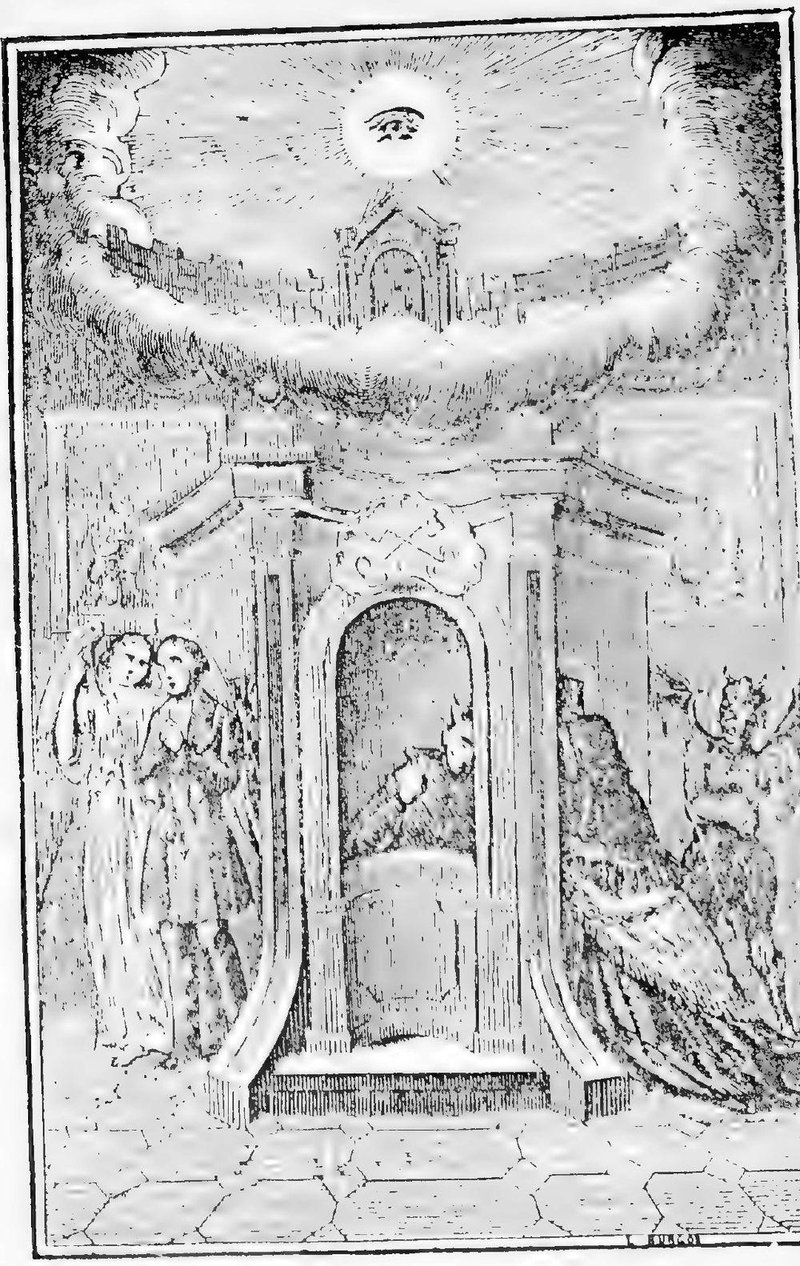
Plate XXXIII. The sacrament of Penance. The city of heaven. A priest in the confessional. A young man who has made his confession. A lady making her confession. St. Mary Magdalen and St. Jerome, models of penance.
See, my son, in this plate a priest shown in the act of administering the sacrament of Penance, that is, of hearing the confessions of sinners. You know already that one who is in mortal sin is a slave of Satan. You see this with that woman making her confession, whom the devil holds bound with a chain. It is quite otherwise with the man on the other side. Because he has made a good confession he is now free of those chains, and an Angel accompanies him. He is in the grace of God, and has practiced many virtues, such as faith, hope, charity, obedience, prudence, humility and fortitude.
For one who has sinned after Baptism there remains no other means of salvation than the sacrament of Penance, either received in fact, or by contrition with the purpose of receiving it when he can. Do you see at the top of the plate heaven pictured, surrounded by a wall, with its gates shut? This shows that one who is in mortal sin cannot enter there. Only a well-made confession, or, if one cannot confess, a firm purpose of making it together with contrition, can open the gates to us. That is what the keys you see above the confessional signify.
Under the natural and written law confession was no more than an act of virtue, and so was penance. But under the law of grace Jesus Christ raised confession and penance to the dignity of a Sacrament, which he instituted to forgive sins committed after baptism.
So much does God desire and require of sinners the confession of their sins that, as soon as our first parents had sinned, he questioned them about their sin, so as to oblige them to humble themselves and confess their fault. God questions Adam, and he confesses his sin, saying: I did eat (Gen. 3:12): I have eaten of the forbidden tree, I have sinned. Then he turns to Eve, and she too confesses her fault, saying: I did eat (Gen. 3:13): I have eaten, I have sinned. Both did penance, and both were saved. Later he questions Cain about his brother, so that he may humble himself and confess having murdered him. But instead of humbling himself and confessing it, he denies it, and… he dies impenitent and is damned.
Under the written law the Israelites were already accustomed to confess their sins, and God commanded it, as appears from chapter 5 of the book of Numbers, verses 6 and 7, where he says: Say to the children of Israel: When a man or woman shall have committed any of all the sins that men are wont to commit… they shall confess their sin. On these words Cornelius a Lapide says: “Let the reader note here the use, or rather the precept, of particular confession in the old law.” Its practice also appears from various other places in the Old Testament.
But let us pass to the law of grace. Here Jesus Christ is presented to us, of whom it is written, coepit facere et docere [he began to do and to teach] (Acts 1:1). Before anything else he began by making a kind of practical confession. That is, he chose to appear as though he were a sinner before he taught this precept and raised penance or confession to a Sacrament. He was conceived without sin, and it was impossible for him to commit the slightest fault, because he is God. Yet to teach us by his example our obligation to confess our sins, he chose to be circumcised like a sinner on the eighth day after his birth. As such he afterwards submitted to the baptism of St. John, and finally he chose to die as if he were a sinner. He himself assures us that he came not to abolish the law but to perfect it (Matt. 5:17). So he did not take away this law of confession. Besides perfecting it by his good example, he raised it to the rank of a Sacrament, placing his merits in it, that they may have life, and may have it more abundantly (John 10:10). I mean that he instituted this sacrament of Penance so that those who receive it well disposed may recover grace, if they have lost it after Baptism, or increase it, if they have kept it.
Jesus Christ saw how many souls were lost for not having the contrition indispensable for recovering grace, besides faith in the promised Redeemer. So he longed unceasingly to institute this Sacrament. Before the hour for doing so came, he said to St. Peter: I will give to thee the keys of the kingdom of heaven. And whatsoever thou shalt loose upon earth, it shall be loosed also in heaven, as we read in the Gospel of St. Matthew, chapters 16 and 18. He made the same promise to the other Apostles, and in them to all priests.
The holy Council of Trent, in session 14, says that these promises of the Saviour were fulfilled when, after the Resurrection, he appeared to his Apostles, breathed on them and said to them: Receive ye the Holy Ghost. Whose sins you shall forgive, they are forgiven them; and whose sins you shall retain, they are retained (John 20:22–23). By these words he made the Apostles and their successors, the priests, judges in the tribunal of Penance until the end of the world. They are to condemn or absolve, not at their whim, but in conformity with the laws of sound morals, having heard the case through the penitent’s confession. By the same act and with the same words Jesus Christ commands all sinners without distinction to submit to the power of judging he has given the priests, if they wish to obtain pardon of their sins; otherwise this power would have been illusory and merely nominal. St. Augustine and the Council of Trent say that Jesus Christ gave the name of keys to this power he gave the priests to absolve sins. He did so in order that sinners might understand that, as no one can enter a locked house without the keys, so neither will they enter heaven, which was shut to them by their sins, unless they use the keys or power he gave the priests for the purpose. And if they had any other means of entering than these keys, it would have been superfluous to hand them over to the priests.
Peraldus, bishop of London, observes that this divine precept of confessing sins was promulgated by the apostle St. James when he said: Confess therefore your sins one to another (to one who is a priest), and pray one for another, that you may be saved (Jas. 5:16) by confession and prayer. On these words Hugh of St. Victor, in book 2 of De Sacramentis, says: “The apostle St. James, as God’s herald, announces to men this precept of confessing sins, on the strict condition that if they do not confess they will be damned.” And in proof that the other Apostles taught the same doctrine, we read in the Acts of the Apostles that when St. Paul was preaching in Asia, many of them that believed came confessing and declaring their deeds (Acts 19:18), that is, their sins. And down to the present day even the most learned and powerful men have submitted to this precept and Sacrament.
I have given you, my son, these notions about the divine right of sacramental confession, its origin and its practice, not only from the beginning of the Church but even before it was a Sacrament. I have done so that you may not let yourself be led astray by the errors of the Montanist, Novatian, Lutheran and Calvinist heretics. As ministers of the devil, who rages at the many souls that escape the snare in which he held them bound, they are persuaded or driven by him to shout that confession was unheard of until a few years ago, or that it is an invention of priests and friars. Those who talk so are very ignorant. If they were instructed in history they would see how ancient confession is, as I have just shown you. But if saying that confession is a modern thing is at least a proof of ignorance, maintaining that it is an invention of priests and friars is the grossest absurdity. If that were so, priests and friars would have no obligation to confess or to submit to this law, for it is well known that the lawgiver is not subject to his law. So if all men, even the Sovereign Pontiff himself, must of necessity submit to confession if they wish to obtain pardon for their sins, it is utterly ridiculous to suppose that confession was an invention of churchmen. There is, then, no other means or recourse for those who have sinned mortally than confession, actual or by desire, or damnation. I mean: either to confess in fact, if one can; or, if one cannot, to have sorrow of contrition with the purpose and will to confess, under pain of damnation.
So far, my son, I have shown you the necessity of this Sacrament. Now I will explain to you, though briefly, what is required to receive it worthily or with fruit. Five things are necessary, namely: examination, sorrow, purpose of amendment, confession and satisfaction.
Examination is the same as searching the conscience. It is required of us, as indispensable for a proper and well-made confession, that we make the efforts within our reach to remember all the sins of commission or omission committed since our last well-made confession. We should go over each of the commandments of the law of God and of the Church, and over the duties of each one’s state. To make this easier one should try to remember the places one has been, the persons one has dealt with, and the business or occupations one has had in hand. If one can find out the number of times one has failed, it must be said; if not, say the number that seems approximately right. One who has had some vice will try to remember how long he lived in it, and will reckon the times he fell each week or each day. He should put into this examination the care usually given to business of great importance, having first implored the help of heaven. (See page 3 and following of the book entitled The Straight Way, where you will find all that can and should be done for a good confession.)
Sorrow is a feeling and grief of the soul at having offended God, and it is of two kinds: contrition and attrition. Sorrow of contrition has as its motive the infinite goodness of God offended. That of attrition has as its motive fear of the harm that follows from sins: the loss of the glory of heaven, liability to eternal punishment, and the stain or ugliness they cause in the soul. You will understand this better from what I am going to tell you. Suppose a son, carried away by rage, had the audacity to kill his father. But afterwards, coming to himself, he reflected on so horrible a crime and said to himself: “Woe is me! Wretch, what have I done! I have taken the life of my own father, a father who loved me so much and had given me so many proofs of love!!!” Such a feeling, if he did not think of the harm that might come to him from so atrocious a crime, is a likeness of the sorrow of contrition. This the sinner has who, carried away by a passion or temptation, has offended, and has in a way crucified anew his father Jesus Christ, who created, redeemed and preserved him; and he grieves, thinking not of God’s justice but of his ineffable goodness. But suppose that son, coming to himself after his crime, instead of reflecting on his father’s goodness, said to himself: “Woe is me! By my rashness I have deserved to be disinherited. Besides, the law will spare no means to arrest me, and once it has, it will apply to me the penalty it lays down for parricides!!!” This grief is a likeness of the sorrow of attrition. The sinner has it when he sees that by sin he has made himself unworthy of the heavenly inheritance and deserving of the eternal punishment of hell, for so vile a thing as sin.
Purpose of amendment is a firm and sincere resolution not to sin again. It must be universal, perpetual and effective. Universal means that it must extend to all sins; this is so indispensable that otherwise the purpose would not be good. Perpetual means that it must be for the whole of life: one must intend not to commit any sin on any other occasion of one’s life. Woe to those who after confessing always go back to committing the same sins! Such conduct is a clear sign that their purpose was not good and their confession was bad, just as it is proof that the wash was not good when the clothes stay as dirty as before. Effective means that we must remove all occasions and proximate dangers of sinning mortally. If all Christians did this, oh, how rare sins would be! Glass is fragile, and yet, kept carefully, it lasts for centuries. Gunpowder is extremely flammable, and kept from fire it lasts incalculably long. We say the same of persons. Though fragile as glass, or flammable as gunpowder through their passions, if they flee or remove the occasions of sin, oh, no, they will not offend God, and they will keep themselves in grace!
Confession is an accusation a sinner makes of his faults to a priest in order to receive absolution. For this they must be declared as they are in the conscience, without glossing over any, without excusing them or keeping them back out of fear or shame. How many souls are damned for this reason! Those who lack the courage to declare them to their ordinary confessor (though this is a foolish cowardice) should go to the feet of another rather than keep them back. No, there is no other way: either confession or damnation.
Satisfaction is the same as performing the penance the confessor has imposed. The effect of the sacrament of Penance is to restore grace to one who lost it by sinning mortally. It makes the good works he had done before while in grace, which through sin had become as it were dead or deadened, revive, that is, become once more regarded and acceptable to God. It also increases grace in one who goes to confession while already in it. A man sentenced to death not only has his goods seized; at every step he takes he comes nearer the scaffold. So one who is in mortal sin has the good works he did before the sin seized, and at every step he takes he comes nearer the eternal torment of hell. But by means of a good confession he not only is freed from the eternal punishment, that torment, but also
the seizure is lifted, and he regains the enjoyment and use of his former good works. What signal advantages and benefits a good confession brings with it!
For this reason, my son, I should like you to receive this sacrament of Penance often. Even if your conscience does not trouble you with any grave sin, that does not matter; so much the better. In that happy case accuse yourself of some grave fault of your past life and detest it anew before God. In this way you will obtain an increase of grace and a safeguard against falling into sin. Do not imitate those who are negligent and careless of their welfare, who with the greatest apathy let a year go by without approaching this holy tribunal of grace. What would you say of someone who went a year without washing, without combing his hair, without changing his shirt, without sweeping his house? “Filthy! Indecent!…” you would exclaim. Well, if such bodily indecency and slovenliness would disgust you, how much more should it disgust you to let a year pass without trying to clean oneself of the filth of sin in this healthful bath of confession? This is especially so if one has had the misfortune to sin mortally, which with such negligence is almost unavoidable. Can you imagine anyone who, having broken a leg or received a serious wound, waited a year before calling the surgeon? Why, then, should one not do for the soul at least what one does for the body?
Q. What is the sacrament of Penance?
A. A Sacrament instituted to forgive sins committed after Baptism.
Q. For whom is the sacrament of Penance necessary?
A. For all who have sinned mortally after Baptism.
Q. Is it very necessary for them?
A. As necessary as Baptism is for the unbaptized.
Q. What is the matter of the sacrament of Penance?
A. The acts of the penitent: confession of the mouth, sorrow of heart with purpose of amendment, and satisfaction in deed.
Q. Who is the minister?
A. The confessor; and the absolution he gives is the form.
Q. How many things are necessary to receive the sacrament of Penance well?
A. Five: examination, sorrow, purpose of amendment, confession and satisfaction.
Q. What is examination?
A. Searching the conscience, or making efforts to remember the sins committed.
Q. What must be done before the examination?
A. Ask God for light to know one’s sins and help to repent of them.
Q. How is the examination to be made?
A. By going through the Commandments of the law of God and of the Church and the obligations of one’s state, noting in what and how many times one has failed.
Q. Should much time be spent on the examination?
A. That depends on the time that has passed since the last confession, and on the conduct one has kept.
Q. What care should be put into the examination?
A. The care one would put into a matter of great importance.
Q. What is sorrow?
A. A feeling and grief of the soul at having offended God, with the purpose of confessing, amending and doing the penance.
Q. How many kinds of sorrow are there?
A. Two: contrition and attrition.
Q. What is sorrow of contrition?
A. A feeling and grief of the soul at having offended God solely because he is who he is, infinite goodness, with the purpose of confessing, amending and doing the penance.
Q. What is sorrow of attrition?
A. A feeling and grief of the soul at having offended God out of fear of losing the glory of heaven or of going to hell, or because of the very ugliness of sin, with the purpose of confessing, amending and doing the penance.
Q. Which is better, sorrow of contrition or of attrition?
A. That of contrition, because by itself it puts the soul in grace; that of attrition does so by means of the sacrament of Penance.
Q. Which of these sorrows is necessary for the sacrament of Penance?
A. Attrition is enough, but the safest course is to bring both.
Q. Can we have sorrow by our own strength alone?
A. No.
Q. What must we do to have it?
A. Ask God for it humbly and perseveringly, using the intercession of most holy Mary, the Guardian Angel and the other Saints; and repeat acts of sorrow.
Q. And to stir ourselves to sorrow, what shall we do on our part?
A. Think of the justice and mercy of God.
Q. Would one who received this Sacrament without sorrow obtain pardon of his sins?
A. No; he would go away with the same sins, and add a sacrilege besides.
Q. What is purpose of amendment?
A. A firm resolution not to sin again, and to repair the injury done to God and the harm caused to one’s neighbor.
Q. What conditions must the purpose have to be good?
A. Three: it must be universal, perpetual and effective.
Q. What does universal mean?
A. That it must cover all sins.
Q. What does perpetual mean?
A. That it must be for the whole of life.
Q. What does effective mean?
A. That it must carry a firm resolution to keep away from the occasions and proximate dangers of sin.
Q. Would one who received this Sacrament without a true purpose of amendment obtain pardon of his sins?
A. No; he would go away with the same sins, and add a sacrilege besides.
Q. What is confession?
A. The accusation of one’s sins made to an approved confessor in order to receive absolution for all of them.
Q. What sins must be confessed?
A. All those one remembers after a careful examination, with the circumstances that change their kind.
Q. Does one make a good confession who leaves some mortal sin unsaid through lack of examination, or keeps it back out of shame?
A. No; he commits a mortal sin of sacrilege.
Q. What remedy is left him to be saved?
A. To confess the sacrilege and all the sins he had at the previous confession.
Q. What should one do who has had a habit of sinning mortally?
A. Make a general confession of the whole time he has had the bad habit.
Q. Why?
A. Because falling back into the same sins without any amendment is a sign that there was no true sorrow or purpose of amendment.
Q. How are sins to be confessed?
A. Humbly and clearly: certain ones as certain, doubtful ones as doubtful, as they are in the conscience; and answering truthfully what the confessor asks.
Q. How should one confess who cannot know for certain the number of his sins?
A. It will be enough to say the number more or less, or how often he has been accustomed to sin each month, each week or each day.
Q. If after confession some unconfessed mortal sin comes to mind, what must be done?
A. Confess it, if it is not difficult, before receiving Communion.
Q. Is that sin forgotten involuntarily forgiven?
A. Yes, if one had universal sorrow for all; but it must be submitted to confession, since it was not told in the previous one.
Q. Must that forgotten sin be confessed to the same confessor?
A. It is not necessary; the penitent may go to another if he wishes.
Q. What is it a sign of to excuse oneself in confession or to lay the blame on another?
A. Of little humility and less sorrow.
Q. What will one confess who has no mortal sin since his last confession?
A. Some light sin; and to give certain matter he will accuse himself of some grave sin of his past life, even though already confessed.
Q. And if he had never in his life committed a grave sin, what should he confess?
A. The fault that seems to him ugliest, and he must form sorrow for it.
Q. What is satisfaction?
A. Accepting and doing the penance the confessor imposes.
Q. Of how many kinds is the penance?
A. Of two: medicinal and satisfactory.
Q. Which is the medicinal?
A. That which the confessor imposes so that the penitent may amend some vice.
Q. Which is the satisfactory?
A. That which the confessor imposes so that the penitent may satisfy for the faults confessed.
Q. When must the penance be done?
A. At the time the confessor orders.
Q. And when the confessor sets no time?
A. It should be done as soon as possible.
Q. When you are at the confessor’s feet to confess, what should you do?
A. Make the sign of the cross and say the general Confession, bowing deeply, with my hands joined.
Q. While the priest gives you absolution, what should you do?
A. Say the Act of contrition with all fervor, and not rise until the confessor has pronounced the words of absolution.
Q. Say the Act of contrition.
A. My Lord Jesus Christ, etc. (see the First Catechism above).
Q. And after confessing, what should you do?
A. Go to a quiet place and there, humbly kneeling, thank God for having forgiven me and ask him for help not to sin again.
Q. When one confesses well, does he fully satisfy for his sins?
A. No; for by the sacrament of Penance the guilt and the pains of hell are forgiven, but not always all the pains of purgatory the sinner deserves.
Q. How, then, are the pains of purgatory remitted in this life?
A. By works of satisfaction or by indulgences.
Q. Which are works of satisfaction?
A. Mortifications, fasts, alms, prayers and other good works.
Q. What is an indulgence?
A. It is a remission of the temporal punishment of sin which the prelates of the Church grant from the merits of Jesus Christ, of most holy Mary and of the Saints.
Q. How many kinds of indulgences are there?
A. Two: plenary and partial.
Q. What is a plenary indulgence?
A. A remission of all the temporal punishment.
Q. What is a partial indulgence?
A. A remission of part of the temporal punishment.1
Q. What is required to gain indulgences?
A. To be in the grace of God, and to do all that the one granting them commands.
Q. Can some indulgences be applied to the souls in purgatory?
A. Yes; the Church grants some that are applicable to them.
Footnotes
-
Indulgentiarum doctrina. ↩