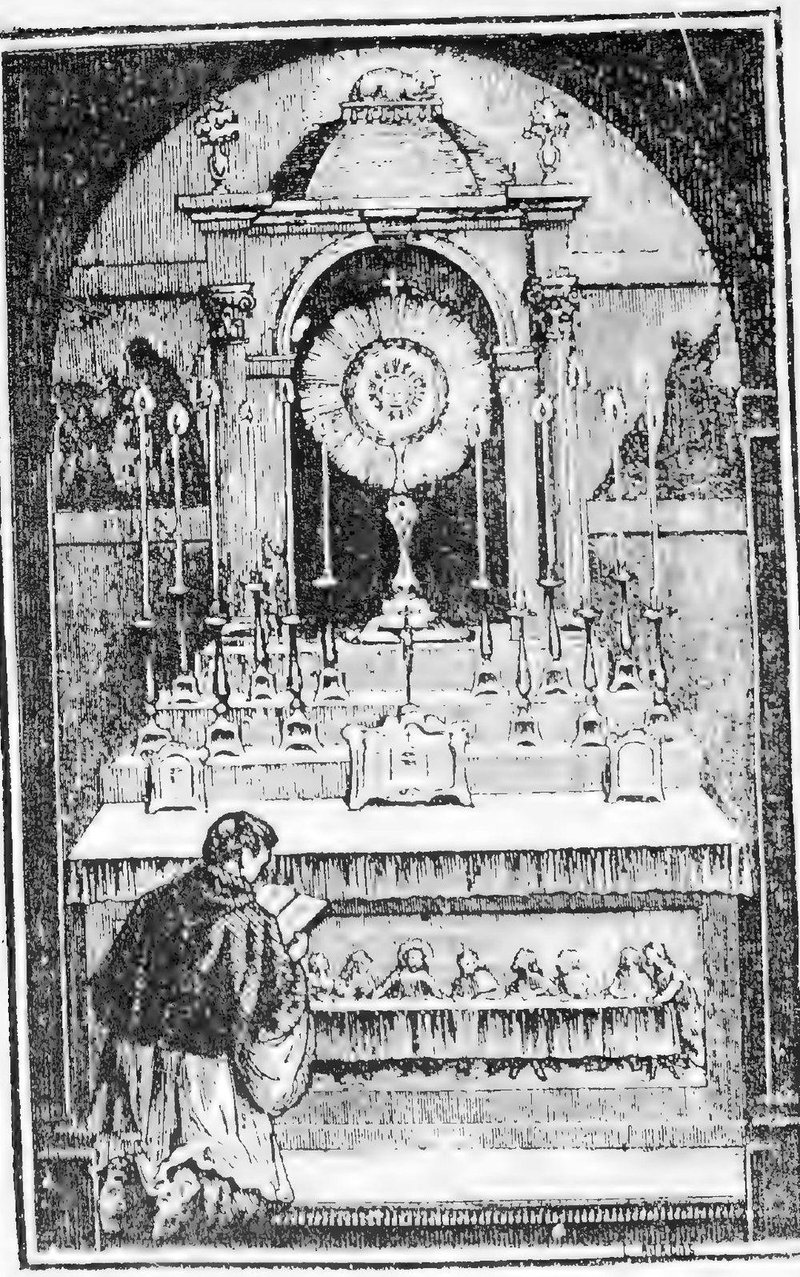
Plate XXXII. The sacrament of the Eucharist. The Sacrament exposed. A priest celebrating Mass. A priest giving Communion. The Last Supper. A priest keeping watch before the Sacrament.
My son, all you need to know about this august Sacrament you see sketched in the plate. On the front of the altar is shown the supper of the last night, at which Christ instituted this adorable Sacrament. On the right is a priest who, celebrating, renews the same supper and the passion and death of Jesus Christ, fulfilling in this the precept of the divine Lord himself. On the left is another priest distributing holy Communion to the faithful, who, docile to the loving call of the Saviour, approach this sacred banquet to share in the greatest of the benefits God has done to men. In the center of the plate is shown the most holy Sacrament exposed to the public veneration of the people. There, though hidden under the mystic white veil of bread, the consecrated host, Jesus Christ is really and truly present. We Christians adore him, contemplating him as exalted, as mighty and as august as he is in heaven, and ready to bestow on us all the graces and blessings that are good for us. This is what I am going to explain to you more fully.
This is the Sacrament par excellence, the source and center of all the other Sacraments, since it contains Jesus Christ, the author of them all. Many are the names given to this Sacrament, according to the ends of its institution and the wonderful effects it causes. It is called Eucharist, which means thanksgiving; or Host, because Jesus Christ who is in it is offered every day for us to his eternal Father as a victim of propitiation; or Bread of the children of God, because God, being our father, feeds us with it. As a mother nurses her children with the milk formed from the blood of her veins, so Jesus Christ, after bringing us to light in Baptism and strengthening us in Confirmation, feeds us as his dearly loved children with the flesh and blood of his own person. It is called Communion, because of the common union he wants among us, loving one another as good brothers, and between him and us as between father and children. Finally it is called Viaticum, among many other names I omit so as not to be tiresome, because it serves as food for the journey to eternity.
God gave many figures of this Sacrament under both the natural and the written law, beginning with the tree of life in paradise and going on to the manna in the desert. On reaching the law of grace he himself says plainly that my flesh is meat indeed: and my blood is drink indeed, and that he that eateth my flesh, and drinketh my blood, abideth in me, and I in him (John 6:56–57). He longed continually for the hour when he was to give us this banquet and institute so august a Sacrament (Luke 22:15). That hour came at last on the fourteenth day of the moon of March, which by our reckoning corresponds to the twenty-fifth of that month, the day before his death. On that day he chose to make his testament in our favor, and he did so in the following way. Having celebrated the Pasch of the legal lamb with his disciples, he rose from the table and with the deepest humility washed their feet, and all were astonished at so heroic an act. But their wonder rose higher still when they saw him sit down again at table and institute and give them this august Sacrament. For this he took in his sacred and divine hands unleavened bread, the only bread eaten at the Pasch. He gave thanks to his eternal Father for the power he had given him over all things; he blessed the bread, broke it and gave it to the Apostles, saying: Take ye, and eat. This is my body. Then he took a chalice with wine and, again giving thanks to his eternal Father, blessed it and gave it to his disciples, saying: Drink ye all of this. This is the chalice of my blood… As often as you shall eat this bread, and drink the chalice, do this for the commemoration of me (Matt. 26:26–28; 1 Cor. 11:24–26). The astonished Apostles received Communion with all humility and devotion. They were empowered to consecrate, and to communicate that power to the Bishops and priests; and this power will continue to the end of the world, as Jesus Christ himself says, for he will be with us even to the consummation of the world (Matt. 28:20). What a wonder, my God! What goodness! What generosity! Oh inexhaustible love of Jesus!
What has been said is a truth of faith, since he who can neither err nor deceive us assures us of it. So, my son, you must believe it firmly; and to strengthen your belief I will give you some
reasons of fittingness, which I will make clearer with some comparisons. Knowing that God created all things out of nothing, you should no longer be surprised that by his unlimited power he changes bread and wine into the substance of his body and blood. Properly speaking there is nothing easy or hard for God. Yet in our way of speaking and understanding it is easier to change one substance into another than to make something exist that before did not exist at all. So if he did the latter in creation, what difficulty can there be in believing that at the consecration what was before bread and wine is changed into the flesh and blood of Christ? Does not something similar happen in ourselves with the bread and wine we eat and drink, which are changed into the flesh and blood of our body?
For this reason this change is called transubstantiation. It means that one substance, bread and wine, is changed into another, the body and blood of Christ. The accidents remain, however, like a veil drawn between the body and blood of Jesus Christ and us, so that we may exercise faith and so that fear may not hold us back from this Sacrament. We believe that the sun is above us at noon, though a cloud that sometimes comes between us and it covers it or keeps us from seeing it, because the effects it produces, heat and light, make it plain to us. In the same way, besides his infallible word which assures us of it, the wonderful effects it produces do not let us doubt the real presence of the Sun of justice, Jesus Christ, in the Sacrament, though the cloud of the sacramental accidents or appearances covers him and keeps us from seeing him. Otherwise, how do just souls have such great and lofty knowledge? How do they have such great courage and burn with love of God and neighbor? How do they practice so many virtues? Given human weakness, this is a riddle. It is explained only by the frequency with which they receive and adore this Sacrament, which enlightens, inflames and quickens them, though the cloud of the accidents covers Jesus Christ, who is really and truly present in it, and keeps them from seeing him. And if some are not enlightened, inflamed and quickened, it is not for lack of light, warmth and life in the Sacrament. It is because, shut up in the cellars of worldly things and sitting in the shadow of death (Luke 1:79), they cannot receive the sovereign influence of this divine Sun. In the same way the material sun that lights us does not produce its wonderful effects in those who withdraw from its influence, living as though buried inside buildings. Do you want to experience such divine effects? Listen to what the Prophet says: Accedite ad eum et illuminamini [Come ye to him and be enlightened] (Ps. 33:6). Visit him, receive him often in Communion, and if you go well disposed you will see how great are the effects you will draw from it.
But I think you are already asking: “Is it possible for the whole body of Christ to be in a small host?” Not only is it possible; it is truly so. I have told you, my son, that Christ is in the Sacrament after the manner of substance. As the whole substance or essence of a plant is in a small seed, so too the whole body and blood of Christ is in a small consecrated form or host. You have a proof of this in yourself. Is it not true that in your eyes, small as they are, the image of a whole man, of a house and so on, is pictured? So it can be, and in fact is, that the whole body of Christ is contained in a small host or particle.
“And if a consecrated host is broken or divided, is the body of Christ divided too?” No, my son. He remains whole in each of the parts, as entire as before the Sacrament was divided. Have you ever looked at yourself in a mirror? You say yes, don’t you? Well then, you saw yourself there, and saw yourself in all of it. But suppose it falls and breaks to pieces: is it you or the mirror that is divided? You will say the mirror; and yet do you not see yourself in each of its pieces? So when the host is divided it is not Christ who is divided, but the Sacrament or the sacramental species, and he remains whole in each of its divisions. And if you ask me further: “Is it possible that Jesus Christ, being only one, can be at the same time in as many places as there are tabernacles with the reserved Sacrament, and priests consecrating one or many hosts?” I will answer that not only is it possible, but the fact cannot be doubted. You will see this truth illustrated by what happens with the sun. Is it not true that, though it is only one, however many vessels full of water are set before it, it lights them all, and the same sun is seen in each? The same happens, though with the greatest perfection, in this Sacrament. However many priests consecrate one or many hosts, Jesus Christ is really present in all of them and in each one in particular. Finally, you will perhaps ask me whether, with so many people receiving Communion every day all over the world, the body of Christ grows less. Ah, my son, it does not grow less, no! To see this, we shall find a comparison in the sun itself. For so many centuries all the inhabitants of the world have shared in its heat, light and influence, and to this day we do not see that it has grown less. I will give you another, more exact comparison. If many people come to the flame of a lamp to light each his own, all carry away light, and yet the flame of the first does not grow less. In a similar way it happens with the body of Christ, which does not grow less however many receive Communion. I have put forward and explained these comparisons to illustrate this mystery of faith, not because I intend to prove it by them.
You must also know, my son, that by virtue of the words of consecration the body of Christ is in the host, and by concomitance the blood is also in it. For since Christ is alive in this Sacrament, a living body cannot be without blood. I say the same of the chalice. By virtue of the words of consecration the blood into which the wine is changed is there, and with it the body too. In the host and in the chalice are present besides the soul, the divinity and all three Persons of the most holy Trinity with all their divine attributes. This being so, as it is, you will see that one who receives Communion under one kind alone receives as much as one who receives under both. In former times little children received Communion under the species of wine, the sick under that of bread, and everyone else commonly under both kinds. But the Church, seeing that this custom brought many difficulties, decided at the Council of Constance that, apart from the priests who consecrate or say Mass (for the sacrifice requires it), all others should receive Communion under the species of bread alone.
The holy Fathers say that Jesus Christ instituted this Sacrament under the species of bread and wine to give us to understand that, as these substances unite with the person nourished by them, preserve his life and feed him, so this spiritual food has the same effect in the soul of one who receives it worthily. He is united with Jesus Christ, who preserves in him the life of grace and feeds him with it, with virtues and with merits. Jesus Christ himself tells us: As I live by the Father; so he that eateth me, the same also shall live by me (John 6:58). So one who receives Communion well disposed can say with the Apostle: I live, now not I; but Christ liveth in me (Gal. 2:20). To help you understand it better, I will tell you that one who receives Communion well disposed is like a grafted tree. It is no longer what it was before, but bears fruit according to the scion grafted into it.
Besides this grace of nourishment and union I have just explained to you, the effects Communion causes are many and very great. It increases fervor and devotion, forgives venial sins, gives strength to resist temptations and helps not to fall into mortal sins. It gives courage to persevere and weakens the heat of concupiscence. A thousand times happy is he who receives holy Communion often and with the proper dispositions! It can be positively affirmed that he has one of the surest signs of predestination. I said often, because woe to those who receive Communion only once a year! However well disposed they may think they are, it can and must be feared with good reason that they are much deceived. For by their delay they show how little they care for the salvation of their soul. What I can assure you, my son, is that of those who receive Communion often, very many go whole years without committing a single mortal sin. Of those who receive once a year, on the other hand, few reach the end of the year without having sinned mortally. I beg you, therefore, as soon as you are of the proper age and have leave for it, to receive Communion, and to do so often and with the proper disposition. Woe to you if you received Communion sacrilegiously, or in mortal sin! Oh, what a horrible sin you would commit! Better, yes, a thousand times better, would it be for you never to have been born.
To receive Communion with fruit, understand that several dispositions are required. Some concern the body and others the soul. Those concerning the body are the natural fast; cleanliness and modesty in person and dress; and recollection of the senses, not looking about or speaking without need, nor hurrying from one place to another. As regards the soul, the state of grace is indispensable. One must be clean not only of all mortal sin but, as far as possible, of venial sins too, or at least have no attachment to them. One should also try to adorn oneself with virtues, especially faith, hope, desire, charity, humility and devotion.
After receiving Communion one should try to spend about half an hour, or at least a quarter of an hour, giving thanks to God. Consider the infinite goodness and love of this heavenly Father, who has deigned to unite himself with us despite our small merits, forgetting the offenses and ingratitude with which we repay his benefits. Never imitate those who leave the church as soon as they have received Communion. Unhappy people, alas! How many graces they waste, and how many they deprive themselves of! These wretches imitate the sacrilegious Judas, who as soon as he had received Communion left the upper room driven by the devil, as St. John Chrysostom affirms.
Try too, my son, to hear holy Mass every day you can. In it the institution of the most holy Sacrament is renewed, together with the sacrifice Jesus Christ offered for us on the cross; and in it you should receive Communion, at least spiritually. This communion, as easy as it is profitable, consists in making, after a true act of contrition, acts of desire to receive Jesus in the Sacrament and to unite oneself with him inwardly. This communion can be made many times a day, even while walking or working, since it loses no time and hinders no bodily occupation. It is so pleasing to the Lord that one day he appeared to the virtuous Paula Maresca, foundress of the monastery of St. Catherine of Siena in Naples. Showing her two vessels, one of gold and the other of silver, he told her that in the gold one he kept her sacramental communions and in the silver one her spiritual communions. In the little book entitled The Straight and Sure Way to Reach Heaven (which I earnestly beg you to read often and attentively), at pages 78 and following, you will find this spiritual communion explained more fully, with the practical way of making it.
Visit Jesus in the Sacrament every day. If you cannot go to church for this, do it from home, using either the Straight Way already mentioned, which has enough at page 183, or the Visits to the Most Blessed Sacrament of St. Alphonsus Mary de Liguori. Since it has prayers for each day of the month, it will help you stir up your devotion. Or at least say the “greater station”, which consists of six Our Fathers, six Hail Marys and six Glory Be’s; by it you will gain many indulgences. If you make this visit from home, with no one seeing you, I should like you to hold your arms out in the form of a cross. Oh, how you will please God! But if you can go to the church, that will be best. The Angels form his court continually, and men, for whom he has remained in so august a Sacrament, abandon him! Oh, this indifference is an unmistakable sign of how little God is loved; for if we loved him we could not bear to leave his presence. Love him, my son, love him with all your heart, since in proof of how much he loved and loves us he has remained among us in the Sacrament. If you love him, he will love you still more. And loving him, you will not sin. You will keep his holy precepts, hear holy Mass devoutly, receive him often in holy Communion and visit him in the tabernacle or monstrance. And after visiting and loving him here in this world, you will go to visit him in the next for all eternity, which is what I wish for you. Amen.
Q. What is the sacrament of the Eucharist?
A. It is a Sacrament which contains really and truly the body and blood, soul and divinity of our Lord Jesus Christ under the species or appearances of bread and wine.
Q. What is the matter of the Eucharist?
A. Bread and wine.
Q. How are the bread and wine changed into the body and blood of our Lord Jesus Christ?
A. By virtue of the words of Consecration, which the priest pronounces at Mass.
Q. Who has given such power to the words of Consecration?
A. Jesus Christ, who, being almighty God, can do what he wills.
Q. After the Consecration do the bread and wine remain?
A. No, because they have been changed into the body and blood of Christ.
Q. But are they not seen just as before?
A. Yes, because the accidents remain, which are color, smell and taste, but without the substance.
Q. Who obliges us to believe all this?
A. Our holy mother the Church; and whoever did not believe it would be a heretic.
Q. Does one who receives only half the host in Communion receive the whole Christ?
A. Yes, he receives him entirely, because Jesus Christ is as much in a small part of the host as in the whole host.
Q. Is it very necessary to receive Communion?
A. It is, because our Lord has said: Except you eat the flesh of the Son of man, and drink his blood, you shall not have life in you (John 6:54).
Q. Should one receive Communion many times?
A. The Church’s desire is that one should receive Communion often, because this Sacrament always causes very good effects in those who receive it worthily.
Q. What effects does this Sacrament cause?
A. Many. It unites us with Jesus Christ. It nourishes us and restores the lost strength of the soul. It increases sanctifying grace and the fervor of charity.
Q. What further effects does this Sacrament cause?
A. It fills us with spiritual sweetness, frees us from temptations, forgives us venial sins, and gives us helps not to fall into mortal ones.
Q. How many things are necessary to receive Communion well?
A. Five: the natural fast, outward modesty, cleanness of conscience, knowledge and desire.
Q. What does the natural fast mean?
A. Not having eaten or drunk anything since the midnight before Communion, unless one receives it as Viaticum.
Q. What does outward modesty mean?
A. That one must go with composure and humility in person and dress.
Q. What does cleanness of conscience mean?
A. Having no mortal sin on it.
Q. What must one do who is in mortal sin and is to receive Communion?
A. Make a good confession first; otherwise he would commit a horrible mortal sin of sacrilege.
Q. What does knowledge mean?
A. That the Christian must be thoroughly instructed, so that before receiving the Eucharist he can reflect on three things: who is coming, to whom he is coming, and why he is coming.
Q. What does desire mean?
A. That one must have a great longing to receive Communion.
Q. Before Communion, while the priest opens the tabernacle, what is customarily said?
A. The general confession.
Q. Say it.
A. I, a sinner, etc. (see the First Catechism above).
Q. When the priest already has the holy host in his hand and shows it to the people to adore, what must be said?
A. Three times these words: Lord, I am not worthy that thy divine Majesty should enter my poor dwelling; but only say the word, and my soul shall be healed and saved.
Q. How will you receive Communion?
A. I will look devoutly at the sacred host and quicken my faith, hope and love. I will raise the cloth with both hands and place it under my chin, and put out my tongue a little, so that it rests on my lower lip.
Q. And after receiving Communion what will you do?
A. I will stay a good while in the church giving thanks to God, and ask graces for myself and others; and I will not spit until the danger of ejecting any particle has passed.
Q. And how long should one go without breakfast after Communion?
A. At least half an hour, if possible, out of reverence for the Sacrament.