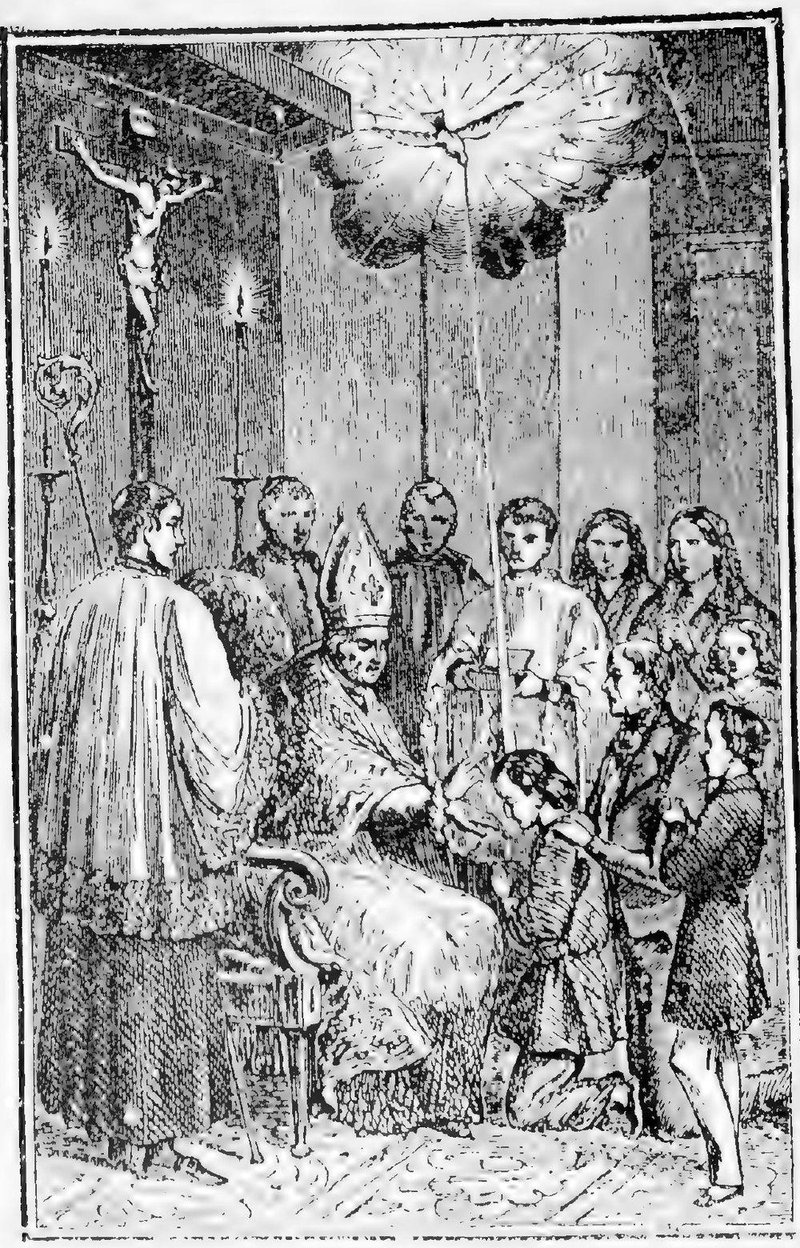
Plate XXXI. The sacrament of Confirmation. The Holy Ghost sending his grace upon the one being confirmed. The Bishop in the act of confirming.
Look at the plate, my son. Do you see how the Bishop is administering the sacrament of Confirmation? Jesus Christ instituted it to confirm us in the divine religion we have professed and to strengthen us in the spiritual life we received in Baptism. Confirmation is called the Sacrament of fullness, because it is the completion and consummation of Baptism, and also because its administration belongs to the Bishops, in whom the fullness of the ministry resides. When they confer it they lay their hands on the person confirmed and make a cross on his forehead with the sacred chrism, saying at the same time these words: I sign thee with the sign of the cross, and I confirm thee with the chrism of salvation, in the name of the Father, and of the Son, and of the Holy Ghost.
The effects of this Sacrament are many and wonderful. By it we receive not only an increase of sanctifying grace, as in the other Sacraments of the living, but also that sovereign gift called by St. James the perfect gift (Jas. 1:17), and by St. Paul the pledge of the Spirit (2 Cor. 1:22). You must know, my son, that by the other Sacraments the gifts of the divine Spirit are communicated to us, but in Confirmation the Holy Ghost himself is given us. The Eucharist is called the Sacrament of Jesus Christ because when we receive Communion we receive not only the grace of Jesus Christ but Jesus Christ himself. So too Confirmation might in some way be called the Sacrament of the Holy Ghost, since by it not only are the gifts of the divine Spirit communicated to us, but we also receive the Holy Ghost himself, as you see represented in the plate. And while it is true that in Baptism we receive the life of grace, this is a weak life like that of newborn babes, as St. Peter teaches us (1 Pet. 2:2), and so it needs to be strengthened and made robust by Confirmation. In Baptism we are formed; in Confirmation we are strengthened. In Baptism we are reborn to life; in Confirmation we are armed for the fight. In Baptism we are enlisted in the army; by Confirmation we are given all we need to fight boldly. Such is the language of St. Melchiades, a Spanish pope. And in fact the special grace this Sacrament causes is to give particular helps for coming out victorious from the battles the enemies of Religion and of our eternal salvation wage against us.
So that you may form a high idea of this Sacrament, I must tell you, my son, that Jesus Christ had already communicated the gifts of the Holy Ghost to the Apostles by means of other Sacraments before Pentecost. But his promise to send them the divine Spirit himself was not fulfilled until that most memorable day. Then, coming down in tongues as of fire, he rested on the heads of the most holy Virgin and the Apostles, and all were filled with his power (Acts 2:1–4). From that day it happened for some time that whenever the Apostles confirmed, the Holy Ghost himself came down visibly on those who received this Sacrament, as we read in several chapters of the Acts of the Apostles. So Simon Magus, amazed at such a wonder, offered them a considerable sum of money if they would grant him the power to do the same. But they rejected the Magician’s request with indignation (Acts 8:18–20). From him the sin by which one tries to buy a spiritual thing with a temporal one takes the name of simony.
It is true that once wonders ceased to be necessary for the spread and establishment of the Gospel, the divine Spirit also ceased to show himself visibly in Confirmation. But he has not for that reason ceased, nor will he ever cease, to come invisibly upon those who receive the sacrament of Confirmation with the proper dispositions.
You must also know, my son, that this Sacrament imprints a character like Baptism, and for this reason it cannot be received a second time either. In Confirmation too sponsors are given as in Baptism. The difference is that here only a godfather is admitted for boys and a godmother for girls, not godfather and godmother as in Baptism. These sponsors contract spiritual relationship, not with each other, but with the godchildren and their parents: in the second degree with the parents and in the first with the godchildren. So no sponsor may marry without dispensation either his godchildren or their parents. The duties sponsors take on toward their godchildren are to teach them Christian doctrine, admonish them and correct them; but this is in case the parents themselves do not do it.
From what has been said, my son, you can see how highly you should esteem the sacrament of Confirmation. How you should thank God for having granted it to you!… And since those who live holy lives are temples of the Holy Ghost, do not sadden him by sinning (Eph. 4:30). Rather try to resist manfully the temptations of the enemies, the world, the devil and the flesh. Receive not the grace of God in vain, I will tell you with the apostle St. Paul (2 Cor. 6:1). Try to practice the virtues this Sacrament points out to you, so that the Lord may give you the crown of glory. Understand that in heaven no one will be crowned except one who on earth has fought and overcome the enemies of the soul. But woe to you if you let yourself be overcome by them and go over to their side! What punishments you would bring on yourself from God for such cowardice or unfaithfulness! You would be cast into hell like Judas, like the apostate angels or devils, where you would burn forever.
Q. What is the sacrament of Confirmation?
A. It is a Sacrament which strengthens us in the faith and gives us the Holy Ghost with all his gifts.
Q. What is the matter of this Sacrament?
A. The laying on of the Bishop’s hands and the anointing with chrism.
Q. What is chrism?
A. It is a compound of olive oil and balsam consecrated by the Bishop.
Q. What does the oil signify?
A. The fullness of grace we receive from the Holy Ghost.
Q. What does the balsam signify?
A. The fragrance of the good example we must give.
Q. What is the form of this Sacrament?
A. The words the Bishop says while applying the matter.
Q. What does the cross the Bishop makes on the forehead of those he confirms signify?
A. That we are marked as soldiers of Jesus Christ.
Q. What effects does this Sacrament produce?
A. It strengthens the Christian so that he may not be afraid to confess the faith of Jesus Christ. It arms him with the holy cross, making him a soldier of the Saviour, and confers on him the Holy Ghost.
Q. Why does the Bishop give a gentle slap to the one he confirms?
A. So that he may understand that he must suffer any affront rather than abandon the faith of Christ.1
Q. Can this Sacrament be received more than once?
A. No, because it imprints a character.
Q. What character is this?
A. As Baptism imprints the character of a Christian, Confirmation imprints that of a soldier of Christ.
Q. Against whom must he fight?
A. Against the enemies of the faith.
Q. Why are we given sponsors in the Sacraments of Baptism and Confirmation?
A. So that we may have someone to help us live as Christians and confess the faith of Jesus Christ.
Q. Do the sponsors of Baptism and Confirmation contract relationship?
A. Yes; they contract it in the first degree with their godchild and in the second with the godchild’s parents.
Footnotes
-
alapa. ↩