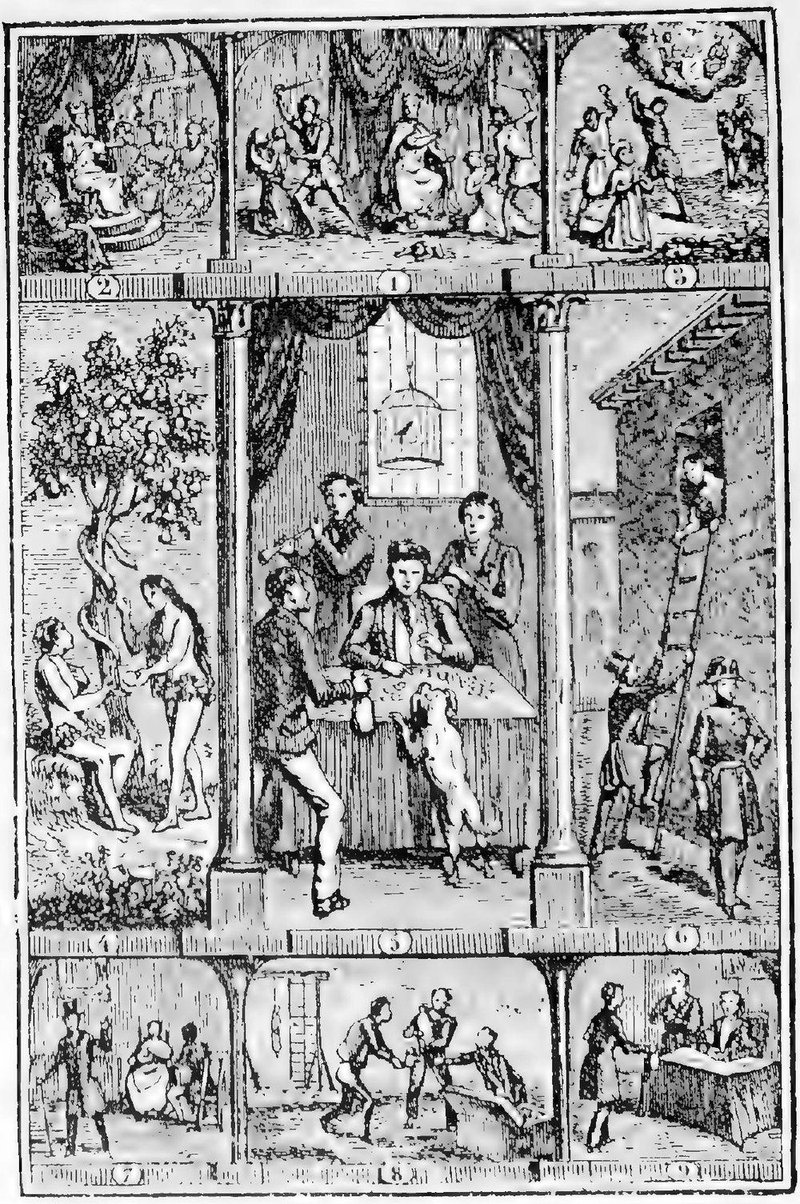
Plate XXVIII. The sins of which one becomes guilty without committing them. 1. Herod, who orders killing. 2. Caiphas, who advises. 3. Saul, who consents. 4. Eve, who provokes. 5. A master who praises. 6. An authority who does not prevent evil. 7. A superior who permits. 8. Sharers in stolen goods. 9. A lawyer who defends a bad cause.
Ah, my son! How very many ought to cry out and say to God with David: From my secret ones cleanse me, O Lord: and from those of others spare thy servant (Ps. 18:13–14)! That is, forgive me the sins I do not know, and also those of which I have become guilty without committing them. So that you may know these sins and keep yourself from them, I will explain them to you with the plate. They are nine.
The first is: Ordering some evil to be done. At no. 1 is Herod, who orders the innocents to be killed (Matt. 2:16). See how the soldiers snatch the innocent little ones from their mothers and cut their throats. It is true that Herod killed none of them with his own hands; and yet he became criminally guilty of that great slaughter by giving the order for it, according to the principle: Qui per alium facit, per seipsum facere videtur [he who acts through another is deemed to act himself]. It follows that whoever orders something evil becomes guilty of the wickedness as if he committed it himself. We do not mean by this that the agents remain innocent, nor that in such cases they ought to obey. For it is well known that superiors are to be obeyed only when what they command can be done without sin. The reason is that human authority is a share in the divine, a power God has given them, as he himself says: Per me reges regnant, et legum conditores justa decernunt [By me kings reign, and lawgivers decree just things] (Prov. 8:15). From this it follows that they can command only just things. When they do not command such things they are not to be obeyed, since in that case they are not exercising God’s authority but abusing it. Then God, who forbids the thing, must be obeyed before those who command it (Acts 5:29).
The second is: Advising evil to be done. At no. 2 is Caiphas, who advised the Sanhedrin, that is, the assembled Jewish scribes and elders, to put Jesus to death (John 11:49–50). All forming a plot, a kind of conspiracy, they managed to get Pilate to decree it. So although they did not kill Jesus with their own hands, they became guilty of that death by their advice, persuasion and urging. This tells you that whoever advises any wickedness, whatever it may be, becomes guilty of it just as if he committed it.
The third is: Consenting to evil. At no. 3 is St. Stephen being stoned to death, and the one on horseback represents Saul, who afterwards was St. Paul. Guarding the garments of those who stoned him, he consented to St. Stephen’s death (Acts 7:57; 8:1). So in a way, as St. Augustine says, he was in the hands of all who threw stones. From this, my son, you can see that those who consent to, take pleasure and delight in the evil others commit become guilty of it as if they committed it themselves.
The fourth is: Provoking to evil. At no. 4 are our first parents and the serpent. Eve, by her idleness and curiosity, gave occasion to the temptation of the devil, who appeared to her in the form of a serpent. She fell into it and provoked Adam, and behold, God punished them all. Adam was punished because he consented; Eve and the serpent because they incited him. So those who provoke or instigate to evil, whether to theft, impurity or any other sin, are guilty and deserve punishment.
The fifth is: Praising what is evil. At no. 5 is shown a master to whom one of his employees brings a sum of money he has got for him unjustly. Instead of rebuking him sharply for it, the master praises the deed, and other servants approve it too. (So great is the merriment at that table that, as you see, even the little dog wants to share in it.) Masters, fathers and mothers become guilty of the same offense when, knowing that their sons, daughters or subordinates steal or swindle, they not only do not rebuke them, but even applaud and praise them.
The sixth is: Not preventing evil when one can and ought. At no. 6 is shown a man trying to climb into a house by night with evil intent, as is indicated by that woman holding the ladder. That other man sees it and could prevent such wickedness, but does not. Those become guilty of such an offense who, having authority or being able to, do not prevent wicked deeds and in some way consent, according to the principle: Qui tacet, dum loqui tenetur, consentire videtur [he who is silent when bound to speak is deemed to consent].
The seventh is: Overlooking and permitting evil, knowing or being bound to know that it will happen. At no. 7 are shown two young people talking alone together, and that other man is the girl’s father or master. With his hand he signals that very bad saying: “Let them sort it out themselves.” Woe to such a man, who becomes guilty of the evil that two young people left alone commit, and will probably commit! Oh, how many fathers and mothers, masters and mistresses, become guilty of the sins their sons and daughters, maids and employees commit, by allowing them dealings, dances, love affairs, theaters and other things of this kind! They will say they see them do nothing wrong. I believe it; but that is because they give them the occasion by withdrawing from their presence, or because the young people take advantage of their negligence in watching. But, parents and masters, understand and know it forever: you have a strict obligation to watch over them, keep an eye on them, and be suspicious of whatever they may do, according to the principle: Licet parentibus de filiis suspicari [parents may be suspicious of their children]. Ah, how many fathers and mothers are damned for the sins of their sons and daughters! Such is the threat already thundered by the prophet Ezechiel (Ezech. 3:18; 33:8).
The eighth is: Sharing in evil. At no. 8 is shown a hanged thief, and others dividing and hiding the jewels he stole, so making themselves sharers in his thefts. Those become guilty of this offense who receive stolen goods; who buy them knowing or suspecting they are stolen; or who take something to overlook it, or turn what is called a blind eye.
The ninth is: Defending what is evil. At no. 9 the one seated represents a judge, and the others are a lawyer and a man engaged in an unjust lawsuit. Though he knows it is unjust, he is still bent on getting his way. He tries with gifts and money to pervert the conscience of both, wanting the lawyer to defend his bad cause and the judge to give sentence in his favor. This may pass in this world, but not in the next. For at God’s tribunal even justices will be judged: Ego justitias judicabo [I will judge justices] (Ps. 74:3). Woe to those who go to law unjustly! Woe to those who protect and favor such litigants! Both make themselves guilty at God’s tribunal.
Q. How many are the sins of which one becomes guilty without committing them?
A. Nine. The first, ordering some evil to be done. The second, advising evil to be done. The third, consenting to evil. The fourth, provoking to evil. The fifth, praising what is evil. The sixth, not preventing evil when one can and ought. The seventh, overlooking and permitting evil, knowing or being bound to know that it will happen. The eighth, sharing in evil. The ninth, defending what is evil.
Q. Why is one said to become guilty of these sins without committing them?
A. Because by them one is the cause of, or an accomplice in, the evil others do.