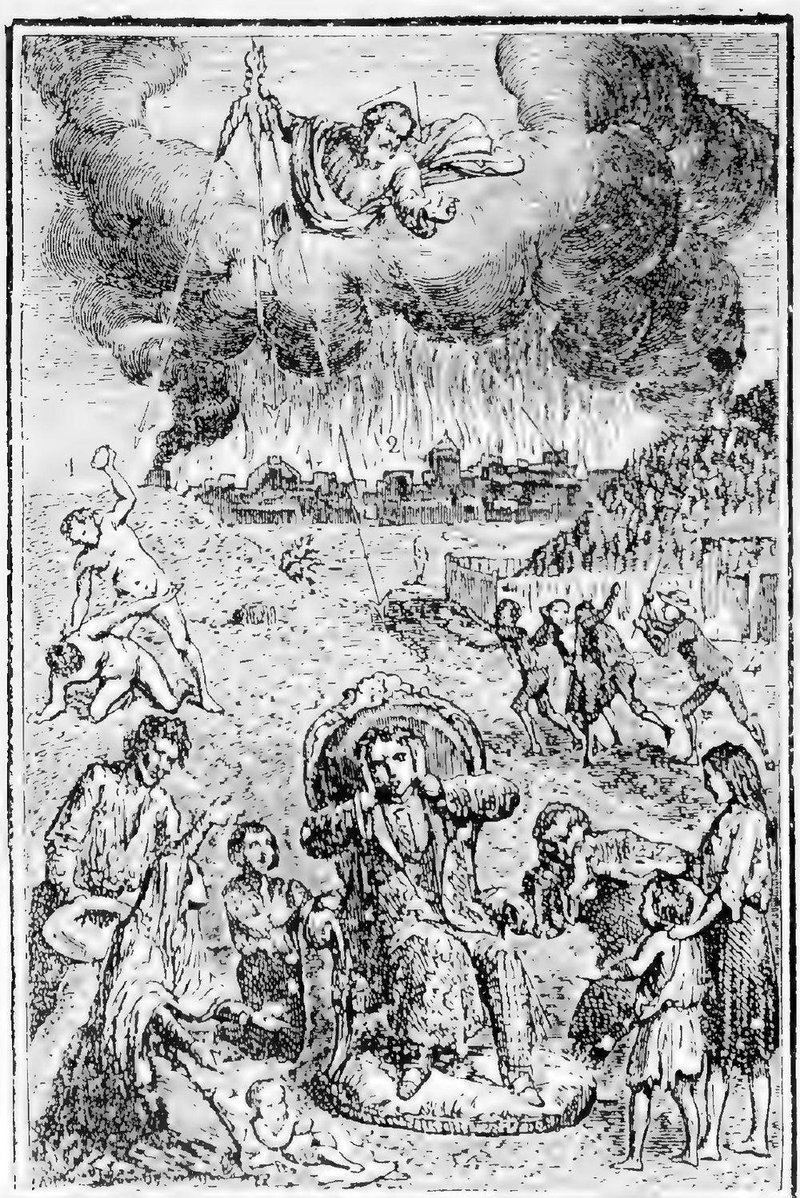
Plate XXVII. The sins that cry to God for vengeance. 1. Cain kills Abel. 2. Sodom in flames. 3. He turns a deaf ear to the poor. 4. He ill-treats workmen or day-laborers.
Look, my son, at the eternal Father in the plate, hurling thunderbolts from heaven at those guilty of the four horrible sins that cry to God for vengeance. Because these sins violate most plainly the charity owed to our neighbor, they are punished with terrible pains in this world and the next.
The first is: Wilful murder. At no. 1 Cain is shown in the act of killing his brother Abel. He urged Abel to go out with him into the field. The innocent man agreed, not suspecting his brother’s evil intention, and Cain, throwing himself on him suddenly and treacherously, killed him. But God, protector and avenger of the innocent, asked Cain: Where is thy brother Abel? He answered: I know not: am I my brother’s keeper? And God said to him then: What hast thou done? the voice of thy brother’s blood crieth to me from the earth. Now therefore cursed shalt thou be upon the earth… When thou shalt till it, it shall not yield to thee its fruit: a fugitive and a vagabond shalt thou be upon the earth (Gen. 4:9–12). Woe to those who by wilful murder provoke, like Cain, the vengeance of the Lord! Like him they will be unhappy in this world and the next. In this world they live in constant remorse and fear, seeming to see the shadow of their victims everywhere, as some unhappy men who had the misfortune to commit so horrible a crime have publicly confessed. In the next they will suffer eternally, if they die impenitent.
The second is: The sin of sodomy. At no. 2 of this plate is shown the city of Sodom, from which this unspeakable sin takes its name. See how the eternal Father sets it alight and turns it to living flames, not only the houses but the animals and people too. Four persons alone were found righteous in the whole city, and at the Angels’ warning they left it. Apart from these, all the inhabitants died in the flames, and the same happened to the neighboring cities of Gomorrha, Adama and Seboim. They passed from the fire of this world to that of hell, where they will burn forever. To convince yourself how infamous the vice of impurity is, which was the reigning vice in that unhappy city and those around it, attend to what God himself said: The cry of Sodom and Gomorrha is multiplied, and their sin is become exceedingly grievous (Gen. 18:20). On these words Cornelius a Lapide comments: “The sins themselves, like accusers, have gone up to heaven to present themselves to me. They cry out against men so impious, and compel me to vengeance.” And that is why, provoked, he punished and burned them. Flee, my son, flee for God’s sake from every sin of impurity. Sins of this kind are the most abominable and the most degrading, those that most provoke the Lord,
and those that cast the greatest number of souls into hell.
The third is: Oppressing the poor. At no. 3 is that rich man sitting in his armchair. Like another Epulo of the Gospel, he cares only for eating and drinking daintily and dressing in every luxury, stopping his ears so as not to hear the cries and weeping of the poor, the widows and the orphans whom he oppresses. How desolate these unhappy people are! Do you see them around his armchair? But raise your eyes, and see how the eternal Father hurls a thunderbolt at that pitiless man to kill him, making him hear at the same time these words: Thou fool, this night do they require thy soul of thee: and whose shall those things be which thou hast provided? (Luke 12:20). Let the oppressor of the poor, whoever he may be, attend to what the Holy Ghost says in the book of Ecclesiasticus, chapter 35: The Lord will not accept any person against a poor man, and he will hear the prayer of him that is wronged. He will not despise the prayers of the fatherless; nor the widow, when she poureth out her complaint. Do not the widow’s tears run down the cheek, and her cry against him that causeth them to fall? For from the cheek they go up even to heaven, and the Lord that heareth will not be delighted with them (Ecclus. 35:16–19); that is, he will be kindled to anger against those who are the cause. On these words Cornelius a Lapide says: “Orphans and widows, like deserted houses, abandoned and exposed to the injuries of all men, are commonly harassed, despoiled and oppressed by the powerful. Since they have no other refuge, they turn to God and cry out to him to free them from oppression and take up the cause of justice. And God, who protects the forsaken, as it is written, To thee is the poor man left: thou wilt be a helper to the orphan (Ps. 9:35), does not despise their prayers. Rather he attends to them, and hears the words they address to him with groans, sighs and tears.” Hence, even though their tears fall to the ground, the cry goes up to heaven, and God punishes the oppressors.
The fourth is: Defrauding workmen of their wages. Do you see at no. 4 that man with a stick in his hand driving the workmen out of his house instead of paying them their wages? He certainly would not do it if he feared God, and remembered that the Holy Ghost says in chapter 34 of Ecclesiasticus: He that taketh away the bread gotten by sweat, is like him that killeth his neighbour. He that sheddeth blood, and he that defraudeth the labourer of his hire, are brothers (Ecclus. 34:26–27). And St. James says these words to such defrauders in chapter 5, verse 4, of his epistle: Behold the hire of the labourers, who have reaped down your fields, of which you have defrauded them, crieth: and the cry of them hath entered into the ears of the Lord of Sabaoth. You have feasted upon earth: and in riotousness you have nourished your hearts, in the day of slaughter (Jas. 5:4–5). That is, like victims to be sacrificed to the wrath of God on the terrible day of judgment, which is the day of his vengeance; and they already suffer great misfortunes beforehand. And to you, poor people, oppressed, harassed and defrauded, I will say with the same apostle St. James: Be patient therefore, brethren, until the coming of the Lord (Jas. 5:7), who will not leave your suffering unrewarded.
Q. How many are the sins that cry to God for vengeance?
A. Four. The first, wilful murder. The second, the sin of sodomy. The third, oppressing the poor. The fourth, defrauding workmen of their wages.
Q. Why are they said to cry to God for vengeance?
A. Because their malice is so great that God begins to punish them even in this world.