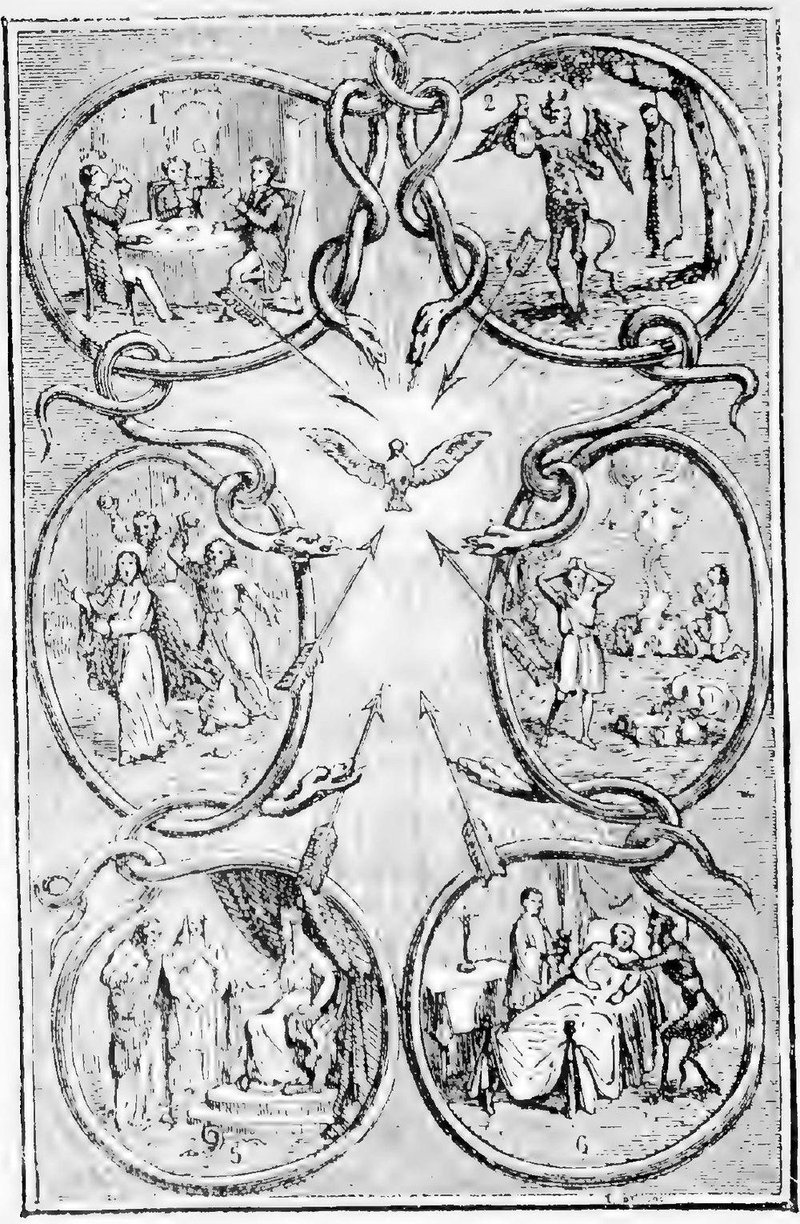
Plate XXVI. The sins against the Holy Ghost. The Holy Ghost. 1. Worldly people. 2. Judas in despair. 3. They try to stone Jesus. 4. The sadness of Cain. 5. The obstinacy of Pharao. 6. The impenitent dying man.
Those arrows aimed at the Holy Ghost, who is in the form of a dove in the center of the plate, are there to show you, my son, that the six sins called sins against the Holy Ghost are committed in contempt of the graces he gives us to withdraw us from sin.
The first is: Presumption of being saved without any merit. Do you see those at no. 1 gambling and drinking, who think of nothing but amusing themselves and passing the time? Ask them whether they want to be saved, and they will answer that they do want it and hope to achieve it. What folly! If a farmer neither tills the fields nor sows, will he reap? If a day-laborer passes the time laughing, playing and making a racket, will he deserve his wage? Certainly not. So those hope in vain to be saved who, far from doing good works, continually resist the inspirations of the divine Spirit, who tells them: “Do good while time is granted you; do on your part what you can, and God will do the rest.”
The second is: Despair of the divine mercy. At no. 2 is Judas, whom the devil tempted and drove to despair after inducing him to betray his divine Master. He began by setting before him the enormity of his sin; he made him see that God would not forgive him; and he ended by advising him to hang himself. Oh, what a horrible wickedness this is! It is true that the malice of mortal sin is great; but it is also true that the goodness and mercy of God are greater still. That is why despair is a most grievous insult to the divine Spirit: it amounts to resisting and abandoning the grace he offers the sinner, or else denying its power and efficacy. But note the sinner’s inconsistency, and the bad advice of the devil, who tells him: “Great is your sin!… despair… kill yourself…” Ah, unhappy man! What do you gain by taking your life? Far from lessening the gravity of the crime, you increase it; and to free yourself from the remorse of conscience you cast yourself into the eternal pains of hell. No, my son, no. This is not the way to find peace after committing a crime. The way is to repent, ask God’s forgiveness and firmly resolve not to commit it again. Instead of attempting his life, the sinner should ask God to preserve it, so that he may confess well and do penance in this world by bearing pains and trials, in order not to have to suffer eternally after death in hell, or in purgatory.
The third is: Attacking known truth in order to sin more freely. Figure no. 3 represents Jesus Christ, and the others are the Jews who wanted to stone him. The Saviour worked wonders by which his divinity was easily recognized; but far from following his teaching, they hated him. And why? Because he rebuked vices, which the proud could not bear, for they preferred darkness to light (John 3:19), like one with sore eyes who craves darkness. This is a horrible sin against the divine Spirit, who warns every person and makes known the evil he must flee and the good he must practice to be saved. But there are some who, instead of being docile to his holy inspirations, resist them. They even persecute the person the Holy Ghost uses as his instrument to warn them, uttering insults and mocking and jeering at his warnings, if they do not also stone him, as the Jews did Jesus. There are others who despise or attack the truths of the faith and the sound maxims of the Gospel, although their own conscience, moved by the Holy Ghost, tells them these are solid, holy and necessary for salvation. Do not imitate them, my son. Rather be always docile, not only to the instructions but also to the inspirations the divine Spirit will give you.
The fourth is: Envy of the spiritual goods our neighbor has received from God. At no. 4 are Cain and Abel. Abel offers God sacrifices of the best he has, and as soon as he can; unlike the other, who waits to sacrifice until the last hour and offers the worst. So God, seeing the goodness of what Abel offered him and the promptness and good will with which he did it, accepted his sacrifices and granted him abundant graces. And when Cain saw that God did not deal with him as with his brother, he was full of rage and, envying his brother’s prosperity, fell into despair. This is what his figure with his hands on his head represents. No, my son, envy no one. Try to be good, and God, who is a most just judge, will give you the reward you have merited by your good works, in this world or the next.
The fifth is: Obstinacy in sin. This is represented by Pharao, shown at no. 5. The one in front of him is Moses, turning his rod into a serpent, as you see in the plate. But far from yielding at the sight of this and the other wonders, that King called the magicians, who are those other figures, to do as much by diabolical art. The wonders God worked in favor of his people Israel not only did not soften him; he persisted in persecuting the Israelites more and more. In punishment for his obstinacy he was drowned in the Red Sea with all his army. In this or some similar way those will be punished who persist obstinately in sin, despising the inspirations of the divine Spirit and the admonitions of the Lord’s ministers. If not in this world, then in the next they will be plunged into the sea of the flames of hell.
The sixth is: The purpose of dying impenitent. That man at no. 6 is a dying man. While he was healthy he thought only of amusing himself, enjoying himself and getting rich, presuming that at the hour of death everything is lost and comes to nothing. But the wretch learns, though too late, how true is the proverb talis vita, finis ita [as the life, so the end]: as one lives, so one dies. Since his life was bad, it is no wonder that his death is bad too. See how he turns his back on the priest who wants to administer the Sacraments to him, and how he listens to the devil, who persuades him to the final impenitence in which he ends.
If you have paid attention, my son, you will have noticed that all the panels showing the six sins against the Holy Ghost are framed with serpents. This is because those words of the Gospel can be applied to sinners of this kind, when they are called a generation of vipers (Matt. 3:7). For that is what they really are, and as such they will not escape the punishments God, whom they have provoked, has prepared for them. And you must know that these sins are almost incurable, or very hard to forgive. This is not on God’s part, but on the part of the sinners themselves. By opposing and resisting what they need to be cured and obtain pardon, they are like the sick man who will not take his medicine and so dies. What I ask of you, my son, is that the mere memory or picture of such execrable sins should fill you with horror. Regard them as the greatest obstacle to your salvation, and make yourself docile to the inspirations of the Holy Ghost, which will lead you straight to the heavenly fatherland.
Q. How many are the sins against the Holy Ghost?
A. Six. The first, presumption of being saved without any merit. The second, despair of the divine mercy. The third, attacking known truth in order to sin more freely. The fourth, envy of the spiritual goods our neighbor has received from God. The fifth, obstinacy in sin. The sixth, the purpose of dying impenitent.
Q. Why are these sins called sins against the Holy Ghost?
A. Because they are committed in contempt of the graces the Holy Ghost gives to withdraw us from sin.