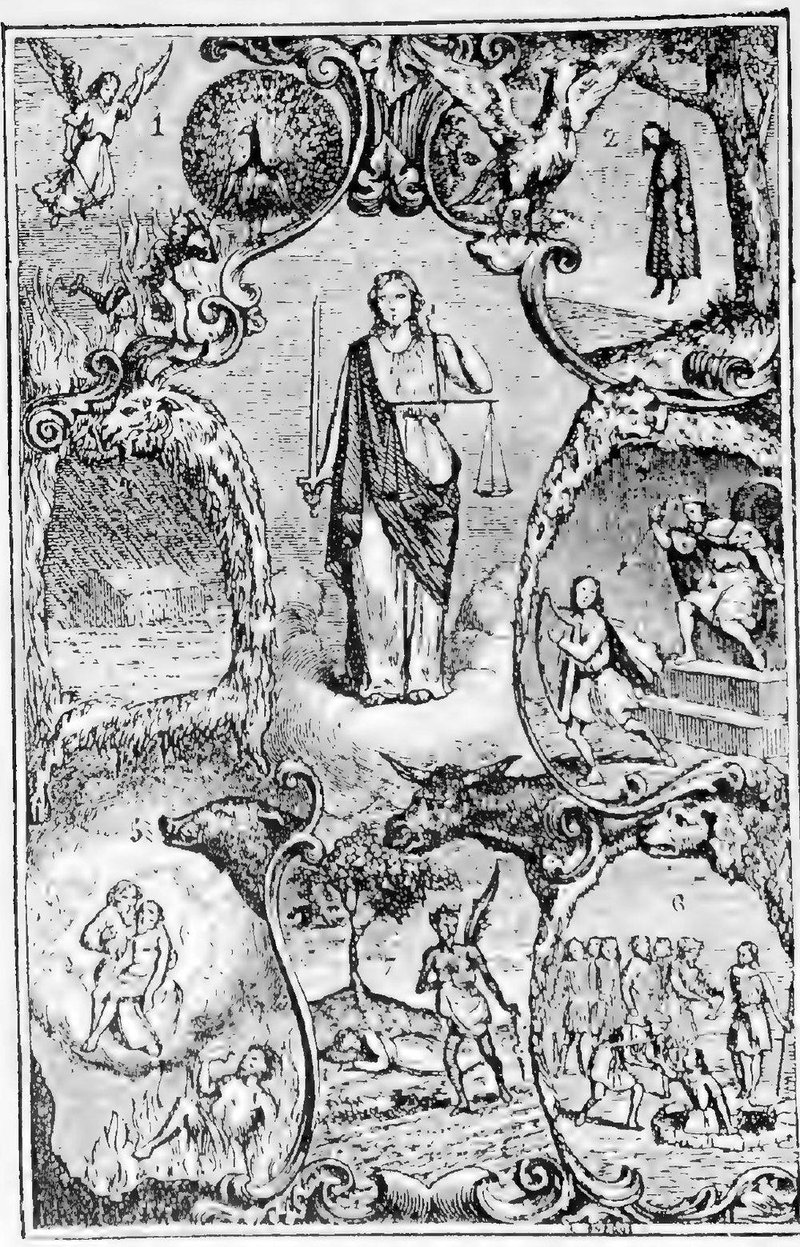
Plate XXV. The capital sins. Justice. 1. Pride: Lucifer and the peacock. 2. Covetousness: Judas and the vulture. 3. Lust: Noe’s ark and the goat. 4. Anger: Saul, David and the tiger. 5. Gluttony: Epulo and the pig. 6. Envy: Joseph’s brothers and the dog. 7. Sloth: the sleeping man and the lean donkey.
Section One. Evil Works
Up to now, dear son, I have explained to you what every Christian must believe, hope for and observe if he wishes, as he ought, to love his God and his neighbor with all his heart. But to put the keeping of the Commandments of the law of God and of the Church into practice, it is necessary, according to the maxim of the Holy Ghost, to decline from evil, and do good (Ps. 36:27). So I feel as it were compelled to explain to you now what works you must keep away from or guard against,
as contrary to your salvation and to the will of God; and which you must practice, if you wish to please him and be happy in this world and the next. Such is the subject of the doctrine of works, which I have divided into two sections. In the first I will treat of evil works, diverte a malo [turn away from evil]; and in the second of good ones, et fac bonum [and do good] (Ps. 36:27).
Every evil work is an offense against God, and is called sin. It can be committed by thought, word, deed and omission. It is divided into original and actual, and actual sin is mortal or venial. Original sin is the one we contract as descendants of Adam, and it is forgiven us by Baptism. Sin is venial when the offense done to God is slight, and it is easily forgiven. If one is truly sorry for it, it is forgiven without needing to be confessed by any of these nine things: 1. hearing Mass devoutly; 2. receiving Communion worthily; 3. attending sermons; 4. the bishop’s blessing; 5. saying the Our Father; 6. saying the general confession; 7. holy water; 8. blessed bread; 9. acts of contrition with striking of the breast. Even so, it is better to confess it. Mortal sin is a grave offense against God. It is called mortal because it kills the soul, taking from it supernatural life, the life of grace. It is not forgiven unless it is confessed, if circumstances allow. If there is no time, there must be true contrition with a firm and real desire to confess it when one can. The sin of omission is committed by failing to do, say or think what we ought to think, say or do. Unfortunately many pay no attention to this sin, though it ruins the soul. In this lesson I will speak to you only of the vices or capital sins, from which all the others flow.
Look at the plate, my son. That figure in the middle represents divine Justice, which will give you reward or punishment according to the good or evil you have done. That is what the scales and the sword she holds signify. In one of the pans are good works, and in the other the laurel branch. This is to give you to understand that if you do well you will enter in triumph into eternal glory; but if on the contrary you do evil, the rigor of divine justice awaits you. The vices or capital sins are seven, all of which are punished with horrible pains in the next life. I will explain them to you one by one, with the virtue opposed to each.
Pride. This vice is a disordered appetite for one’s own excellence. Such was the vice that mastered Lucifer, as you see at no. 1 of the plate. St. Michael attacks him, saying to him: “Who is like God!” For Lucifer in a way claimed to be equal to the Most High. His proud claim turned out so contrary for him that from a beautiful angel he was changed into a most hideous devil. From the height of heaven he was hurled into the depths of hell, and from a place of delights he was cast into a place of eternal pains. The proud man is compared to the peacock, which is shown in the plate for this reason. Seeing itself so beautiful, it grows vain and conceited and spreads its tail feathers into a fan; but they say it lowers its pride when it sees the ugliness of its feet.
Humility is the virtue opposed to this vice. By it every person, having a true knowledge of himself, judges rightly of his good or evil doing. So that you may not grow proud, my son, but may always remain humble, consider what you were before, what you are now and what you will be afterwards. Before, you were nothing… Now, as to the body, you are a sack of filth, subject to all illnesses and to death. As to the soul, besides having been born with original sin, you are capable of committing countless sins. And what will you be? Alas! As to the body, first a rottenness swarming with worms, and after them a handful of dust until the day of resurrection. As to the soul, either eternally happy or eternally wretched. Love, then, my son, the virtue of humility. Besides gaining you heavenly glory, since by it you imitate our divine Redeemer, who said: Learn of me, because I am meek, and humble of heart (Matt. 11:29), it will make you happy in this life, through the great peace in which you will live, generally esteemed. The humble man draws the hearts of all people to himself. The proud man, on the contrary, is loathed by everyone. Even when some pay court to him, if he is powerful, it is not out of love but out of need. But let the wheel of fortune turn, and you will at once see the very ones who flattered him before despise him, making him go through the same humiliations he made others suffer. Even so, I charge you never to do this yourself. Pity the proud man both in prosperity and in misfortune, and pray God for him, that he may touch his heart. And never forget that maxim of the holy Gospel: return good for evil.
Covetousness. This vice is a disordered appetite for temporal riches. Look at no. 2 of the plate. This figure represents Judas, who hanged himself after selling Jesus, his master, for thirty pieces of silver, which is what the purse in his hand indicates. Such are the effects of covetousness. Oh! How many there are who commit the most horrible crimes to increase their wealth!… The covetous man is compared to the vulture, because this animal is insatiable for human blood and devours people’s entrails. So too the covetous man commits the greatest felonies, extortions and injustices to enrich himself at the cost of his fellow men’s misery, and is never satisfied.
Liberality is the opposite virtue. One who has it disposes of riches in the way fitting for himself and for others, wanting only what belongs to him in justice. He relieves his neighbor’s needs with alms as far as he can, and shows the generous and prudent marks of kindness his fortune allows.
Lust. This vice is a disordered appetite for base pleasures. It is so monstrous, so terrible and so hateful to God that for it he has sent the greatest punishments upon the earth. Note at no. 3 the ark of Noe, in which only eight persons were saved out of all who peopled the world. All the rest were drowned in the waters of the flood God sent on the earth to punish the sins of impurity; and understand that at that time the world was already very populous. Because of this same sin God sent fire and burned the cities of Sodom and Gomorrha; and for it the men of Sichem, of Israel and of Benjamin were slain, with many others I could cite to you. The lustful person is compared to a lascivious beast, as you see in the plate. Yes, my son, yes: this sin turns into a beast whoever commits it; it turns him into a devil. Flee, then, from such a vice. It would make you unhappy in this world, with diseases, expense, dishonor and early death, and in the next it would make you suffer the eternal pains of hell.
Chastity is the contrary virtue. By it the chaste person lessens the force of lustful passion by fleeing occasions and mortifying the body, and by prayer obtains from God and the most holy Virgin the grace not to sin. I charge you in a special way, my son, to try at all costs to keep yourself chaste. Remember that we are living temples of the Holy Ghost (1 Cor. 6:19), who took possession of us on the day of our baptism. We must not profane that temple, as we should certainly do by any impurity we committed. Think that God sees you, and that he can strike you dead at any instant and cast you into hell.
Anger. This vice is a disordered appetite for revenge. Look, my son, at no. 4 of the plate: Saul pursuing David weapon in hand, though he had received nothing but favors from him. But he began to be jealous and envious of David’s successes and exploits, and was always scheming to kill him. This passion is compared to the tiger, the fiercest beast, which kills and tears apart for the mere pleasure of doing harm; the spiteful man does the same.
Meekness and Patience are the virtues opposed to the cruel vice of anger. With meekness we bear with our neighbors and treat them with kindness and charity. With patience we bear without irritation the pains, damages and injuries that afflict us. Try to acquire these virtues, my son, being meek and humble of heart in imitation of Jesus Christ, the most holy Virgin and the Saints. Never fly into a rage or let yourself be carried away by anger. Think that if you do not forgive, you will not be forgiven (Matt. 6:15); and that no mad dogs will enter heaven, such as the wrathful are, or those who let themselves be carried away by anger.
Gluttony. This vice is a disordered appetite for eating and drinking. Woe to one who gives himself up to the excesses of gluttony! His god, according to the Apostle, is his belly (Phil. 3:19). He forgets his Creator, his neighbor and himself, and at last finds himself damned at the hour he least expects, as you see at no. 5. That one below is the rich Epulo, the rich man of whom the Gospel tells us, who feasted sumptuously and let poor Lazarus, who is above in Abraham’s bosom, die of want at his gate (Luke 16:19–31). The glutton is compared to the pig, which eats the acorn without stopping to look up at the oak it falls from. So he devours and gulps without raising his eyes to heaven to give thanks to God, who created him and the food he stuffs himself with. My son, do not let yourself be mastered by so degrading a passion.
Temperance is the virtue opposed to this vice. Think that we must eat and drink to live, not live to eat and drink. Abstinence, or moderation in food and drink, is most useful for body and soul. So whenever you eat, deny yourself some little trifle. And when your age allows it and your director approves, I advise you to do some fasting besides what holy Church commands.
Envy. This vice is sorrow at another’s good, or displeasure at one’s neighbor’s happiness or good fortune. Look, my son, at no. 6 of the plate. That youth is the chaste Joseph, and these others are his brothers, who are putting him into a dry cistern so that he may die there. They began by envying him because they saw he was more loved by his father Jacob, and because he had had dreams or visions which gave to understand that a day would come when he would be greater than they. In the end they sold him as a slave to some foreign merchants (Gen. 37). The envious man is compared to a dog. If it sees a bone or food thrown to others, it is driven by envy to run at once to take it from them, and it quarrels with all.
Charity, the virtue opposed to this vice, consists in loving our neighbor as ourselves for the love of God. It rejoices in his prosperity and feels his misfortunes as if they were our own, relieving them as far as we can, as we should wish to be relieved if we were in the same case. This is what you must practice, my son. If you love your neighbor you will be loved by God, and for the good you do him you will receive the reward in this world and the next.
Sloth. This vice is a slackness or dejection of spirit in doing good, and it brings with it a certain sadness about spiritual things and the exercise of the virtues. Look at no. 7 of the plate: do you see how soundly the lazy man sleeps? But observe too how the devil, taking advantage of his drowsiness, sows cockle in his field (Matt. 13:25). The evil spirit always takes advantage of the opportunities the lazy man gives him to take possession of his soul, like the thief who breaks into the house when the master is least on guard. The lazy man is compared to the donkey, which will not move without the stick.
Diligence is the virtue opposed to sloth. Let us keep in mind, my son, what St. Peter charges us all in these words: Be sober and watch: because your adversary the devil, as a roaring lion, goeth about seeking whom he may devour (1 Pet. 5:8). We must therefore watch and strive to do good works, keeping the holy precepts and each fulfilling the obligations of his state. Let us flee from sin, my son, and practice virtue, and God will crown us with glory. Amen.
Q. How many kinds of works are there?
A. Two, good and evil.
Q. Which are the good?
A. Virtuous works, or those that conform to reason and the law of God.
Q. Which are the evil?
A. Sins.
Q. What is sin?
A. Doing, saying, desiring or thinking something against the law of God.
Q. How many kinds of sin are there?
A. Two, original and actual.
Q. What is original sin?
A. It is the sin we inherit from our first parents Adam and Eve.
Q. What effects does original sin cause in us?
A. It makes us be born children of wrath and unhappy on earth, subject to all miseries, illnesses and death.
Q. What is actual sin?
A. That which is committed by one’s own will.
Q. Into what kinds is it divided?
A. Into mortal and venial.
Q. What is mortal sin?
A. Doing, saying, desiring or thinking something against the law of God in a grave matter.
Q. Why is it called mortal?
A. Because it kills the soul of the one who commits it, taking from it the life of grace.
Q. What effects does mortal sin cause in the soul?
A. It strips it of all the merits previously acquired, takes from it the life and beauty of grace, makes it ugly as the devil, makes it unworthy of heaven and deserving of the torments of hell.
Q. Then is there nothing that should frighten us so much as mortal sin?
A. That is indeed so, and we must flee from it as from the sight of a serpent (Ecclus. 21:2).
Q. What is venial sin?
A. Doing, saying, desiring or thinking something against the law of God in a light matter.
Q. Why is it called venial?
A. Because it is easier to obtain venia, or pardon, for it than for mortal sin.
Q. What effects does venial sin cause in the soul?
A. It lessens the fervor of charity, disposes the soul to fall into mortal sin, makes it unworthy of God’s benefits, and deserving of terrible pains in this world or in purgatory.
Q. Is not doing and not saying what we ought a sin?
A. Yes, it is a sin of omission, and it will be mortal or venial according to what is omitted.
Q. Should this sin be greatly feared?
A. Very greatly, all the more because it attracts less attention, and meanwhile it ruins the soul.
Q. What must concur for a word, action or omission to be a mortal sin?
A. Three things: full advertence, full consent, and a forbidden thing in grave matter.
Q. If one of these conditions is lacking, what sin will it be?
A. A venial sin.
Q. How many are the enemies of the soul?
A. Three: the world, the devil and the flesh.
Q. Why are they called enemies of the soul?
A. Because they always make war on it and try to make it fall into sin.
Q. What is the world?
A. Men who follow perverse maxims, lovers of interests, honors and pleasures.
Q. How does the world tempt us?
A. By putting before us the sayings and ways of its followers to seduce us.
Q. How shall we defend ourselves against the world?
A. With the law of God, the Gospel, and the deeds of Jesus and the Saints.
Q. What is the devil?
A. He is the bad angel, enemy of God and envious of our happiness.
Q. How does the devil tempt us?
A. By putting evil thoughts in us within, and stumbling blocks without.
Q. How shall we defend ourselves against the devil?
A. With humility, prayer, holy water and signing ourselves with the cross.
Q. What is the flesh?
A. It is our own nature, which shrinks from good and inclines to evil.
Q. How does the flesh tempt us?
A. With evil inclinations and disordered passions.
Q. What are the passions?
A. They are impulses or inward disturbances that blind us.
Q. How many are the passions?
A. Eleven, but the most harmful are two: love
of self and fear of worldly people.
Q. What is the object of self-love?
A. Pride on the part of the soul, and sensuality on the part of the body.
Q. How shall we overcome the flesh with its passions?
A. By fleeing dangers, and also by mortification, frequent use of the Sacraments, and devotion to most holy Mary, the Angels and the Saints.
Q. How shall we overcome fear of worldly people?
A. By paying no heed to their sayings or their bogeys, fearing God alone.
Q. Why does God permit the temptations of our enemies?
A. For our exercise and greater crown, since he is not crowned, except he strive lawfully (2 Tim. 2:5).
Q. Since the enemies are so many, so strong and so cunning, shall we not necessarily be overcome?
A. Never. No one is overcome except one who gives himself up through cowardice and of his own will. For God never permits the temptation to be greater than the grace he gives us to overcome it with profit (1 Cor. 10:13), if we on our part do what we ought.
Q. What should one do who has the misfortune to fall into sin?
A. Repent at once, and confess as soon as possible.
Q. How many are the capital sins?
A. Seven. The first, pride. The second, covetousness. The third, lust. The fourth, anger. The fifth, gluttony. The sixth, envy. The seventh, sloth.
Q. Why are these sins called capital?
A. Because they are the head of the rest.
Q. Are they always mortal?
A. No.
Q. What is pride?
A. A disordered appetite to be thought more of than others.
Q. What is covetousness?
A. A disordered appetite for riches.
Q. What is lust?
A. A disordered appetite for carnal pleasures.
Q. What is anger?
A. A disordered appetite for revenge.
Q. What is gluttony?
A. A disordered appetite for eating and drinking.
Q. What is envy?
A. Sorrow at another’s good.
Q. What is sloth?
A. Slackness in doing good.
Q. Are there not seven virtues against these seven sins?
A. Yes, and they are these. Against pride, humility. Against covetousness, liberality. Against lust, chastity. Against anger, meekness and patience. Against gluttony, temperance. Against envy, charity. Against sloth, diligence.