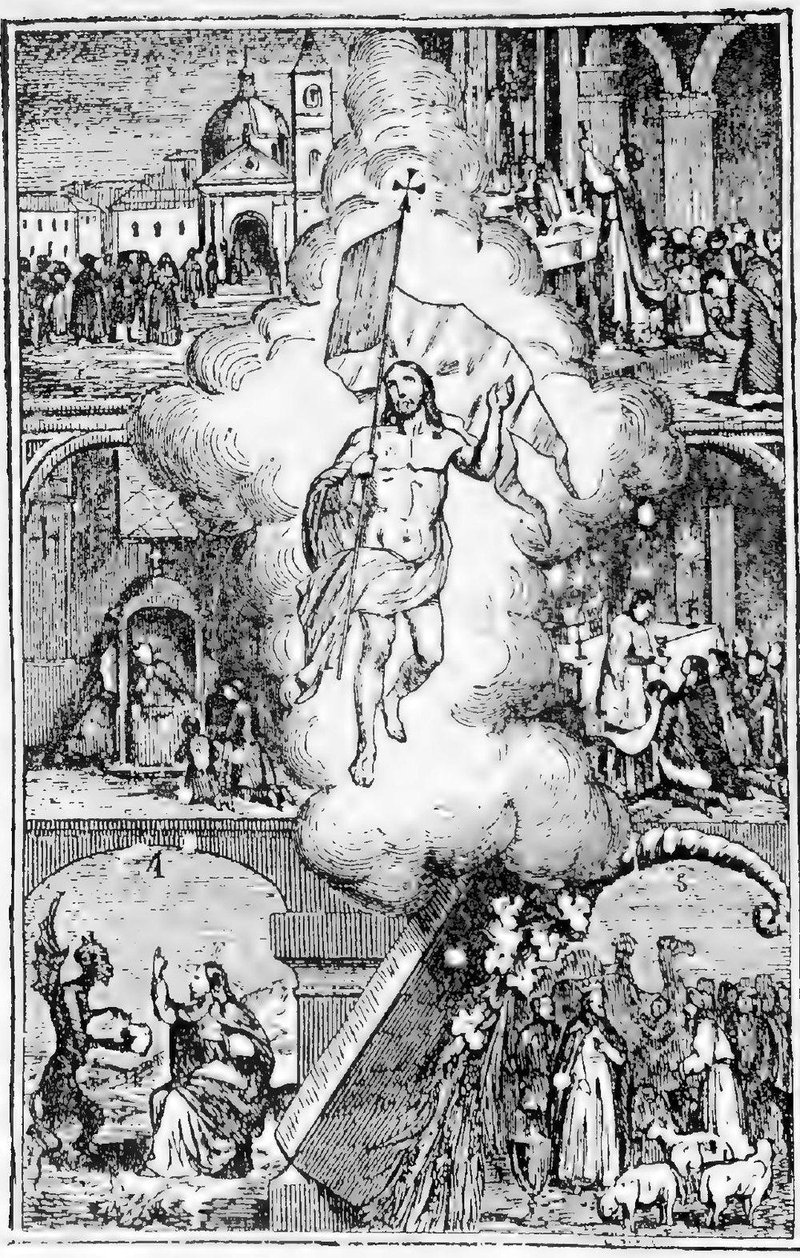
Plate XXIV. The Commandments of the Church. Jesus risen. 1. People going to church; people hearing Mass. 2. Confession. 3. Communion. 4. Jesus in the desert. 5. Abraham paying tithes to the high priest Melchisedech.
You know already, my son, that to be saved you must keep the commandments of the law of God. Since honoring parents and elders is one of them, it is clear that you must obey the Prelates of the Church, who are included under the name of elders and parents because they are spiritual fathers, and keep their precepts, if you want to be saved. They are authorized by Jesus Christ to command us, and we are obliged to obey them. So Jesus Christ himself commands that if anyone will not obey the precepts of the Church, let him be to thee as the heathen and publican (Matt. 18:17). And in St. Luke, chapter 10, verse 16, speaking to the Apostles, and in them to all ecclesiastical superiors, he says to them: He that heareth you, heareth me; and he that despiseth you (or your precepts), despiseth me. So it is clear that those who will not fulfil the precepts of the Church, giving as their reason that only those imposed by God must be kept and not those of men, stand convicted of despising God himself, of despising Jesus Christ and his Gospel; and they declare themselves heathens and publicans. You, my son, keep them with careful exactness, as every good Christian should. Imitate that crowd of people you see at no. 1 of the plate. Like good children they are entering the holy church to fulfil what the Church, their loving mother, commands. And so that you may see the great usefulness of these commandments and understand them well, I will explain them to you with the plate.
The first commandment is: To hear Mass entire on Sundays and holy days of obligation. Do you see that priest at no. 1 on the right? He is shown celebrating holy Mass, which the people are hearing in accordance with this precept of the Church, whom we must all obey. Her superiors are bound to watch over our good, so much so that they must give an account of us at God’s tribunal, as St. Paul teaches (Heb. 13:17). That is why they have ordained this commandment for our benefit and profit. Not only this: they must also see that the Lord’s precepts are kept, that the benefits he has given us are acknowledged with gratitude, and that the Saints are venerated and imitated. To attain these ends holy Church orders that on Sundays and other days of obligation we hear Mass entire. By it we give God a special worship, showing ourselves grateful for the benefit the mystery of that day represents to us. And since God is praised in his Saints, at the same time as we show him our gratitude we praise him by honoring the most holy Virgin and the Saints venerated on that day, who can obtain many special graces for us. So we please God and fulfil the natural duty we all have, as creatures, of paying the tribute of love, honor and homage to the Creator. “Holy Mass,” says St. Francis de Sales, “is the chief work the Church has ordained for keeping the feasts holy.”
The holy Council of Trent teaches us that the holy sacrifice of the Mass is the same as that of Calvary, differing only in the manner of its offering. On the cross Jesus Christ offered himself by really dying; on the altar he is offered in a way that represents his death. There he was a victim covered with blood in the sight of men; here he is a victim covered with glory in the sight of the Angels. There he died really; here mystically. There he offered himself to redeem us; here to apply to us the price of redemption. There he merited this price for us; here he hands it over to us.
This precept binds all the faithful who have the use of reason, unless some lawful impediment excuses them. Already in the time of the Apostles the faithful attended holy Mass, as we read in holy Scripture (Acts 20:7); and it has continued ever since, as can be gathered from the canons and decrees given by the holy Fathers and Councils. So, my son, try to attend Mass on all the days the Church commands. If you can hear it every day, do not fail to do so, and you will see how useful it will be to you; but let this last be done without failing in your duties. Hear it with all attention, respect and devotion. I mean meditating on the sublime mysteries its ceremonies recall to us, keeping great modesty outwardly and the deepest reverence within your soul. And do this not coldly or merely to follow custom, as unfortunately happens not seldom, but with a lively desire to share in the wonderful effects of this holy sacrifice.
The second is: To confess at least once a year, in Lent, or earlier if one is in danger of death or is to receive Communion. Picture at no. 2 a lady making her confession, and others waiting recollected and modest. Imitate them, my son. Confess with every good disposition, for the Church obliges us to it, on the basis of divine law, so that no one may be negligent in a matter of such importance. And no one ought to be. It is very natural for one who has got dirty to wash, and for one who is sick to consult the doctor, tell him his ailments and take the medicines he prescribes. It is also very reasonable that if a son is negligent in these things his parents should order him to do them, since they must also watch over their children’s cleanliness and bodily health. Well then, the Catholic Church, who is our mother, is anxious for the health and cleanness of our souls. She commands all of us her children to wash at least once each year in this healthful bath of the sacrament of Penance, and to take this spiritual medicine ordained by Jesus Christ himself. This commandment binds all the faithful who have the use of reason.
The third is: To receive Communion at Easter. Look at no. 3 of the plate, and you will see a priest giving holy Communion and some Christians receiving it with great fervor. You must know, my son, that in the early times of the Church the faithful received Communion every day, as we read in the Acts of the Apostles (Acts 2:46), and this holy custom lasted many years. Then there was no such precept, because, according to Suárez, the devotion of the faithful made up for it or made it unnecessary. But in the course of time they took to receiving Communion only every eight days, then less often. At last, seeing this lukewarmness, Pope St. Fabian ordered that people should receive Communion at least three times a year: at Christmas, Easter and Pentecost. Finally, that fervor having cooled more and more, the Lateran Council ordered the faithful to receive Communion once a year, and at Easter. But the Church’s wish is that the faithful should receive Communion very often, as she showed at the Council of Trent: “The holy Council would wish that at every Mass the faithful present should communicate.”1 A natural mother is very glad when she sees her children have an appetite and eat with relish. On the contrary, she is distressed if she notices they have no appetite. Then she urges them to make an effort, and begs them with tears if they do not give in, because she fears they will die of starvation. So our mother the Catholic Church is greatly pleased when she sees that we hunger for this heavenly bread and, well disposed, eat it often. But if she sees that we have no appetite for it, and that it even makes some feel sick, as the manna did the Hebrews (Num. 21:5)… what affliction and grief weigh down her motherly heart! “My children,” she says tenderly to negligent Christians, “alas! if you do not eat this bread, you will die, and die eternally” (John 6:54). You, my son, do not imitate these last. Rather, as soon as you are of age, ask your director whether you may receive Communion. If he allows it, receive Communion very often, and God will fill you with graces and heavenly blessings.
The fourth is: To fast when holy mother Church commands. Though there are four kinds of fasting, natural, moral, spiritual and penitential, I will speak to you here only of the penitential fast, and the example of Jesus Christ will teach it to you. See him represented at no. 4 in the desert, where he fasted forty days and forty nights, as the holy Gospel tells us (Matt. 4:2). Elias and Moses had fasted as long, and between them Jesus appeared transfigured on Mount Thabor. This penitential fast consists in abstaining from certain foods, and in going without all food for a certain time. Holy Church imitates doctors, who do not let the sick eat as much as they want or what they want. Because she desires our spiritual health, she prescribes for us at certain times and on certain days abstinence and fasting. She does so to subject the flesh to the spirit, in imitation of St. Paul (1 Cor. 9:27); to satisfy divine justice for the faults of our past life; to prepare the soul for prayer and other exercises of piety; to preserve innocence; and to obtain special graces from the Lord. That the Church can command fasting is beyond doubt, since it is beyond doubt that she has authority over the souls and bodies of her children. But the devil, envious of the profit we Christians draw from fasting, comes to tempt us as he tempted Christ in the desert. Do you notice at the same no. 4 how he holds out stones to him, proposing that he turn them into bread? He tempts us too with gluttony, because he knows that from it and through it many great evils come upon the human race. Read history and you will find that Adam and Eve lost grace through a dainty and made all their posterity unhappy. Through the Hebrews’ excessive fondness for eating meat, many of them died in the desert (Num. 11:33), and they went to the length of idolatry. And today, unfortunately, many Christians commit idolatry too through gluttony, so that, as St. Paul says, their god is their belly (Phil. 3:19). Imitate not these, my son, but the Saints, many of whom from infancy knew how to mortify themselves by abstaining from the pleasures of the palate. Or at least, when you are of age, keep this precept of the Church faithfully, unless some lawful impediment excuses you from it.
The fifth is: To pay tithes and first-fruits faithfully, or whatever has been duly substituted for them. You must know, my son, that tithes and first-fruits, in substance, are nothing else than the fitting support of worship and its ministers. No. 5 of the plate represents the patriarch Abraham, who paid tithes to Melchisedech, the high priest (Gen. 14:20). Providing for worship and its ministers is as old as the world itself. Adam, as soon as he was created, knew the Creator and saw his obligation to be grateful to him and offer him sacrifices. Abel and Cain did the same. Noe practiced it after the flood, and after him Abraham, Isaac and Jacob. Under the written law Moses, according to God’s will, ordered worship admirably, and what the Israelites were to give for it.
At the beginning of the law of grace there was no need to demand or receive tithes or first-fruits, since many of the faithful placed their goods at the Church’s disposal (Acts 4:34–35). In the first centuries the Church abounded in riches, the fruit of offerings which she distributed in alms. But after some time she found herself short of what was needed to maintain worship and its ministers decently. So she was obliged to use her right and to make the payment of tithes and first-fruits another of her formal precepts.
Such, my son, are the devout ends the Church has had in establishing these precepts. From the usefulness and profit that come from them to the whole Christian people you can see how diligent you should be in keeping them. In doing so you will at the same time fulfil those of the law of God. For I told you elsewhere that he will not have Christ for his father who does not have the Church for his mother; and without her you could not attain the end for which you were created, which is heavenly glory. And so that you do not forget that in obeying holy Church you obey Jesus Christ himself, I show him to you in the middle of the plate, risen. For he is the founder and head of this holy Church, and this miracle of the resurrection is one of the chief foundations and proofs of her truth.
Q. How many are the Commandments of the Church?
A. They are five, etc. (see the First Catechism above).
Q. Are we obliged to keep the Commandments of the Church?
A. Yes; and he who despises what the Church has ordained despises Jesus Christ.
Q. What causes excuse from keeping them?
A. Two: dispensation and grave inconvenience.
Q. What is the purpose of the precepts of the Church?
A. Chiefly two: the worship of God and the sanctification of the faithful.
Q. What does the first commandment command?
A. That on feast days we hear the whole Mass with attention and devotion.
Q. What is the Mass?
A. It is a living representation of the life, passion and death of Jesus Christ, and a sacrifice in which the same Christ who offered himself on the cross is offered.
Q. To whom is the Mass offered?
A. To the eternal Father.
Q. For what ends is it offered?
A. For four: to honor him, to give him thanks, to satisfy for our sins and to ask him for favors.
Q. What must one do to hear it well?
A. Be present at it from beginning to end, and be attentive and devout, thinking of the Lord’s passion or of some other spiritual thing.
Q. When does the obligation to hear Mass begin?
A. At the age of discretion, which is commonly reckoned at seven years.
Q. What does the second command?
A. That we confess every year.
Q. Why does it say “at least once a year”?
A. To show the Church’s desire that we should confess more often.
Q. Whom does it bind?
A. All Christians who have reached the use of reason.
Q. What does the third command?
A. That every year at Easter time we receive Communion in our own parish.
Q. Does one who confesses and receives Communion badly fulfil these precepts?
A. No, and he commits two horrible sacrileges.
Q. What does the fourth command?
A. To keep the days of abstinence and fasting, unless there is a privilege, dispensation or grave impediment.
Q. How must we keep this commandment?
A. As people of good conscience keep it; and in case of doubt, ask the confessor.
Q. What does the fifth command?
A. The support of worship and its ministers.
Q. Who has undertaken to support worship and its ministers?
A. The civil Government.
Q. And if the Government did not fulfil it, who would be obliged?
A. The people, by divine and natural law.
Footnotes
-
Council of Trent, Session XXII, chapter 6. St. Pius X encouraged frequent and daily Communion (Sacra Tridentina, 1905). ↩