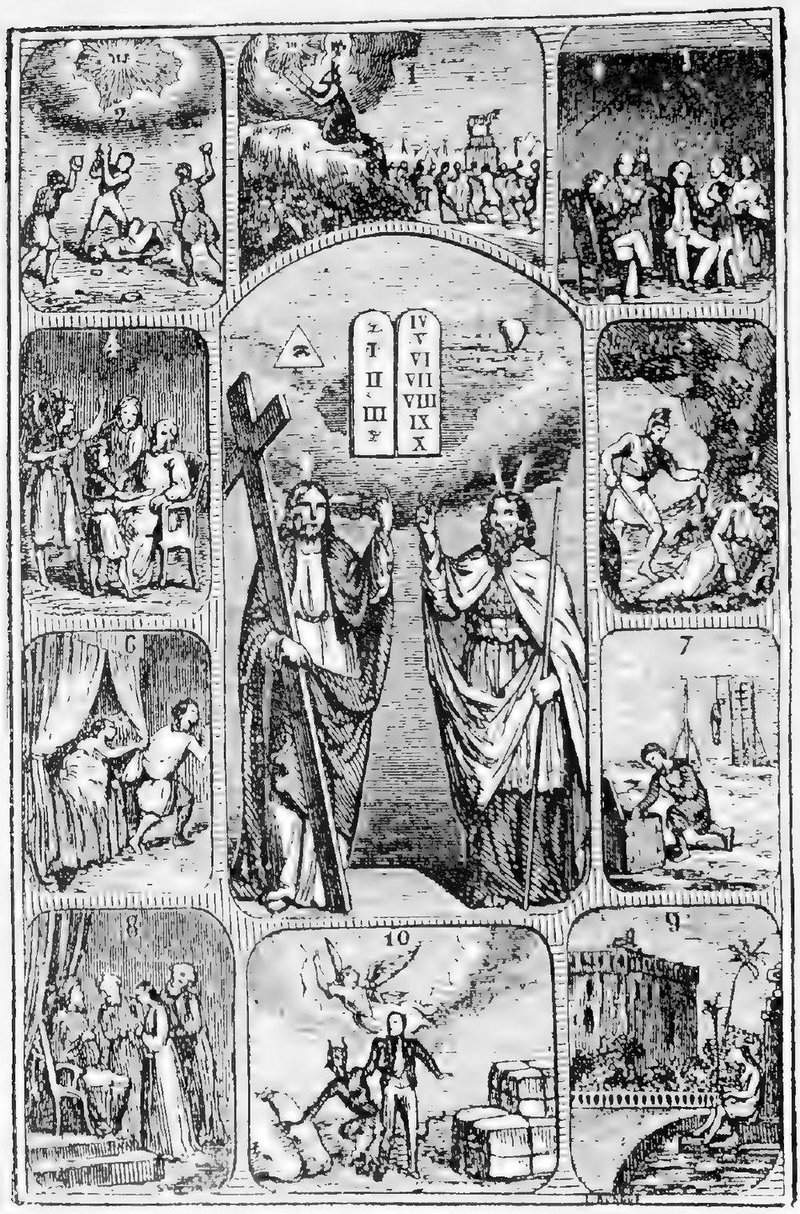
Plate XXIII. The Commandments of the law of God. Jesus and Moses. 1. Receiving the tables, and the worship of the calf. 2. Death of a blasphemer. 3. Keeping holy the feasts. 4. Tobias. 5. David and Saul. 6. The chaste Joseph. 7. The hanged thief. 8. The chaste Susanna. 9. David looking at Bethsabee. 10. The covetous man.
You have seen already, my son, what every Christian must believe and hope for, and how he must make his prayers. But since this is not enough to obtain eternal life, which I wish you, I am going to explain to you the Commandments of God’s holy law. They are all contained in the love of God and of our neighbor, for Jesus Christ said in his holy Gospel: This is the greatest and the first commandment: Thou shalt love the Lord thy God with thy whole heart… and thy neighbour as thyself (Matt. 22:37–39). After that I will show you the rest concerning the doctrine of Charity.
You know already that God created us for heaven. But while he keeps us on earth he wants us to be just, so that by living an orderly and holy life we may be saved. He also created all things to serve us as means to reach our end better. He gave all of them certain laws, which they keep exactly, as we see in the stars, plants and so on. To us too he gave a law, which he imprinted on our hearts. It is called natural, because we receive it with our very nature, and it binds all men in the world in all places and times.
And yet, clear as this natural law is, men swept along by vices and passions almost entirely forgot it in the course of time. To renew it God chose the people of Israel, and made Moses its head or leader. He is the one in the plate with the rod in his hand. On Mount Sinai God gave him the law written on two tables of stone. One of them contained the first three precepts, which concern the glory and honor of God. The other contained the remaining seven, concerning the honor and good of our neighbor. These ten commandments make up what we call the Decalogue, or the written law. When God gave this law, a great crash of thunder was heard, with lightning and flashes, so that all might understand that if they did not keep the commandments God laid on them, they would be punished in this world and the next (Exod. 19:16; 20).
These commandments bind all men now as before. Jesus Christ, who is the one beside Moses with the cross in his hand, said that he had not come into the world to abolish the law but to fulfil and perfect it (Matt. 5:17). And to a young man who asked him what he must do to obtain a happy life in this world and the next, he answered that he should keep the commandments (Matt. 19:17). I say the same to you, my son: keep the commandments, and you will be happy in this life and the next. Ah, if all the world kept them, what great happiness there would be on earth!… For these commandments contain all that must be done to love God and our neighbor. The first three teach us how we must behave toward God with our heart, our mouth and our works. The other seven teach us ways of doing good to our neighbors, and of not harming them in their person, their interests or their honor, by deed, by word or even by desire.
The finger of God wrote these ten commandments on two tables of stone. These tables should serve us as mirrors, in which we may look at ourselves and know whether we have offended God and our neighbor and so stained our soul. In that case we must repent and make a good confession. Then our soul will be left whiter than snow. And in the sight of these mirrors of the tables of God’s law we shall adorn it with all the virtues, for the commandments themselves contain them all. I must also tell you, my son, that each of these commandments has two parts, one that commands and one that forbids. By the part that forbids they curb our evil inclinations; by the part that commands they spur us on to do good works.
So, so that you and others may keep and fulfil them exactly, I am going to give you a brief idea of each of them, explaining the plate to you.
Q. What is charity?
A. It is a supernatural virtue infused by God into the soul, by which we love God above all things, and our neighbor as ourselves for the love of God.
Q. What is the sign or proof that we have the virtue of charity?
A. It is the keeping of the Commandments.
Q. How many are the Commandments of the law of God?
A. They are ten (see the First Catechism above).
Q. Why are these Commandments called “of the law of God”?
A. Because God gave them to Moses on Mount Sinai, written on two tables of stone.
Q. Has Jesus Christ given a law different from that one?
A. No; he has only declared and confirmed it.
Q. Is it necessary for salvation to keep all the Commandments of the law of God?
A. Yes; all ten must be kept, without leaving out one.
Q. To understand this very important truth better, could you give me a comparison?
A. Yes. Just as one who had to cross a great and swollen river by a bridge of
ten arches would not manage to reach the other side of the river if one of those arches had collapsed, so neither will one reach heaven who leaves one of the ten Commandments unfulfilled, however well he keeps the others.
Q. Is it possible to keep these Commandments?
A. Not only possible but easy, with the help of God, which he always gives if it is asked of him rightly.
Q. What do these Commandments of the law of God do in us?
A. They curb our evil inclinations and spur us on to do good works.
Q. What fruit do they give us?
A. Full blessing, spiritual and temporal, as God has promised.
Q. In what does this blessing consist?
A. In peace of conscience and inward joy, and outwardly in abundance of goods, if it is good for us.
Q. What is the final fruit that comes from keeping the Commandments of the law of God?
A. Eternal life.
Q. How do you know?
A. Because Jesus Christ has said so: If thou wilt enter into life, keep the commandments (Matt. 19:17).
Q. What has God prepared for those who do not keep them?
A. The curse and eternal death.
The first commandment. To understand this commandment, look at the plate. At no. 1 is Moses, receiving the tables of the law on the summit of Mount Sinai. Below are the people, who have made themselves an idol, a golden calf, out of the women’s jewels, and worship it as God. As you see, those people are holding feasts in honor of that idol, eating, drinking and dancing noisily. God punished this horrible sin, called idolatry, with the death of twenty-three thousand persons.1
In the first commandment God says: I am the Lord thy God… Thou shalt not have strange gods before me (Exod. 20:2–3). The first words of this commandment are like a very short preface, in which God reminds us that he is our true and supreme Lord and Master, and that therefore we are obliged to obey him with all diligence. Then, in the other words, he commands us not to acknowledge any other as God. The Hebrews fell into this sin by worshiping the golden calf. Even today the unbelievers who worship creatures instead of the Creator fall into it, as do the superstitious and fatalists who hold the devil as their God.
So, my son, by virtue of this commandment you must adore God, love him with all your heart, and adore none but him. You must flee from vice, because vice in the heart is like an idol or false god on the altar, says St. Augustine (Vitium in corde idolum est in altari).
To adore God is to acknowledge him as Creator, Preserver, sovereign Lord, master of all things and the supremely perfect being.
You must adore God, my son, by faith, acknowledging him as truth itself; by hope, acknowledging him as goodness itself; by charity, acknowledging him as the infinite good; and by the virtue of religion, giving him the worship due to him. We must exercise these virtues by making acts of them. In particular we are obliged to make acts of faith, hope and charity when we reach the use of reason, when we are tempted, from time to time during life, and at the point of death.
You must also, my son, practice the virtue of religion, whose chief acts are devotion, prayer, adoration, sacrifice, offering and vow.
Flee like death, my son, from the sins opposed to Religion, which are irreligion, superstition and unlawful worship. Irreligion is failing in the respect due to persons, things and places consecrated to God. Superstition is giving to creatures a worship due to God alone, which is called idolatry; or else having recourse to the devil, which is properly called superstition. Those who go to the devil usually do so in one of these ways: by magic, divination, sorcery and vain observance. Unlawful worship is when God is given a worship different from what is due to him. And I must warn you, my son, that unlawful worship and superstition are tricks Satan uses to corrupt Religion and get people damned by turning them away from God.
By this same commandment, my son, you must honor and venerate most holy Mary, the Angels and Saints, relics and images.
Keep all the commandments, dearly loved son, but especially the first. So you will please God and gain much, and you will be delivered from evils spiritual and bodily, temporal and eternal. Above all you will be delivered from idolatry and ungodliness, which are the cause of a great many evils.
Q. What are we commanded in the first commandment?
A. To adore one God only and serve him perfectly.
Q. How must God be adored?
A. With the greatest reverence of soul and body, with faith, hope, charity and religion.
Q. Since God is a spirit, will not the adoration of the soul be enough?
A. No. Since we have received soul and body from God, we must adore him with both.
Q. What is it to love God above all things?
A. To be willing to lose them all rather than offend him.
Q. Who fulfils the first commandment?
A. He who exercises himself in acts of faith, hope, charity and religion.
Q. When are we obliged to make acts of these virtues?
A. When we reach the use of reason; fairly often during life; when we are tempted; and at the point of death.
Q. Make an act of faith.
A. I believe that the Son of God became man.
Q. Why do you believe it?
A. Because God, who is infallible truth, has revealed it.
Q. Who sins against faith?
A. Unbelievers, Jews, apostates, schismatics and heretics.
Q. What sin does a Christian commit who denies some truth of faith?
A. The sin of heresy.
Q. From what vices do heresies and apostasies arise?
A. Usually from pride and lust.
Q. Make an act of hope.
A. I hope that God will give me grace and the glory of heaven.
Q. On what do you base this confidence?
A. On the goodness and omnipotence of God, on the merits of Jesus Christ, and on my good works.
Q. What sins are against hope?
A. Despair, through lack of hope; presumption and rashness, through false hope.
Q. Who sins by despair?
A. He who, because of his many and grave sins, distrusts the mercy of God.
Q. Who sins by presumption?
A. He who trusts to be saved by his own strength without God’s help, or only by the mercy of God without doing what he ought on his own part.
Q. Who sins by rashness?
A. He who puts off his conversion until the hour of death.
Q. Make an act of charity, or of the love of God.
A. I love God above all things.
Q. Why?
A. Because God is supreme goodness and has loved us from eternity.
Q. What sins are against charity, or the love of God?
A. Every sin against any precept or virtue, and especially hatred of God.
Q. Make an act of love of neighbor.
A. I love my neighbor as myself for the love of God.
Q. Who are our neighbors?
A. All who are already in heaven or can go there.
Q. What is religion?
A. It is a supernatural virtue by which we give worship to God as the first principle of all things.
Q. Why is it called religion?
A. Because it binds or unites our hearts with God.
Q. What are the acts of religion?
A. Some are internal and others external.
Q. What are the internal ones?
A. Those conceived in the heart which unite us with God, such as mental prayer and devotion.
Q. What are the external ones?
A. Certain actions that show the feelings of piety conceived in our soul, such as adoration, sacrifice, oath and vow.
Q. Who sin against Religion?
A. Idolaters, the superstitious, sorcerers, the sacrilegious and the ungodly.
Q. What is idolatry?
A. Adoring false gods, as the gentiles did, or giving to creatures the worship that belongs to God alone.
Q. What is superstition?
A. It is worship corrupted by vain ceremonies, or belief in things the Church has not approved.
Q. What is sorcery?
A. It is using lots or tricks to find out things, or to divine the future, or to do harm.
Q. What is sacrilege?
A. Treating sacred persons, things or places unworthily.
Q. What is ungodliness?
A. It is mocking Religion, its ministers and its sacred things and rites, and regarding with indifference and contempt the duties Religion itself imposes.
Q. Is it lawful to honor and venerate the Angels and Saints?
A. It is not only lawful but also useful to commend ourselves to them, because they are friends of God and our mediators.
Q. Is it lawful to honor the relics of the Saints?
A. Yes, because their bodies were living members of Jesus Christ and temples of the Holy Ghost, and they will rise glorious to eternal life.
Q. Must we venerate the images of Jesus Christ, of most holy Mary and of the Saints?
A. Yes, because they represent to us the originals in heaven, to whom our worship is directed.
The second commandment is: Thou shalt not take the name of the Lord thy God in vain (Exod. 20:7). First of all I must tell you, my son, that the words “Name of God” mean his power, wisdom, goodness and majesty: God himself. In this commandment we are commanded to honor God by word, and forbidden to dishonor him by word.
We honor God by word when we pronounce his name reverently, recalling his divine perfections; and we dishonor him when we pronounce it lightly and for no reason at all.
We also honor God by word when we swear as we ought. By an oath we pay homage to his truth, his justice and his sovereign majesty. But for this the oath must be made in truth, that is, only to support something certain; in justice, to promise something lawful; and in judgment, to assure something of importance (cf. Jer. 4:2). So, my son, when the laws of the Church or of the State oblige you to swear, and especially when you are summoned by the courts to tell the truth about what you are asked, you may swear if these conditions are present. In this case the oath is not a sin, nor is it forbidden; rather it is an act of virtue, and by it we honor God, as I have told you.
What is forbidden in this commandment, my son, is perjury, or false oath, which is an enormous crime. To swear falsely is to affirm on oath something false or doubtful, or to make on oath a promise one does not mean to keep. When a promise is made on oath, it must be made with the intention of fulfilling what is promised, if it is just and reasonable; and one who does not fulfil such a promise is called a perjurer. But if the thing he swore was evil, for example if he swore to take revenge or something else evil, he sinned in making such an oath and would commit another sin if he fulfilled it. Finally, my son, I urge you most earnestly to have a great horror of the very bad habit some have formed of swearing oaths, in words or with signs, with the greatest ease and over nothing. Such oaths may be assertory, or promissory; or imprecatory, wishing oneself harm; or threatening, menacing someone. Remember, my son, the proverb that says: “In the house of him who swears, misfortune will not be lacking.”
This commandment also bids us praise the Name of God, and to this end we must call upon it and praise it with humility, devotion and fervor. What happiness to be able to do already on earth what we shall do afterwards for all eternity in heaven! What happiness to practice now so as to perform so holy an occupation well afterwards in heaven! Oh, how God delights in the praises of mortals! Jesus Christ, true God and true man, listened with pleasure to the praises the children of Jerusalem gave him. And when the envious Jews complained, Jesus answered them that they should remember the words of the Prophet: Out of the mouth of infants and of sucklings thou hast perfected praise (Matt. 21:16; Ps. 8:3). Ah, my son, take pains to sing, and to sing well, the praises of God, of Jesus Christ and of most holy Mary. Imitate the Angels of heaven, who do it so well and with such delight; and say devoutly the prayers to Jesus and to most holy Mary. Opposed to the praises we owe God are blasphemies, horrible sins, the crimes chiefly forbidden in this second commandment. Blasphemy is an insult in words against God, outraging him directly in himself, or indirectly in the things that have a particular relation to him. Blasphemy is of two kinds, heretical and non-heretical. Non-heretical blasphemy contains no error against faith: for example, cursing God, or uttering with contempt the Name of Jesus, or his body or blood, or cursing the Mother of God or the Saints. Heretical blasphemy is an insult that, besides contempt of God, contains an error against faith: for example, denying to God what belongs to him, or attributing to him what does not befit him, or attributing to creatures what befits God alone.
Blasphemy is a most grievous sin, because the blasphemer offends God or the Saints in what is most sacred, their very honor. Its gravity is seen in the severity of the penalty with which God commanded it to be punished. The law says: He that blasphemeth the name of the Lord, dying let him die: all the multitude shall stone him, whether he be a native or a stranger. He that blasphemeth the name of the Lord, dying let him die (Lev. 24:16). Look, my son, at no. 2 of the plate. Do you see the man they are stoning? He is a blasphemer to whom the law is being applied. Holy Scripture says that the son of an Israelite woman and an Egyptian quarreled with an Israelite. In the heat of the quarrel a blasphemy escaped him: he cursed the Lord. Those who heard it seized him and brought him to Moses, who had him put in prison until he could consult God about what to do with the man. And the Lord said to Moses: Bring forth the blasphemer without the camp, and let them that heard him, put their hands upon his head, and let all the people stone him (Lev. 24:10–14). By this ceremony the Lord wished to make it understood that sins left unpunished bring harm on the whole body or nation that tolerates and overlooks them. God himself threatens to destroy the nation or country in
which this detestable vice reigns (Isa. 1:4). And Lorinus relates that when Robert, King of France, was praying for peace in his kingdom, a Crucifix assured him that there would never be peace until he had banished blasphemy from it. Both that answer and that threat seem to be coming true in our unhappy nation! So if you hear someone blaspheme, exclaim with feeling and full of zeal for God’s honor: “Hail Mary most pure! Praised be God! Praised be Jesus Christ!”
This commandment includes vows and promises. By them God is honored if they are well kept, and one sins if they are not kept. So they must be fulfilled in the way they were made, at the time and in the form intended, except in cases of impossibility or lawful dispensation. That is why we must not make vows without first reflecting and taking our confessor’s advice. I must tell you that there are solemn vows and simple vows. Solemn vows are those made on receiving sacred orders or on making profession in one of the religious Orders approved by the Church. Simple vows are those made privately, or in some congregation not raised to a religious Order. I must also tell you that the vows of religion are three: poverty, chastity and obedience. They are opposed to the three great passions of the human heart, which are love of riches, love of sensual pleasures and love of independence. Finally, my son, I will tell you that this second commandment brings us two great goods. First, it serves as a safeguard for loving God, by obliging us to respect him; for what can be despised with impunity is easily no longer loved. Second, it safeguards dealings among men and their good faith, which are the foundation of society. Keep this and the other commandments well, my son, and I promise you that you will be happy in time and in eternity, as I so much wish you.
Q. What are we forbidden in the second commandment?
A. We are forbidden to swear false oaths, and even true ones without necessity; to fail to fulfil vows; to utter blasphemies; and any other dishonor done to God with words.
Q. What is it to swear?
A. To call God to witness something.
Q. What conditions must an oath have to be lawful?
A. Three: truth, necessity and justice.
Q. What is it to swear without truth?
A. It is to swear against what one thinks, or falsely.
Q. What sin does one commit who swears without truth, or in doubt whether what he swears is true?
A. It is a mortal sin, even if the oath is about a light matter, because of the grave irreverence done to God.
Q. What is it to swear without necessity?
A. It is to swear without grave cause, or about things of little moment.
Q. What sin is it to swear without necessity?
A. It is a venial sin, if truth and justice are not lacking.
Q. What is it to swear without justice?
A. It is to swear something unjust or evil, such as doing some harm to one’s neighbor.
Q. What sin does one commit who swears without justice?
A. Mortal or venial, according to what is sworn.
Q. Is one who swears to do something good obliged to do it?
A. Yes.
Q. Is one who swears to do something evil obliged to do it?
A. No; rather he must repent and confess it.
Q. Is it a sin to swear in vain by creatures?
A. Yes, because in them one swears by the Creator.
Q. What remedy is there against swearing in vain?
A. To get used to saying yes or no, as our Lord Jesus Christ teaches us (Matt. 5:37).
Q. What is a vow?
A. To promise God something.
Q. Will it be enough that the thing promised is good?
A. No; it must be better than its contrary.
Q. How must vows be made?
A. With deliberation and advice.
Q. Are we obliged to fulfil vows and promises?
A. Yes; and one who cannot should tell his confessor.
Q. What is blasphemy?
A. A word insulting to God, to the Saints or to Religion, such as taking from them what belongs to them, or attributing to them what does not befit them.
Q. Is the sin of blasphemy very grave?
A. It is most grave, because the blasphemer offends God or the Saints in what is most sacred, their very honor.
Q. Do those sin against this commandment who always have the name of God, of Jesus or of some Saint on their lips, not out of devotion but out of habit and for no purpose?
A. Yes.
The third commandment is: Remember that thou keep holy the sabbath day (Exod. 20:8), which the Spanish formula gives as “Keep holy the feasts”. This commandment directs how we must honor God with our works on Sundays and feast days, commanding us to refrain on them from servile works and to hear holy Mass. You must know, my son, that God our Lord laid down that in each week there should be one day consecrated to his holy service. In appointing one day each week the Lord intended to establish order and uniformity in the worship that must be paid him, to remind us of this obligation, and finally to maintain interior worship and promote exterior and public worship. In ancient times this day was the Sabbath, but now it is Sunday, for many reasons, of which I will give you some. First, to distinguish us Christians from the Jews. Second, because Sunday was the first day of the world. Moreover, the resurrection of our Lord Jesus Christ was on a Sunday; the Holy Ghost came on a Sunday; and some authors say that the general judgment, when we shall have to give an account of all our works, will be on a Sunday. Oh, if we thought continually of that great day, how well we should live, and how we should keep holy, as we ought, the Sundays and other feasts of the year!
Sundays and feasts are kept holy by refraining from servile works and doing good works. By servile works are meant the labors proper to servants, craftsmen and workmen, which are done more with the body than with the mind. They are forbidden even if not done for gain. However, if a case of necessity arises one may work, first asking leave of the parish priest and hearing Mass before or after, as is convenient. It is also allowed when there is a lawful custom approved by the superiors, as in some places at harvest time if there is danger that the crops will be lost. Today, however, in some places, not by custom but by abuse, people work on feasts and Sundays. In the fields one sees ploughing, digging and so on; and in the towns too, unfortunately, one sees some at work. Woe to them!
I tell you, my son, that working on Sundays and feasts without necessity is a sin, more or less grave according to the time spent and the scandal that results. Those who make others work without grave cause sin likewise, and they also violate the consciences of their brothers. You must know, my son, that working on feasts is not only a sin; it leads to losing Religion oneself and making others lose it. For in this way people forget God and the end for which they were created, and open the door of eternal damnation for themselves, not to mention the many temporal and bodily evils such profanation brings. In the sacred book of Exodus God our Lord commanded that the feast day be kept, under pain of death for anyone who worked (Exod. 35:2). And in the book of Numbers we read how this law was applied. It says: “And it came to pass, when the children of Israel were in the wilderness, and had found a man gathering sticks on the sabbath day, that they brought him to Moses and Aaron and the whole multitude. They put him into prison, not knowing what they should do with him. And the Lord said to Moses: Let that man die, let all the multitude stone him without the camp. And when they had brought him out, they stoned him, and he died as the Lord had commanded” (Num. 15:32–36). This tragic event was a lesson and a warning to the Israelites. It should be so with far more reason for Christians, who must be very exact in keeping holy the feast days consecrated entirely to the Lord’s service, setting aside every other business that would distract them from this most essential obligation. This was the example the Apostles gave Christians (Acts 16:13).
It is true that now, under the law of grace, the death penalty is not applied to those who work on feast days. But the Lord does not bless their labors or their persons, so these do them no good; rather they lose, as the proverb says: “Work on feasts is losing, not gaining.” What will farmers get from ploughing, digging and doing other work, if afterwards a drought, a hailstorm or some other mishap comes and destroys everything, and they gather nothing? What will muleteers gain by working on feast days, if afterwards one of their beasts falls and is crippled? What will manufacturers get from making people work on feast days, if afterwards slack times come and they sell nothing, or a fire burns down their factory, or a bankruptcy makes them lose everything? Finally, what do workmen gain by working on feast days, if afterwards they fall ill? Let them remember the proverb: “What is earned on the feast is spent at the apothecary’s.” God does not bless but curses those who work on a feast day. They are thieves who rob God of what is his: Sunday is Dies Domini, the Lord’s day. Yes, they rob him of it by working for themselves. But let them know once and for all that their labors will be their sorrows and misfortunes, temporal and eternal. They will be poorer and more wretched in this world and the next.
Do not imitate those profaners, my son. Imitate rather that family you see at no. 3 of the plate, a model of all the virtues. They have laid aside their work, as the tools you see hanging there show, and are busy reading good books, in spiritual conversation, in prayer, and in teaching and learning Christian doctrine. You must do the same. And since the chief work the Church prescribes for keeping the feast holy, under pain of mortal sin, is hearing holy Mass, I tell you that you must hear it on Sundays, on feasts and on the days when there is an obligation. You will hear it with respect, attention, devotion and completeness. With respect means that you must go decently dressed and keep a modest posture in church, avoiding looking about, talking and anything that might scandalize the faithful. With attention means that you must occupy yourself with what is being done at the altar; for this purpose read in your prayer book, following the order of the ceremonies. With devotion means that you must offer yourself with our Lord Jesus Christ, sincerely desiring to imitate his examples and live according to the Gospel. With completeness means that you must hear the whole Mass. Besides hearing holy Mass, my son, try to attend the other religious services and to exercise yourself in works of mercy toward your neighbors.
Finally I will tell you, my son, that the goods brought by keeping the third commandment are very great. First, it keeps us from forgetting our last end, and preserves us from staining our heart with disordered attachment to earthly goods. Second, it gives workers time to restore their strength of body and soul. And lastly, it draws down blessings on our works. Happy those who keep the feasts holy and keep the other commandments, for they will be happy in time and in eternity!
Q. What does the third commandment command us?
A. That on Sundays and feast days we refrain from servile works and hear Mass.
Q. What are servile works?
A. The labors proper to servants, craftsmen and workmen, such as tilling the ground, weaving, sewing and other mechanical occupations.
Q. May these labors sometimes be done lawfully on Sundays and feasts?
A. Yes, when there is necessity, first asking leave, if possible, of the Bishop or the parish priest, but without failing to hear holy Mass.
Q. Does one sin who works on Sundays and feasts without necessity or leave?
A. Yes, more or less gravely according to how long it lasts and the scandal that results.
Q. To fulfil the precept, besides hearing Mass, is it necessary to exercise oneself in good works?
A. One does not fulfil it perfectly who, being able, does not exercise himself in works of piety, such as frequenting the Sacraments, attending the divine offices, catechism and sermon, visiting the sick and practicing other works of mercy.
The fourth commandment is: Honour thy father and thy mother (Exod. 20:12). It includes our elders and all superiors, whom we must obey by doing what they command; and we also owe them reverence and help. Look at no. 4 of the plate. That old man is Tobias. The young man before him is his son, and the other one further off is the archangel St. Raphael, teaching him how he must revere his father. The young Tobias always and in everything followed the Archangel’s counsel, and so he was the joy of his parents and had the happiest lot, both in this world and in the next. Ah, dear son, believe me, I wish you well like another Raphael. Love, obey, revere and help your parents. Think that they are representatives of God and of his divine providence, and that they cannot be offended without offending God himself. Imitate Jesus, who was wholly subject to Mary his Mother and St. Joseph (Et erat subditus illis, Luke 2:51), not only as a child but as a youth. All his life, until his death, he honored his parents perfectly. Although he was God, and so their superior, he chose to give this good example to all children and subordinates. Happy those who imitate him, for they will be happy in this world and the next! But unhappy those who, instead of imitating Jesus, imitate Satan, who would not be subject to God his Creator. He was cast into hell, where he suffers the punishment of his rebellion. The same unhappy lot will fall to children who do not honor their parents. They expose themselves to having their parents, provoked by their disobedience, utter curses on them, which are commonly followed by God’s curses.
In the dialogue that follows immediately you will find explained, my son, how parents are to be honored. You will also find that by the name of parents are meant spiritual superiors and rulers, with their respective obligations. I will only say here that the benefits brought by keeping this fourth commandment are many, and all very great. For greater clarity I will reduce them to four. First, it strengthens the peace of States and families by inspiring respect for superiors. Second, it makes authority wise and fatherly. Third, it teaches the subordinate that it is God he obeys in the person of his superiors, making his obedience affectionate, filial and constant. Fourth, it leads all to live for one another. Children and subordinates must regard their parents and all superiors as representatives of God. They must believe that the obedience, respect and services they give them are given to God, and that God will reward them generously. Parents and superiors must regard their children and subordinates as so many children of God, brothers of Jesus Christ, created and redeemed by him and destined for the kingdom of heaven. Finally, we must all remember that we are brothers. We have one father, who is God; we all have one mother, most holy Mary; and we all form one single moral body, whose head is Jesus Christ. As the members of one body help one another, so we must all help one another. By this we shall know whether we are children of God and disciples of Jesus Christ: by loving one another as he loves and has loved us (John 13:34–35).
Q. What does the fourth commandment command us?
A. To honor our parents and every superior.
Q. How are parents to be honored?
A. With love, obedience, reverence and help.
Q. What does “with love” mean?
A. That we must love our parents tenderly and constantly, as representatives of God, whose place they hold.
Q. What does “with obedience” mean?
A. That we must do what they command us with simplicity, promptness and cheerfulness.
Q. What does “with reverence” mean?
A. That we must treat them with veneration, respect and courtesy.
Q. What does “with help” mean?
A. That we must help them bodily and spiritually.
Q. What is meant by bodily help?
A. That we must assist them in poverty, in old age and in sickness.
Q. What is meant by spiritual help?
A. That we must help them to live as Christians and to receive the Sacraments when they are sick, and commend them to God in life and after death.
Q. What reward does God give children who behave well toward their parents?
A. God usually rewards them with a long and happy life.
Q. What will become of children who behave badly?
A. They will be cursed by God and men, and will suffer many misfortunes.
Q. What does this fourth commandment require of parents?
A. To feed, bring up, instruct, correct and watch over their children, to give them good example, and not to give them a state of life against their will.
Q. Are other superiors also included in this commandment?
A. Yes; our spiritual and temporal superiors are included.
Q. Who are our spiritual superiors?
A. Our Holy Father the Pope, the Bishops, the priests and our godparents.
Q. Who are our temporal superiors?
A. Kings, rulers, masters, teachers and the aged.
Q. What do we owe them?
A. We must love, obey and respect them, because they are set up by God to govern and command us.
Q. To what are superiors obliged?
A. To bring about the spiritual and temporal happiness of those under them.
Q. How must servants behave toward their masters?
A. They must serve them with submission, respect, obedience and faithfulness.
Q. What are the obligations of masters toward their servants?
A. Almost the same as those of parents toward their children.
Q. If a father, mother, authority or superior should ever command something contrary to the law of God, may one obey?
A. No, because we ought to obey God, rather than men (Acts 5:29).
The fifth commandment is: Thou shalt not kill (Exod. 20:13). You must know, my son, that our parents are the first of our neighbors; that is why the Lord deals with them before the rest, as you have seen in the previous explanation. Then immediately he says: the fifth is, thou shalt not kill. By this he forbids us to harm our neighbor in body and soul, by deed, by word and even by desire. The first thing God forbids in this commandment is murder or homicide, because man has no right over the lives of others. If Judges can condemn criminals to death, it is because God has delegated this power to them. Dueling or challenging is likewise forbidden, because no one has the right to take justice into his own hands. Infanticide is also forbidden, which is taking the life of a child, even one not yet born; it is a horrible crime. Moreover, it is forbidden to wound or strike one’s neighbor, to speak insulting words or curses to him, to advise that some harm be done him, to desire it or take pleasure in harm done him, and to be saddened at good that has come to him. No one may, out of spite or anger, harm himself, wish himself dead or take his own life, as those do who commit suicide; for we are not masters of our own life. Health and life are a gift of God, of which he will demand a strict account.
This commandment forbids not only the death of the body but also that of the soul, which is caused by scandal. Scandal is a word or act that is less than upright and so gives others occasion to offend God. Scandal is a greater sin than homicide itself, because homicide takes the life of the body but scandal takes the life of the soul. And in confessing this sin the penitent must say what kind of scandal he gave and how many people were scandalized. In every case he must repair the harm done and the scandal caused, by saying or doing the contrary of the evil he said or did, and by praying for the persons scandalized.
We will end this explanation with what you will see in the plate. Look at those two figures at no. 5. The one standing is David, and the other is Saul, who pursued him to the death. But David was so meek, peaceful and generous that, although he could have killed his persecutor when he found him in the cave of Engaddi, he spared him (1 Kings 24). In spite of this generosity, Saul went on pursuing him with rancor until he died in despair, and his end was hell.2 David, on the contrary, was dearly loved by God and was saved. So do not imitate Saul, my son. Bear hatred or rancor to no one. Forgive everyone, even your enemies, like David, who, far from taking revenge on his relentless persecutor, forgave him with all his heart. Imitate Jesus and St. Stephen, who not only forgave their enemies but prayed for them to the heavenly Father (Luke 23:34; Acts 7:59). So you will not only forgive your enemies, all who slander and persecute you; you will also pray to God for them. In this way you will be forgiven, and you will show that you are a child of the heavenly Father, who maketh his sun to rise upon the good, and bad, and raineth upon the just and the unjust (Matt. 5:45). Imitating them thus on earth, you will go afterwards to heaven, where you will be happy for all eternity, as I so much wish you.
Finally, I must tell you, my son, that this commandment produces two great goods. First, it protects the chief of natural goods, which is the life of the body. Second, it protects the most precious of supernatural goods, which is the life of the soul.
Q. What does the fifth commandment forbid us?
A. It forbids us to offend our neighbor in body and soul, by deed, word or desire.
Q. How is he offended in body?
A. By wounding or killing him unjustly.
Q. Do soldiers and officers of justice who kill in fulfilling their duties sin?
A. No, because they do not act unjustly.
Q. May we do or wish any evil to our enemies?
A. No, because we may not take revenge; rather we must return good for evil.
Q. Is it a sin to curse one’s neighbor and speak insulting words to him?
A. Yes.
Q. How is one’s neighbor offended in soul?
A. By giving him scandal.
Q. What is scandal?
A. It is a blameworthy word or action by which one’s neighbor is given occasion to offend God.
Q. May one harm oneself, wish oneself dead in anger, or commit suicide?
A. No, because no one is master of his own life.
Q. Do those sin against this commandment who commit excesses in eating and drinking and in other things harmful to them?
A. Yes.
The sixth commandment is: Thou shalt not commit adultery (Exod. 20:14), which the Spanish formula gives as “Thou shalt not fornicate”. The one at no. 6, in the act of fleeing, is the chaste Joseph. His faithless mistress urged him to commit an impure sin. But he, horrified and thinking that God was watching him, rejected her urging and escaped (Gen. 39). This practice of fleeing in this kind of temptation is what gives the happiest results. From a very small boy Joseph already had such a horror of impurity that once, seeing his brothers doing something indecent, he rebuked them, and seeing that they did not mend their ways, he told Jacob his father (Gen. 37:2). Because he was so virtuous his father loved him more than the others, and as a mark of the special affection he bore him he made him a coat of many colors, which signified the various virtues that adorned him. He was in fact chaste, meek, humble, patient, obedient and charitable. He was very different from his brothers, who were vicious and, driven by envy, persecuted him and finally sold him as a slave to some merchants. From them he passed into the power of an Egyptian whose wife tried to make him sin, as I have said. When she could not seduce him she invented a slander against him, by which his master was deceived and had him put in prison. But God, who never forsakes those who serve him faithfully, came to his defense. He set him free and so ordered things that Joseph was raised up as governor of the whole land of Egypt and steward of the house of King Pharao. Yet in spite of this exaltation he took revenge on no one. On the contrary, he forgave them all and did them good. He had his brothers come with his father, and he fed them all.
From this Joseph, my son, you must learn to practice virtue from childhood and above all to be chaste. It is the virtue so loved by God, by Jesus Christ and by most holy Mary, the virtue that makes children and young people like the Angels. If you hear or see other children saying or doing shameful things, think that it is a sin. Rebuke them if you have the chance; if not, keep away from them and show them your displeasure. Imitate the chaste Joseph in chastity, meekness, charity and the other virtues, and the Lord, as a reward for these virtues, will make you happy in this world and the next. Remember always that God sees you. However well hidden you may be, God sees you. This holy thought, which is a truth of faith, will keep you from sinning. If you are good, if you keep away from and flee every sin, especially the sin of impurity, and if you practice the virtues, God our Lord will love you dearly. If it is useful for the good of your soul, he will give you goods and fortune as he gave them to the chaste Joseph; and if not in this world, it will be in the next, where he will give you a throne of eternal glory. Nevertheless, I must warn you that if anyone persecutes or mocks you because you flee from sins and practice virtue, pay no attention. Think that a day will come when he will be mocked and condemned for all eternity.
What God commands in this commandment is the virtue of chastity. He forbids everything opposed to this angelic virtue, such as adultery, fornication and every sin of impurity, whether in word, in deed or even in looks. The sin of impurity is very great and has very fatal consequences, the chief of which is the eternal damnation of many souls. So you will make use of the means you will find in the following dialogue, so as to guard yourself and be always free of a monster that has done so much harm to bodies and souls, in time and in eternity.
This commandment brings three very great goods. First, it protects the honor of families. Second, it shelters health and innocence from one’s own passions and those of others. Third, it gives a delightful peace during life and great confidence at the hour of death.
Q. What does the sixth commandment forbid us?
A. It forbids us to say, listen to, look at and touch or do shameful things.
Q. What are we commanded in this same commandment?
A. To be chaste in body and soul, because we form one body with Jesus Christ and are living temples of the Holy Ghost.
Q. What remedy has one who has sinned against chastity?
A. To repent truly and then make a good confession.
Q. And so as not to sin against chastity, what safeguards should be taken?
A. To love God much and fear his judgments, thinking that at the first sin he can cast us into hell, as he did with the angels who sinned.
Q. What else?
A. To meditate on the passion and death of Jesus Christ; to be devoted to most holy Mary, calling on her in temptations; to frequent the Sacraments; and to practice some bodily mortification, especially in looking, hearing, eating and drinking, keeping away from the dangers of sinning.
Q. And from what dangers must one keep away?
A. From all, but especially from idleness and curiosity, from familiarity with persons of the other sex, from looking at obscene figures or pictures, from reading immoral writings or books, and from listening to indecent conversations.
The seventh commandment is: Thou shalt not steal (Exod. 20:15). Do you see, my son, at no. 7 of the plate, the man taking something out of a chest? It is Achan, who committed this sin in the city of Jericho. As a punishment for it God caused thirty-six of the army to die, and three thousand to flee shamefully before a small number of enemies. Josue, learning by revelation from God that this had been a punishment from heaven, had Achan seized and stoned. Immediately, by order of God himself, he had all the stolen goods burned, together with everything else Achan owned (Jos. 7). My son, this example teaches you that God sometimes sends punishments on towns and kingdoms for the thefts, frauds or injustices of their inhabitants (Ecclus. 10:8), and even for those committed by some private persons. Note well that he who steals ends up poorer than he was before, because what is acquired unjustly makes one lose what was acquired lawfully. So working on Sundays and stealing are the two roads that lead infallibly to poverty. And so, my son, I urge you most earnestly never to take anything belonging to another, however small. For it is well known that from little one goes on to much, and from robbery to murder, and finally to the scaffold. Look at no. 7 of the same plate, at the man who has been hanged. If you asked him, “How did you come to mount that gallows?” and the wretch could answer, he would tell you: “When I was a child I used to take fruit, sweets and other things to eat at home, behind my parents’ backs, out of greed. Because I was fond of gambling I also took from my
home whatever pennies I could. With these petty thefts I began to lose the fear of God. As at first I stole at home, so afterwards I stole in other people’s houses. From small amounts I went on to steal considerable sums when the chance came; and if I ever met resistance, I murdered whoever opposed me. I fell in with bad companions who encouraged me to commit such crimes, and these have finally brought me to this gallows. If only all children would take warning from me and keep from taking other people’s things, even the smallest!… Woe to them if they do, for by that same ladder they will climb to this scaffold on which I find myself!…”
This commandment, my son, forbids robbery. Robbery is unjustly taking and keeping one’s neighbor’s goods, and causing him some harm, such as by damaging or spoiling what belongs to him, when the neighbor has a right not to be deprived of them. The chief ways of robbing are theft, rapine and fraud. It is called theft when the thing is taken without the owner noticing. So these are said to steal: the workman who, without doing his duty, still demands his full pay; the tailor who skims off part of the cloth; the servant who takes something from his masters; dishonest merchants and litigants in bad faith; corrupt magistrates and judges; usurers; and in a word thieves and all who appropriate what does not belong to them. Children who steal from their parents sin against this commandment, because they appropriate what does not belong to them. Rapine is robbery done brazenly and with violence, which offends not only against property but also against the person. Masters who do not pay those who work for them the full wage agreed likewise fall into this wickedness. Fraud is robbery done by deceit: in buying or selling, passing off damaged goods as sound, using false weights and measures, making usurious contracts, and so on. Those also sin against this commandment who harm their neighbor by wasting or destroying what belongs to him, or by preventing him by unjust means from making a lawful gain. Likewise these sin against this commandment: those who unjustly keep others’ goods; those who do not pay their debts when they can; those who do not pay day-laborers, workmen or servants their wages, or make them wait a long time for them; those who do not return a deposit entrusted to them; and those who have found something and do not inquire after the person who lost it in order to return it.
You must know, my son, that it is not enough for one who has sinned against this commandment to confess the sin. He must also make restitution. If he cannot restore everything, let him restore what he can; and if he cannot now, let him do so when he can. As for those who must make restitution, I will tell you the order to be followed. 1. The thief. 2. The one who ordered the robbery. 3. The one who advised it. 4. The one who approved it and encouraged the thief. 5. The one who authorized it, without whose consent it would not have been committed. 6. Those who hid the goods. 7. Those who shared in them. 8. Those who did not prevent it when they were bound in justice to do so. Finally, I will say that restitution must be made to the person injured, or to his heirs, and as soon as possible, also making good the damages and losses. In case of doubt, let him consult his confessor. All this is said for the past. For the future, the best means of not falling into injustice is to respect others’ goods as we should wish our own to be respected. It will be good for you to know, my son, that what they call communism of goods is opposed to this seventh commandment, because it destroys the order of society established by God.
The goods that come from this commandment are these. First, it protects our fortune against the injustice of the wicked. Second, it shows us plainly the infinite goodness of God and the holiness of Religion.
Q. What does the seventh commandment forbid us?
A. Unjustly taking and keeping our neighbor’s goods, and causing him any harm.
Q. How does one become guilty of robbery?
A. By theft, rapine and fraud.
Q. In what way is harm done to one’s neighbor?
A. By damaging or spoiling what belongs to him.
Q. When one has robbed or done damage, will it be enough to confess and repent of it?
A. No; one must also make restitution, immediately if one can, and if not, when and as far as one can.
Q. Must things found be returned to their owner?
A. Yes.
The eighth commandment is: Thou shalt not bear false witness (Exod. 20:16). Look, my son, at no. 8 of the plate. The man seated is the judge before whom the chaste Susanna was brought by those two old men. Because she feared God, she would not yield to their shameful solicitations, and in their anger they accused her falsely, saying they had found her committing a sin. But God took the side of the truth, arranging that Daniel should uncover the lie and wickedness of the two false witnesses, who for this were stoned to death (Dan. 13). You must keep this passage of holy Scripture well in mind, my son, so as never to bear false witness or tell lies. For God, who punished those liars, would punish you too. Even people would loathe you and not believe you; for it is well known that a liar is not believed even when he tells the truth.
Now I will tell you, my son, how you must behave with regard to this commandment. It forbids us to bear false witness and all the sins that go with it, such as lying, detraction, calumny, tale-bearing and rash judgment. To lie is to say something contrary to what one thinks, with the intention of deceiving; sometimes one also lies by actions or outward signs. Lies are of three kinds: pernicious or harmful, officious, and idle. A pernicious lie is one that harms one’s neighbor: for example, when someone testifies before a judge that so-and-so has committed a crime, knowing it is not true. An officious lie is one told to save someone from an evil, or to obtain some good for oneself or another. An idle lie is one told without harm or profit. All of them are sins. Every lie is opposed to God, who is truth itself, and to the true purpose of speech, the use of which was given us to communicate our ideas to one another sincerely, and not to deceive one another. To this I must add, my son, that if a lie causes great harm to one’s neighbor, it is a mortal sin. Officious and idle lies are of themselves venial sins, and so they are always blameworthy in a Christian, because by them he fails in truth, even if it is in jest.
To bear false witness is a lie told before authority after taking an oath to tell the truth. Calumny is a lie to the injury of one’s neighbor, imputing to him a fault of which he is innocent or a defect he does not have. Detraction is the unjust revealing of one’s neighbor’s defects, and this happens in three ways. First, by word, when without reason or necessity the hidden vices or defects of some person are disclosed. Second, by silence, when one fails to praise some good act of one’s neighbor when one ought to. Third, by signs: as when someone shows impatience on hearing another praised, or shrugs his shoulders, smiles maliciously, or by some other sign shows that he disapproves of what he hears. Calumny and detraction are grave or light sins according to the harm they cause. It is also a sin to speak of faults that are publicly known, if one does so out of hatred or ill will. As a rule all these faults come from little humility and less charity. But God, in punishment for them, allows those who speak ill, or their close relatives, to fall into the same defects and even worse ones. I must also tell you that not only those who speak ill sin, but also those who listen to it, if they listen with malicious relish, or when they do not stop it though they could and should. When, however, one cannot stop the detraction, one must refrain from taking part in it, and by putting on a serious and sad face give to understand that one does not like to hear such talk.
Anyone who has fallen into any of these wicked acts must restore the other’s good name or repair the harm he has caused, repent and confess. One who has calumniated, for example, must retract what he has falsely said of his neighbor. One who has spoken ill must excuse his neighbor’s faults if possible, make the most of his good qualities, and commend him to God. Besides detraction there is another wickedness called tale-bearing. It consists of imprudent or malicious reports that can sow discord among friends and relatives, or married people. One guilty of this offense is cursed by God, as holy Scripture says (Ecclus. 28:15). There is another wickedness included in this commandment, called rash judgment, which consists in judging ill of one’s neighbor without sufficient proof or reason. Finally, I will tell you that this same commandment forbids indiscretion, that is, betraying secrets and reading other people’s letters.
The chief benefits this commandment brings are two. First, it protects our good name. Second, it preserves peace and mutual trust among men.
Q. What does the eighth commandment forbid us?
A. It forbids us to lie, bear false witness, speak ill of others and make rash judgments.
Q. What is it to lie?
A. It is to say the contrary of what one thinks, with the intention of deceiving.
Q. Is it ever permitted to lie?
A. Never, because a lie always offends God, who is truth itself.
Q. What is it to bear false witness?
A. It is a lie told before authority after one has taken an oath to tell the truth.
Q. What is it to calumniate?
A. It is to impute to another a crime he has not committed.
Q. What is detraction?
A. It is unjustly revealing one’s neighbor’s defects.
Q. What must one do who has fallen into any of these wicked acts?
A. Repent, repair the harm and confess.
Q. What is rash judgment?
A. Thinking ill of one’s neighbor without grounds.
The ninth commandment is: Thou shalt not covet thy neighbour’s wife (Exod. 20:17). Do you notice at no. 9 that palace, on whose roof terrace a king is looking at the woman down below? It represents David, who, looking at Bethsabee as she bathed, fell into desire and sinned (2 Kings 11). This should serve you as a warning to be careful in looking at persons or things that may stir up lustful thoughts or desires in you. Flee from bad company, from familiarities, flirtations, dances, theaters and other shows where indecent things are done. Do not look at figures, photographs, pictures or other provocative things, and do not read obscene books. In short, guard yourself against everything that may lead you to impure thoughts and desires; for it is better to keep the fire from catching than to have to put it out once it has caught. Woe to you if you did not follow my advice! You would be lost… However good you might be, you would fall miserably, like David and others.
This commandment forbids interior sins against chastity, such as desires and thoughts. Impure desires are sins when they are voluntary and consented to in the heart, even if the evil desired is not done, as Jesus Christ says in his holy Gospel: Whosoever shall look on a woman to lust after her, hath already committed adultery with her in his heart (Matt. 5:28). Impure thoughts are sins when one dwells on them willingly and takes pleasure in them. But when one does not want them, nor the cause that produces them, they are not sins; rather they are an occasion for gaining much merit. What must be done in order not to fall is to guard the senses, especially the sight; to love God very much; to receive the holy Sacraments of Penance and Communion often and fervently; and to be very devoted to most holy Mary, to one’s Guardian Angel and to St. Aloysius Gonzaga.
The tenth commandment is: Thou shalt not covet… any thing that is his (Exod. 20:17), “Thou shalt not covet thy neighbor’s goods”. Notice at no. 10 how the devil tempts that man to covet and steal what belongs to another, and see how his Guardian Angel holds him back, saying to him: “What you would not want for yourself, do not want for anyone.” Would you like others to take or covet what is yours? You will say no. Then neither must you lay hands on or covet anything of your neighbor’s.
You must know, my son, that in this commandment God forbids evil thoughts and evil desires, because both stain the soul and moreover lead man to commit evil actions. And this is another of the reasons why what is not lawful to do is not lawful to think or desire either. Finally, the prohibition in these two commandments shows plainly the infinite goodness of God and the holiness of the Catholic religion.
Great, my son, very great are the benefits God has done us in giving us the Decalogue. The first three commandments, by fixing our duties toward God, free men from idolatry and preserve them from irreligion, which is the seed of all evils.
The fourth commandment, by resting the duties of superiors and subordinates on mutual charity, makes society and the family secure.
The rest protect our goods, as well as our life, our honor, our virtue and our interests, against the passions of the malicious. So the whole Decalogue is a great benefit, which nothing can replace, and without which we should find ourselves in the most unhappy situation. The Decalogue, or the law of God, is as necessary to man and society as the law of gravity is to all bodies. What would become of bodies without that law! And while the Decalogue is so necessary, it is the easiest and simplest thing: it is enough to love, to love God and our neighbor. Love God, my son, for being who he is. Love him out of obedience, since he commands it. Love him for the benefits he has given you, such as creation, preservation, vocation, redemption and very many others. Love him with all your heart, with all your soul, with all your strength and with all your mind. Offer to his greater honor and glory all you do, say and think. For love of him suffer with patience and resignation all the pains he sends you, without regard to the means or instruments he uses for it. Keep his commandments, since keeping them is a proof of love for him. And since he commands us to love our neighbor, let us love him as ourselves, wishing for him, for the love of God, what we would wish for ourselves.
Q. What do the ninth and tenth commandments forbid?
A. They forbid us interior sins against the sixth and seventh, because God, who sees hearts, wants us to be clean within and without.
Q. Is every evil thought that comes to us a sin?
A. When it is noticed and the will consents to it, yes. But when this is lacking, it is not a sin but a temptation.
Q. In how many ways does one sin by thought?
A. In two: by complacency and by desire.