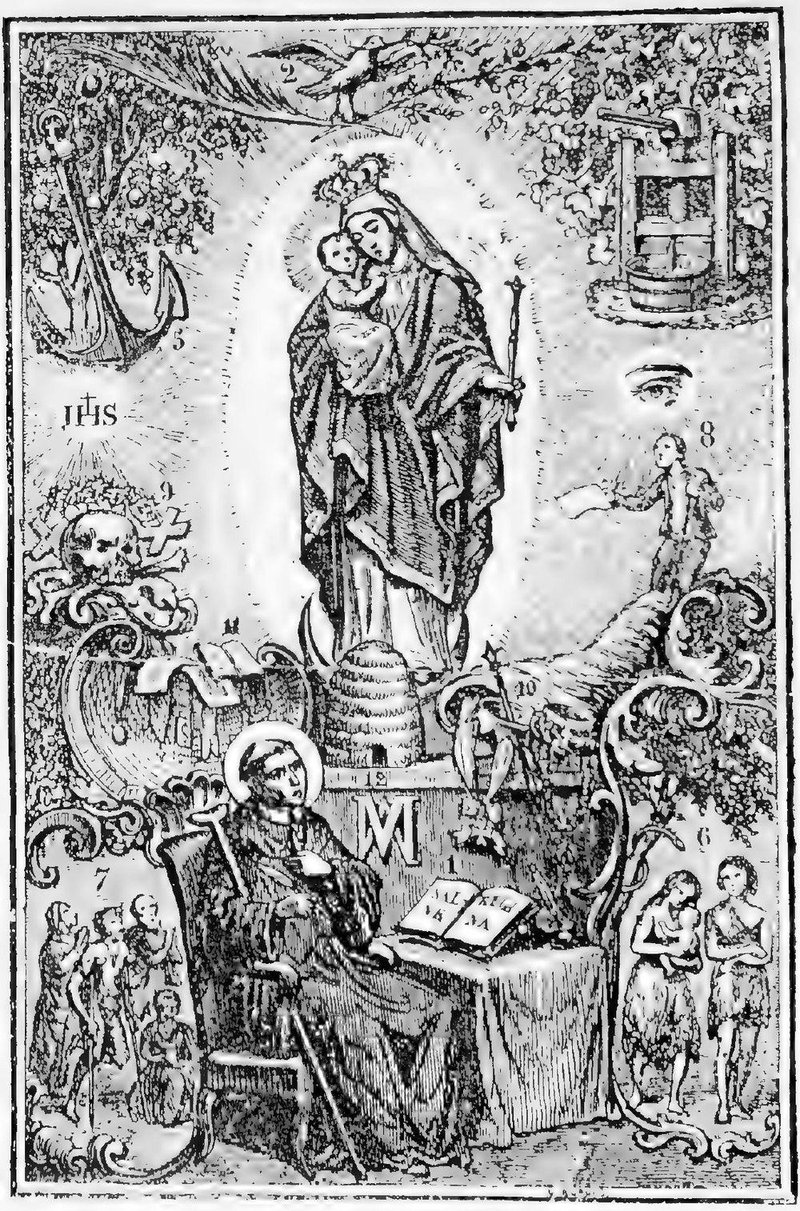
Plate XXII. The Salve. Mary, Queen and Mother. 1. The book of the Salve. 2. The dove with an olive branch. 3. The tree of life. 4. The leafy vine. 5. The anchor of hope. 6. Our first parents Adam and Eve. 7. These are in great trials. 8. They present petitions through the hands of Mary, advocate; eyes of pity and clemency. 9. Thorns, crosses and death. 10. Crowns and scepter. 11. Rosaries and scapulars. 12. The beehive.
Dear son in Jesus Christ, I have just explained the Hail Mary to you and shown you the origin and excellence of this prayer. Now I am going to speak to you more at length about the most holy Virgin in explaining the Salve. But first I must point out that Mary is not only the Mother of God but our Mother too. For her own natural Son, Jesus Christ, entrusted her to us and gave her to us as if by will, before he breathed his last on the cross (John 19:26–27), so that she might be our adoptive Mother. On these titles rest her excellence and the confidence we must have in her.
To be Mother of God she was conceived without sin and adorned with all the graces, privileges and excellences a mere creature can possibly have. That is why the Evangelists give her the greatest praise that can be given a mere creature simply by calling her Mother of God. As our adoptive Mother, the love she bears us is so great that if it were possible to gather together the love of all fathers for their children, of all husbands for their wives, and of all men and women Saints for those devoted to them, we should see that it comes nowhere near the love the most holy Virgin bears each one of us. And since, as is well known, to love is to wish well, we can infer from this how much she will care for our happiness and how many graces she will grant us. For Mary, unlike natural mothers, who cannot always do for their children all they would like, lacks neither the will nor the power.
The faithful are deeply moved by this tender love of the most pure Virgin, and they know from the daily and special graces with which she favors them everywhere how great her power is. So their devotion to her is very great. And so they have taken care, and still take care, to dedicate images and altars in her honor under various titles and scenes of her life. So that you may have true respect and veneration for them, I will speak to you a little about these images of Mary which the faithful place in churches, in houses and in public places, and before which they burn lamps and which they venerate. I wish everyone would imitate this praiseworthy custom, or at least have a picture of this good Lady in the most public or principal place in the house, and also in the place where they usually say their devotions. When we see a portrait of a general or some famous man, at once some of his victories and exploits come to mind. In the same way we recall the perfections and virtues of the most holy Virgin and the Saints when we look at their images or pictures. Here it will be very much to the point to tell you what the holy Council of Trent laid down on this subject in Session 25: “The images of Christ, of the Virgin Mother of God, and of the other Saints are to be had and kept, especially in churches, and due honor and veneration are to be given them. This is not because any divinity or power is believed to be in them for which they are to be venerated, or because anything is to be asked of them, or confidence placed in them, as was done of old by the gentiles, who placed their hope in
idols. It is because the honor shown them is referred to the originals they represent, so that through the images we kiss, and before which we uncover our heads and bow down, we adore Christ and venerate the Saints whom they represent”.
The same holy Council, and St. Thomas too, also teaches that the veneration of sacred images bears much fruit. They remind us of the wonders God has worked through the Saints and of how the Saints practiced virtue, and at the same time they teach us what we must do to be like them. Given our human condition, we need these sensible things. Our soul is in the body as in a dark prison, which can perceive almost nothing except through the windows of the senses. That is why we must use material images to form some idea of spiritual and absent things and to remember them. And for the same reason the faithful, so as not to forget the most holy Virgin, have built so many churches and dedicated so many images in her honor.
Out of the abundance of the heart the mouth speaketh, as Jesus Christ teaches us (Matt. 12:34). So the faithful who love Mary show her their heartfelt love not only with the angelic words of the Hail Mary but also with other prayers and forms they have composed to satisfy their desire to praise and venerate her. One of them is the Salve Regina. It was composed by a monk of St. Benedict, represented by the one in the plate seated below Mary, to whom he was very devoted. This divine Virgin granted him great wisdom. Grateful for so signal a favor, he honored her with this prayer, which the Catholic Church has adopted to praise the sovereign Queen of heaven and earth every day, even in the divine office.
I now go on to explain to you the emblems and symbols of the plate and the words of praise of Mary contained in the Salve. You see, my son, that this image of Mary holds Jesus in her arms, and this shows plainly that she is Mother of God. She also bears a scepter and crown, to signify that she is Queen of heaven and earth. As such that monk, her devotee, greets her, and so in the book on his table (no. 1) one reads: Salve Regina, “Hail, holy Queen”.
Mother of mercy. Do you notice up there at the very top that dove (no. 2) carrying an olive branch in its beak? It is a figure of Mary. After the flood a dove showed by this sign that the waters had gone down (Gen. 8:11). So too Mary brings us the branch of her divine Son, to show us plainly that some of the punishments the Lord used to send upon the earth in ancient times have now abated and been withdrawn. The branch is of olive because the olive is a symbol of peace. It points to the peace made between God and men by virtue of the Redemption and through the intercession of Mary, who takes pity on our miseries. For this reason we call her Mother of mercy.
Our life. This is the meaning of that tree (no. 3). It represents the tree of paradise, whose fruit made those who ate it immortal, and it is a most expressive figure of Mary. Those who have the happiness of eating or receiving, with due disposition, Jesus Christ, the blessed fruit of her womb, in holy Communion will not die eternally, as the holy Gospel teaches us (John 6:51). She is also Life because she obtains grace for sinners, perseverance for the just and relief for the souls in purgatory.
Our sweetness. Look at that winepress (no. 4). From a leafy vine of good stock come clusters which, pressed in the press, give a generous wine. Besides being a smooth and sweet drink, it strengthens and gladdens the heart. So too Mary, as an abundant vine, vitis abundans [a plentiful vine] (Ps. 127:3), brought forth for us Jesus, who is the cluster, botrus Cypri [a cluster of cypress, Cant. 1:13]. Pressed in the press of his passion and death, he gives us, through the mediation of his divine Mother, a wine of grace and devotion, the most strengthening of all.
And our hope. At no. 5 of the plate you will see an anchor, which represents the hope we must have in Mary. Perhaps you have heard already that all ships carry anchors so as not to be lost. They cast them into the water when they are caught in a storm, hoping in this way to avoid shipwreck. Well, each of us is a ship tossing on the stormy sea of this world. So if we do not want to sink or be dashed to pieces, we must always carry the sacred anchor of devotion to Mary. If we make use of it in the storms our passions stir up, we shall be saved without doubt. And if we hope as we ought, it is most certain that our hopes will not be disappointed.
To thee do we cry, poor banished children of Eve. Do you notice at no. 6 Adam and Eve, with the child Eve holds in her lap? It signifies the human race, which inherited miseries and tribulations from its first parents; and that is why it asks Mary to shelter it.
To thee do we send up our sighs, mourning and weeping in this valley of tears. Of all the names given to the world, none fits it better than “valley of tears”, for so it is in fact. Besides the general calamities, consider the particular ones of each kingdom, province and city, and go down to each family and individual. We shall find so many reverses of fortune, misfortunes, illnesses, deaths and so on that one evil follows hard on another, and for every pleasure there are a thousand griefs that make us shed abundant tears. So, since we cannot escape one or another of them, we have no recourse left but to call on Mary, mother of mercy, sure that she will protect us in our needs, if it is good for us. If we do so, like those at no. 7, who are in great trials, we shall without doubt be helped, for we know that Mary is the consoler of all the afflicted who cry and sigh to her from the heart.
Turn then, most gracious advocate. Mary is our advocate, who intercedes for us with her Son who is to judge us. So we must present our petitions to her for her to recommend them, as you see this man at no. 8 doing. But do not forget that Mary will refuse to be our advocate if we do not try to imitate her virtues and lead a life in keeping with God’s holy law. For he who by his evil works renews the pains of her Son’s passion, which caused her so many sorrows, can in no way hope for the Mother’s protection.
Thine eyes of mercy toward us. This is what that eye of pity and clemency at no. 8 signifies. If we have the happy lot of being looked upon by Mary, she will undoubtedly help us, because she never abandons those who call on her from the heart. Let us try, then, to set our tribulations before her with fervor and humility; she will look on us with favorable eyes.
And after this our exile, show unto us the blessed fruit of thy womb, Jesus. This crown of thorns at no. 9 signifies our exile in this world because of our first parents’ sin, since which the earth brings forth thorns. The two crosses signify the pains of body and soul that are so common, and the skull death, which we must infallibly suffer. But after death Jesus Christ is to judge us. That is why we beg Mary to show us her Son, the fruit of her womb, or to accompany us into his presence. Seeing that it is his Mother who pleads and intercedes for us, he will heed her, and the sentence he pronounces will be favorable.
O clement! We give this title to Mary with every right, because it is she who tempers the rigor of divine justice, so that the clemency of this exalted Queen causes us to be judged with indulgence. Her clemency is so great that it surpasses beyond comparison that of all the emperors, kings and princes there have been and will be. This is what those crowns and scepters at no. 10 show, turned upside down to indicate that they have been surpassed by Mary.
O loving! This title too is one of Mary’s most honorable, for she stood out among all creatures for her piety. The rosary and other devotional things you notice at no. 11 remind us that we must imitate her in this virtue of piety to deserve her love and protection.
O sweet Virgin Mary! Finally, with these words we call upon the exalted Queen of heaven and earth, because she is sweetness and tenderness itself, and because she was the most chaste and pure of all creatures. Not without reason has that beehive, no. 12, been placed beneath her feet. Bees are a symbol of virginity, because they busy themselves only with drawing honey from flowers. All this is applied to the most holy Virgin. From the lovely and fragrant flowers of her virtues she formed a most sweet honeycomb, in which her perfection shone and was admired, and by it she deserved to be Mother of the Son of God. And since this privilege is the greatest that can fall to a creature, we call upon her by this glorious title to interest her more and more in what we ask of her. We end the Salve with these words: Pray for us, O holy Mother of God, that we may be made worthy of the promises of Christ. That is, that after she has obtained for us from her beloved Son Jesus Christ his friendship and grace in life, we may have a good death, so that in heavenly glory we may praise the Son and the Mother eternally.
All that has been said, my son, teaches you how wonderful and powerful the most holy Virgin is. Pay her homage, then, every day. Imitate her virtues of humility, chastity, patience and charity. Frequent the holy Sacraments in her honor. Flee from evil and do all the good you can. As long as you are truly devoted to her, Mary’s protection will not fail you in this world, and in the next she will obtain for you the eternal life I wish you. Amen.
Q. Besides the prayer of the Hail Mary, what other prayer do we usually say to most holy Mary?
A. The Salve, the Litanies and others.
Q. Say the Salve for me.
A. Hail, holy Queen, etc. (see the First Catechism above).
Q. When you say these prayers, with whom are you speaking?
A. With the Virgin Mary, Mother of God and our Mother.
Q. How must you say them?
A. With respect, confidence and love.
Q. Must we pray to the Angels and Saints too?
A. Yes, because they are our immediate mediators.1
Footnotes
-
1 Tim. 2:5. ↩