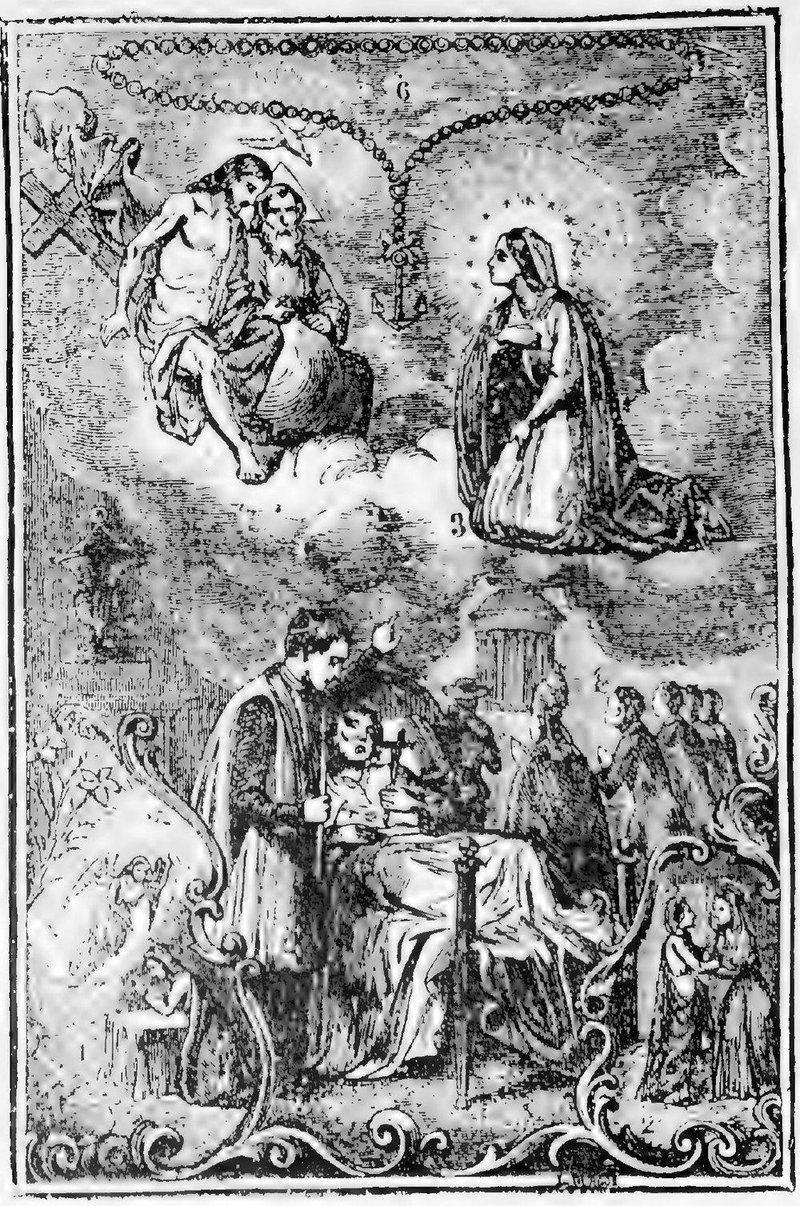
Plate XXI. The Hail Mary. 1. The Annunciation. 2. The Visitation. 3. The most holy Virgin praying to God for us. 4. The Church militant entreating most holy Mary. 5. That she may pray at the hour of death, in which that sick man finds himself. 6. Hope and confidence in Mary.
You will have noticed already, my son, that it is the general custom to say the Hail Mary after the Our Father. This shows the great confidence the faithful have always had in the intercession of the most holy Virgin, to obtain more easily from God, through her mediation and merits, what they have asked in the Our Father. In this they imitate those who, seeking some favor from the king, try to have the queen present the petition to him. You saw in the last lesson that the prayer of the Our Father is in fact a petition dictated by Jesus Christ, which we present to the eternal Father, King of heaven and earth. Well then, to obtain more easily what we ask in it, we make use of the mediation of the most holy Virgin or of some Saint, placing that petition in their hands for the purpose. So you must understand that when we say an Our Father to St. Joseph, for example, or to our Patrons or another Saint, we do not say “St. Joseph, St. Anthony, who art in heaven, hallowed be…” That is, we do not say the Our Father to them or speak with them. While we address ourselves to God, we ask the Saints by intention and affection to present our prayers to him, so as to obtain by their intercession the graces we desire. “The intercession of the Saints is useful,” says the holy Council of Trent.1 And St. Thomas affirms that we must ask them to pray for us, since the order of the divine law requires that we mortals obtain through their mediation the graces we need to be saved (In IV Sent. d. 45, q. 3, a. 2). If this is true of the Saints, of how much greater worth will be the intercession of the most holy Virgin, whose prayers can do more than those of all the Saints together? It is true that we have an advocate with God the Father, Jesus Christ, who is always interceding for us, as St. John affirms (1 John 2:1). This advocate is not only most powerful to obtain for us from the heavenly Father all the graces we need; he can also grant them to us himself. But it is also true that he wants us to make use of the intercession of the Saints, and above all of the most pure Virgin. In her honor he has determined that graces should pass through her hands, the hands of his most holy and dearly esteemed Mother, as St. Bernard affirms in these words: “Such is the will of God, who willed that we should have everything through Mary” (Sic est voluntas ejus, qui totum nos habere voluit per Mariam). Pharao said to those who asked him for food: Go to Joseph (Ite ad Joseph) (Gen. 41:55), because all the treasures of Egypt were entrusted to him. So in a certain sense the eternal Father and Jesus Christ seem to say to us too, when we come to them for some grace: “Go to Mary, because to her we have entrusted all the treasures of mercy. She is full of grace, so that all of you may receive of her fullness.” So, my son, we must go to Mary if we want to obtain graces. And since the graces the faithful have received from her in all ages are so many and so great, they have honored her under different titles and in different images: of the Conception, of Carmel, of the Rosary, of Montserrat, of Atocha, and so on. But you must understand that the faithful do not believe by this that there are many Mothers of God, or that the Virgin Mary is multiplied. No: the Mother of God is one, the Virgin Mary. As there is only one God and one Jesus Christ, so there is only one Mother of Jesus; and since he is God, his Mother is, and is called, Mother of God. She is honored under various titles because her various excellences, and the graces or special favors she has granted us, give occasion for it. So, so that you may place in her
your confidence and be truly devoted to her, I am going to explain to you that plate of the Hail Mary.
First of all, my son, you must know that the Hail Mary is the most reverent and honorable prayer, and the one by which we can most oblige the most holy Virgin. It is a wholly divine and heavenly prayer. The Our Father was dictated and said for the first time by Jesus Christ, the second person of the most blessed Trinity. The Hail Mary, we may say, was dictated by the third, the Holy Ghost, and said for the first time by St. Gabriel, St. Elizabeth and our mother the Church, inspired by the same divine Spirit. I told you on another occasion that the Incarnation of the Son of God was the work of the Holy Ghost. Look at the plate, and at no. 1 you will see the archangel St. Gabriel shown in the act of bringing the message to the most holy Virgin. As minister of the divine Spirit, who is shown there in the form of a dove, he says to her these wonderful words: Hail (Mary), full of grace, the Lord is with thee: blessed art thou among women (Luke 1:28). No. 2 shows the most pure Virgin at the time when, bearing her Son in her womb, she went to visit her cousin St. Elizabeth. Elizabeth, inspired by the same Holy Ghost, said to her: Blessed is the fruit of thy womb (Luke 1:42); and to these words the Church added Jesus. The words Holy Mary, Mother of God, pray for us sinners, now and at the hour of our death. Amen. Jesus were also dictated and added by the Catholic Church, ruled and governed by the same Holy Ghost. She did so when gathered in the holy Council of Ephesus to root out the errors of Nestorius, who had the audacity to blaspheme the most holy Virgin, disputing her glorious title of Mother of God. Most jealous for Mary’s honor, inspired by the divine Spirit, the Church burst out in these words, as honorable to her as they are consoling to us: Holy Mary, Mother of God, pray for us sinners, now and at the hour of our death.
Notice, my son, at no. 3, the most holy Virgin kneeling before the most blessed Trinity, as Daughter of God the Father, Mother of God the Son and Spouse of God the Holy Ghost. Like another Esther at the feet of the divine Assuerus, she is praying for her people. And because of the great love the three divine Persons have for her, they grant us all graces through her mediation. The figures at no. 4 represent us faithful who make up the Church militant. We ask the most holy Virgin to pray to God for us now (and you see that she does so in fact) and also at the hour of our death. The figure at no. 5 is of a dying man, whom the priest attending him urges to place his confidence in Mary, sure that he will obtain a good death. That rosary at no. 6, from which an anchor hangs, reminds us of the hope and confidence we must place in Mary. It tells us that by means of the most holy Rosary we shall be delivered from the storms of this world and reach happily the harbor of eternal salvation at the hour of death. Nor is it surprising that so many graces are obtained through the Rosary, since, as Alan de la Roche affirms, after holy Mass it is the holiest, greatest and most pleasing devotion. You know already that the whole Rosary has three parts, and in each of them five mysteries are remembered: joyful in one, sorrowful in another, and finally glorious. Each mystery is followed by an Our Father, ten Hail Marys and a Gloria Patri.2 So you need not wonder that it is so powerful a prayer, since it is made up of the holiest and most sacred things in the Catholic religion.
So, my son, you must try to say every day at least one part of the most holy Rosary, with all attention and devotion, without dozing, wandering or doing anything unfitting, thinking instead of the mysteries you set out to meditate or of the Our Fathers and Hail Marys you are saying. Also, every day when you get up, try to say three Hail Marys to the most holy Virgin, and the same when you go to bed, always asking her for the three virtues of humility, chastity and charity. I advise you to say a Hail Mary to her too whenever you hear the clock strike the hours. Try as well to carry with you a rosary, scapular or medal of the most holy Virgin, by which you will gain many indulgences.3 Venerate it as your spiritual Mother when you go to bed and when you get up, imitating in this well-brought-up children who on certain occasions kiss their natural mother’s hand. If some temptation assails you at night, call on Mary at once and venerate her image. I assure you that if you are constant in calling on her and resisting the temptation, she will infallibly help you and you will not sin. For this purpose try to have some image of this good Mother in your room, and greet her when you go in and out, doing so often with the Hail Mary. Remember that she is very courteous. That is why St. Thomas of Villanova says that, as a well-bred person returns a greeting, Mary does the same with those who greet her. Say to her, then: “Hail Mary, full of grace,” and do not doubt that, even if you do not hear it, she will answer you: “Since through you I am full of grace, I grant you graces, and abundantly, from my fullness…” What a happy lot is ours! And since this greeting is angelic, greet her as the Angels do. Unite yourself with them; live like them; be chaste like them, humble, devout and fervent like them. Commend yourself to them every day, to your Guardian especially, that he may keep you from all evil and obtain for you the grace of knowing how to serve Mary, as he serves her because she is his Queen and ours too.
Q. Why after the prayer of the Our Father do we say the Hail Mary?
A. So that most holy Mary may obtain for us what we have asked in the prayer of the Our Father.
Q. Who is most holy Mary?
A. She is a great Lady, conceived without original sin, full of grace and virtues, Virgin and Mother of God, Queen of heaven and earth, and advocate of sinners.
Q. Where is most holy Mary, the Mother of God?
A. In heaven, in body and soul.
Q. What, then, is the one in the church and in other places?
A. It is her image, which represents to us the one in heaven.
Q. How many Mothers of God are there?
A. One, and no more.
Q. Why, then, do we say Mother of God, or Virgin, of Carmel, of the Rosary, of Sorrows, and others?
A. It is because of the various titles and mysteries under which she is honored. But the Mother of God is only one; for as there is only one God, so there is only one Mother of God.
Q. Is it good to be devoted to most holy Mary?
A. It is a very good thing and a sign of predestination.
Q. In what does true devotion to most holy Mary consist?
A. In refraining from all sin, imitating her virtues, paying her some acts of homage, frequenting the holy Sacraments, and doing well, gladly and perseveringly, the prayers and other things of her service.
Q. Say the prayer of the Hail Mary.
A. Hail Mary, etc. (see the First Catechism above).
Q. Of what words is the prayer of the Hail Mary made up?
A. Of the words of the archangel St. Gabriel, those of St. Elizabeth, and those our mother the Church added.
Q. What words did the archangel St. Gabriel say?
A. These: Hail (Mary), full of grace; the Lord is with thee; blessed art thou among women.
Q. When did he say them?
A. When he brought most holy Mary the message that she was to be the Mother of the Son of God.
Q. What words did St. Elizabeth say?
A. These: Blessed art thou among women, and blessed is the fruit of thy womb.
Q. When did she say them?
A. When most holy Mary visited her, bearing the Son of God in her womb.
Q. What words did the Church say?
A. These: Holy Mary, Mother of God, pray for us sinners, now and at the hour of our death. Amen.
Q. When did she say them?
A. When she condemned the heresies of Nestorius at the Council of Ephesus.
Q. What do the Archangel’s words Hail denote?
A. The deep respect with which he greeted Mary; and they teach us how we must do it.
Q. What does the name Mary mean?
A. Lady, and star of the sea.
Q. What do the words full of grace signify?
A. The abundance of graces with which the most holy Trinity had prepared her to be Mother of God.
Q. What do these words teach us: the Lord is with thee?
A. That most holy Mary is in a special way the temple and tabernacle of the most holy Trinity.
Q. What do these words signify: blessed art thou among women?
A. That no woman has the graces of most holy Mary.
Q. What are these words: blessed is the fruit of thy womb?
A. They are a praise of Jesus which redounds to the praise of his Mother, as good fruit does to the tree that bears it.
Q. Why do we say to her: Holy Mary, Mother of God?
A. To remind her that we venerate her as the true Mother of God and our Mother.
Q. And why do we say to her: pray for us sinners, now and at the hour of our death?
A. Because we trust that she will obtain from God and grant us the graces we continually need, and above all at the moment of death, on which eternity depends.