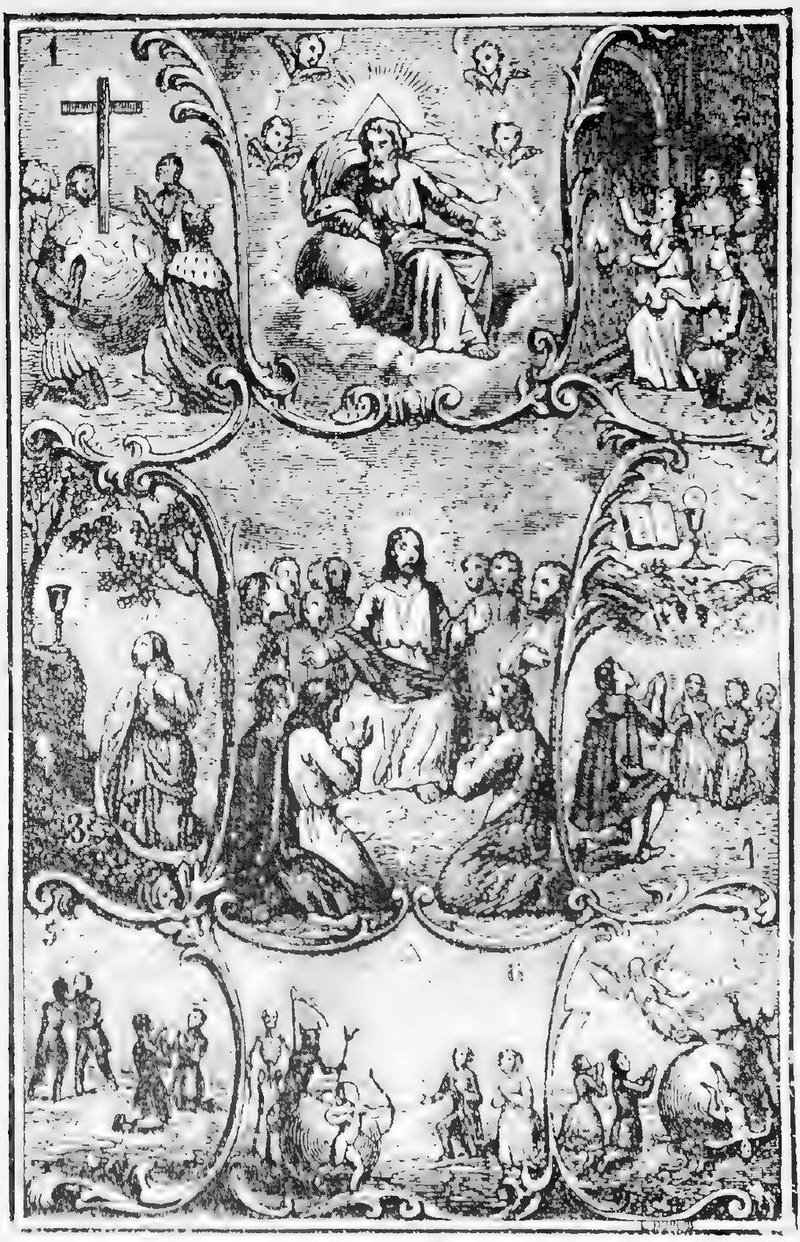
Plate XX. The prayer of the Our Father. Jesus Christ teaching the prayer of the Our Father. The Eternal Father. 1. The five parts of the world. 2. Those who seek the kingdom of God and his will. 3. Jesus in the garden, saying: “Thy will be done, not mine.” 4. These ask for bread. 5. These forgive one another and ask God’s forgiveness. 6. They ask God not to let them fall into temptation. 7. They ask to be delivered from all evil.
Up to now, my son, I have explained to you the plates of the Creed and what you must chiefly believe in order to be saved. Now we shall go on to explain what you must hope for, and how you are to ask it of God our Lord, that is, what prayers you are to address to him to obtain it. That is the subject of this part of the Catechism, which covers the doctrine concerning Hope.
But before all else you must know, my son, that prayer is the means God our Lord has given us to obtain all graces and be delivered from all evils. Do not forget, then, that one cannot reap without first sowing, nor live without eating. So God wills that, to obtain his graces and live in his grace, we should pray or ask him. In the ordinary course of his providence this is so indispensable that whoever does not pray will obtain nothing and will infallibly be lost, just as one who would not sow would gather nothing, and one who would not eat would die. Prayer is the food of the soul. For this reason Jesus Christ speaks so often of prayer in the holy Gospel, saying that we ought always to pray, and not to faint (Luke 18:1), that is, never to give up. And not content with urging us to it by words, he went on to show us its necessity by deeds, so that he spent much time in this holy and important exercise, giving whole nights to it. Following the example of so holy a Master, the Apostles have done the same, and so have all the Saints and all souls who care about the important and only business of their salvation. Those who have not followed these good examples and have given up praying have been miserably lost, or will be lost beyond remedy. Look at the plate: in its center Jesus Christ is shown teaching the Apostles and disciples the prayer of the Our Father.
This prayer of the Our Father is the best and most excellent form of prayer, because it was dictated and taught by Jesus Christ himself, true God and true man, uncreated wisdom and Son of the eternal Father to whom we pray. What great confidence it should inspire in us! If we needed some favor from the king now, and to obtain it the king’s own son dictated the petition to us, teaching us how to ask it, would we not already count it granted? Such, then, is the prayer of the Our Father. It is nothing less than a petition which Jesus Christ himself has dictated to us, for presenting our needs to his eternal Father, King of heaven and earth.
Pay attention, my son, to the words with which we head this petition, Our Father, who art in heaven, which are the consoling title we give to God our Lord. Look at the top of the plate, where the eternal Father is surrounded by Seraphim who praise him unceasingly. Reflect that he is the natural Father of Jesus Christ. Jesus Christ, wishing to be our brother by becoming man for us, also wishes us to have as our adoptive Father the one who is his natural Father, and to call him Father as he does. And so great is the love this good Father has for us that he wants us
to be his children. We owe this benefit to Jesus Christ and his law of grace. In the Old Testament God was always called Lord, but now he wants us to call him Our Father. And so he is in fact, taking such care of us that not one hair of our head will fall without his disposing it (Luke 21:18). Let us therefore give ourselves wholly to his holy will, since he alone knows what is good for us. A natural father who loves his son does for him everything he can and knows to be useful to him; if he does not, it is because he does not know it or cannot do it. So, knowing that God loves us more than all fathers and mothers love their children, that he knows all that is good for us and can do all that he knows, can we ever fear or doubt that whatever happens to us is for our good? What happiness is ours! What great good fortune has fallen to us! Let us ask him, then, with all confidence to grant us whatever is useful to us. That is just what he wants and expects of us in order to grant us his graces.
Having given these general ideas, I am going to explain the plate to you part by part, together with the seven petitions, the seven things we ask of God in the Our Father. Do you see that globe (no. 1) with the holy cross on top? Do you see those figures around it? They show that in all five parts of the world there are people who know and praise God our Lord. Here, then, is what we ask in this first petition, hallowed be thy name: that throughout the world it may always be blessed and praised, and that the providence by which he orders all things may be revered. Would you like a rule for knowing whether you love God? See whether you are glad to see him loved and grieved that he is offended and blasphemed, and whether you try to praise him and to prevent and correct the offenses committed against him. You especially, my son, should praise him, because he greatly delights in the praises of children. And if you hear any blasphemy against his name, try to make amends for it, even if only by raising your heart to him and saying: “Praised be God, Jesus Christ! Hail Mary most pure!”
The second petition is thy kingdom come. Do you see at no. 2 those people carrying a light in their hand? They represent those who seek God and his kingdom in the midst of the darkness of this world, following the command of Jesus Christ, who said: Seek ye first the kingdom of God (Matt. 6:33). They also signify the good works by which truly Christian souls try to shine, and so the heavenly Father is glorified, as Jesus Christ himself says (Matt. 5:16). Living an orderly and holy life, they happily reach the gates of the kingdom of heaven. Meanwhile God our Lord already reigns in their hearts by grace, the passions of the flesh, the world and the devil having been driven out. That is what you must ask in this petition.
The third is thy will be done on earth as it is in heaven. Look at no. 3 of the plate. It represents Jesus Christ in the garden of Gethsemani. In the midst of anguish and pain he asks his heavenly Father, if it is possible, to spare him from drinking the chalice of passion and death being prepared for him. And yet he says: Not my will, but thine be done (Luke 22:42). Here is what we ask of God our Lord in those words: the grace to do his will in all things and in every way here on earth, as the Angels and Saints do it in heaven, even in things most repugnant to nature, and if need be even to suffer death, as Jesus Christ our Lord did. Death rather than sin! Let us always aspire to perfection and sanctification by keeping all the commandments of God and the Church entirely, and what our state of life requires. For this is the will of God, your sanctification, as St. Paul says (1 Thess. 4:3).
The fourth petition is give us this day our daily bread. Look at no. 4 of the plate. Those you see there ask the heavenly Father for bread like poor little ones, like children, and this good Father gives it to them abundantly. You must know that there are three kinds of bread: bodily bread, which is everything that has to do with sustaining the body; the bread of the divine word; and the eucharistic bread. Those ears of wheat and bunches of grapes you see in the plate under the same no. 4 signify bodily bread. The open book, which is holy Scripture, signifies the bread of the divine word. And the chalice with the host signifies the eucharistic bread. Ask God that you may receive them all to the profit of your soul.
The fifth petition is forgive us our trespasses1 as we forgive those who trespass against us. Look at no. 5 at those two shaking hands. They had quarreled; they did not speak to or look at each other; but now they forgive each other. These who are kneeling pray for their enemies. They ask God to forgive them as they forgive with all their heart all who have offended and wronged them, and they wish to return good for evil and be their friends. Here is what you must do, my son: bear ill will to no one and forgive everyone. Otherwise God would not forgive you (Matt. 6:15).
The sixth petition is lead us not into temptation.2 Look, my son, at no. 6 of the plate. Those two kneeling pray and beg God to keep them from falling into the temptation of the enemies of the soul, which are the world, the devil and the flesh. Do you see them there? That globe signifies the world; that ugly one is the devil; and the one shooting arrows of impure love and evil thoughts is the flesh. Behind them stands death. This means that if one consents to their temptations, the soul is left dead. I said if one consents, because if on the contrary one resists them, instead of losing one will gain greater merit; for it is by conquering that one merits the crown and the reward of eternal glory.
The seventh petition is but deliver us from evil. Amen. In this petition we ask God to deliver us from all evils of soul and body. Those of the soul are sin and the dangers and occasions of falling into it. Those of the body are famine, wars, plague, earthquakes, scarcity and others. From these last we must ask God to deliver us if it is good for us in order to serve him and grow holy, and for his glory. But from the first, since they are true evils, we must beg him to deliver us absolutely. Let us do on our part all that is within our reach, and let us not doubt that God will do the rest. So we see at no. 7, where the Guardian Angel is driving off the enemies, who are those down below, and those who pray are left free. The word Amen is a Hebrew word. In the Creed and other acts of faith it means “so I believe”, as I told you; but in the Our Father and other prayers it means “so be it”, or “so I desire”, or “so I hope”. You see, my son, how wonderful the prayer of the Our Father is. In it we ask God for heavenly, spiritual and bodily goods, and we beg him to deliver us from three evils: past, present and future. Past evils are sins. Present evils are the various temptations by which we are driven toward sin. Future evils are the punishments due for sins, whether temporal or eternal. With this prayer we seek the glory of God, our own good and our neighbor’s. Let us say it often, then, with devotion and confidence. And let us think that God will not refuse what we ask him, and will grant so well-devised a petition favorably.
Q. What is hope?
A. A supernatural virtue, infused by God into the soul, by which we hope for the glory of heaven through God’s help, the merits of Jesus Christ and our good works.
Q. When do we especially exercise hope?
A. When we pray.
Q. What is it to pray?
A. It is to raise the soul to God and ask him for favors.
Q. How many kinds of prayer are there?
A. Two: mental and vocal.
Q. What is mental prayer?
A. It is prayer made by exercising the three powers of the soul, without using words.
Q. What is vocal prayer?
A. It is prayer made with words that come from the heart.
Q. How must we pray?
A. With faith, attention, humility, confidence and perseverance.
Q. What are the chief vocal prayers?
A. The Our Father, the Hail Mary and the Hail Holy Queen.
Q. Say the Our Father.
A. Our Father, etc. (see the First Catechism above).
Q. Who made the prayer of the Our Father?
A. Christ our Lord.
Q. Why did he make it?
A. To teach us to pray.
Q. When you say the Our Father, with whom are you speaking?
A. With God our Lord.
Q. What do we ask of God in the prayer of the Our Father?
A. Everything we need, for the body as well as for the soul.
Q. How many petitions has the Our Father?
A. Seven.
Q. Are these words, Our Father, who art in heaven, a petition?
A. No. They are a greeting we make to the Lord with humility and confidence.
Q. Why do we call him Father?
A. Because he is so, since from him we have received the being and the grace we have.
Q. Why do we say our?
A. So that, being brothers, we may love one another and pray for all.
Q. Why do we say who art in heaven, since he is in every place?
A. Because heaven is where he shows himself most particularly.
Q. What is the first petition?
A. Hallowed be thy name.
Q. What do we ask of God in that petition?
A. That he may be known, loved and praised by all.
Q. What is the second petition?
A. Thy kingdom come.
Q. What do we ask of God in that petition?
A. That he may reign in us here on earth by grace, and afterwards give us the eternal glory of heaven.
Q. What is the third petition?
A. Thy will be done on earth as it is in heaven.
Q. What do we ask of God in that petition?
A. That he may be obeyed by all the inhabitants of the earth as he is by the blessed in heaven.
Q. What is the fourth petition?
A. Give us this day our daily bread.
Q. What do we ask of God in that petition?
A. Sustenance for body and soul.
Q. To sustain our body, do we not need other things besides bread?
A. Yes. But since bread is the chief food, in it we ask for all the rest.
Q. With the word bread, what do we ask for the soul?
A. We ask for the grace to persevere in living well, the bread of the divine word, the eucharistic Bread and the other Sacraments.
Q. What is the fifth petition?
A. Forgive us our trespasses as we forgive those who trespass against us.
Q. What do we ask of God in that petition?
A. The forgiveness of our sins and of the punishments due to them.
Q. Why do we add as we forgive those who trespass against us?
A. Because God does not forgive one who does not forgive his neighbor.
Q. What is the sixth petition?
A. Lead us not into temptation.
Q. What do we ask of God in that petition?
A. That he may not allow us to consent to the temptations of the enemies of our soul.
Q. What is the seventh petition?
A. But deliver us from evil.
Q. What do we ask of God in that petition?
A. That he may deliver us from all evils and dangers, spiritual and bodily.
Q. What does the word Amen mean?
A. So be it, or may God grant it to us.