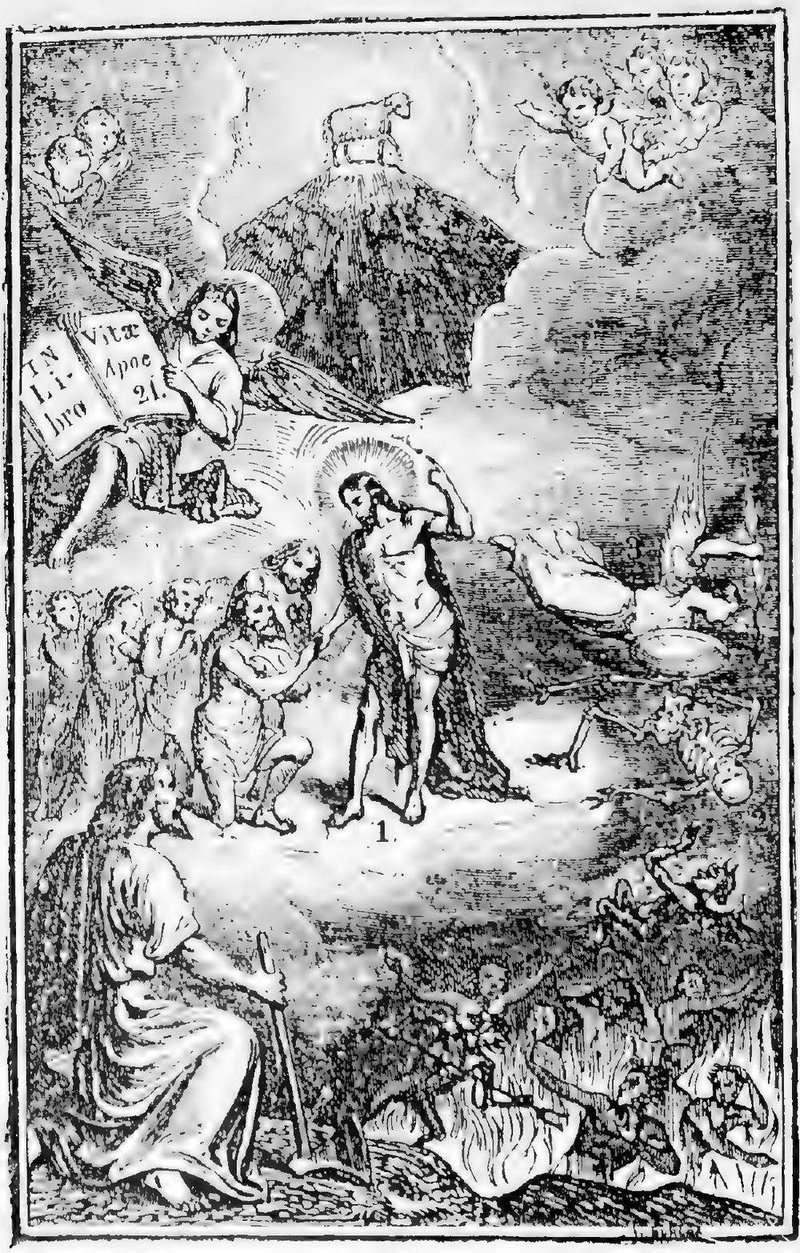
Plate XIX. Life everlasting. The apostle St. Matthias. 1. Jesus Christ, who gives eternal life. 2. Death. 3. The Angel of the Lord. 4. Those predestined to glory. 5. The mountain and the Lamb of the Lord.
Do you see, my son, that personage (no. 1) in the middle of the plate? It is Jesus Christ, giving eternal life to the good, while the wicked go to the eternal pains of hell, represented by that fire down below. Above them is the figure of death (no. 2), and above it an Angel of the Lord (no. 3) hurling thunderbolts against the reprobate to show the rigor of divine justice. But the others, to whom Jesus gives his hand, have kept the commandments and will of God. By their good works and perseverance they have deserved to have their names written in the book of life, which is the one that Angel carries (no. 4). Jesus himself raises them to glory.
At its entrance there is at once a mountain (no. 5) with a lamb on its summit, which is a figurative way of speaking. The mountain signifies perfection and glory. To climb to the top of a mountain one must make an effort and struggle against one’s own inclination, which, like water, always pulls downward. So too we must make an effort to reach perfection and glory. Jesus Christ himself tells us so: The kingdom of heaven suffereth violence, and the violent bear it away (Matt. 11:12). The prophet David asked long ago: Who shall ascend into the mountain of the Lord: or who shall stand in his holy place? And he answers: The innocent in hands, and clean of heart, who hath not taken his soul in vain, nor sworn deceitfully to his neighbour. He shall receive a blessing from the Lord, and mercy from God his Saviour (Ps. 23:3–5). That lamb, because of its great meekness, is a figure of Jesus Christ, who takes away the sins of the world; and also because he was slain to give us eternal life, since we are saved by his merits. So, my son, imitate Jesus Christ, and thus you will climb the mountain of perfection and glory. Imitate him in all the virtues, especially in meekness and humility of heart. For you must know that he says the meek shall possess the land (Matt. 5:4), especially the promised land, which is glory.
It is a truth of faith that we shall all rise, as I showed you in the last lesson. Each one’s soul, united with his own body, will live for ever without ever dying again, so that we shall go on being eternally just as we are found at the moment of the general resurrection. So it will not be like the resurrections of some dead people that we read of in holy Scripture or in the lives of some Saints, who, having been raised, died again. Jesus Christ and the Saints only brought those bodies back to life for a time, to show their supernatural power. But after that day these same bodies will have very different qualities, as we said, and so they will never die again. The good will live in the eternal glory of heaven, which alone deserves the name of true life. The wicked will live in the eternal pains of hell, which are worse than death itself and are called the second death (Apoc. 20:14); and that is why death is cast with them into the infernal abyss. The good will have complete happiness, because in body and soul they will enjoy the supreme and eternal Good, which is their last end; and this is what it is, and is called, to live eternally. The damned, on the contrary, will be deprived in body and soul of all good and plunged in every evil, spiritual and bodily. Their life will be a continual death that never finishes and never finishes them: they shall seek death, and shall not find it (Apoc. 9:6).
The good in heaven will have two kinds of goods, essential and accidental. The essential goods consist in seeing and enjoying God and in knowing all the mysteries of grace and secrets of nature. From this vision and enjoyment come the greatest love, an unspeakable contentment and a joy that will last for all eternity. The accidental goods are the glory, peace, delight and so on with which the Saints esteem and love one another as children of God, brothers and friends. These joys are so many and so great that they cannot be understood in this world. So the apostle St. Paul says: Eye hath not seen, nor ear heard, neither hath it entered into the heart of man, what things God hath prepared for them that love him (1 Cor. 2:9). And Boethius, with the theologians, says that the glory of heaven is “a state made perfect by the gathering of all goods” and all joys.1
Besides these essential and accidental goods and joys common to all the good, there will be particular ones with which chaste persons and virgins, Martyrs and Doctors will be honored in body and soul, and all according to their merits. This particular accidental good is what St. Alphonsus Mary de Liguori, with St. Thomas, calls the aureole, or little crown of fine gold.2 It will be given them for the brilliant and notable victory they won in this world over the devil, driving him by their doctrine and preaching not only from themselves but from other souls as well. But this variety of particular accidental rewards will not produce the least envy or division among them. Rather it will give them satisfaction and joy, because there each one rejoices in another’s good as if it were his own, knowing that the other’s glory, though greater, is not owed to him. You will understand it better with this comparison. Suppose a father has three sons, one tall, the second middling and the last small, and he makes all three a suit of the same cloth and cut, but with more or less material according to their height. Since each receives a suit in proportion to his height, it is clear that the smallest will not envy the biggest’s suit or the middle one’s, nor the middle one the biggest’s. Rather each, content with the one that suits him, will be glad to see his brothers well dressed too. The same will happen in heaven. Each, content with the glory that belongs to him, which is the garment God gives everyone in proportion to the greatness of his merits, will not only not envy that of the others but will rejoice in it.
Besides these joys, the blessed enjoy others that are properly bodily. As I told you in the last lesson, they consist in impassibility, subtlety, agility and clarity. Impassibility means that glorified bodies will feel no pain. As St. John says, God shall wipe away all tears from their eyes: and death shall be no more, nor mourning, nor crying, nor sorrow (Apoc. 21:4). But the bodies of the damned will suffer every evil, so that God himself declares he will rain punishments upon them like the drops of a heavy shower (cf. Ps. 10:7). The bodies of the blessed will also have the gift of subtlety, by which they will be able to enter any place, however closed. So the glorious body of Jesus Christ came out of the tomb without removing the stone that covered it, and entered the upper room without opening the doors. Those of the damned, on the contrary, will always be shut up in those dungeons, never able to get out or escape. The gift of agility, which the bodies of the just will also have, will make them pass from one place to another with the greatest speed, like thought. The Holy Ghost gives us some idea of it when he says they shall take wings as eagles (Isa. 40:31). Not so the damned. Like those cripples who, buried in a bed of pain, cannot move hand or foot, they will not be able even to stir. Lastly, glorified bodies will have the gift of clarity, which will make them shine as the sun (Matt. 13:43). On the contrary, those of the damned will be black as the devils themselves and plunged in the eternal darkness of hell.
Finally, the Creed ends with the word Amen, which means “I believe and confess that everything contained in it is infallible truth.” But understand, my son, that you must believe not only what is contained in the Creed. You must believe all that is contained in the holy Scriptures, and all that God has revealed and that his Church teaches us as a matter of faith, since it was to her that he revealed it and through her that he makes it known and understood to us. Know that he who believes and conforms his works to this faith will be saved, and he who does not believe will be condemned (Mark 16:16). In a certain way it can be said that the whole faith is contained in the Creed, inasmuch as everything comes back to it. And that is why it is said that by reciting it with devotion and attention one makes an act of faith in everything God has taught us.
Try, then, my son, to live an orderly and holy
life, keeping the precepts of God’s holy law, fulfilling your duties and doing all the good works you can; and think of that great reward that will be given you. If pains and labors afflict you, bear them with patience and grace. Think of what the apostle St. Paul says: The sufferings of this time are not worthy to be compared with the glory to come (Rom. 8:18). That glory is infinite and eternal, and the labors of this life, however painful, soon end; afterwards soul and body will be delighted with the eternal sweetness of glory. So even if you know or hear that others do not believe these truths, do not follow them. For a day will come when, to their sorrow, they will find that what they will not believe now is just as we are taught. To finish and conclude, I will tell you what we read in chapter 5 of the book of Wisdom, which I mentioned to you elsewhere:
“Then (on the day of the last judgment) shall the just stand with great constancy against those that have afflicted them, and taken away their labours. These seeing it, shall be troubled with terrible fear, and shall be amazed at the suddenness of their unexpected salvation (or glory), saying within themselves, repenting (well, but late and to no purpose), and groaning for anguish of spirit: These are they, whom we had some time in derision, and for a parable of reproach. We fools esteemed their life madness, and their end without honour. Behold how they are numbered among the children of God, and their lot is among the saints. Therefore we have erred from the way of truth… We wearied ourselves in the way of iniquity… What hath pride profited us? or what advantage hath the boasting of riches brought us? All those things are passed away like a shadow… Such things as these the sinners said in hell” (Wis. 5:1–8, 14).
Q. What is the twelfth article of the Creed?
A. Life everlasting. Amen.
Q. What does “life everlasting” mean?
A. That there is another life, which will never end, where the good will be rewarded and the wicked punished.
Q. What more do these words signify?
A. That the soul will never die.
Q. How many gods are there?
A. Only one true God.
Q. Who is God?
A. God is the Lord, infinitely good, wise and powerful, a most pure and most perfect spirit, immense, eternal, the beginning and end of all things, who rewards the good with the glory of heaven and punishes the wicked with the eternal pains of hell.
Q. What does “God is the Lord” mean?
A. That God is the sovereign Master of all things because he created them, and that he himself preserves and governs them.
Q. What does “infinitely good” mean?
A. That he is supreme goodness and does good to all his creatures.
Q. What does “infinitely wise” mean?
A. That he knows all things and has ordered all things wisely in measure, and number, and weight [Wis. 11:21].
Q. What does “infinitely powerful” mean?
A. That he can do all things, and nothing is impossible to his will.
Q. What does “God is a spirit” mean?
A. That he has no body and cannot be seen or touched.
Q. What do “most pure and most perfect” mean?
A. That he is so pure and perfect that he could not be more so.
Q. What does “immense” mean?
A. That he has no limits in any of his perfections.
Q. What does “eternal” mean?
A. That he always has been, is and will be.
Q. What does “the beginning of all things” mean?
A. That he brought them all out of nothing.
Q. What does “the end of all things” mean?
A. That he directs them all to his greater honor and glory.
Q. Where is God?
A. In heaven, on earth and in every place.
Q. In how many ways is God in every place?
A. In three: by essence, presence and power.
Q. What does it mean to be in every place by essence?
A. That he gives and preserves being in all things.
Q. What does “by presence” mean?
A. That he has all things present to him, even the most hidden thoughts and desires.
Q. What does “by power” mean?
A. That he can make and unmake all things.
Q. If God is in every place, why do we not see him?
A. Because he is a spirit.
Q. Does God see us?
A. Yes. That is why we must keep from sinning and strive to do good works, knowing that the Lord who is to reward or punish us is watching us continually.
Q. Who is the most holy Trinity?
A. It is God himself, one in essence and three in persons.
Q. What are the persons of the most holy Trinity called?
A. Father, Son and Holy Ghost.
Q. Is the Father God?
A. Yes.
Q. Is the Son God?
A. Yes.
Q. Is the Holy Ghost God?
A. Yes.
Q. Are they three Gods?
A. No. Although the persons are three and distinct from one another, they have only one divine nature.
Q. Which of the three persons is holier, more perfect and older?
A. None surpasses the others. All three are equal in every kind of perfection.
Q. Which of the three divine persons became incarnate, or was made man?
A. The second, who is the Son.
Q. Did the Father and the Holy Ghost become incarnate?
A. No.
Q. What did the Son of God do to become man?
A. He took a human body and soul like ours in the most pure and virginal womb of most holy Mary, by the work of the Holy Ghost.
Q. What is the Son of God made man called?
A. Jesus, which means Savior, and Christ, which means anointed.
Q. With what was Christ anointed?
A. With the fullness of the grace of the Holy Ghost.
Q. How was he anointed?
A. As King, Priest and Prophet, above all kings, priests and prophets.
Q. How many natures are there in Christ?
A. Two, divine and human.
Q. How many persons?
A. One, and that divine.
Q. How many intellects?
A. Two, divine and human.
Q. How many wills?
A. Two, divine and human.
Q. How many memories?
A. One, and that human, because as God he has all things present.
Q. Who suffered passion and death for us?
A. Jesus Christ, on the holy tree of the cross.
Q. What torments chiefly did Jesus Christ suffer in his most holy passion?
A. He was scourged, crowned with thorns, nailed to a cross, and he died on it.
Q. Why did he suffer those torments?
A. To save and redeem us sinners.
Q. What does “to save us” mean?
A. To give us his friendship and grace in this life and eternal glory in the next.
Q. What does “to redeem us” mean?
A. To bring us out of slavery to the devil and to sin.
Q. Did Jesus Christ suffer as God or as man?
A. As man, because as God he cannot suffer.
Q. Since Jesus Christ is God and man, would not anything he did have been enough to redeem and save us?
A. Yes, certainly.
Q. Why, then, did he choose to suffer so many pains and humiliations, even to the death of the cross?
A. To show us his love, and to teach us the virtues we must practice and the horror we must have of sin.
Q. Where is Christ?
A. As God, in every place; and as God and man, in heaven and in the most holy Sacrament of the altar.
Q. What does God command men?
A. He commands them to do good works and to refrain from doing evil ones.
Q. Is man free to do good and evil?
A. He is entirely free. That is why he deserves reward if he does good and punishment if he does evil.
Q. Who are the good whom God rewards with the glory of heaven?
A. Those who live and die in the grace of God.
Q. What is the glory of heaven?
A. It is a most perfect place or state in which the just see and enjoy God and possess all goods and joys, with no mixture of any evil, for all eternity.
Q. Do those who die in the grace of God go to heaven at once?
A. If they have fully satisfied for their sins, yes.
Q. Where do those go who have not fully satisfied for their sins in this life, but die in the grace of God?
A. To purgatory.
Q. What pains do the souls in purgatory suffer?
A. Two: the pain of loss and the pain of sense.
Q. What is the pain of loss?
A. Being deprived of the sight of God.
Q. What is the pain of sense?
A. The torment of the fire that burns them.
Q. Can we relieve the souls in purgatory in their pains?
A. Yes, by applying to them indulgences, the suffrage of Masses and other good works.
Q. How long will the souls be in purgatory?
A. Until they have fully satisfied for their sins.
Q. Who are the wicked whom God punishes with hell?
A. All who die in mortal sin.
Q. What is hell?
A. It is a most terrible and dreadful prison, full of fire and occupied by devils, where those who die in mortal sin are tormented according to their guilt.
Q. What pains do the damned suffer in hell?
A. Two: the pain of loss and the pain of sense.
Q. How do the pains of hell differ from those of purgatory?
A. In that those of hell will last eternally, and those of purgatory will end when the souls have fully satisfied for their sins.
Q. Where do children go who die without Baptism?
A. To limbo, where they cannot see God.
Q. Why do you believe these truths?
A. Because God, who is infallible truth, has revealed them.
Q. How do you know that God has revealed them?
A. Because our mother the Church, ruled and governed by the Holy Ghost, teaches us so.