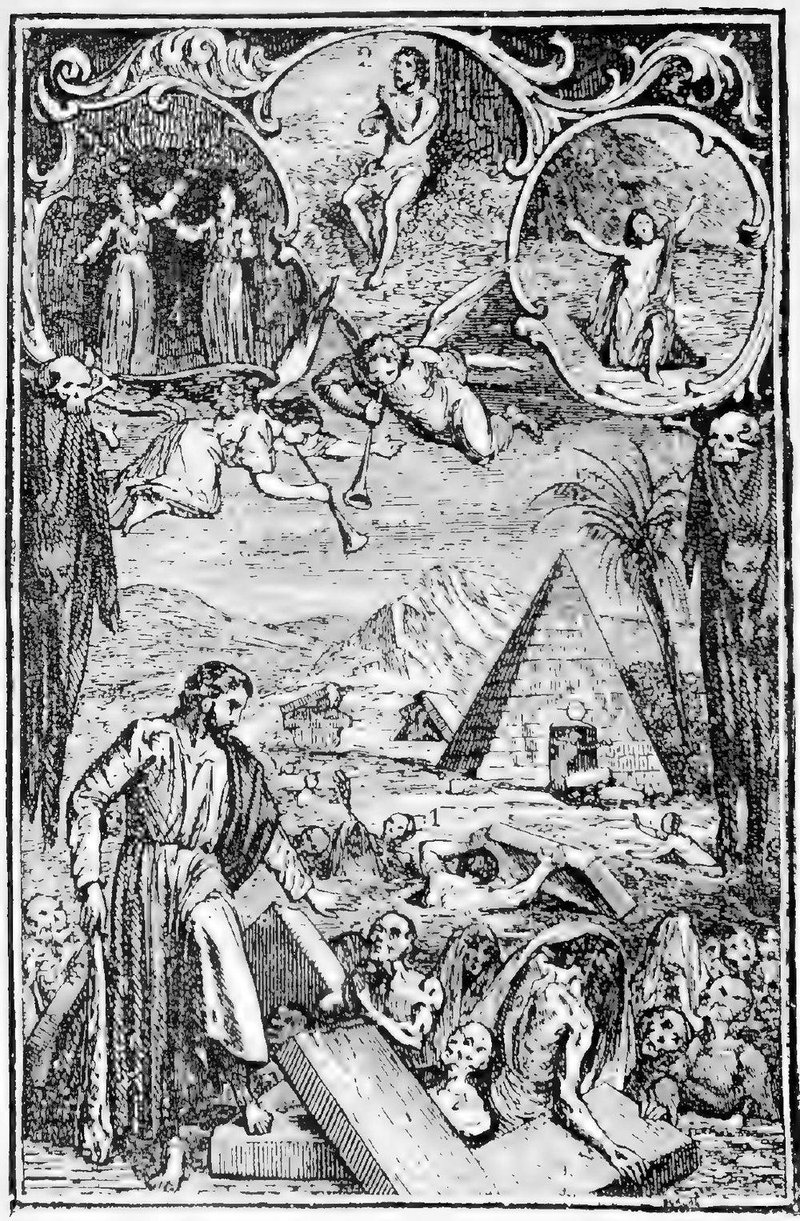
Plate XVIII. The resurrection of the flesh. The apostle St. Thaddeus. 1. The dead rising. 2. Job confesses the resurrection of the flesh. 3. A dead man raised by touching the bones of the prophet Eliseus. 4. The resurrection of Elias and Enoch.
My son, do you notice in that plate the crowd of dead men (no. 1) stirring and hurrying to come out of their graves? It means that you must believe that we shall all rise again, good and bad, glorified and damned. Souls will be united again to their own bodies. Thus united and brought back to life, the good will go to the glory of heaven in body and soul; and the wicked, those who have lived and died in mortal sin, will go in body and soul to hell to burn there eternally.
It is called the resurrection of the flesh, and not of the body, to make clear that what will rise is the same, identical flesh in which each one has lived, and not an apparent body, as some have mistakenly said. It is also called the resurrection of the flesh, and not of man, so that no one should go wrong by thinking that the soul also died and would rise. The soul is immortal; only the flesh will rise, because only the flesh dies.
This is a truth that has always been believed, under the natural law, the written law and the law of grace. In a certain way nature itself teaches it, and natural reason persuades us of it.
Look, my son, at figure no. 2, at the very top of the plate. It represents Job, a man who lived under the natural law in holy simplicity and was very pleasing in God’s eyes. He abounded in riches, in family and in every good that can be possessed in this world. But the Lord, to test his faithfulness, allowed him to lose everything: riches, family and even his health. The evils that oppressed him were so great that his flesh wasted away and only bones and skin were left him. Yet in the midst of so many pains he takes heart and is consoled by the hope of the resurrection, and he cries out: I know that my Redeemer liveth, and in the last day I shall rise out of the earth. And I shall be clothed again with my skin, and in my flesh I shall see my God. Whom I myself shall see, and my eyes shall behold, and not another: this my hope is laid up in my bosom (Job 19:25–27).
Do you not see those figures on both sides of Job? They are passages, one from the Old Testament and one from the New, that also allude to the resurrection of the flesh. The one at no. 3 is a man who, after he died, was put into the tomb of the prophet Eliseus. As soon as he touched the Prophet’s bones he came to life and stood on his feet (4 Kings 13:21). The other (no. 4) is the resurrection of Elias and Enoch, of whom the book of the Apocalypse says that after three days and
a half, the spirit of life from God entered into them. And they stood upon their feet (Apoc. 11:11).
This truth of the resurrection of the flesh was believed under the written law as well. The prophet Ezekiel, in chapter 37, gives a most wonderful prophecy and description of it. And the prophet Daniel says: And many (that is, all) of those that sleep the sleep of death in the dust of the earth, shall awake (shall rise): some unto life everlasting, and others unto reproach, to eternal punishment (Dan. 12:2).
Under the law of grace this truth has always been held so certain that all Christians believe it. From the very beginning, when Jesus Christ came to Bethania, where Lazarus had been dead four days, he told Martha, Lazarus’s sister, that her brother would rise again. Martha answered him: I know that he shall rise again, in the resurrection at the last day. Jesus said to her: I am the resurrection and the life (John 11:24–25), I who rise and give life. And St. Matthew says: And he shall send his angels with a trumpet, and a great voice: and they shall gather together his elect from the four winds, from the farthest parts of the heavens to the utmost bounds of them (Matt. 24:31), from one end of the world to the other.
The resurrection of the dead was one of the things that most held the attention of the apostle St. Paul, so that he spoke of it very often, both in his sermons and in his letters: The trumpet shall sound, and the dead shall rise again (1 Cor. 15:52). And earlier he had said: But some man will say: How do the dead rise again? or with what manner of body shall they come? Senseless man, that which thou sowest is not quickened, except it die first. And that which thou sowest, thou sowest not the body that shall be; but bare grain, as of wheat, or of some of the rest. But God giveth it a body as he will: and to every seed its proper body (1 Cor. 15:35–38). So he will give each man the body that belongs to him. When one reflects on what happens in each grain or little seed, from which, once buried, a fine ear of wheat or a great tree springs, one sees that it is foolishness to deny that the resurrection of the flesh, of dead bodies, is possible.
“All nature,” says Tertullian, “preaches to you the resurrection of bodies. Seeds, grasses, plants and trees seem dead things in winter. But spring comes, and behold, they all rise again. The sun sets in the evening, and the bright day turns into dark and dreadful night. But the next day draws near and… see how it rises again! The moon seems to die every month, and every month it rises again.” Finally he says: “God has chosen to teach you that the dead will rise more by deeds than by words. So before prophecy, he set nature before you, so that, as a disciple of nature, you might believe prophecy the better, and not doubt that God raises the flesh, knowing that he raises all things.”1
What St. John Damascene says about the resurrection of the flesh is admirable. Listen, my son, and I will give you some of his words. “That almighty God who in the beginning formed the body of man from a little dust has the same power now to form it again after it has turned to dust.” He then goes on to show the great difficulties that would follow from not hoping for this resurrection. “If we were not to rise again,” he says, “we could say: let us eat, drink and enjoy ourselves, for death ends everything. If we were not to rise again, how should we differ from the beasts?… If we were not to rise again, we should be more unhappy than the beasts themselves. There would be no God and no providence; everything would be chance.”2 For we see that many who lead exemplary lives are nevertheless weighed down with pains, labors and afflictions, while others who lead very loose lives and wallow in the excesses of ungodliness swim in delights. Only by considering this, anyone with a grain of understanding will see how indispensable the resurrection of the flesh is. There will be, there will infallibly be, a resurrection of the flesh, because God is a just rewarder. As he will reward the soul and flesh that have been mortified to serve him, so too he will punish those who have turned away from him and given themselves up to pleasures. Where would God’s justice be if after death the flesh that had been mortified, like that of poor Lazarus, had the same lot as the pampered and indulged flesh of the rich Epulo? You know it, my son: natural reason itself teaches you that this flesh you now have must rise again. Since it is the soul’s companion in good or evil, it must also be its companion in reward or punishment.
We shall all rise at the age of Christ when he rose, who was thirty-three years old, unto the measure of the age of the fulness of Christ, as the Apostle says (Eph. 4:13). There will be no differences of children or old men, nor deformed or stunted people. Since it will be the work of God, who makes all things perfect, he will raise us all in a perfect state too, correcting the defects of nature. He will cause children, though in their own flesh, to have the body they would have had if they had lived to thirty-three. Old people will have corrected all the defects they contracted after thirty-three, and so will the deformed, and so on.3
We shall all rise. But the good will bear on their foreheads the sign of their predestination, with the impress of grace and of the eternal glory that will adorn their soul. From it this glory will be communicated to the body by the four gifts or endowments. These are: impassibility, which will preserve it not only from death but also from all pain and suffering; subtlety, by which it will pass through everything, with nothing able to hinder it; agility, which will make it so subject to the soul that it will move without weariness to any place in the twinkling of an eye; and clarity, which will make it shine like the sun and so diaphanous or transparent that through it the blessed will be able to contemplate the beauty and loveliness of this great machine of the universe, the admirable work of the Creator.
The wicked will rise with the horrible look of sin, which is the sign of reprobation. It will make their bodies so ugly, loathsome and abominable that one alone would be enough to infect the whole world if it remained on earth. But they will rise incorruptible, by an effect of divine justice, which will in this way impose on them an eternal punishment.
You see, my son, the enormous difference there will be between the one kind of body and the other at the resurrection. Little reasoning is needed to know which of these two lots is to be preferred. Be wise, then, my son. Try to live an orderly and holy life, and do not sin to pamper that flesh. Remember that it would then rise ugly and loathsome and would have to burn eternally in hell. But if you take care to mortify it, it will be preserved and will be happy for ever in heaven.
Q. What is the eleventh article of the Creed?
A. The resurrection of the flesh.
Q. What does “the resurrection of the flesh” mean?
A. That on the day of judgment all souls will be united again with their bodies.