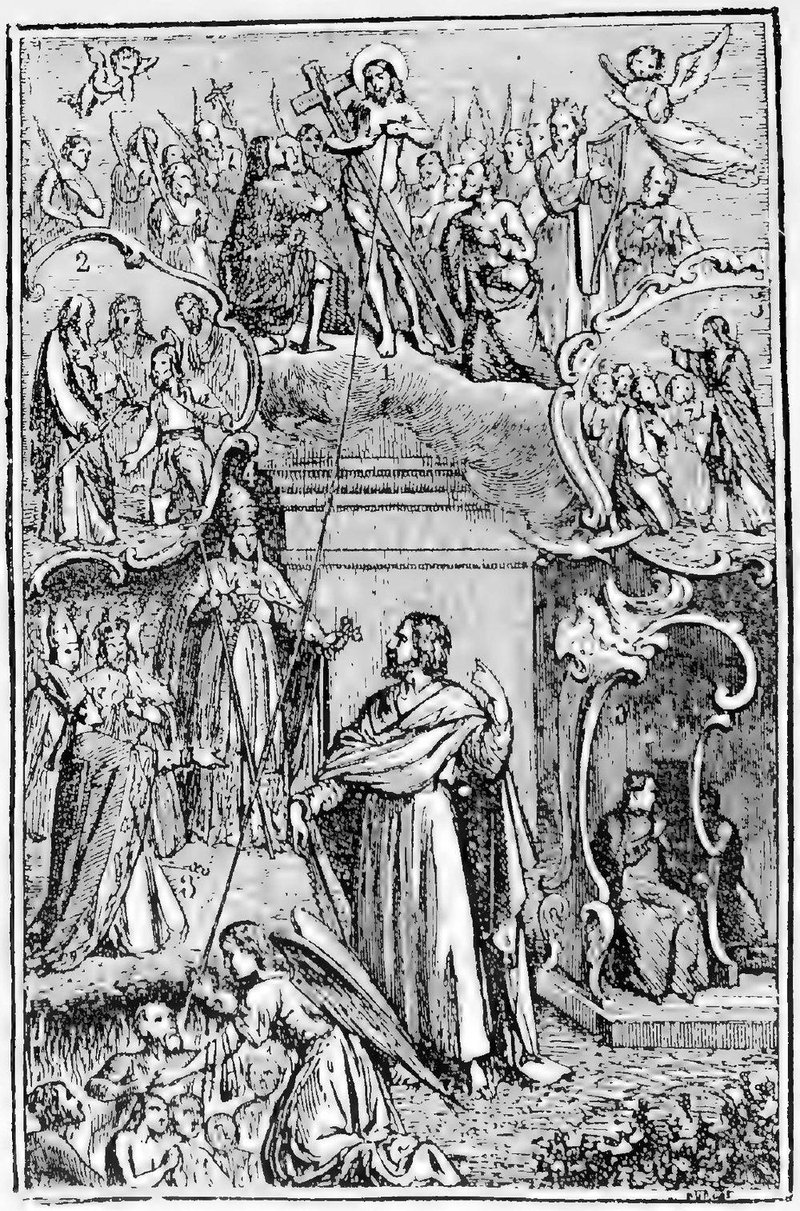
Plate XVII. The communion of Saints, the forgiveness of sins. The apostle St. Simon. 1. Jesus Christ with the Saints of heaven. 2. Onias and Jeremias. 3. The inhabitants of the earth. 4. The Church with the power to forgive sins. 5. Jesus Christ gives the power to forgive. 6. The priest who absolves.
In this plate, my son, you will find shown what I explained to you in the last lesson about the communion of Saints. At the top is Jesus Christ with the Saints. Because all their merits come from the price of his blood, I show you that fountain springing from his side. It symbolizes his merits and those of the Saints, whose power reaches down to purgatory. There you see the Angels coming to take out the souls that have managed to pay their debts by these merits; and that is exactly what the Angel pouring a cup of blood over them shows. And since all graces come to us through the most holy Virgin Mary, you will see, if you look closely, that the Angel carries on his arm rosaries and scapulars of this loving Mother. Do you not see those on the right side of the plate (no. 2)? They are Onias the high priest and Jeremias the prophet, who continually offered prayers to God from Abraham’s bosom for the Hebrew people, as we read in chapter 15 of the Second Book of Machabees. The prophet Jeremias handed a sword to the great captain Judas Machabeus and said to him: *Take this holy sword a gift from God, wherewith
thou shalt overthrow the adversaries of my people Israel* (2 Mach. 15:16). The others (no. 3) are the inhabitants of the earth, who also offer prayers to God. The Supreme Pontiff stands with the keys in his hand, about to open the doors behind which the treasures of the Church are locked, to give them out to the faithful, living and dead, or in purgatory. And here you have the three states of the Church in continual communication, or communion of goods. That is what we believe and confess when we say “I believe the communion of Saints.”
This article, as you know, is followed by that of the forgiveness of sins, by which we believe and confess that the Church has power to forgive them all. It is true, my son, that the power to forgive sins belongs properly and peculiarly to God. But it is also true that, as its owner, he can give it how he wishes and to whom he wishes. And in fact he gave it to his Church. This is what that figure (no. 4) represents, holding in one hand a staff with three crosses and in the other the keys of the kingdom of heaven. That figure represents first of all the Supreme Pontiff, visible head of the Church and successor of St. Peter. It also represents the whole Catholic priesthood, to which God communicates the share of this power that belongs to it in the Church, in due subordination to the Pope.
Before going on, my son, you must know that we are all born with the original sin in which we were conceived. So we are all children of wrath (Eph. 2:3) and slaves of the devil. We cannot be just, nor members of the Church, nor children of God, nor brothers of Christ, nor heirs of heaven, except by the forgiveness of sins, as the apostle St. Peter affirms (Acts 2:38).
There are two kinds of sin, original and personal. Original sin is the one we inherit from our first parents. Personal sin is the one we commit by our own malice. But the Church has power to forgive us both, by virtue of the merits of Christ placed in the Sacraments he himself instituted, and by the power of the ministry he conferred on her. For Christ therefore we are ambassadors, says St. Paul (2 Cor. 5:20); let a man so account of us as of the ministers of Christ (1 Cor. 4:1).
It is a truth of faith, and is clear from the holy Gospel, that Jesus Christ gave this faculty or power to the Church when he said to St. Peter: Thou art Peter (which in the language Christ spoke means rock), and upon this rock I will build my church… And I will give to thee the keys of the kingdom of heaven. And whatsoever thou shalt bind upon earth, it shall be bound also in heaven: and whatsoever thou shalt loose upon earth, it shall be loosed also in heaven (Matt. 16:18–19). With these words, said to St. Peter in particular, he promised what he fulfilled after his resurrection. He would make him head of his Church and give full powers to him and his successors. In his person he would also give them to the other Apostles and to all ministers lawfully sent to administer holy Baptism and the other Sacraments of the Church, to which the power of forgiving sins is attached, as the Apostles themselves taught and as unbroken tradition shows. Jesus Christ gave the same expressly when, appearing to the Apostles after he had risen, he breathed on them (John 20:22). It was like what he did when he created our first parents, to whom with a breath he gave natural life, giving them a spirit of life, a soul like God. So too he gave the Apostles a life-giving spirit, saying to them: Receive ye the Holy Ghost. Whose sins you shall forgive, they are forgiven them; and whose sins you shall retain, they are retained (John 20:22–23): they shall not be absolved. Our first parents began to live by the breath God gave them. In the same way a kind of new life is given to the ministers of the Catholic Church by the breath they receive from Christ through the ministry of the Bishops. A new spirit animates them, and it is no longer they who speak, but the Spirit of the heavenly Father through their mouth. (Notice, my son, that I say of the Catholic Church. Those of the other churches have none of this, because it is not Christ who breathes on them but Satan.) And when one of them says: “I baptize thee… I absolve thee… This is my body…” (Ego te baptizo… Ego te absolvo… Hoc est corpus meum…), it is plain that it is not they who speak but God our Lord, who uses them as his ministers or instruments.
Do you see, my son, no. 5 of the plate? It represents the act in which Jesus Christ gave this power to the Apostles and their successors. And lower down (no. 6), do you not see a priest already using it in hearing confession? Here I must warn you that when Jesus Christ gave the Church power to forgive sins, he did not give it to all the faithful, men and women, or to all who believe in him. He gave it only to the Apostles, with the power and the command to pass it on to their successors in the priestly ministry until the end of the world, so that men should never lack this means of salvation. So the Apostles ordered; so the Church received it from them; so the Councils have defined; and so Christians have always believed, until three centuries ago a religious unworthy of the name, called Luther, rebelling against the Church our mother, began to teach the contrary. Pay close attention to this, my son. Perhaps you will meet some bad Christian, infected with the false maxims of heresy, who will try to persuade you of the errors of that heresiarch and his followers. In that case flee from him as from a viper, call upon God, and ask him to keep you in the faith of the holy beliefs I have just explained to you.
It is very much to the point, my son, that you should know this. Of the seven Sacraments instituted by Christ, only two were instituted to forgive sins and recover lost grace: Baptism and Penance. The other five were instituted to increase it. For this reason these are called Sacraments of the living, and those Sacraments of the dead, as I will tell you elsewhere. As for Baptism, you must know that holy Church, taught by Christ and the Apostles, guided by the Holy Ghost and desiring the salvation of all men, gives every human being power, in the name of Christ and in case of necessity, to administer this Sacrament and through it to obtain the forgiveness of sins. I said every human being, whether man or woman, Catholic or unbeliever, provided they have the intention of doing what holy mother Church does. But a layman should never baptize in the presence of a priest, nor an unbeliever in the presence of a Catholic, nor a woman in the presence of a man.
As for the Sacrament of Penance, you must know that two things are needed: first, canonical ordination; and second, lawful mission. For lack of the first, Lutheran and Calvinist ministers cannot administer this Sacrament, because they are not canonically ordained; nor can laymen, even if they are Catholics, so long as they are in the lay state. For lack of the second, lawful mission, the following cannot administer it, ordinarily speaking: priests who, though canonically ordained, have fallen into heresy or schism; and those who, though Catholics and canonically ordained, are not sent, which in common speech is called not having faculties; and those suspended, and so on, that is, those whom the bishops have forbidden to use faculties they once had. And yet, so great is the Church’s desire for the salvation of all her children that in case of necessity she gives the power to all these who are canonically ordained. And even if the priest administering the Sacrament were a wicked man, the Sacrament would still be valid. If you were given a very precious liquor or a very effective medicine to drink, it would have the same effect on you whether it were offered in a cup of the finest gold or in an earthenware mug, because in either case the liquor or medicine would be the same. The same must be said of the Sacraments, in which we are given to drink the most precious liquor of the blood of Jesus Christ and the most effective medicine of his merits, to forgive our sins and heal the wounds they caused us. True, they ought to be administered in a cup of the finest gold, I mean by a priest full of charity. But the Sacrament does not lose its power because it is given in an earthenware mug, that is, by a bad priest, nor does it fail to cause the same effect, which is the forgiveness of sins. So, my son, if you should have the misfortune to sin after Baptism, you must not be dismayed, still less despair of your salvation. My little children, the apostle St. John wrote to his disciples, these things I write to you, that you may not sin. But if any man sin, we have an advocate with the Father, Jesus Christ the just: and he is the propitiation for our sins: and not for ours only, but also for those of the whole world (1 John 2:1–2). And earlier he had said: If we confess our sins, he is faithful and just, to forgive us our sins, and to cleanse us from all iniquity (1 John 1:9).
And what is most consoling, my son, is that this forgiveness of sins committed after Baptism, which the Church can forgive us, is not limited to a certain number or kind of them. It extends to all sins, whatever they may be. And this not just once, which would already be a great deal, but as often as the sinner comes to the priest truly contrite and humbled, even if the sins he brings are the most enormous that can be committed in the world. What makes the benefit infinite is that God forgives so sincerely that he never remembers them again. It is as if you put a great stone in a sack and dropped it into the sea: you would never see it again. He admits the sinner to his friendship and grace, gives him a right to his goods and his kingdom, and as a pledge of it all makes him a sharer in his own body in the Eucharist.
These benefits tell us how many thanks we ought continually to give God for having caused us to be born in a Christian land and made us children of the Catholic Church. To her alone Christ has given the keys of the kingdom of heaven, and she alone has power to forgive sins. When one thinks that, however many and great they may be, she can forgive them all, provided the sinner does all he ought on his part, one is amazed and compelled to exclaim: Truly the power of heaven has been placed in men on earth! But if the sinner hardens himself, if he grows obstinate and resists the grace of the Holy Ghost calling him to penance, and his sins are not forgiven, it is not for lack of power in this Sacrament or in the Church. It is the sinner’s own fault. And what will cause him the greatest pain in hell will be to think that he is damned through his own fault, when he had so many means of salvation within his reach.
Never sin, then, my son. But if you should ever have this misfortune, humble yourself as soon as possible and repent. Do not harden your heart, and do not despair of forgiveness, however many and grave your sins may be. Make a good confession, and the Church will forgive them all and throw wide open to you the gates of heaven, where may we see each other together. Amen.
Q. What does “the communion of Saints” mean?
A. That the just share in one another’s spiritual goods, as members of one body.
Q. What is the tenth article of the Creed?
A. The forgiveness of sins.
Q. What does “the forgiveness of sins” mean?
A. That the Church has power to forgive every kind of sin.