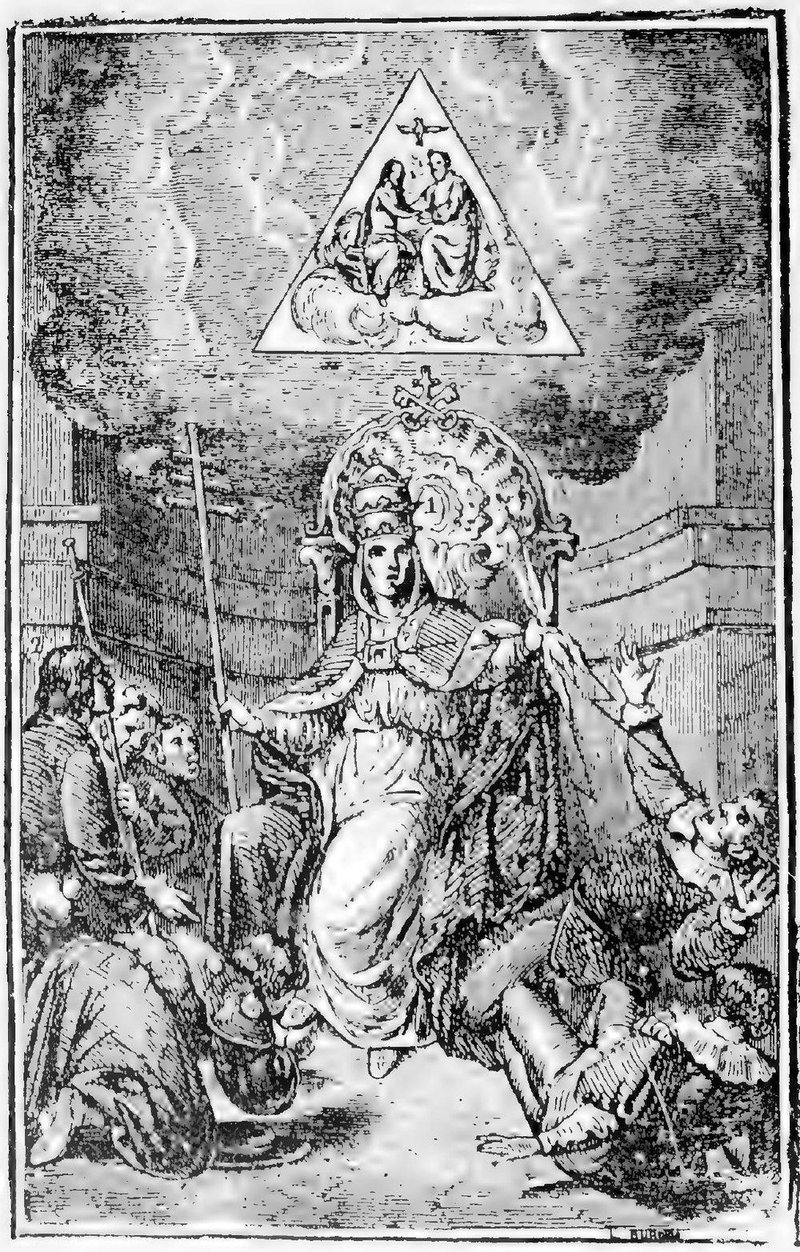
Plate XVI. The summary of Faith. 1. The Supreme Pontiff. 2. The Catholics. 3. The wicked.
This plate, my son, shows you the image or portrait of the Supreme Pontiff, the head of the Church (no. 1). The figures on the right (no. 2) kissing his foot are the faithful who come from the farthest parts of the earth to pledge him obedience; that is why you see them with the pilgrim’s staff. Those on the left (no. 3) are the ones who will not listen to the Church or obey her. She hurls excommunications against them, treating them as the heathen and publican, as Jesus Christ commanded (Matt. 18:17).
I must warn you that there are some who, seeing they cannot resist the force of the arguments for the divinity of the Catholic Church, do not oppose her openly or to her face. Rather they pretend to praise her, the better to strike their blow, and they aim their shots at her head, who is the Pope. But you will understand that if a body’s head is taken off, it must perish. This is what Protestants and other sectarians do: to destroy the body of the Catholic Church they try to take away her visible Head, the Pope. So that you are not deceived, I will tell you this. Jesus Christ is the good shepherd who gave his life to redeem the sheep his eternal Father entrusted to him. When this work of redemption was finished he was to return to heaven. So as not to leave his dearly loved flock without a visible shepherd to guide it, he chose St. Peter from among the Apostles to carry out this charge or office. Among other appearances, after he had risen, Jesus Christ once appeared to St. Peter and six other companions on the shore of the sea of Galilee. Turning to St. Peter, he asked him whether he loved him more than the others. Peter answered: Yea, Lord, thou knowest that I love thee. Jesus Christ then said to him: Feed my lambs. He asked him the same question a second time and gave the same charge, and the third time he said to him: Feed my sheep (John 21:15–17). By the name of lambs the Church has always understood the simple faithful, and by the name of sheep the Bishops, who nourish the faithful of their dioceses as sheep do their lambs. The authority of the Pope is superior to that of the Bishops, and they must respect and obey it, because it was set up by Jesus Christ himself. So he charged St. Peter when he said to him: I have prayed for thee, that thy faith fail not: and thou being once converted, confirm thy brethren (Luke 22:32), that is, the Bishops. St. Peter is the foundation; and if the foundations of a house are taken away, it inevitably falls to the ground.
The need for the Pope can also be known by natural reason. No society, great or small, can last without a head or chief to preside over it and govern it. In families we see the authority of the father. In towns, cities and kingdoms we see Mayors, Governors, the King in monarchies and Presidents in republics. The same must be said of the society formed by Jesus Christ, the Church. She cannot last without a head or superior to govern her, whom we call the Pope.
The authority of the Bishops is not enough, because it is limited to their dioceses and does not extend to the Church in general. Nor are Councils sufficient. They are difficult to assemble; and even if they were not, they cannot always be in session, since the Bishops who would make them up cannot always be away from their dioceses, where their presence is very necessary. And this universal authority is always indispensable for the good of the Church, as the head always is for the body. Could anything be clearer?
Besides, in every general council the Pope is always its chief or president. There is not and cannot be a lawful general council without a Pope to convoke or confirm it. The Roman Pontiff, as Melchior Cano says, is the one who defines questions of faith. He does so not by new revelations or miracles but by human means, calling consultors, more or fewer according to the gravity of the matter, so that with their learning they may help him find out the truth. For although the assistance of the Holy Ghost is promised to the Church, God does not choose to work miracles without need. So he wants her to use human means, while he takes care to guide her so that she does not err. The Bishops (in council) are also judges in questions of faith, but the Pope is the supreme judge. Their sentence has no force without his confirmation; and if any of them depart from the truth, it is his task to bring them back to the right road, according to what Jesus Christ said to St. Peter, as I told you a moment ago.1 You see, then, my son, the need there is of a Pope for the Catholic Church to last. Venerate him, obey him, and never listen to those who speak ill of the Pope and of the Church of Rome. However much religion and zeal those who speak so may make a show of, they are always anti-Catholic. For God’s sake flee from them.
Besides believing the Catholic Church, and in her head who is the Pope, you must also believe the communion of Saints. To help you understand this communion, I must tell you that the Catholic Church is the most wonderful and magnificent society in all creation, and the whole work of creation is destined for her. She is made up of all the Angels and Saints of heaven, all the souls in purgatory, and all the Christian faithful in the world. The portion already in heaven is called the Church triumphant, because there they are crowned with the glory they merited by the triumphs they won here over their enemies, the world, the devil and the flesh. The portion in purgatory is called the Church suffering, because by the pains they suffer there they are cleansed or purified of the faults they contracted here. They were slack in the struggle they kept up against those enemies, or let themselves be overcome by them at times, though their offenses or slackness have already been forgiven. And the portion here on earth is called militant, because it is always in a state of war, campaigning or fighting against the enemies of the soul already named.
These three states of the Church can be compared to three branches that grow from the same tree or trunk and rest on it. They live and bear fruit by the juice or sap it gives them; for the three states of the Church live in God and by the spirit and charity of God. Besides, just as the sap that runs through one branch passes to the others on returning to the root, so those of one state communicate with those of the others and, if need be, help them. The Angels intercede and pray to God for us and offer him our prayers and good works, as Jacob saw on that mysterious ladder on which the Angels went up and down from heaven (Gen. 28:12); the archangel St. Raphael also told Tobias so (Tob. 12:12). The holy Onias appeared to Judas Machabeus praying for the people (2 Mach. 15:12), and the other Saints do the same. We too honor the Angels and Saints. We place their images in our churches, decorate our homes with them, honor and venerate them and carry them with us. We offer them our devotion and our vows, and take them as patrons and mediators, to obtain the Lord’s graces through them.
The same communication takes place with regard to the souls in purgatory. The Angels and Saints pray to God for them and accompany them to glory. We offer for them prayers, alms, fasts, labors, communions and the holy sacrifice of the Mass. And they, already sure of eternal salvation, eagerly desire ours. When they are carried to glory, their glory increases that of the Angels and Saints, and their prayers increase our protection. In this way there is a communion of goods among the three parts of the Church, triumphant, suffering and militant. It is like that among the members of one body, which share all they have and are all nourished by the same food.
Nevertheless, I must warn you, my son, that to share in this communication one must be in grace. If we are in mortal sin, even if we keep the faith, we are still members, yes, but dead members. In this unhappy case we share in the prayers of the other living members or Saints only insofar as they are prayers of petition: that is, insofar as by their prayers they can obtain from God that he bring us back to the right road and restore us to his friendship and grace. But if happily we are in grace, we share in all the good works done by all the faithful or Saints anywhere in the world.
Besides the state of grace, to share in the common suffrages and prayers of the Church it is indispensable not to be excommunicated. The excommunicated are like branches cut off or members separated from the body. This separation from the body of the Church militant has always been regarded as a terrible sign of eternal separation from the Church triumphant, and as a mark of reprobation. You must prefer to die a thousand times rather than separate yourself from the Church of Jesus Christ or do things for which you deserve to be separated. Excommunications, which may be called the Church’s thunderbolts, not only wound the soul; they also cause sensible and manifest effects, as has been seen more than once in the present century. So, my son, you must take the greatest care not to incur any excommunication, and to keep yourself in grace, so as not to make yourself unworthy of so great a good as this communion of Saints and sharing in the goods of holy Church.
Let us sum up, finally, in a few words the doctrine contained in this article of faith, which we confess in the Creed when we say “I believe the communion of Saints”. It is the union among the Church triumphant, the Church suffering and the Church militant: among the Saints in heaven, the souls suffering in purgatory, and the faithful living on earth. These three parts of one Church form one body, whose invisible head is Jesus Christ. The Pope, Vicar of Jesus Christ, is the visible head of the Church militant. And the faithful are united among themselves by the bonds of charity and by a mutual communication of intercession and prayers. From this come the invocation of the Saints, prayers for the dead, and confidence in the influence of the blessed around the throne of God. From this we deduce that everything is in common in the Church: prayers, good works, graces, merits and so on. And one of the greatest misfortunes of a Christian is to find himself deprived, by sin, excommunication or schism, of the communion of Saints and the other goods the Church opens to us. We deduce that this dogma of the communion of Saints ought also to help unite hearts, stifle resentments both general and private, and inspire all Christians with feelings of brotherhood. In Jesus Christ, says St. Paul, there is neither Jew nor Greek, nor barbarian; you are all one in Christ Jesus (Gal. 3:28; Col. 3:11), one body and one family. That is, for a Christian there are no parties or rivalries: it is enough for him that they are Christians. Such was the intention of Jesus Christ. If we often fail to live up to it, the fault is ours, not his Religion’s.
Q. What is the ninth article of the Creed?
A. The holy Catholic Church, the communion of Saints.
Q. What does “the holy Catholic Church” mean?
A. That there is a Church which is our Mother, and which is infallible in what she teaches.
Q. What is the Church?
A. It is the congregation of all the Christian faithful who believe and profess the faith and law of Christ, having Christ himself as invisible head and the Pope as visible head.
Q. Who is the Pope?
A. The Supreme Pontiff of Rome, Vicar of Christ on earth, whom we are all obliged to obey.
Q. Why is the Church called holy?
A. Because Christ, her head, is holy, her Sacraments are holy, her law is holy, and she makes holy those who keep it.
Q. What does “Catholic” mean?
A. That she teaches all revealed truths and extends to all times and places.
Footnotes
-
Pastor Aeternus, 1870. ↩