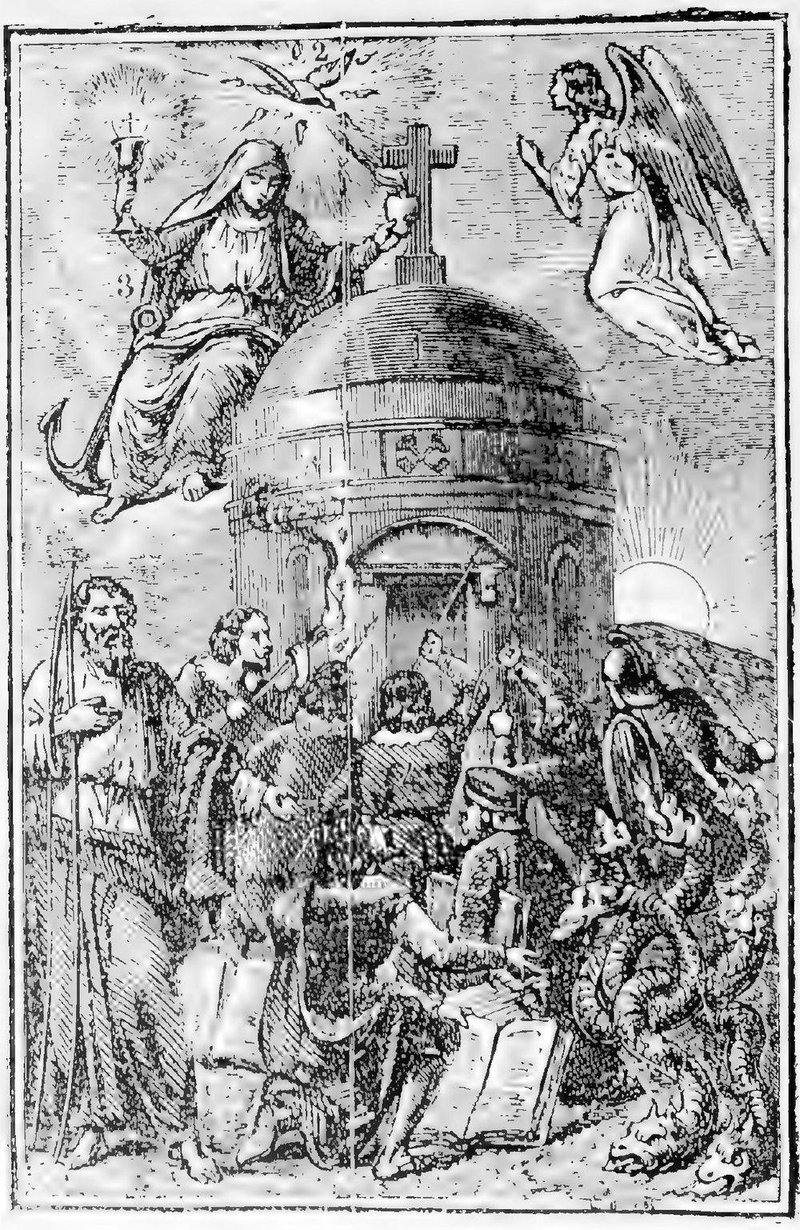
Plate XV. The holy Catholic Church. The apostle St. Philip. 1. The figure of the Church. 2. The Holy Ghost, who rules and governs the Church. 3. The true Religion. 4. Persecutors of the Church.
Do you see, my son, that beautiful building, no. 1? It is a figure of the Church. But since that building and this word Church might cause you some confusion, given your childish ideas, I am going to explain both to you, so that you may know what you confess when you say the Creed. In speaking of the Church, I do not show you this plate so that by that building you will understand that when we say “I believe the holy Church” we are speaking of the material church, the place where we the faithful gather to pay God the tribute of love, honor and homage we owe him, which is called Religion. No: in that sense the church is the same as the temple, the house of God or house of prayer. By those words we confess that we believe in the Church of Jesus Christ in the proper sense. That is a society or congregation of the faithful, united by the profession of the same faith, by sharing in the same Sacraments, and by submission to their lawful Prelates, chiefly to the Roman Pontiff, its visible Head. They acknowledge him as Vicar of Jesus Christ, who is its invisible Head. And so this Church which we believe is a moral body: the kingdom of Jesus Christ, so to speak, which has the Pope as its visible Head and as its
invisible Head Jesus Christ himself. From him it not only takes the name of Christian, but also receives life through Baptism, and its preservation and perfection through the other Sacraments. The lawful Prelates with the Pope are those charged by Jesus Christ himself to make his will known to us and to keep this society in order, which they do by laws. They are also charged to watch over the deposit of faith, which is the truths he came to teach us. You see, then, that I show you that building only to make the Church in some way visible to you.
To be a member of this congregation, a true child of this Church of Jesus Christ, and so a true Catholic, three things are indispensable. First, to be baptized. Second, to profess the same faith that this Church professes, which is the Catholic faith. Third, to obey the lawful Prelates, especially the Supreme Pontiff of Rome.
In the first place you must be baptized, because Baptism begets us in Jesus Christ. For this reason it is, and is called, the door of the Church and of the other Sacraments. Pagans and Jews, therefore, since they are not baptized, are not children of Jesus Christ, nor members of the Church, nor Catholics. Those who do not profess the same faith as the Church are called, and are, heretics. And those who do not obey the lawful Prelates, especially the Supreme Pontiff, are called, and are, schismatics. Even though they are baptized, they have separated themselves from the Catholic Church by their errors or disobedience. Heretics and schismatics are like a limb cut off from the body, or a branch cut off from the tree. And what an unhappy lot awaits them! An arm cut off from the body is good for nothing but to be buried, and a branch cut and separated from the tree bears no fruit and is good only for the fire. So heretics and schismatics, as limbs cut off from the body of the Catholic Church and branches cut from this tree of life, are no longer able to bear wholesome fruit. They are fit only to be buried in the grave of hell and burned in the flames of that devouring fire.
Do you notice above the building, which I told you is a figure of the Church, the divine Spirit in the form of a dove, no. 2? This signifies that the Catholic Church is ruled and governed by the Holy Ghost, according to the promise of Jesus Christ: The spirit of truth… shall abide with you, and shall be in you (John 14:17), and he will remain until the end of the world. And those flames or tongues of fire around him are the seven gifts he pours out on the Church and on the faithful.
That figure, no. 3, which holds a chalice in one hand and a flaming heart in the other and has an anchor at her feet, represents the true religion, queen of the moral virtues. The three things the figure holds signify the three theological virtues, by which the faithful go directly to God. The chalice signifies faith; the anchor, hope; and the flaming heart, charity toward God and neighbor. In these a true Catholic must exercise himself.
Do you notice that crowd in front of the building which, as I told you, represents the Church, no. 4? It signifies the schismatics, heretics, the ungodly, pagans, and all the persecutors the true Church has had and will have. Notice that they carry instruments to destroy her and do away with her and her children. The torch this one carries is not for giving light but for setting fire. The lances, swords and arrows of the others are for killing and wiping out the Christian name. Besides weapons they use heretical, ungodly, subversive and immoral writings, and that is what those books signify. Do you notice lower down that evil beast St. John tells us of in the Apocalypse (Apoc. 13:1)? It signifies the seven capital vices, the necessary consequence of bad doctrines and perverse maxims. It also signifies the seven chief tyrants who persecuted Christianity, and also the seven battles the devil wages against souls walking the road of perfection. But, thanks be to God, it has been conquered. For it is written that the gates of hell (which are sins, since through them many enter that place of torments) shall not prevail against the Catholic Church (Matt. 16:18). Even if all her enemies conspire against her like the most dreadful storm, the splendor of her divinity will always appear. That is just what the sun peeping out at one side of the plate signifies.
This sun also shows what the Catholic Church does with the religion she professes. As the sun lights, warms and makes the earth fruitful, so she enlightens minds and inflames hearts with the love of God and neighbor, making them fruitful in virtues. Ah! What would become of the universe without the sun? What darkness! What cold! What calamities and miseries! And what would become of the world without the sun of the Religion the Catholic Church professes and teaches? What darkness of mind! What errors! What cold in hearts deprived of the fire of charity and the other virtues! What vices, in the end, what sins, and what damnation of souls! That is why the devil, the enemy of our souls, envious of our temporal and eternal happiness, takes great care to send us his blind followers to darken, since he cannot take away, the beautiful and most fruitful sun of the Catholic Church. Vain efforts! For the material sun, when it hides in the evening and leaves us in the dark, does so to light other countries, and rises the next morning more beautiful than ever. So too the sun of the Church, when because of the persecutions of tyrants and vicious men it goes out in one place, shines and triumphs in others. Then it appears again in the same country with greater splendor than before, once the virtues have been purified of the dregs of earthly affections; and its persecutors are left confounded and ashamed, with rage and spite in their hearts.
It is very much to the point, my son, that you should know that persecuting the good is characteristic of the wicked who are given over to vice. They say: Let us lie in wait for the just, because he is… contrary to our doings (Wis. 2:12). Jesus Christ suffered persecutions, and these were the inheritance he left his disciples, saying to them: If they have persecuted me, they will also persecute you. If you had been of the world, the world would love its own: but because you are not of the world… therefore the world hateth you (John 15:20, 19). It must be a great consolation for a Christian who sees himself marked with this sign of persecution to think that in it he has a proof that he belongs to God and not to the world.
In this very thing the divinity of the Catholic Church shines out. While she shows such moderation toward all the sects of Protestants, schismatics, Jews, Mohammedans and idolaters, they show a furious rage against Catholics. They stir up so many persecutions against them and direct at them every kind of satire, mockery, insult and sarcasm, proving thereby the hatred they bear them. The reason is plain. The sects were born of error and passion, and as children of the same parents they get on together very easily. But the Catholic Church is the daughter of eternal Truth, taught by God himself and built by Jesus Christ himself, as he promised St. Peter when he said to him: Thou art Peter [rock], and upon this rock I will build my church, and the gates of hell shall not prevail against it (Matt. 16:18). That is why the children of such perverse parents cannot bear to see this daughter of heaven or leave her in peace. Let them persecute her, then, and welcome; we shall not give up, but rather be more confirmed in her, since persecutions are a proof of her divinity.
The Catholic Church is the mother of all Christians, since she has begotten them anew in Baptism. She is the ark of salvation, outside of which no one can be saved, and the only door by which one can enter heaven. Therefore it was necessary that God should form her in such a way that the whole world could know her, and no one could confuse her with the synagogue of Satan (Apoc. 2:9), mother of all the reprobate and damned. To this end he first built her on the great mountain of the holiness, virtues and merits of our Lord Jesus Christ. And seeing that her enemies also claimed to come from him and to take his name, he marked her with four signs so clear that only one willfully blind can mistake her. He did this so that not even the roughest and most ignorant person could fail to recognize her or confuse her with the church of would-be and false Christians. These signs are that she is ONE, HOLY, CATHOLIC and APOSTOLIC. I am going to explain them to you, though briefly.
In the first place he made her ONE. Since there is only one God, and he has given us only one faith, as St. Paul says, and one baptism (Eph. 4:5), which is the door of the Church and of the other Sacraments, there cannot be more than one true Religion either, in which men can please God and fulfil his most holy will. Jesus Christ, who compares his Church to a flock (John 10:16), did not form several apostolates and several gatherings of the faithful, but ONE gathering and one single apostolate. He did not give it many heads but only ONE: himself as invisible Head, and St. Peter and his successors, the Popes, as visible Head. He commanded them to go and gather all the nations into his flock, teaching them all the same law and doctrine. It is otherwise with the synagogues of Satan, the sects of heretics. Some teach one thing and others another, and what they teach today they reject tomorrow, never agreeing among themselves, so that the proverb is fulfilled: “every sparrow with its own ear of corn.” And since truth can only be ONE, the true Church can only be the one that, coming from Jesus Christ, has always taught the same faith, the same law and doctrine; that has always administered the same Sacraments; that has always had one single head or chief, one single government, one single worship; and that has always been truly ONE. One has only to open one’s eyes to see that this is the Catholic Church, in whose fold we have the happiness of living.
The second character God gave his Church was to make her HOLY. A God who is holiness itself, and who was announced as coming as the Saint of saints (Dan. 9:24), could not make her otherwise. That is why her doctrine is HOLY, the Sacraments she administers are HOLY, the worship she gives God is HOLY, she is HOLY in all her practices, and HOLY in many of her members or children. Notice well, my son: Jesus Christ came to form for himself a society of Saints in heaven, and these were to be not few but many, for it is written: Vidi turbam magnam, quam dinumerare nemo poterat [I saw a great multitude, which no man could number] (Apoc. 7:9). For this reason there must always be Saints in the true Church. And in fact in the Catholic Church there have been, there are and there always will be Saints. Eleven years ago five were canonized. But the sects of heretics cannot count even one; if not, let them name them; nor will they ever have any. Do you know how they get rid of this argument? They mock the Saints and even the most holy Virgin Mary. But they will be the ones mocked when they are brought before the judgment seat of God. When they see that Catholics are saved because they kept the laws and doctrine our HOLY Church teaches, and that they themselves are condemned even though they kept those of theirs, they will cry out, but now to no purpose: We fools esteemed their life (that of true Catholics) madness, and their end without honour. Behold how they are numbered among the children of God, and their lot is among the saints. Therefore we have erred from the way of truth (Wis. 5:4–6).
The third character or sign of the true Church is to be CATHOLIC, which means universal; for the Prophets had already announced that she would spread through all lands. She is CATHOLIC as to time. Having begun in the time of Jesus Christ and with Jesus Christ, she will last until the end of the world, as he himself promised, and in heaven for all eternity. For this reason no sect of heretics can boast of being the true Church, because none of them began with Jesus Christ, but much later. Of each of them one can always point to the time it began, which was when the heresiarch who gave it its name lived. Nor will any of them last until the end of the world: either they die soon after they are born, or they change so much that at most they keep only their original name. She is CATHOLIC also as to place, in her extension and spread throughout the world. She embraces in her bosom every kind of people, without distinction of nation, class, age or sex. And in all times, in all nations and among all kinds of people where she is found, she has, has had and will always have the same faith, the same doctrine or morals, the same kind of government under the Roman Pontiff. Her members, wherever they are, will always be united by the same beliefs, the same hope and charity, being alive by grace and as to communion, which I will explain to you when I speak of the communion of Saints. Hence she embraces all who are to be saved. But being another ark of Noah, outside of which the whole world was drowned in the flood, all those too who will not enter this mystical ark, the Church of Jesus Christ, will be drowned or damned. “He cannot have God for his father,” says St. Cyprian, “who has not the Church for his mother.”1
You see, my son, that this character or sign is so peculiar to our holy Church that it can in no way belong to any other. This proves plainly that all those that are not ours are false. And this sign proves it so well that some modern heretics have tried to give themselves the name of Catholics and to call their churches, or rather synagogues of Satan, Catholic. By this name “Catholics” they mean being members of the universal Church made up of all who believe in Jesus Christ. But you see, my son, that this is only abusing the word “Catholic” to lead the unwary astray. For how can that collection of sects be called a Church, which have no union among themselves; where one believes what another denies; where one calls the other heretical and they anathematize each other? No: what makes Catholicism, the catholicity of the Church, is not simply the confession of Jesus Christ throughout the world. It is especially the unity of faith: having the same faith, doctrine and tradition, one soul, one heart, one mouth, one and the same preaching and form of church government, as St. Irenaeus affirms.2 So even if the heretics were more numerous and spread their errors throughout the world, they would not on that account be Catholics, nor would their synagogue be the true Church of Jesus Christ. Besides everything else, they would always lack unity in faith, doctrine and so on. And even if there were only one faithful believer in each nation, he would be Catholic, so long as he kept that unity described by St. Irenaeus.
The fourth mark or sign is to be APOSTOLIC. That is, she was founded by the Apostles and is governed by their successors, the bishops. These have succeeded one another from the Apostles without interruption and publicly, with a lawful mission, always keeping in their public teaching and government of the Church the unity of faith and of communion with her head and center, the Roman Pontiff. Listen, my son, to what Jesus Christ said to the Apostles when he charged them with the founding and government of his Church until the end of the world: Going therefore, teach ye all nations; baptizing them in the name of the Father, and of the Son, and of the Holy Ghost. Teaching them to observe all things whatsoever I have commanded you: and behold I am with you all days, even to the consummation of the world (Matt. 28:19–20). And we all know that the Apostles fulfilled the mission Jesus Christ gave them. One has only to read the list of the Catholic bishops, especially of the Supreme Pontiffs of Rome, head or chief of Christianity, or rather of Catholicism. There one sees that Pius IX, who by the mercy of God happily governs us, succeeded Gregory XVI, he Pius VIII, and so, going back from one to another, we shall come to St. Peter, whom Jesus Christ made Prince of the Apostles and his Vicar on earth. I added “with a lawful mission”, that is, one coming from him who holds the keys of the kingdom of heaven, or of the Church, who is the Pope. So intruded bishops, or those who separate themselves from obedience to the Pontiff of Rome, are not successors of the Apostles but thieves, as Jesus Christ calls them (John 10:1), and we must flee from them as sheep flee from wolves. So if any heretics come to you, my son, saying that their churches are apostolic too, you have only to say to them with Tertullian: “Show the origin of your churches. Let us see that the order of your bishops has so descended by succession from the beginning that the first was one of the Apostles, or had as his predecessor one of the apostolic men who persevered in union with the Apostles.”3 Since the sects of heretics can never show this, none of them can rightly boast of being APOSTOLIC. On the contrary, the Catholic Church is the only one that can prove it, and so she alone is in all truth APOSTOLIC.
Here, then, my son, you have explained the four characters or signs which, as I told you, God has left us for knowing the true Church and not confusing her with the multitude of synagogues of Satan that also claim to be the Church of God. Since they belong to none of these but only to ours, as you have seen, it follows that ours is the only true one. In her and with her we must live and die united, if we are to go to heaven.
And since the Chief or head of this Church, St. Peter, fixed his apostolic chair in Rome, she is also called ROMAN, that is, governed by the Pontiff of Rome, successor
to the authority of St. Peter, and so, like him, Vicar of Jesus Christ and Father of all Catholic Christians.
Some heretics did not know how to answer the Catholics who asked them where their church was before their heresiarch came into the world. So they pretended that the Church of Jesus Christ could be invisible. That is as much as to say that the sun can be hidden at noon on a clear day with no eclipse. You must know, then, my son, that the true Church is necessarily visible. Her faithful and members are visible; the Sacraments she administers to them are visible; the conduct shaped by the wise and holy laws she gives is visible; the Pastors or Bishops who govern her under obedience to the Sovereign Pontiff are visible; and the Supreme Pontiff who governs her in all her universality and with full power is visible too. Besides, she must be visible because Jesus Christ commanded that doubts and complaints be brought to the Church and her decisions respected (Matt. 18:17). This could not be done if she were not visible. This visibility is well shown in the city seated on a mountain of which the holy Gospel speaks (Matt. 5:14). The heretics’ evasions are therefore vain, and so you can have no doubt that the one true Church is our CATHOLIC, APOSTOLIC, ROMAN Church. In her you must persevere, united in heart and outwardly, and you must keep her holy laws with all exactness if you wish to be saved. Otherwise you would be lost for ever.