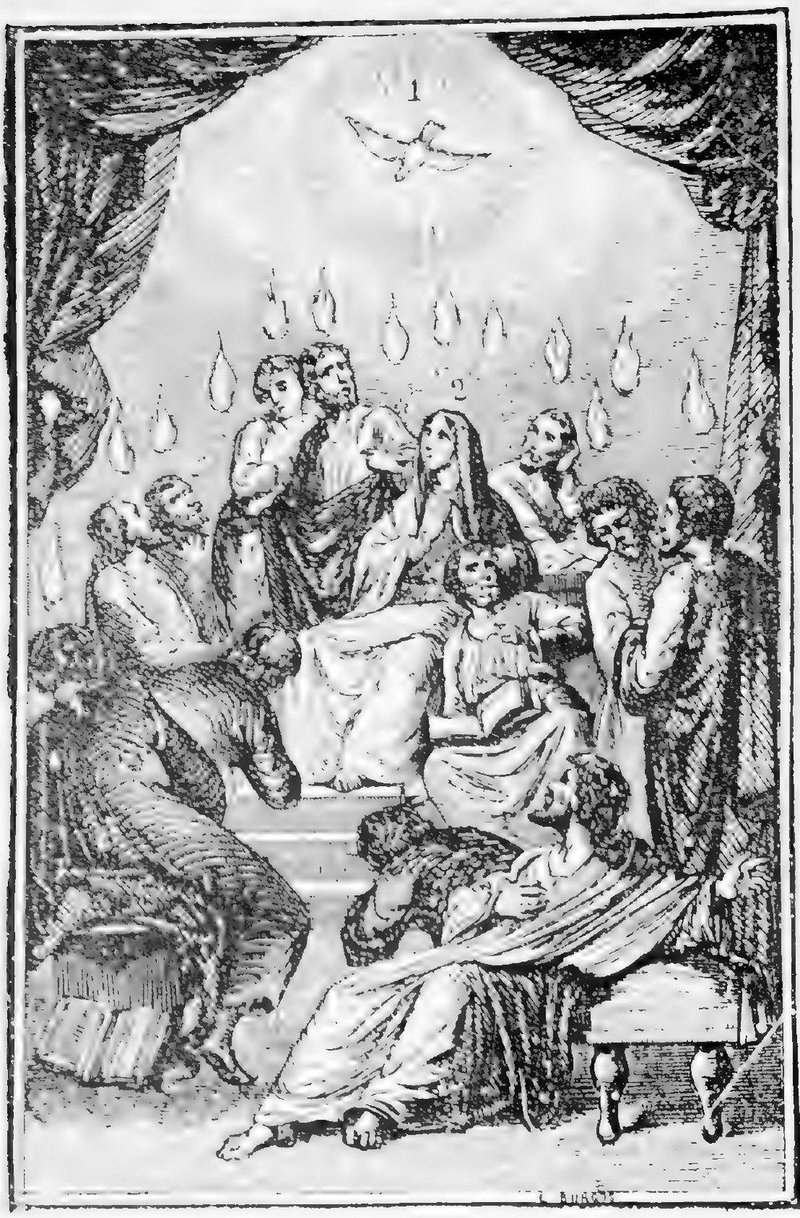
Plate XIV. I believe in the Holy Ghost. 1. The Holy Ghost. 2. The most holy Virgin.
My son, in this plate you will see the Holy Ghost (no. 1) represented in the form of a dove and of tongues of fire. That Lady you see at no. 2, and the other men, are the most holy Virgin and the Apostles, upon whom the divine Spirit came visibly (Acts 2:1–4).
The Holy Ghost is the third Person of the Most Holy Trinity. He proceeds from the Father and the Son and has the same attributes as they, because he has the same divinity. For this reason we say and believe that the Holy Ghost is God.
This, then, is the proper name of the third Person of the Most Holy Trinity. As the first is called Father and the second Son, the third is called Holy Ghost. He who knows it well, Jesus Christ, teaches us so in the holy Gospel, when he commanded his disciples to go through the world and preach the holy Gospel to all nations, baptizing them in the name of the Father, and of the Son, and of the Holy Ghost (Matt. 28:19). St. John says the same: There are three who give testimony in heaven, the Father, the Word (or Son), and the Holy Ghost (1 John 5:7).
Perhaps you will ask me: why is the third Person of the Most Holy Trinity called Holy Ghost, or Holy Spirit? The Father is spirit, the Son is spirit, the Angels are spirits and our souls are spiritual. And the Father is holy, the Son is holy, the good Angels are holy, and so are all the men and women who are in heaven. What difference is there, then, between the third Person of the Most Holy Trinity and these holy spirits? I will tell you, my son: not so that you understand it perfectly, but so that you do not confuse the third Person with these other things. It is true that all of them are spirits, but precisely because they are spiritual. The third Person, however, is called Spirit because, besides being spiritual like the Father and the Son, and more perfectly still than the Angels and souls, he is the term of the love of the Father and the Son. This love is a kind of breathing forth of the will, an impulse toward the thing loved; and from this breathing (spiratio) he takes the name of Holy Spirit, which is as much as to say “breathed forth holily”. It is true too that all the things named are holy: the Father and the Son by nature, and the Angels and men by participation. But the third Person is called holy in a special way that does not belong to the others, namely because he is breathed forth holily. So by this word Holy added to the word Spirit we designate the supreme purity of the love from which the third Person proceeds; and he is distinguished from intellectual creatures, from the Angels and souls. Therefore, since the third Person proceeds from this active breathing of the Father and the Son, the name Holy Spirit is not a name common to all the holy things called spirits. It is the proper and personal name of the third Person of the Most Holy Trinity, as it is proper to the first to be called Father and to the second to be called Son. What you do not understand, believe.
This Person of the Most Holy Trinity is also called Holy Spirit by excellence: I mean, because he is the supreme spirit and supremely holy, and the author of all created spirits and of all holiness. To help you understand it better, I will explain it with a comparison. Only to the Supreme Pontiff do we give the name of Holy Father. Yet others, such as cardinals, bishops and priests, are spiritual fathers, and by reason of their exemplary conduct or of their office are holy. So when we call the first the Holy Father, we do not do it to deny that others are fathers and holy too. We do it because that name belongs to him by excellence: both because he is the head of all the other fathers, and because he ought to be holier than all by his more regulated conduct, as he is by office, so as to represent to us worthily the person of Christ, whose place he holds on earth.
Likewise this divine spirit is called Holy because he sanctifies us, giving us his grace and dwelling in our hearts. As omnipotence is attributed to the Father and wisdom to the Son, so to the Holy Ghost is attributed the sanctification of men, to whom he communicates holiness, because he is a spirit of love and charity. What wonderful things I could tell you if I tried to explain what the Holy Ghost has done in this respect, chiefly in the Catholic Church! Who made of some rough fishermen such wise and great Apostles, and of cowards such zealous preachers of the Gospel? The Holy Ghost. Who filled the hearts of the Martyrs with such incredible courage? The Holy Ghost. Who enlightened the holy Doctors and Pontiffs of the Church? Who formed the most fragrant lily of so many millions of Virgins, and sanctified all the Saints? The Holy Ghost. With the fire of his charity he consumed all that was impure and defective in them. With his gifts and virtues, and with their cooperation, he prepared them to be happy in heaven eternally. And who gives life to, sustains and sanctifies the holy Catholic Church, the spouse of Jesus Christ, and adorns her to be presented worthy of her heavenly Bridegroom, if not the Holy Ghost?
Know, my son, that although in the plate the Holy Ghost is represented in the form of a dove, and is almost always so represented elsewhere, it is not because he has this shape. Spirits have none; shape belongs only to bodies. It is because they sometimes take one, to adapt themselves to our way of knowing things, which is through the senses. As the philosophers say: all our knowledge depends on, or takes its origin from, the senses. The divine Spirit is painted in the form of a dove for two reasons. First, because he appeared so over the river Jordan above Jesus Christ when he was baptized, and also on the shoulder of St. Gregory and on the head of St. Catherine of Siena. Second, to make us understand, by the properties of the dove, the effects he produces in us. The dove is simple, gentle, pure, jealous and fruitful. Exactly these are the effects the Holy Ghost causes in souls. He makes them simple, gentle and pure; zealous for the greater glory of God in their own sanctification and in the good of their neighbor. He makes them fruitful in virtues and in words, to bring others to birth in the life of grace, or convert them from their faults and sins, and make them grow in the practice of the virtues.
If you notice, in the plate the divine Spirit is above the Apostles in the form of tongues of fire. This figure of tongues shows the effect he caused in the Apostles, giving them an altogether divine eloquence, which their enemies could not resist. And the fire signifies the ardor of charity he gave them, and the supernatural light by which he made them know all the mysteries of Jesus Christ and of his Church; and that is why they tell us such sublime things.
You must also know that those who live holily, or are in the grace of God, says the apostle St. Paul, are the temple of God, and the Holy Ghost dwells in their hearts (1 Cor. 3:16). For this reason, generally speaking, by any mortal sin that is committed the temple of the divine Spirit is profaned. But if the sin is one of impurity, it is profaned in a special way (1 Cor. 6:18–19), so that the divine Spirit is as it were forced to leave and give place to the devil, the infernal and unclean spirit. So, my son, never sin. Hate impurity above all and flee from it as from the sight of the serpent. Be devout to the most holy Virgin Mary, who is the Spouse of the Holy Ghost, so that through her mediation this divine Spirit may grant you his gifts and produce in you his wonderful fruits.
Q. What is the eighth article of the Creed?
A. I believe in the Holy Ghost.
Q. What does “I believe in the Holy Ghost” mean?
A. That the Holy Ghost is the third person of the Most Holy Trinity, in whom I believe.