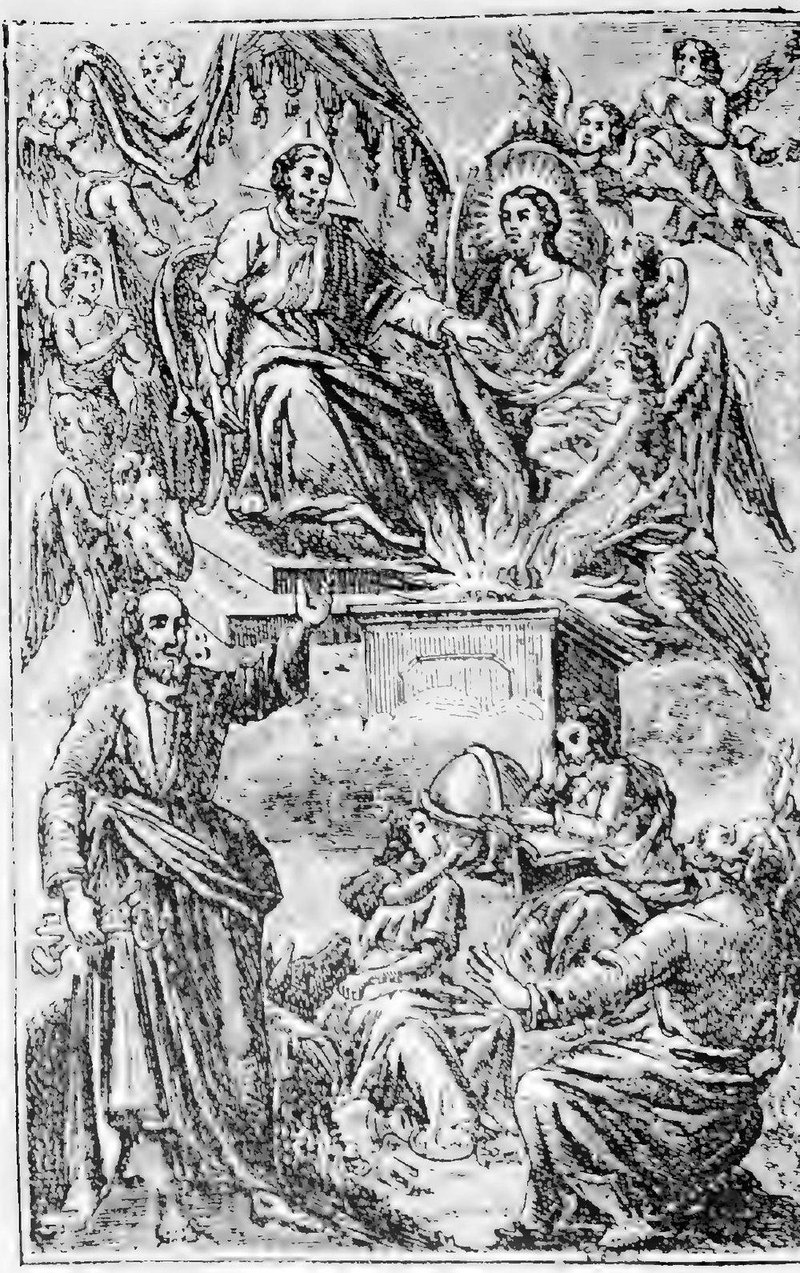
Plate IV. I believe in God the Father. 1. The eternal Father. 2. The prophet Isaias. 3. The apostle St. Peter. 4. A philosopher. 5. An ungodly man. 6. The Son of God.
Look, son. Do you see in this other plate the one seated on that throne of majesty (no. 1)? It is the image of God. That there is a God is taught us by faith and by natural reason, as the other figures below represent. Do you see the one kneeling (no. 2)? It is the prophet Isaias. Our Lord let himself be seen by him on a very lofty throne, and he heard the Seraphim singing that hymn of praise: Holy, holy, holy, the Lord God of hosts (Isa. 6:3). And he is exclaiming: Thou, O Lord, art our father (Isa. 63:16). The next (no. 3) is St. Peter, prince of the Apostles, on whom Jesus Christ promised to found and build his Church as soon as Peter acknowledged him and said: Thou art Christ, the Son of the living God (Matt. 16:16). That man (no. 4), who has a globe or sphere and his hand on a book, represents a wise and judicious philosopher. By contemplating created things he comes to know the Creator, because he knows there can be no effect without a cause. Observing all natural things, their order and motion, he infers that there must necessarily exist a Creator and intelligent first mover.
And you yourself will know it, even if you have not studied philosophy, for natural reason alone is enough. Tell me: if, on seeing a great palace, magnificently decorated and furnished, someone claimed that it was all the work of chance, that everything had made itself, without any architect or craftsman building the edifice and working and arranging the ornaments, would you not take the man who said so for a raving madman? Now apply it. The world is this immense and magnificent palace, which the sun lights by day and the moon by night. The sky is peopled with stars; the earth with men, animals and plants; the sea and rivers with fish; and the air with birds. Spring, summer, autumn and winter follow one another in admirable order. In the bowels of the earth there are gold, silver, precious stones and countless metals. And a world of such wealth and beauty, did no one create it? Yes: God created it. All things say with a mute but powerful voice: He made us, and not we ourselves (Ps. 99:3). The heavens shew forth the glory of God, and the firmament declareth the work of his hands (Ps. 18:2).
Do you see that man (no. 5), with an unclean animal at his side and a plate and cups in front of him? He is one of those of whom St. Paul says that they are enemies of the cross of Christ: whose God is their belly (Phil. 3:18–19). They try only to please it with tasty morsels and choice drinks, with rich clothes and with shameful things in which they wallow like pigs in the mire, as St. Peter says (2 Pet. 2:22). Each of these hath said in his heart: There is no God (Ps. 13:1). He does not say it because he believes it, but because his heart, perverted and stained with vices, faults and sins, would like there to be none. But like it or not, his understanding knows the existence of that God who must punish him as his crimes deserve; and his conscience, which nothing can silence, cries this very thing to him: “You are not on the right road; you are going astray; you deserve punishment.”
We, then, must believe that there is a God; that he has all perfections; that he is in all things; that he knows everything, sees everything, hears everything. Ah! If we would not dare to commit a slight fault in front of our father, our master or some other person, still less must we dare to commit it, or to speak evil, before God, who is everywhere. We can hide from men; but from God, what vain effort!
This God is Father. Within the Most Holy Trinity the first person is called Father because he begot and begets in his divine understanding his only-begotten Son, and so he is Father by nature. The plate shows this: in front of the image of the Father there is a mirror (no. 6), in which is his substantial image, which is the Son. Knowing himself from eternity, and seeing himself in his divine understanding as in a mirror, and being fruitful, he produces the Son, like himself, equal to himself and consubstantial with himself.
These mysteries are so far above human understanding that if God had not deigned to reveal to us the generation of his Son, we should not even know that it exists. More than that: we could not even speak of it if he himself did not open our mouths and purify them. This is what that Seraph signifies who with tongs takes a live coal from the altar before the Lord. This very thing appeared to the prophet Isaias in a vision, and his lips were purified with a live coal so that he might speak worthily of God (Isa. 6:6–7).
With regard to us and to all other created things, the three divine Persons bear the name of Father, because all three created all that exists, and created it for us. They are like a natural father who plants an estate for his son’s benefit and hands it over to him. They are Father also because of the fatherly love God has for us and has shown by granting us his grace, by which he makes us his friends, adopted children and heirs of heaven. That is why he wants us to say to him with full voice: “Our Father, who art in heaven.” Who, then, could be so ungrateful as not to love so good a Father? Let us love him, then, with all our heart, with all our soul, with all our mind and with all our strength. Let us never offend him: rather die than sin and offend God. So, my son, even if you see others offend him, do not do it yourself. If you saw others stabbing your father, you would certainly not imitate them; rather you would weep. Think, then, that when men sin they offend God and crucify again Jesus Christ (Heb. 6:6). So instead of imitating them you must weep to see them ill-treat God, your dear Father. If you saw others throw themselves into a well or into the fire, would you follow them? Think, then, that those who sin throw themselves into the pit and the fire of hell.
Q. What is the first article of the Creed?
A. I believe in God the Father almighty, creator of heaven and earth.
Q. What does “I believe in God” mean?
A. That I believe and am certain that there is a God, and that there is only one true God.
Q. Why do you believe it?
A. Because God himself has revealed it; and besides, heaven and earth bear witness that there exists a God, creator and preserver of all things.
Q. What does “Father” mean?
A. That God is Father by nature of his only Son; he is also Father by grace of all good Christians; and finally he is Father by creation of all things.