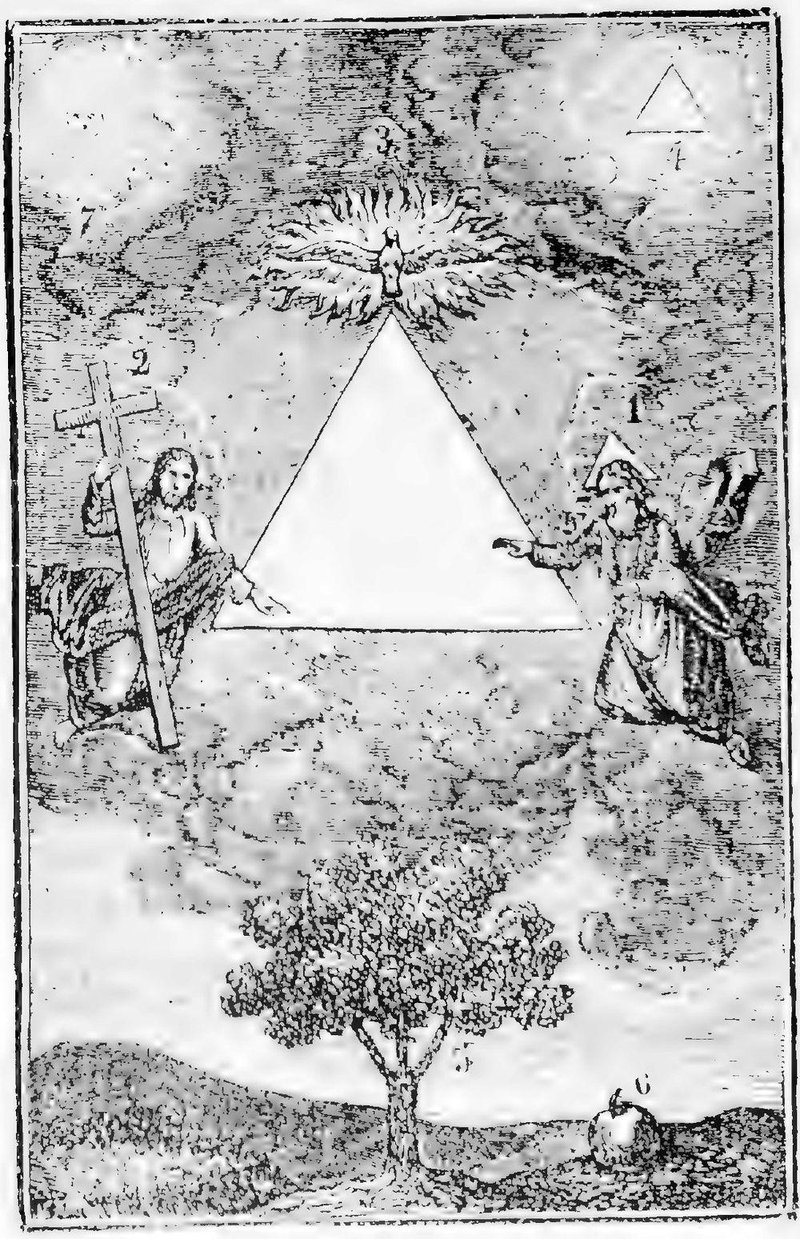
Plate V. The Most Holy Trinity. 1. The eternal Father. 2. The eternal Son. 3. The Holy Ghost. 4. The triangle. 5. A tree. 6. An apple. 7. The sun.
Do you see, my son, that beautiful plate? It represents to you, though very imperfectly, the mystery of the Most Holy Trinity. It consists in believing one only God in three really distinct persons, Father, Son and Holy Ghost. No created tongue can speak worthily of this mystery, and no understanding, however penetrating, can comprehend it. We should not even have an idea of it if God himself had not deigned to reveal it to us. Faith teaches us what this mystery consists in; but to want to comprehend it would be as rash as it is useless. Since God is by nature incomprehensible, would it not be rashness and lost time to try to understand how there is one God in three persons? It is told of St. Augustine that one day he was walking on the seashore, meditating on this mystery, about which he was writing some treatises. He saw a very beautiful child (doubtless an Angel in that form) busily carrying sea water in a little shell to a small hole he had dug there. “What are you doing, child?” the Saint asked him. “I want to put all the water of the sea into this little pit,” he answered. The Saint laughed at the simplicity and innocence of the little one and said to him: “What you are attempting is impossible, my son.” The boy replied: “It is easier for me to work this marvel than for you to understand the mystery of the Most Holy Trinity.” With that he disappeared, and the Saint was left amazed, and warned that all the mysteries, this one especially, must be believed with simple faith, even though we must try to know them well and meditate on them often, until the day comes when God deigns to show them all to us in heaven. Do not be, then, one of those who will believe only what they understand; for if we understood them, they would cease to be mysteries. Believe them with a most lively faith, as God teaches them to us through the Catholic Church our mother. It is according to her doctrine that I am going to explain this and the other mysteries to you.
If on the one hand reason teaches us that there cannot be many gods, faith assures us that there is only one. On the other hand faith adds that we are obliged to believe that in God there are three persons, Father, Son and Holy Ghost. The Father is not begotten and does not proceed from another. The Son is begotten, equal to the Father and of the same substance. The Holy Ghost proceeds from the Father and the Son. There are three, says St. John, who give testimony in heaven, the Father, the Word (so the Son is called), and the Holy Ghost. And these three are one (that is, one essence) (1 John 5:7).1 At the baptism of Jesus Christ the Son was baptized, the voice of the Father rang out in the air, and the person of the Holy Ghost came down in the form of a dove (Matt. 3:16–17). And Jesus Christ himself taught this mystery. He commanded his Apostles to teach it, and to baptize all the nations of the world in the name of the Father, and of the Son, and of the Holy Ghost (Matt. 28:19). In these words the unity of nature or essence is seen in the expression “in the name”, and the trinity of persons when the Father, the Son and the Holy Ghost are named.
This is the faith of the Catholic Church: to believe one God in Trinity and Trinity in Unity. One is the person of the Father, another that of the Son, another that of the Holy Ghost. One is the divinity of the Father, of the Son and of the Holy Ghost, equal the glory, coeternal the majesty. The Father is God, the Son is God, and the Holy Ghost is God; yet they are not three Gods but one only God, because there is only one divine nature in each person and in the three together.2 So that you may understand it better, I will give you some comparisons, as the Council of Nicaea wishes when it says: Per similitudines, quamvis infirmiores, accipe bona documenta [Through comparisons, even weaker ones, receive good lessons]. Look at the plate. Do you see, son, that tree (no. 5) which has three equal branches, and is only one tree because the three branches have one and the same trunk? So the three divine Persons are only one God, because the three have one and the same divine nature. Under the tree, too, you will see an apple (no. 6), which will also serve you as a comparison. The apple, while being one, has three things quite distinct from one another: smell, color and taste. The smell is not the taste, nor the taste the color, nor the color the smell; and yet it is one apple. See how the apple gives you some idea of the unity of the divine nature and of the trinity and distinction of persons.
You will also see in the plate a triangle (no. 4). This geometric figure has three angles. Each one by itself is a figure; but the three together are only one triangular figure.
We have only one soul, and this soul has understanding, memory and will. So the soul thinks, the soul remembers and the soul wills; and in spite of that it is only one soul.
You must also know that the Father is the principle of the Son, and Father and Son are the principle of the Holy Ghost; and yet one person is not before the other, and each is as eternal as the other. The Father, knowing himself, or beholding himself in his divine understanding, which is fruitful, begot from eternity his Son, equal to himself in essence and perfections. And from the mutual love of the Father and the Son, also from eternity, proceeds the Holy Ghost, likewise equal to both in substance and attributes. Since these processions have always been, it cannot be said that one divine person is before another: Father, Son and Holy Ghost are eternal. Look there in the plate at the sun (no. 7), which is a figure of this ineffable mystery. From the sun come the rays of light and the brightness. Although the sun is the principle of the ray, and both are the principle of the brightness, each is as old as the other. So, if the sun were eternal, the ray and the brightness would be eternal too, as St. Augustine says. Something like this holds true, in due proportion, in this mystery.
Among these divine Persons there is neither greater nor less, because they are equal in all the absolute perfections of Power, Wisdom, Holiness, Eternity, Lordship, Greatness and Majesty.
Now I am going to explain to you why these divine Persons are called Father, Son and Holy Ghost. The first is called Father because he begot the Son: being an infinite good, he could not be without communicating himself infinitely within himself, and so he communicates his own divine nature to the Son whom he begot. This second Person, who is born of the knowledge of the first, is called Son because he is begotten; and here on earth the one begotten is called son, and the one who begets, father. The third Person is called Holy Ghost because, as the Father and the Son love each other, he proceeds as spirit, breathed forth by the impulse of this love.
My son, try to believe this and the other mysteries that God teaches you and the Catholic Church proposes to you, and live well and holily. If you do, the things you now know only by faith and through a glass (1 Cor. 13:12) you will afterwards see in heaven as they are in themselves. Meanwhile exercise your faith. Make the Lord this offering of your understanding, believing all Catholic truths even though you do not understand or comprehend them. Give him your heart, loving him with all your affection and practicing all the virtues. Love and venerate most holy Mary, who is Daughter of God the Father, Mother of God the Son, and Spouse of God the Holy Ghost. Ask her for a most lively faith, a most firm hope and a most fervent charity, so that by practicing these theological virtues you may please God and be happy for all eternity.