Part One. The Doctrine of Faith
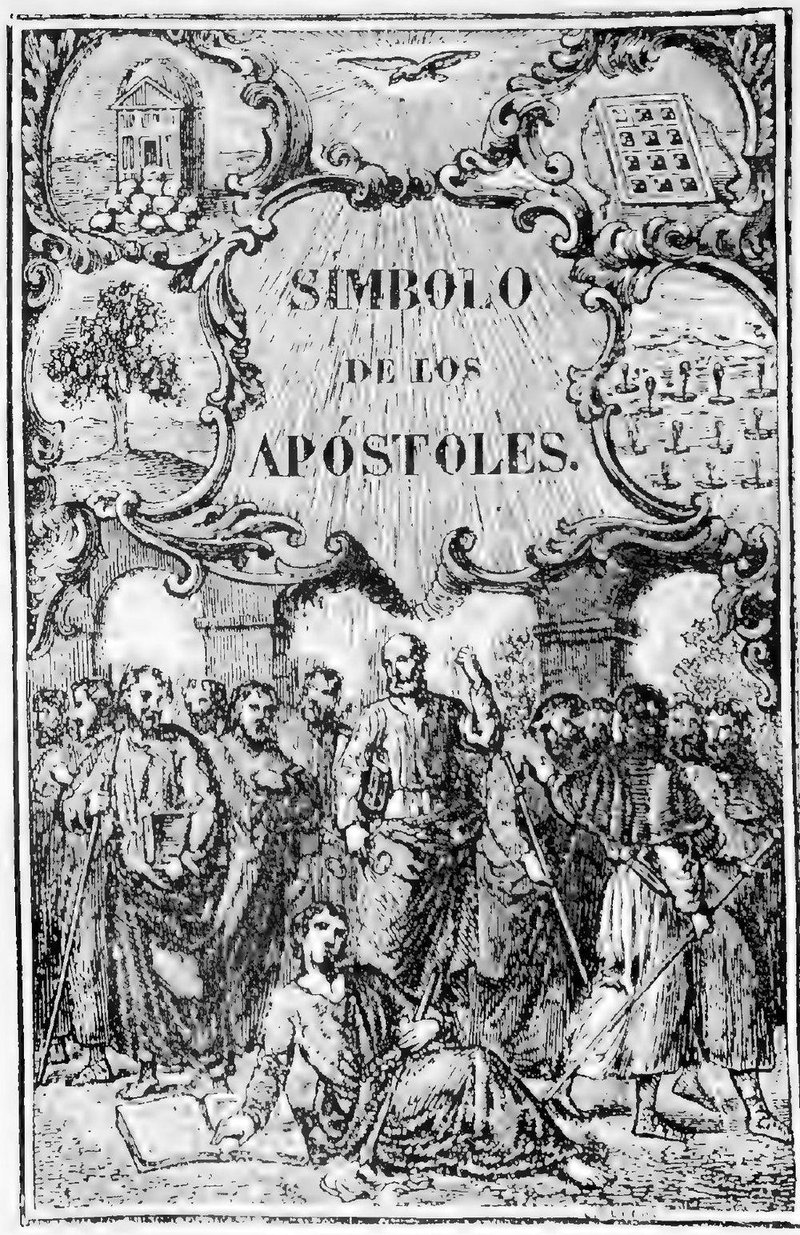
Plate III. The Creed of the Apostles. The twelve stones of the Jordan. The tree of twelve fruits. The rational of the old law. The twelve fountains. The twelve Apostles.
Do you see, my son, those twelve men ready to set out on a journey? They are the Apostles of our Lord Jesus Christ. Do you notice that in the middle of them there is one holding keys in his right hand? It is St. Peter, to whom our God and Redeemer gave full powers to establish and govern his Church throughout the world; those powers are represented by the keys [Matt. 16:19]. With the index finger of his left hand he points to the dove above, a figure of the Holy Ghost. This shows that, after receiving from the divine Spirit the gifts and graces they needed, they fulfilled what their divine master Jesus Christ had charged them with when he said: Go ye into the whole world, and preach the gospel to every creature (Mark 16:15), baptizing them in the name of the Father, and of the Son, and of the Holy Ghost (Matt. 28:19). He that believeth with a living faith, quickened by good works, shall be saved: but he that believeth not shall be condemned (Mark 16:16). But before going out to evangelize the whole world, they composed or arranged the Creed. It has twelve parts, and these twelve parts embrace the chief mysteries of our faith: the existence of God, his unity, and the trinity of persons in one essence. The first part teaches us what we must believe and confess about the Father; the following six, what we must believe about the Son; and the remaining five, about the Holy Ghost.
See how they all have the pilgrim’s staff in hand and are about to set out, each on his road. And that man lying there, who holds a lighted torch turned toward the ground in one hand and a big book in the other, signifies that the Apostles, by the heavenly doctrine they preached, curbed and fought the passions and vices, represented by the torch, and confounded the worldly wisdom of the pagan philosophers, represented by the book.
Before separating to go and evangelize the part of the world that had fallen to each in the distribution (St. Leo, Sermon 4 on the holy Apostles Peter and Paul), they thought it fitting to form the Creed, so that all might teach the same doctrine. They also wanted the faithful to have in it a sign or password to tell their beliefs apart from those of unbelievers and heretics. In an army, so as not to be surprised at night, the officers give the sentries a certain password, and those who do not give it exactly are taken for enemies. The Apostles, leaders of the Church militant, did the same. They gave this password, with the express order that those who did not conform to it should be reckoned not as friends or children of the Church of Jesus Christ, but as enemies, as the heathen and publican [Matt. 18:17], as all heretics in fact are.
Those other things you see in the plate are figures of the twelve Apostles. The highest on the left represents the twelve stones Joshua ordered taken out of the river Jordan when the people of God crossed it on dry ground to enter the promised land. For the Apostles by their heavenly doctrine have taught the true people of God to cross the rushing torrent of the passions of this world and enter heaven, the true promised land. They cross without wetting their feet, thanks to the spiritual footwear, which is the firm resolution to give ourselves wholly to God and to bear witness to the gospel of peace (Eph. 6:15), at least by our exemplary life.
The tree below it is the one St. John saw bearing twelve fruits [Apoc. 22:2]. Just as fruit serves people for food, so we must feed on these twelve fruits, which are the doctrine of the Apostles, if we want to live in grace in this world and afterwards eternally in heaven. The highest figure on the right represents an ornament of the vestment of the high priest of the old law, called the rational. On it the names of the twelve tribes of Israel, after their patriarchs, were written on twelve precious stones [Exod. 28:15–21], a figure of the twelve Apostles. The one below it represents the twelve fountains the children of Israel found at their second halt in the desert, at the place called Elim, where they rested beside the waters (Exod. 15:27). This is to show us that the Apostles are these twelve fountains, from which we who wish to reach heaven, the true promised land, must drink, and beside which we must rest.
Try, then, my son, to believe and practice what the holy Apostles taught us, and you will be saved. If not, you would be damned and would have to burn in hell for all eternity.
I must point out that the Creed, as the great Father St. Augustine says, is the rule and standard of our holy Catholic faith. It teaches us the divine mysteries and infallible truths we must know and believe. Nor is it enough to know them vaguely: we must understand them according to each person’s capacity. The more they are understood, the more the will is kindled to attain and enjoy those heavenly delights. It is different with one who knows them only vaguely: since he does not notice the glory they hold out and offer us, he does not value them as a good Christian should. For this reason Pope Gregory XI condemned those who wrongly asserted that the “faith of the charcoal-burner” was enough for salvation, that is, knowing and believing vaguely and in general what holy Mother Church commands, without trying to understand explicitly each and every one of the truths the Creed teaches us. So I am going to explain them to you, though briefly.
Q. What is Christian Doctrine?
A. It is the Doctrine Christ taught us.
Q. How many parts has it?
A. Four.
Q. What is taught in them?
A. What the Christian must believe, ask for, do and receive in order to be saved.
Q. To which virtues do these things chiefly belong?
A. To faith, hope and charity.
Q. Where are we taught what we must believe?
A. In the Creed and the Articles of faith.
Q. Where, what we must ask for?
A. In the Our Father and other prayers.
Q. Where, what we must do?
A. In the Commandments.
Q. Where, what we must receive?
A. In the Sacraments.
Q. Are we obliged to know and understand Christian Doctrine?
A. Yes, because we cannot fulfil it without knowing and understanding it.
Q. Who are obliged to teach Christian Doctrine?
A. Parents with regard to their children, and parish priests with regard to their parishioners.
Q. Who else?
A. Teachers with regard to their pupils, and masters with regard to their servants.
Q. Do such people sin if they do not teach the doctrine?
A. Yes; and those under them also sin if they do not apply themselves to learning it.
Q. What is faith in general?
A. Believing what is not seen.
Q. In how many ways is there faith?
A. In two: divine and human.
Q. What is human faith?
A. Believing what we do not see because men say it, who can be deceived and deceive us.
Q. What is divine faith?
A. It is a supernatural virtue, infused by God into the soul, by which we believe all that God has said and revealed, and that the Church proposes to us as a matter of faith.
Q. Can what is of divine faith fail?
A. No, because it rests on the infallible testimony of God.
Q. Say the Creed.
A. I believe in God, etc. (see the First Catechism above).1
Q. Who arranged the Creed?
A. The twelve Apostles.
Q. Why did they arrange it?
A. So that all might teach the same doctrine throughout the world.
Q. And we, why do we say the Creed?
A. To confess the faith and to be more confirmed in it.
Q. What are the articles of the Creed?
A. They are the chief mysteries of all that we must believe.
Q. How many are the articles of the Creed?
A. Twelve, just as the Apostles who arranged it were twelve.
Footnotes
-
[Claret’s note:] This answer, and the others whose content is in the text on the page cited, are to be recited in full in their proper place. ↩