Works › The Book on the Sacrifice of the Mass
Volume 38 · pp. 140–142
Tractate III, Chapter XVIII
A marker with ≈ is an approximate page boundary, placed by measure of the text; the page photographs remain the authority. In the paired views, clicking a page marker brings that page into view.
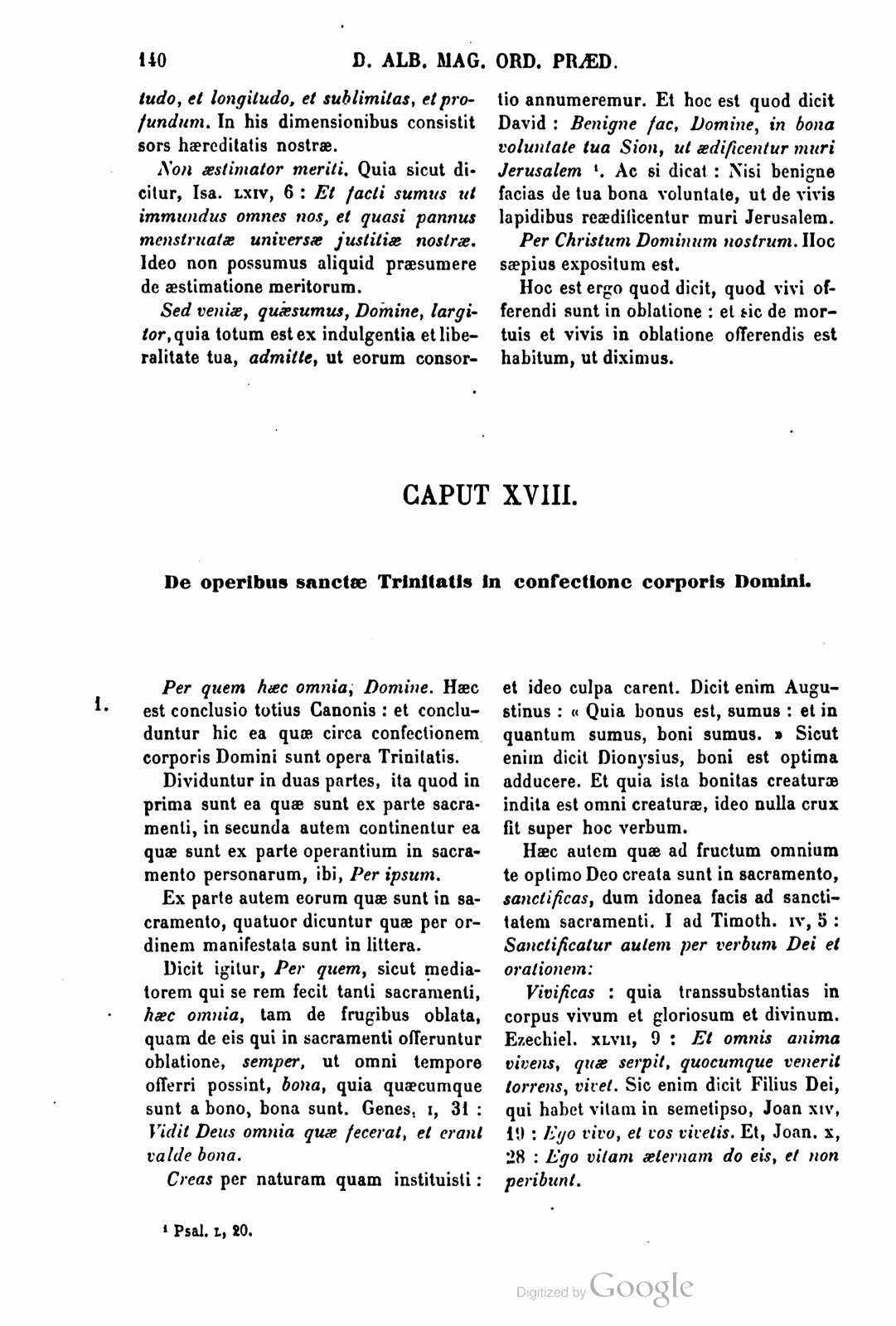
CAPUT XVIII.
De operibus sanctae Trinitatis in confectione corporis Domini.
1. Per quem haec omnia, Domine. Haec est conclusio totius Canonis: et concluduntur hic ea quae circa confectionem corporis Domini sunt opera Trinitatis.
Dividuntur in duas partes, ita quod in prima sunt ea quae sunt ex parte sacramenti, in secunda autem continentur ea quae sunt ex parte operantium in sacramento personarum, ibi, Per ipsum.
Ex parte autem eorum quae sunt in sacramento, quatuor dicuntur quae per ordinem manifestata sunt in littera.
Dicit igitur, Per quem, sicut mediatorem qui se rem fecit tanti sacramenti, haec omnia, tam de frugibus oblata, quam de eis qui in sacramenti offeruntur oblatione, semper, ut omni tempore offerri possint, bona, quia quaecumque sunt a bono, bona sunt. Genes. I, 31: Vidit Deus omnia quae fecerat, et erant valde bona.
Creas per naturam quam instituisti: et ideo culpa carent. Dicit enim Augustinus: "Quia bonus est, sumus: et in quantum sumus, boni sumus." Sicut enim dicit Dionysius, boni est optima adducere. Et quia ista bonitas creaturae indita est omni creaturae, ideo nulla crux fit super hoc verbum.
Haec autem quae ad fructum omnium te optimo Deo creata sunt in sacramento, sanctificas, dum idonea facis ad sanctitatem sacramenti. I ad Timoth. IV, 5: Sanctificatur autem per verbum Dei et orationem.
Vivificas: quia transsubstantias in corpus vivum et gloriosum et divinum. Ezechiel. XLVII, 9: Et omnis anima vivens, quae serpit, quocumque venerit torrens, vivet. Sic enim dicit Filius Dei, qui habet vitam in semetipso, Joan. XIV, 19: Ego vivo, et vos vivetis. Et, Joan. X, 28: Ego vitam aeternam do eis, et non peribunt.
Ergo quoad speciem sacramenti sanctificat: quoad rem autem contentam quae est sacramenti res, vivificat, quae est corpus Christi verum et vivum quod de Virgine traxit: quoad rem autem sacramenti benedicis: quia haec est res contenta et significata omnibus praestans gratiam. Psal. CXXVII, 8: Benedictio Domini super vos. Benediximus vobis in nomine Domini.
CHAPTER XVIII.
On the works of the Holy Trinity in the confection of the body of the Lord.
1. Through whom all these things, O Lord. This is the conclusion of the whole Canon, and here are concluded those things which, concerning the confection of the body of the Lord, are works of the Trinity.
They are divided into two parts, so that in the first are those things which are on the part of the sacrament, but in the second are contained those things which are on the part of the persons working in the sacrament, there: Through him.
But on the part of those things which are in the sacrament, four things are said, which have been manifested in order in the letter.
Therefore he says, Through whom, as through the mediator who made himself the reality of so great a sacrament, all these things, both those offered from fruits and those concerning those who are offered in the oblation of the sacrament, always, so that they may be offered at every time, good, because whatever things are from the good are good. Genesis 1:31: God saw all things which he had made, and they were very good.
Thou dost create through the nature which thou didst institute, and therefore they lack fault. For Augustine says: Because he is good, we are; and insofar as we are, we are good. For as Dionysius says, it belongs to the good to bring forth the best things. And because that goodness of the creature has been placed in every creature, therefore no cross is made over this word.
But these things, which have been created in the sacrament for the fruit of all by thee, the best God, thou dost sanctify, while thou makest them suitable for the holiness of the sacrament. 1 Timothy 4:5: But it is sanctified by the word of God and prayer.
Thou dost vivify, because thou dost transubstantiate them into the living and glorious and divine body. Ezekiel 47:9: And every living soul that creeps, wherever the torrent shall come, shall live. For thus the Son of God says, who has life in himself, John 14:19: I live, and you shall live. And John 10:28: I give them eternal life, and they shall not perish.
Therefore with respect to the species of the sacrament he sanctifies; but with respect to the contained reality which is the reality of the sacrament, he vivifies, and this is the true and living body of Christ which he drew from the Virgin. But with respect to the reality of the sacrament thou dost bless, because this is the contained and signified reality providing grace to all. Psalm 127:8: The blessing of the Lord upon you. We have blessed you in the name of the Lord.
Quoad liberalitatem autem dantis hoc sacrificium, dicit: Ac praestas nobis. Ipse enim paratus est dare omnibus omnia superabundantius quam petimus aut intelligimus: quia ipse ex liberalitate sua largitor est omnium bonorum.
Haec igitur sunt ex parte sacramenti.
In omnibus autem his praeter quam in primo, quod facit Deus pro se sine nobis, et praeter ultimum, quod iterum facit Deus propria bonitate, fit crux, ut virtus crucis intelligatur facere. Et quod haec virtus a primo perfectore sanctitatis intelligitur procedere in sacramentalibus. Psal. CXLIV, 16: Aperis tu manum tuam, et imples omne animal benedictione. Libera enim manu largitur suas benedictiones.
2. Per ipsum. Hic tangit Trinitatis in sacramento indivisas, et tamen appropriatas operationes. Primo autem tangit operationem quae est Filii quando dicit, per ipsum, quod notat causam mediam. Mediator enim unus est Dominus Jesus Christus. I ad Timoth. II, 5: Unus Deus, unus et mediator Dei et hominum, homo Christus Jesus, per quem haec omnia sicut per seipsum mediantem haec perfecta sunt.
Cum ipso. Hoc attribuitur Patri qui cum Filio semper operatur redemptionis opera, ut inter Patrem et Filium consensus notetur, sicut ipse dicit, Joan. V, 19: Quaecumque ille, scilicet Pater, fecerit, haec et Filius similiter facit. Unde dicit etiam, Joan. XIV, 10: Pater autem in me manens, ipse facit opera.
In ipso dicit propter Spiritum sanctum: quia in illius bonitate omnia perficiuntur opera. Et dicitur in ipso, propter continentiam. Unde, ad Roman. XI, 35: Quoniam ex ipso, et per ipsum, et in ipso sunt omnia: ipsi gloria in saecula. Amen.
Est tibi Deo Patri, in qua prolatione fit crux ante calicem, ut significetur quoniam in Patre est auctoritas totius divinitatis. Omnipotenti autem dicit, quia omnia haec ut in corpore mystico perficiantur, omnipotentiae est Dei Patris. Patri enim attribuitur omnipotentia: quia potentia perfecta non vult ab alio esse, sed a seipso.
But with respect to the liberality of the giver of this sacrifice, he says: And thou dost provide for us. For he himself is prepared to give all things to all more superabundantly than we ask or understand, because by his liberality he is the giver of all good things.
These, therefore, are on the part of the sacrament.
But in all these, except in the first, which God does for himself without us, and except the last, which again God does by his own goodness, a cross is made, so that the virtue of the cross may be understood to do it, and because this virtue is understood to proceed from the first perfecter of sanctity in sacramental things. Psalm 144:16: Thou openest thy hand and fillest every animal with blessing. For with free hand he bestows his blessings.
2. Through him. Here he touches the indivisible and yet appropriated operations of the Trinity in the sacrament. First he touches the operation which belongs to the Son when he says, through him, which marks the middle cause. For one mediator is the Lord Jesus Christ. 1 Timothy 2:5: One God, and one mediator of God and men, the man Christ Jesus, through whom all these things have been perfected as through himself mediating them.
With him. This is attributed to the Father, who always works the works of redemption with the Son, so that consensus between the Father and the Son may be noted, as he himself says, John 5:19: Whatever he, namely the Father, shall have done, these things the Son also does likewise. Hence he also says, John 14:10: But the Father remaining in me, he does the works.
In him he says because of the Holy Spirit, because in his goodness all works are perfected. And it is said in him, because of containment. Hence, Romans 11:35: Since from him, and through him, and in him are all things; to him glory forever. Amen.
Is to thee, God the Father; in this utterance a cross is made before the chalice, so that it may be signified that in the Father is the authority of the whole divinity. But he says almighty, because that all these things be perfected as in a mystical body belongs to the omnipotence of God the Father. For omnipotence is attributed to the Father, because perfect power does not will to be from another, but from itself.
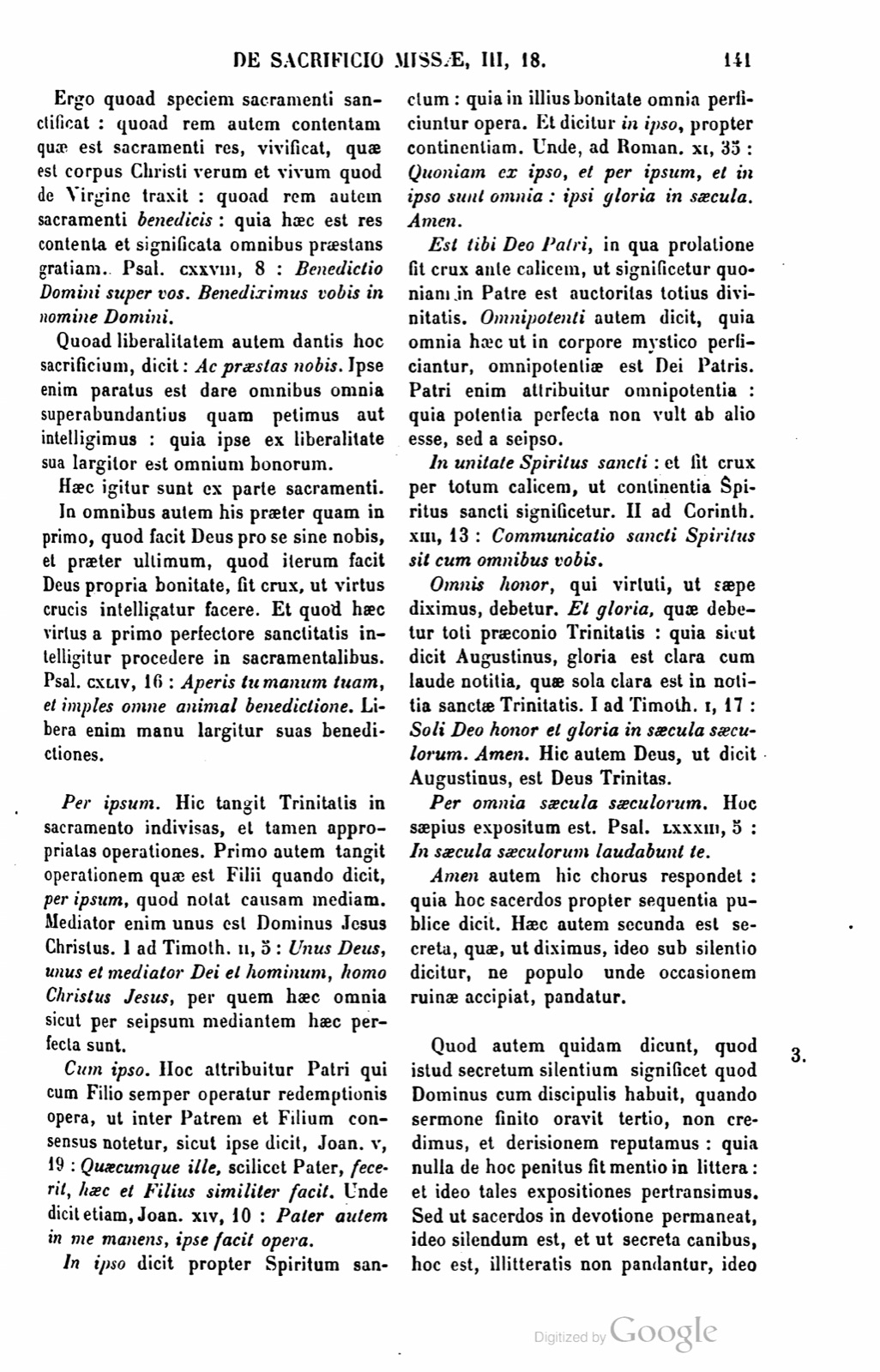
In unitate Spiritus sancti: et fit crux per totum calicem, ut continentia Spiritus sancti significetur. II ad Corinth. XIII, 13: Communicatio sancti Spiritus sit cum omnibus vobis.
Omnis honor, qui virtuti, ut saepe diximus, debetur. Et gloria, quae debetur toti praeconio Trinitatis: quia sicut dicit Augustinus, gloria est clara cum laude notitia, quae sola clara est in notitia sanctae Trinitatis. I ad Timoth. I, 17: Soli Deo honor et gloria in saecula saeculorum. Amen. Hic autem Deus, ut dicit Augustinus, est Deus Trinitas.
Per omnia saecula saeculorum. Hoc saepius expositum est. Psal. LXXXII, 5: In saecula saeculorum laudabunt te.
Amen autem hic chorus respondet: quia hoc sacerdos propter sequentia publice dicit. Haec autem secunda est secreta, quae, ut diximus, ideo sub silentio dicitur, ne populo unde occasionem ruinae accipiat, pandatur.
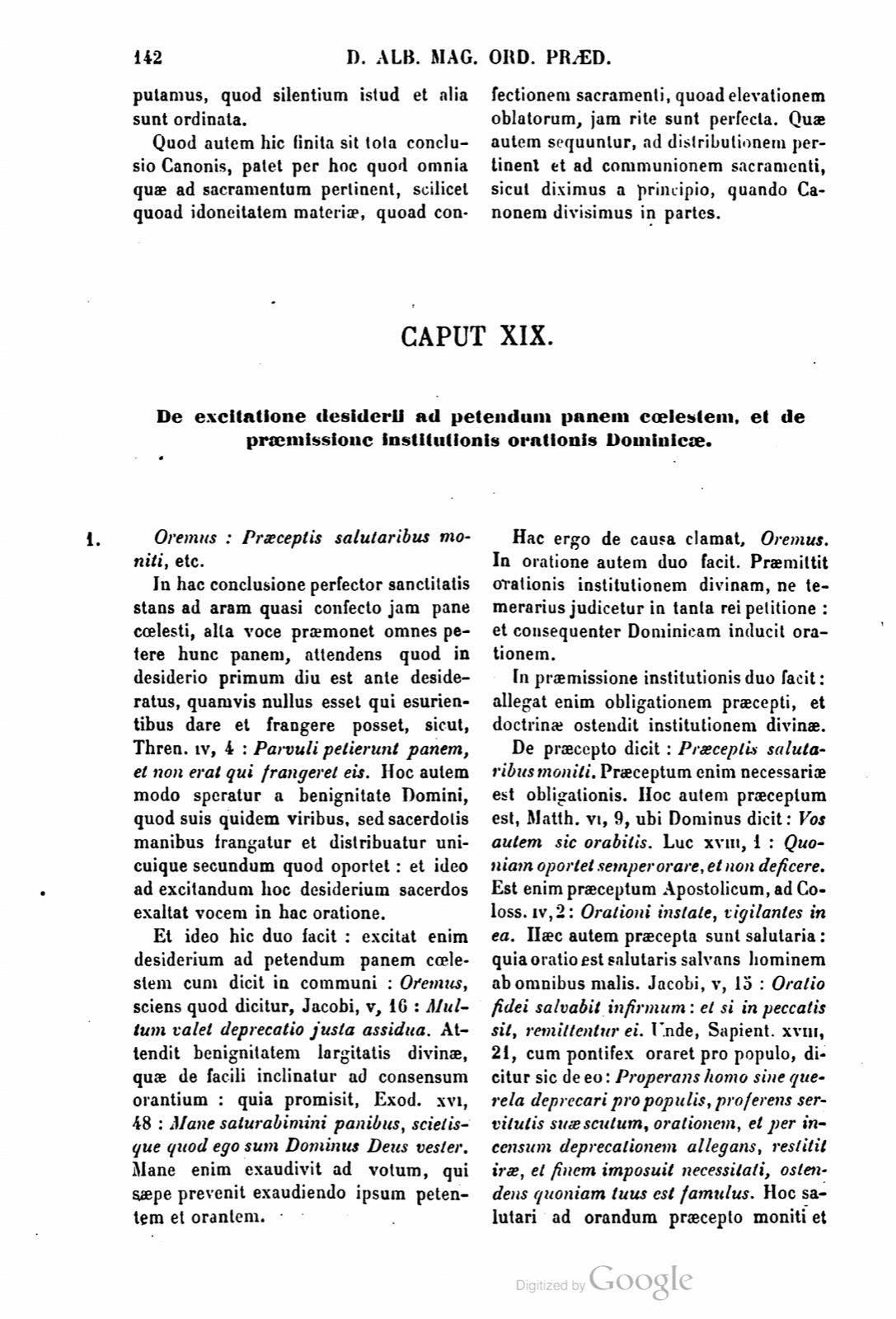
3. Quod autem quidam dicunt, quod istud secretum silentium significet quod Dominus cum discipulis habuit, quando sermone finito oravit tertio, non credimus, et derisionem reputamus: quia nulla de hoc penitus fit mentio in littera: et ideo tales expositiones pertransimus. Sed ut sacerdos in devotione permaneat, ideo silendum est, et ut secreta canibus, hoc est, illitteratis non pandantur, ideo putamus, quod silentium istud et alia sunt ordinata.
Quod autem hic finita sit tota conclusio Canonis, patet per hoc quod omnia quae ad sacramentum pertinent, scilicet quoad idoneitatem materiae, quoad confectionem sacramenti, quoad elevationem oblatorum, jam rite sunt perfecta. Quae autem sequuntur, ad distributionem pertinent et ad communionem sacramenti, sicut diximus a principio, quando Canonem divisimus in partes.
In the unity of the Holy Spirit; and a cross is made through the whole chalice, so that the containment of the Holy Spirit may be signified. 2 Corinthians 13:13: May the communication of the Holy Spirit be with all of you.
All honor, which, as we have often said, is owed to virtue. And glory, which is owed to the whole proclamation of the Trinity, because, as Augustine says, glory is clear knowledge with praise, which alone is clear in the knowledge of the Holy Trinity. 1 Timothy 1:17: To God alone honor and glory forever and ever. Amen. But this God, as Augustine says, is God the Trinity.
Forever and ever. This has often been expounded. Psalm 82:5: They will praise thee forever and ever.
But here the choir responds Amen, because the priest says this publicly on account of what follows. But this is the second secret, which, as we have said, is said under silence for this reason, lest that from which the people might receive an occasion of ruin be disclosed.
3. But what certain persons say, that this secret silence signifies that which the Lord had with the disciples when, after the discourse was ended, he prayed a third time, we do not believe, and we count it a mockery, because no mention at all is made of this in the letter; and therefore we pass over such expositions. But so that the priest may remain in devotion, therefore there must be silence, and so that secrets may not be disclosed to dogs, that is, to the unlearned, therefore we think that this silence and the other things have been ordered.
But that the whole conclusion of the Canon is finished here is clear from the fact that all things which pertain to the sacrament, namely with respect to the suitability of the matter, with respect to the confection of the sacrament, and with respect to the elevation of those offered, have now been duly perfected. But the things which follow pertain to the distribution and to the communion of the sacrament, as we said at the beginning when we divided the Canon into parts.
If a page does not appear, its photograph has not been uploaded yet.