Works › The Book on the Sacrifice of the Mass
Volume 38 · pp. 123–126
Tractate III, Chapter XIII
A marker with ≈ is an approximate page boundary, placed by measure of the text; the page photographs remain the authority. In the paired views, clicking a page marker brings that page into view.
CAPUT XIII.
De elevatione et de eam perficientibus. Et primo, quae Christus in seipso perfecit?
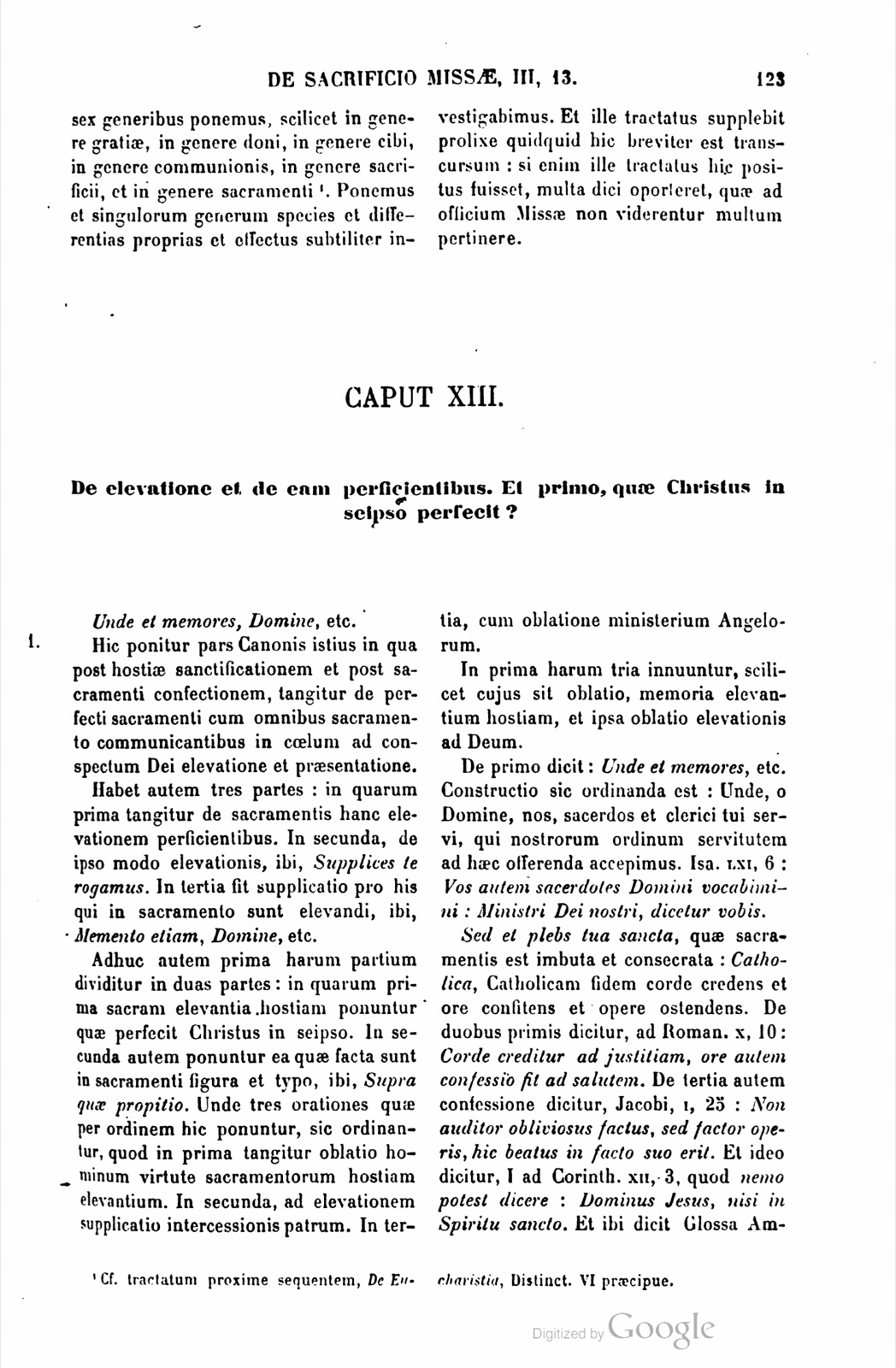
1. Unde et memores, Domine, etc. Hic ponitur pars Canonis istius in qua post hostiae sanctificationem et post sacramenti confectionem, tangitur de perfecti sacramenti cum omnibus sacramento communicantibus in coelum ad conspectum Dei elevatione et praesentatione.
Habet autem tres partes: in quarum prima tangitur de sacramentis hanc elevationem perficientibus. In secunda, de ipso modo elevationis, ibi, Supplices te rogamus. In tertia fit supplicatio pro his qui in sacramento sunt elevandi, ibi, Memento etiam, Domine, etc.
Adhuc autem prima harum partium dividitur in duas partes: in quarum prima sacram elevantia hostiam ponuntur quae perfecit Christus in seipso. In secunda autem ponuntur ea quae facta sunt in sacramenti figura et typo, ibi, Supra quae propitio. Unde tres orationes quae per ordinem hic ponuntur, sic ordinantur, quod in prima tangitur oblatio hominum virtute sacramentorum hostiam elevantium. In secunda, ad elevationem supplicatio intercessionis patrum. In tertia, cum oblatione ministerium Angelorum.
In prima harum tria innuuntur, scilicet cujus sit oblatio, memoria elevantium hostiam, et ipsa oblatio elevationis ad Deum.
De primo dicit: Unde et memores, etc. Constructio sic ordinanda est: Unde, o Domine, nos, sacerdos et clerici tui servi, qui nostrorum ordinum servitutem ad haec offerenda accepimus. Isa. LXI, 6: Vos autem sacerdotes Domini vocabimini: Ministri Dei nostri, dicetur vobis.
Sed et plebs tua sancta, quae sacramentis est imbuta et consecrata: Catholica, Catholicam fidem corde credens et ore confitens et opere ostendens. De duobus primis dicitur, ad Roman. X, 10: Corde creditur ad justitiam, ore autem confessio fit ad salutem. De tertia autem confessione dicitur, Jacobi, I, 25: Non auditor obliviosus factus, sed factor operis, hic beatus in facto suo erit. Et ideo dicitur, I ad Corinth. XII, 3, quod nemo potest dicere: Dominus Jesus, nisi in Spiritu sancto. Et ibi dicit Glossa Ambrosii, quod qui dicit Dominus Jesus in Spiritu sancto, dicit illud corde, ore, et opere. Nos, inquam, servi tui et plebs, memores tam beatae passionis, etc., ejusdem Christi Filii tui. Ejusdem cujus corpus et sanguinem conficimus.
2. Sic ergo est constructio ordinanda: Memores, cujus numquam habenda est oblivio. Psal. LXII, 7 et 8: Sic memor fui tui super stratum meum, in matutinis meditabor in te, quia fuisti adjutor meus. Psal. CXXXVI, 6: Adhaereat lingua mea faucibus meis, si non meminero tui.
Ejusdem Christi, mediatoris Dei et hominum, cujus corpori et sanguini participamus, ita quod in Christo incorporati manemus, sicut ipse dicit, Joan. VI, 57: Qui manducat meam carnem, et bibit meum sanguinem, in me manet, et ego in eo. Joan. XV, 4: Sicut palmes non potest ferre fructum a semetipso, nisi manserit in vite, sic nec vos, nisi in me manseritis.
Filii tui, tibi consubstantialis, ut sic per ipsum ad te habeamus accessum. Ad Roman. V, 1 et 2: Pacem habeamus ad Deum per Dominum nostrum Jesum Christum, per quem et habemus accessum per fidem in gratiam istam in qua stamus, et gloriamur in spe gloriae filiorum Dei. Propter hoc enim, ut dicit Augustinus, univit sacrificium et offerentem cum Patre, ut per sacrificium et offerentem accedentes non sisteremus, sed accederemus usque ad Patrem. Iste enim est verus cubicularius et verus ostiarius, qui ad secreta Patris introducit. Genes. XLIII, 16: Introduc viros domum, et occide victimas, et instrue convivium, quoniam mecum sunt comesturi meridie, hoc est, in plena luce et fervore charitatis reficiendi sunt dulcedine deitatis meae. Joan. X, 9: Ego sum ostium. Per me si quis introierit, salvabitur: et ingredietur, et egredietur, et pascua inveniet. Et ibidem, v. 3: Huic ostiarius aperit, ubi dicit Glossa Augustini, quod Christus mediator est ostium et ostiarius fideles inducens ad Patrem.
CHAPTER XIII.
On the elevation and on those things perfecting it. And first, what Christ perfected in himself.
1. Whence also mindful, O Lord, etc. Here is placed the part of this Canon in which, after the sanctification of the host and after the confection of the sacrament, there is touched upon the elevation and presentation to the sight of God in heaven of the perfected sacrament together with all those communicating in the sacrament.
It has three parts: in the first of these there is touched upon the sacraments perfecting this elevation. In the second, upon the very mode of elevation, there: We humbly beseech thee. In the third there is made a supplication for those who are to be elevated in the sacrament, there: Remember also, O Lord, etc.
Moreover, the first of these parts is divided into two parts: in the first are set down the things elevating the sacred host which Christ perfected in himself. But in the second are set down the things which were done in figure and type of the sacrament, there: Upon which with a propitious. Hence the three prayers which are set down here in order are thus ordered, because in the first is touched the oblation of human beings elevating the host by the power of the sacraments; in the second, a supplication of the intercession of the fathers for elevation; in the third, with the oblation, the ministry of the Angels.
In the first of these three things are indicated, namely whose oblation it is, the memory of those elevating the host, and the very oblation of elevation to God.
Concerning the first he says: Whence also mindful, etc. The construction is to be ordered thus: Whence, O Lord, we, the priest and clerics thy servants, who have received the service of our orders for offering these things. Isaiah 61:6: But you shall be called priests of the Lord; ministers of our God, it shall be said to you.
But also thy holy people, which is imbued and consecrated with the sacraments; catholic, believing the Catholic faith in heart and confessing it with mouth and showing it in deed. Concerning the first two it is said, Romans 10:10: With the heart one believes unto justice, but confession with the mouth is made unto salvation. But concerning the third confession it is said, James 1:25: Not becoming a forgetful hearer, but a doer of the work, this one will be blessed in his deed. And therefore it is said, 1 Corinthians 12:3, that no one can say, The Lord Jesus, except in the Holy Spirit. And there the Gloss of Ambrose says that he who says The Lord Jesus in the Holy Spirit says it with heart, mouth, and deed. We, I say, thy servants and thy people, mindful of the so blessed passion, etc., of the same Christ thy Son, the same one whose body and blood we confect.
2. Thus therefore the construction is to be ordered: Mindful, of whom forgetfulness must never be had. Psalm 62:7 and 8: Thus I was mindful of thee upon my bed; in the morning I will meditate on thee, because thou hast been my helper. Psalm 136:6: Let my tongue cleave to my jaws, if I do not remember thee.
Of the same Christ, mediator of God and men, of whose body and blood we partake, so that, incorporated in Christ, we remain, as he himself says, John 6:57: He who eats my flesh and drinks my blood remains in me, and I in him. John 15:4: As the branch cannot bear fruit from itself unless it remains in the vine, so neither can you unless you remain in me.
Of thy Son, consubstantial with thee, so that thus through him we may have access to thee. Romans 5:1 and 2: Let us have peace toward God through our Lord Jesus Christ, through whom also we have access by faith into this grace in which we stand, and we glory in the hope of the glory of the sons of God. For on account of this, as Augustine says, he united the sacrifice and the one offering it with the Father, so that those approaching through the sacrifice and the one offering it should not halt, but should approach all the way to the Father. For he is the true chamberlain and true doorkeeper, who introduces to the secrets of the Father. Genesis 43:16: Bring the men into the house, and kill victims, and prepare a banquet, because they are to eat with me at noon, that is, they are to be refreshed with the sweetness of my deity in full light and fervor of charity. John 10:9: I am the door. If anyone enters through me, he shall be saved; and he shall enter and go out and find pastures. And in the same place, verse 3: To him the doorkeeper opens, where the Gloss of Augustine says that Christ the mediator is the door and the doorkeeper introducing the faithful to the Father.
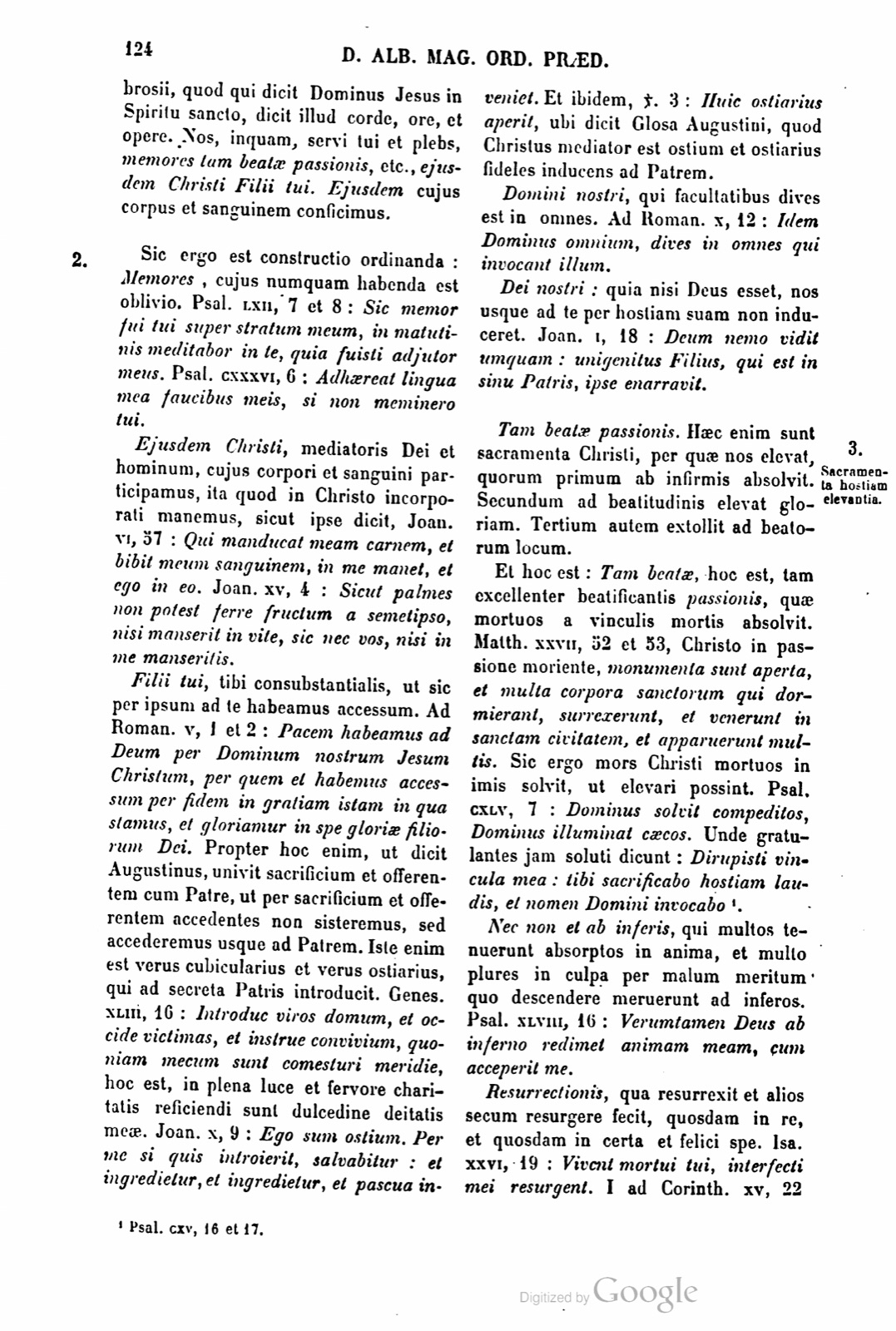
Domini nostri, qui facultatibus dives est in omnes. Ad Roman. X, 12: Idem Dominus omnium, dives in omnes qui invocant illum.
Dei nostri: quia nisi Deus esset, nos usque ad te per hostiam suam non induceret. Joan. I, 18: Deum nemo vidit umquam: unigenitus Filius, qui est in sinu Patris, ipse enarravit.
[Marginal label: Sacramenta hostiam elevantia.] 3. Tam beatae passionis. Haec enim sunt sacramenta Christi, per quae nos elevat, quorum primum ab infirmis absolvit. Secundum ad beatitudinis elevat gloriam. Tertium autem extollit ad beatorum locum.
Et hoc est: Tam beatae, hoc est, tam excellenter beatificantis passionis, quae mortuos a vinculis mortis absolvit. Matth. XXVII, 52 et 53, Christo in passione moriente, monumenta sunt aperta, et multa corpora sanctorum qui dormierant, surrexerunt, et venerunt in sanctam civitatem, et apparuerunt multis. Sic ergo mors Christi mortuos in imis solvit, ut elevari possint. Psal. CXLV, 7: Dominus solvit compeditos, Dominus illuminat caecos. Unde gratulantes jam soluti dicunt: Dirupisti vincula mea: tibi sacrificabo hostiam laudis, et nomen Domini invocabo 1.
Nec non et ab inferis, qui multos tenuerunt absorptos in anima, et multo plures in culpa per malum meritum quo descendere meruerunt ad inferos. Psal. XLVIII, 16: Verumtamen Deus ab inferno redimet animam meam, cum acceperit me.
Resurrectionis, qua resurrexit et alios secum resurgere fecit, quosdam in re, et quosdam in certa et felici spe. Isa. XXVI, 19: Vivent mortui tui, interfecti mei resurgent. I ad Corinth. XV, 22 et 23: Sicut in Adam omnes moriuntur, ita et in Christo omnes vivificabuntur: unusquisque autem in suo ordine: primitiae Christus: deinde ii qui sunt Christi, qui in adventu ejus crediderunt. Et sic in ipso resurgimus a morte animae ad justificationem, et a morte corporis ad gloriam. Ad Romanos, IV, 25: Qui traditus est propter nostra delicta, et resurrexit propter nostram justificationem.
Sed et in coelos. Tangit tertium nos elevans sacramentum, et dicit coelos pluraliter, quia quamvis Christus ad dexteram Patris ascenderit super omnes coelos, sicut dicitur, ad Ephes. IV, 10, tamen in omnes coelos omnium per ordines singulos ascendit: quia omnibus et singulis illuminationes suas invehit et invexit et invehet in aeternum. Et ideo decem sunt dies quibus celebratur ascensio: quia novem Angelorum coelos conscendit, et sic decimo in dextera Patris resedit. Psal. XVII, 17: A summo coelo egressio ejus, et occursus ejus usque ad summum ejus: nec est qui se abscondat a calore ejus.
Of our Lord, who is rich in resources toward all. Romans 10:12: The same Lord of all, rich toward all who invoke him.
Of our God, because unless he were God, he would not bring us all the way to thee through his host. John 1:18: No one has ever seen God; the only-begotten Son, who is in the bosom of the Father, he has made him known.
[Marginal label: Sacraments elevating the host.] 3. Of the so blessed passion. For these are the sacraments of Christ by which he elevates us: the first absolves from the infirm; the second elevates to the glory of blessedness; the third lifts up to the place of the blessed.
And this is: So blessed, that is, of so excellently beatifying a passion, which absolved the dead from the chains of death. Matthew 27:52 and 53: When Christ was dying in the passion, the tombs were opened, and many bodies of the saints who had slept rose and came into the holy city and appeared to many. Thus therefore the death of Christ loosed the dead in the depths, so that they could be elevated. Psalm 145:7: The Lord looses the fettered; the Lord enlightens the blind. Hence those already loosed, rejoicing, say: Thou hast broken my bonds; to thee I will sacrifice a host of praise and will call upon the name of the Lord 1.
And also from the lower regions, which had held many swallowed up in soul, and many more in guilt through evil merit by which they deserved to descend to the lower regions. Psalm 48:16: Nevertheless God will redeem my soul from hell, when he shall receive me.
Of the resurrection, by which he rose and made others rise with him, some in reality, and some in certain and happy hope. Isaiah 26:19: Thy dead shall live; my slain shall rise. 1 Corinthians 15:22 and 23: As in Adam all die, so also in Christ all shall be brought to life: but each one in his own order: Christ the first-fruits; then those who are Christ's, who have believed at his coming. And thus in him we rise from the death of soul to justification, and from the death of body to glory. Romans 4:25: Who was handed over for our offenses and rose for our justification.
But also into the heavens. He touches the third sacrament elevating us, and he says heavens in the plural, because although Christ ascended to the right hand of the Father above all the heavens, as is said, Ephesians 4:10, nevertheless he ascended into all the heavens of all through each of the orders, because to all and to each he brings in and has brought in and will bring in his illuminations forever. And therefore there are ten days on which the ascension is celebrated, because he climbed the nine heavens of the Angels, and thus on the tenth day sat at the right hand of the Father. Psalm 17:17: His going out is from the height of heaven, and his course is to its height; nor is there anyone who hides himself from its heat.
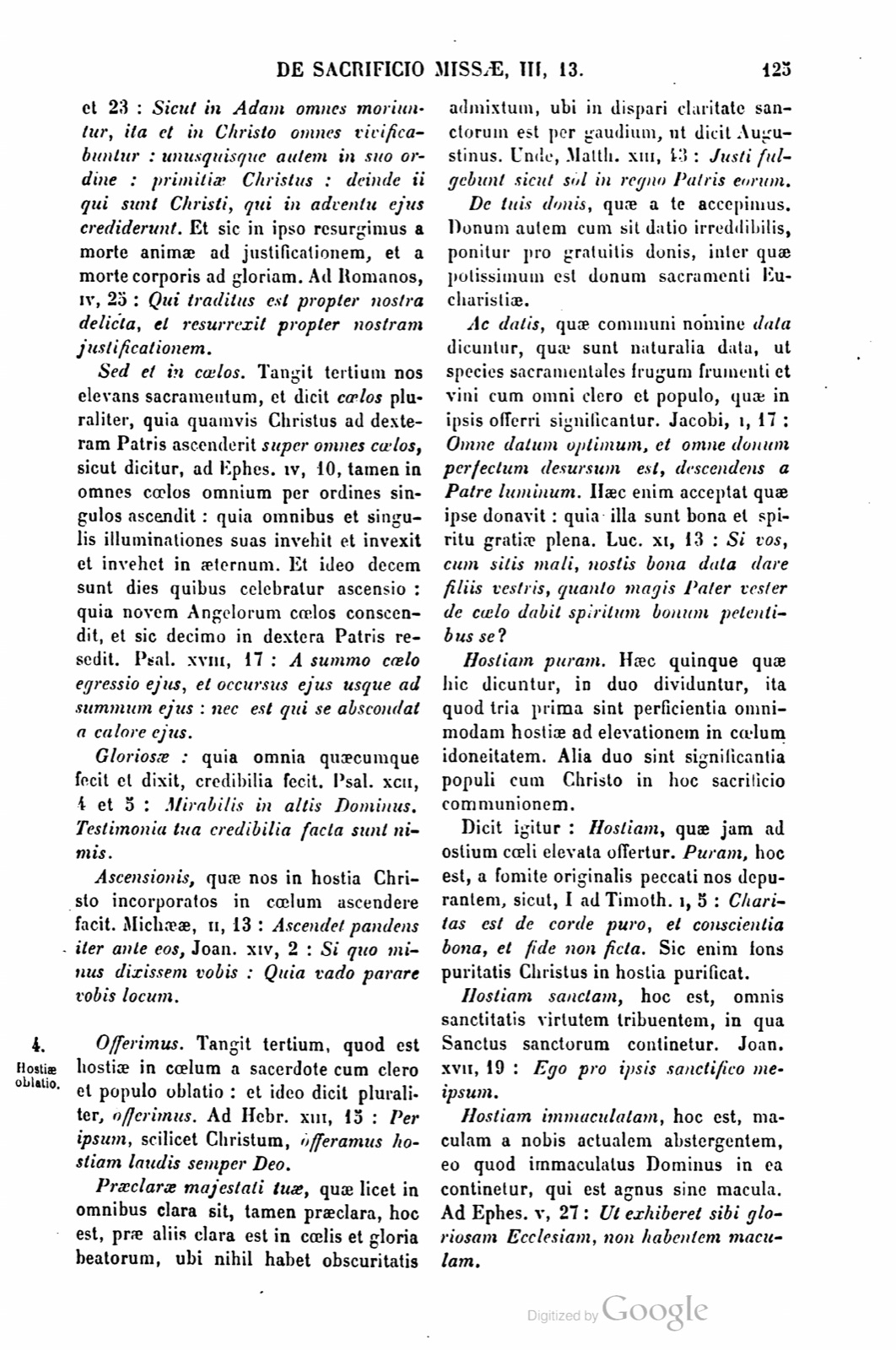
Gloriosae: quia omnia quaecumque fecit et dixit, credibilia fecit. Psal. XCII, 4 et 5: Mirabilis in altis Dominus. Testimonia tua credibilia facta sunt nimis.
Ascensionis, quae nos in hostia Christo incorporatos in coelum ascendere facit. Michaeae, II, 13: Ascendet pandens iter ante eos. Joan. XIV, 2: Si quo minus dixissem vobis: Quia vado parare vobis locum.
[Marginal label: Hostiae oblatio.] 4. Offerimus. Tangit tertium, quod est hostiae in coelum a sacerdote cum clero et populo oblatio: et ideo dicit pluraliter, offerimus. Ad Hebr. XIII, 15: Per ipsum, scilicet Christum, offeramus hostiam laudis semper Deo.
Praeclarae majestati tuae, quae licet in omnibus clara sit, tamen praeclara, hoc est, prae aliis clara est in coelis et gloria beatorum, ubi nihil habet obscuritatis admixtum, ubi in dispari claritate sanctorum est per gaudium, ut dicit Augustinus. Unde, Matth. XI, 43: Justi fulgebunt sicut sol in regno Patris eorum.
De tuis donis, quae a te accepimus. Donum autem cum sit datio irreddibilis, ponitur pro gratuitis donis, inter quae potissimum est donum sacramenti Eucharistiae.
Ac datis, quae communi nomine data dicuntur, quae sunt naturalia data, ut species sacramentales frugum frumenti et vini cum omni clero et populo, quae in ipsis offerri significantur. Jacobi, I, 17: Omne datum optimum, et omne donum perfectum desursum est, descendens a Patre luminum. Haec enim acceptat quae ipse donavit: quia illa sunt bona et spiritu gratiae plena. Luc. XI, 13: Si vos, cum sitis mali, nostis bona data dare filiis vestris, quanto magis Pater vester de coelo dabit spiritum bonum petentibus se?
Hostiam puram. Haec quinque quae hic dicuntur, in duo dividuntur, ita quod tria prima sint perficientia omnimodam hostiae ad elevationem in coelum idoneitatem. Alia duo sint significantia populi cum Christo in hoc sacrificio communionem.
Dicit igitur: Hostiam, quae jam ad ostium coeli elevata offertur. Puram, hoc est, a fomite originalis peccati nos depurantem, sicut, I ad Timoth. I, 5: Charitas est de corde puro, et conscientia bona, et fide non ficta. Sic enim fons puritatis Christus in hostia purificat.
Hostiam sanctam, hoc est, omnis sanctitatis virtutem tribuentem, in qua Sanctus sanctorum continetur. Joan. XVII, 19: Ego pro ipsis sanctifico meipsum.
Hostiam immaculatam, hoc est, maculam a nobis actualem abstergentem, eo quod immaculatus Dominus in ea continetur, qui est agnus sine macula. Ad Ephes. V, 27: Ut exhiberet sibi gloriosam Ecclesiam, non habentem maculam.
Of the glorious ascension, because whatever he did and said he made credible. Psalm 92:4 and 5: Wondrous is the Lord on high. Thy testimonies have been made exceedingly credible.
Of the ascension, which makes us, incorporated into Christ in the host, ascend into heaven. Micah 2:13: He who opens the way shall ascend before them. John 14:2: If it were otherwise I would have told you, because I go to prepare a place for you.
[Marginal label: Oblation of the host.] 4. We offer. He touches the third thing, which is the oblation of the host into heaven by the priest with the clergy and people; and therefore he says in the plural, we offer. Hebrews 13:15: Through him, namely Christ, let us always offer a host of praise to God.
To thy excellent majesty, which, although it is bright in all things, nevertheless is excellent, that is, bright beyond others in the heavens and the glory of the blessed, where it has nothing of obscurity mixed in, where in the unequal brightness of the saints it exists through joy, as Augustine says. Hence, Matthew 11:43: The just shall shine like the sun in the kingdom of their Father.
From thy gifts, which we have received from thee. But gift, since it is an unreturnable giving, is set down for gratuitous gifts, among which the gift of the sacrament of the Eucharist is most powerful.
And from things given, which by a common name are called givens, which are natural givens, such as the sacramental species of the fruits of wheat and wine with all clergy and people, who are signified to be offered in them. James 1:17: Every best given and every perfect gift is from above, descending from the Father of lights. For he accepts these things which he himself gave, because those things are good and full of the spirit of grace. Luke 11:13: If you, though you are evil, know how to give good gifts to your children, how much more will your Father from heaven give a good spirit to those asking him?
A pure host. These five things which are said here are divided into two, so that the first three are things perfecting the host's every suitability for elevation into heaven. But the other two are things signifying the communion of the people with Christ in this sacrifice.
Therefore he says: A host, which already is offered elevated to the door of heaven. Pure, that is, purifying us from the tinder of original sin, as 1 Timothy 1:5 says: Charity is from a pure heart, and a good conscience, and unfeigned faith. For thus Christ, the font of purity, purifies in the host.
A holy host, that is, giving the virtue of all holiness, in which the Holy of Holies is contained. John 17:19: For them I sanctify myself.
An immaculate host, that is, wiping away from us an actual stain, because the immaculate Lord is contained in it, who is a lamb without stain. Ephesians 5:27: That he might present to himself a glorious Church, not having stain.
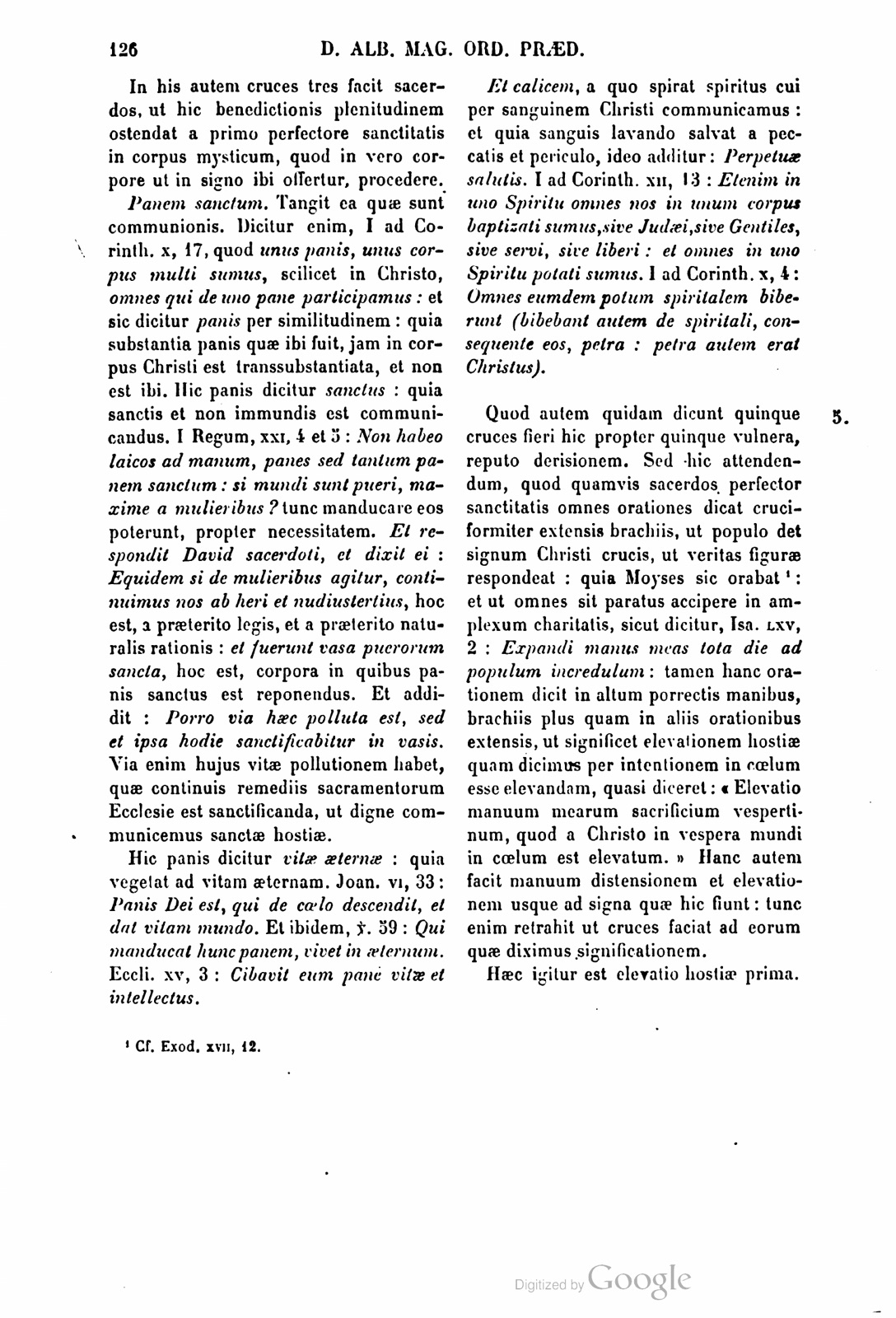
In his autem cruces tres facit sacerdos, ut hic benedictionis plenitudinem ostendat a primo perfectore sanctitatis in corpus mysticum, quod in vero corpore ut in signo ibi offertur, procedere.
Panem sanctum. Tangit ea quae sunt communionis. Dicitur enim, I ad Corinth. X, 17, quod unus panis, unus corpus multi sumus, scilicet in Christo, omnes qui de uno pane participamus: et sic dicitur panis per similitudinem: quia substantia panis quae ibi fuit, jam in corpus Christi est transsubstantiata, et non est ibi. Hic panis dicitur sanctus: quia sanctis et non immundis est communicandus. I Regum, XXI, 4 et 5: Non habeo laicos ad manum, panes sed tantum panem sanctum: si mundi sunt pueri, maxime a mulieribus? tunc manducare eos poterunt, propter necessitatem. Et respondit David sacerdoti, et dixit ei: Equidem si de mulieribus agitur, continuimus nos ab heri et nudiustertius, hoc est, a praeterito legis, et a praeterito naturalis rationis: et fuerunt vasa puerorum sancta, hoc est, corpora in quibus panis sanctus est reponendus. Et addidit: Porro via haec polluta est, sed et ipsa hodie sanctificabitur in vasis. Via enim hujus vitae pollutionem habet, quae continuis remediis sacramentorum Ecclesiae est sanctificanda, ut digne communicemus sanctae hostiae.
Hic panis dicitur vitae aeternae: quia vegetat ad vitam aeternam. Joan. VI, 33: Panis Dei est, qui de coelo descendit, et dat vitam mundo. Et ibidem, v. 59: Qui manducat hunc panem, vivet in aeternum. Eccli. XV, 3: Cibavit eum pane vitae et intellectus.
Et calicem, a quo spirat spiritus cui per sanguinem Christi communicamus: et quia sanguis lavando salvat a peccatis et periculo, ideo additur: Perpetuae salutis. I ad Corinth. XI, 13: Etenim in uno Spiritu omnes nos in unum corpus baptizati sumus, sive Judaei, sive Gentiles, sive servi, sive liberi: et omnes in uno Spiritu potati sumus. I ad Corinth. X, 4: Omnes eumdem potum spiritalem biberunt (bibebant autem de spiritali, consequente eos, petra: petra autem erat Christus).
Quod autem quidam dicunt quinque cruces fieri hic propter quinque vulnera, reputo derisionem. Sed hic attendendum, quod quamvis sacerdos, perfector sanctitatis, omnes orationes dicat cruciformiter extensis brachiis, ut populo det signum Christi crucis, ut veritas figurae respondeat: quia Moyses sic orabat 2: et ut omnes sit paratus accipere in amplexum charitatis, sicut dicitur, Isa. LXV, 2: Expandi manus meas tota die ad populum incredulum: tamen hanc orationem dicit in altum porrectis manibus, brachiis plus quam in aliis orationibus extensis, ut significet elevationem hostiae quam dicimus per intentionem in coelum esse elevandam, quasi diceret: "Elevatio manuum mearum sacrificium vespertinum, quod a Christo in vespera mundi in coelum est elevatum." Hanc autem facit manuum distensionem et elevationem usque ad signa quae hic fiunt: tunc enim retrahit ut cruces faciat ad eorum quae diximus significationem.
Haec igitur est elevatio hostiae prima.
But in these things the priest makes three crosses, so that here he may show that the fullness of blessing proceeds from the first perfecter of sanctity into the mystical body, which is offered there in the true body as in a sign.
Holy bread. He touches those things which belong to communion. For it is said, 1 Corinthians 10:17, that many of us are one bread, one body, namely in Christ, all who partake of one bread; and thus it is called bread by similitude, because the substance of bread which was there has already been transubstantiated into the body of Christ and is not there. This bread is called holy because it must be communicated to the holy and not to the unclean. 1 Kings 21:4 and 5: I do not have common loaves at hand, but only holy bread; if the boys are clean, especially from women, then they will be able to eat them because of necessity. And David answered the priest and said to him: Indeed, if it is a question of women, we have kept ourselves from yesterday and the day before, that is, from the past of the law and from the past of natural reason; and the vessels of the boys were holy, that is, the bodies in which the holy bread is to be placed. And he added: Moreover this way is polluted, but even it today will be sanctified in the vessels. For the way of this life has pollution, which must be sanctified by the continual remedies of the sacraments of the Church, so that we may worthily communicate in the holy host.
This bread is called of eternal life because it nourishes unto eternal life. John 6:33: The bread of God is he who descends from heaven and gives life to the world. And in the same place, verse 59: He who eats this bread shall live forever. Ecclesiasticus 15:3: He fed him with the bread of life and understanding.
And the chalice, from which breathes the spirit to whom we communicate through the blood of Christ; and because the blood, by washing, saves from sins and peril, therefore there is added: Of perpetual salvation. 1 Corinthians 11:13: For in one Spirit we were all baptized into one body, whether Jews or Gentiles, whether servants or free, and we have all been given to drink in one Spirit. 1 Corinthians 10:4: They all drank the same spiritual drink, for they drank of the spiritual rock that followed them; and the rock was Christ.
But what certain persons say, that five crosses are made here because of the five wounds, I count a mockery. But here it must be attended that, although the priest, the perfecter of sanctity, says all the prayers with arms extended in the form of a cross, so that he may give the people the sign of the cross of Christ, so that the truth may answer to the figure, because Moses prayed in this way 2, and so that he may be prepared to receive all into the embrace of charity, as is said, Isaiah 65:2: I have stretched out my hands all day to an unbelieving people; nevertheless he says this prayer with hands stretched out on high, the arms extended more than in other prayers, so that he may signify the elevation of the host, which we say must be elevated into heaven by intention, as though he were saying: The elevation of my hands is the evening sacrifice, which was elevated into heaven by Christ in the evening of the world. And he makes this extension and elevation of hands until the signs which are made here; then he draws them back so that he may make the crosses for the signification of those things which we have said.
This, therefore, is the first elevation of the host.
If a page does not appear, its photograph has not been uploaded yet.