Works › The Book on the Sacrament of the Eucharist
Volume 38 · pp. 408–410
Chapter IV, 4
A marker with ≈ is an approximate page boundary, placed by measure of the text; the page photographs remain the authority. In the paired views, clicking a page marker brings that page into view.
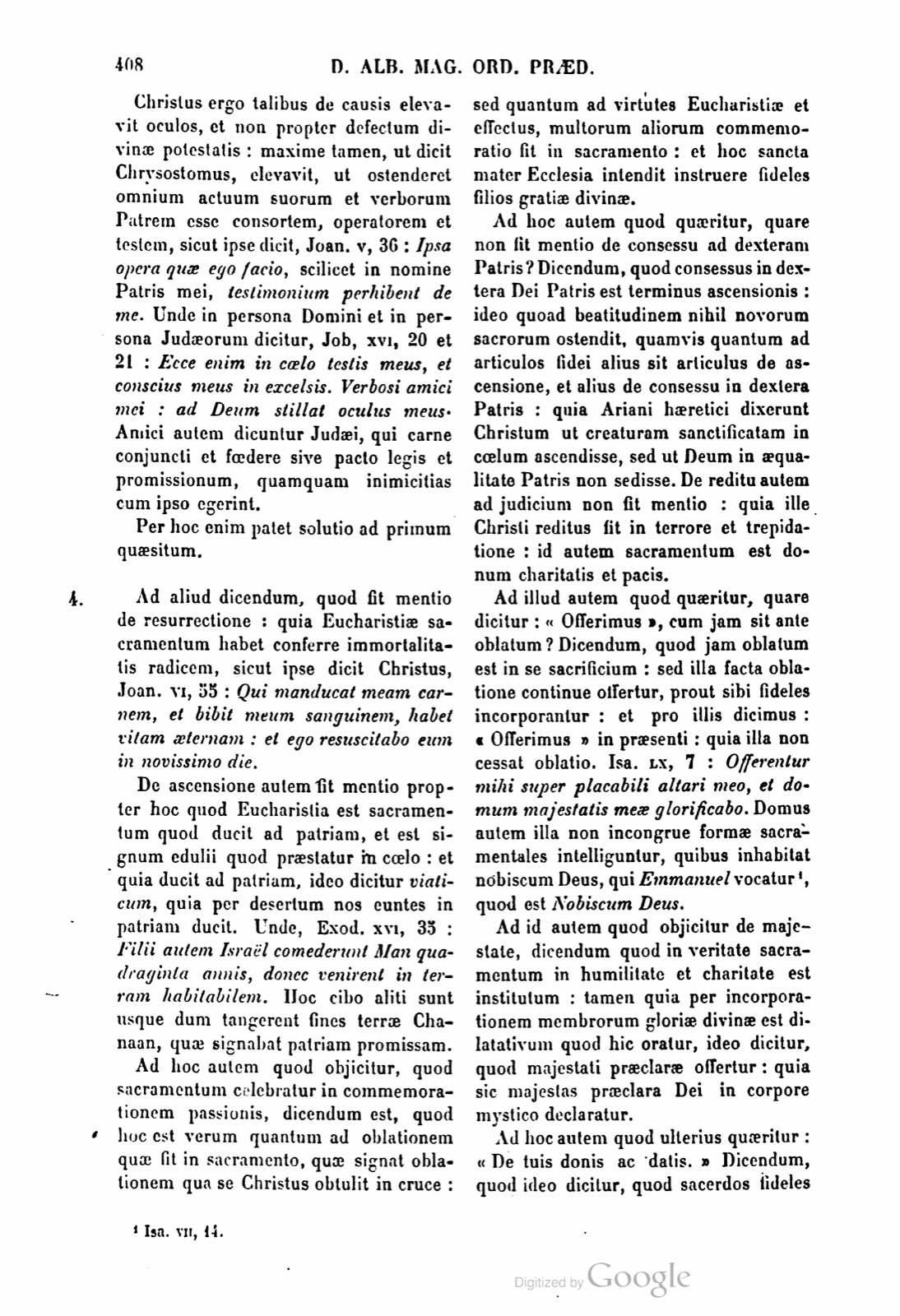
Ad hoc autem quod quaeritur, quare non fit mentio de consessu ad dexteram Patris? Dicendum, quod consessus in dextera Dei Patris est terminus ascensionis: ideo quoad beatitudinem nihil novorum sacrorum ostendit, quamvis quantum ad articulos fidei alius sit articulus de ascensione, et alius de consessu in dextera Patris: quia Ariani haeretici dixerunt Christum ut creaturam sanctificatam in caelum ascendisse, sed ut Deum in aequalitate Patris non sedisse. De reditu autem ad judicium non fit mentio: quia ille Christi reditus fit in terrore et trepidatione: id autem sacramentum est donum charitatis et pacis.
Ad illud autem quod quaeritur, quare dicitur: « Offerimus », cum jam sit ante oblatum? Dicendum, quod jam oblatum est in se sacrificium: sed illa facta oblatione continue offertur, prout sibi fideles incorporantur: et pro illis dicimus: « Offerimus » in praesenti: quia illa non cessat oblatio. Isa. LX, 7: Offerentur mihi super placabili altari meo, et domum majestatis meae glorificabo. Domus autem illa non incongrue formae sacramentales intelliguntur, quibus inhabitat nobiscum Deus, qui Emmanuel vocatur 1, quod est Nobiscum Deus.
Ad id autem quod objicitur de majestate, dicendum quod in veritate sacramentum in humilitate et charitate est institutum: tamen quia per incorporationem membrorum gloriae divinae est dilatativum quod hic oratur, ideo dicitur, quod majestati praeclarae offertur: quia sic majestas praeclara Dei in corpore mystico declaratur.
Ad hoc autem quod ulterius quaeritur: « De tuis donis ac datis. » Dicendum, quod ideo dicitur, quod sacerdos fideles incorporatos Christo offerre non potest, nisi per dona Dei Christo incorporentur. Unde, Joan. X, 29: Pater meus, quod dedit mihi, majus omnibus est. Et dicitur de donis propter gratuita: data dicitur autem propter naturalia quae dantur creatione, et multo magis cum per gratiam reparantur, quae per peccatum quasi perdita in corruptione fuerunt. Joan. VI, 37: Omne quod dat mihi Pater, ad me veniet: et eum qui venit ad me, non ejiciam foras. Et hoc dixit Christus loquens de hoc sacramento, et de incorporandis sibi per sacramentum. Hic autem modus orationis praefiguratus est, I Paralip. XXIX, 14, ubi sic dicit David: Tua sunt omnia: et quae de manu tua accepimus, dedimus tibi. Haec enim oblatio Dei est ut auctoris, et sacerdotis est sicut ex liberalitate ministrantis, et fidelium est sicut oblatorum in sacrificio. Et ideo quamvis Deo nihil offeratur nisi quod suum est, et quod est ab ipso: quia aliter non esset acceptum, tamen quando libera voluntate hoc facimus, damus: quia voluntas libera est, quamvis oblatum sit redditum. Unde, I Paralip. XXIX, 16 et seq., dixit David: Domine Deus noster, omnis haec copia quam paravimus ut aedificaretur domus nomini sancto tuo, de manu tua est, et tua sunt omnia. Scio, Deus meus, quod probes corda, et simplicitatem diligas: unde et ego in simplicitate cordis mei laetus obtuli universa haec: et populum tuum qui hic repertus est, vidi cum ingenti gaudio tibi offerre donaria. Domine, Deus Abraham, et Isaac, et Israel, patrum nostrorum, custodi in aeternum hanc voluntatem cordis eorum, et semper in venerationem tui mens ista permaneat.
But to this which is asked, why mention is not made of sitting together at the right hand of the Father, it must be said that the sitting together at the right hand of God the Father is the term of the ascension; therefore, as regards beatitude, it shows nothing of new sacred things, although as regards the articles of faith one article is concerning the ascension and another concerning the sitting together at the right hand of the Father, because the Arian heretics said that Christ ascended into heaven as a sanctified creature, but did not sit as God in equality with the Father. But mention is not made of the return to judgment, because that return of Christ occurs in terror and trembling; but this sacrament is a gift of charity and peace.
But to that which is asked, why it is said, "We offer," when it has already been offered before, it must be said that the sacrifice has already been offered in itself; but when that oblation has been made, it is offered continuously, according as the faithful are incorporated into him; and for them we say, "We offer," in the present, because that oblation does not cease. Isaiah 60:7: They shall be offered to me upon my acceptable altar, and I shall glorify the house of my majesty. But that house is not unfittingly understood as the sacramental forms, by which God, who is called Emmanuel 1, that is, God-with-us, dwells with us.
To that which is objected concerning majesty, it must be said that in truth the sacrament was instituted in humility and charity; nevertheless because through the incorporation of the members it expands divine glory, which is prayed for here, therefore it is said that it is offered to excellent majesty, because thus the excellent majesty of God is declared in the mystical body.
To this which is further asked, "from your gifts and things given," it must be said that this is said because the priest cannot offer the faithful incorporated into Christ unless they are incorporated into Christ through the gifts of God. Hence John 10:29: My Father, what he has given me, is greater than all. And it is said from gifts because of gratuitous things; but things given is said because of natural things which are given by creation, and much more when they are repaired through grace, which through sin were as if lost in corruption. John 6:37: Everything that the Father gives me will come to me, and him who comes to me I will not cast out. And Christ said this speaking of this sacrament and of those to be incorporated into himself through the sacrament. But this mode of prayer was prefigured in 1 Chronicles 29:14, where David says thus: All things are yours, and what we have received from your hand, we have given to you. For this oblation is God's as author's, and it is the priest's as from the liberality of one ministering, and it is the faithful's as those offered in sacrifice. And therefore, although nothing is offered to God except what is his and what is from him, because otherwise it would not be accepted, nevertheless when we do this by free will, we give, because the will is free, although the thing offered is rendered back. Hence in 1 Chronicles 29:16 and following David said: Lord our God, all this abundance which we have prepared so that a house may be built for your holy name is from your hand, and all things are yours. I know, my God, that you test hearts and love simplicity; hence also I in the simplicity of my heart have joyfully offered all these things, and I have seen your people who are found here with great joy offer gifts to you. Lord, God of Abraham and Isaac and Israel, our fathers, preserve forever this will of their heart, and may this mind always remain in veneration of you.
Ad hoc autem quod quaeritur, quare dicitur: « Hostiam puram, etc. » Dicendum, quod hoc non ponitur propter corpus Christi verum, sed propter corpus mysticum, quod incorporatum vero corpori petitur offerri. Hoc autem habet peccati originalis impuritatem, et peccati actualis immunditiam, et peccati venialis maculosam contagionem: et contra haec tria corpus mysticum petitur per corpus Christi verum purificari, sanctificari, et immaculatum fieri: et ideo hostia pura dicitur purificans, hostia sancta dicitur sanctificans, et hostia immaculata dicitur ad innocentiam restituens.
Crux autem super hostiam fit in quolibet istorum, ut ostendatur quod per virtutem crucis, puritas et sanctitas et immaculatio a Christo ad corpus mysticum derivetur.
But to this which is asked, why it is said, "a pure Host, etc.," it must be said that this is not posited because of the true body of Christ, but because of the mystical body, which, incorporated into the true body, is sought to be offered. But this body has the impurity of original sin, and the uncleanness of actual sin, and the spotted contagion of venial sin; and against these three the mystical body is sought to be purified, sanctified, and made immaculate through the true body of Christ; and therefore the pure Host is called purifying, the holy Host is called sanctifying, and the immaculate Host is called restoring to innocence.
But the cross is made over the host in each of these, so that it may be shown that through the power of the cross, purity and sanctity and immaculation are derived from Christ to the mystical body.
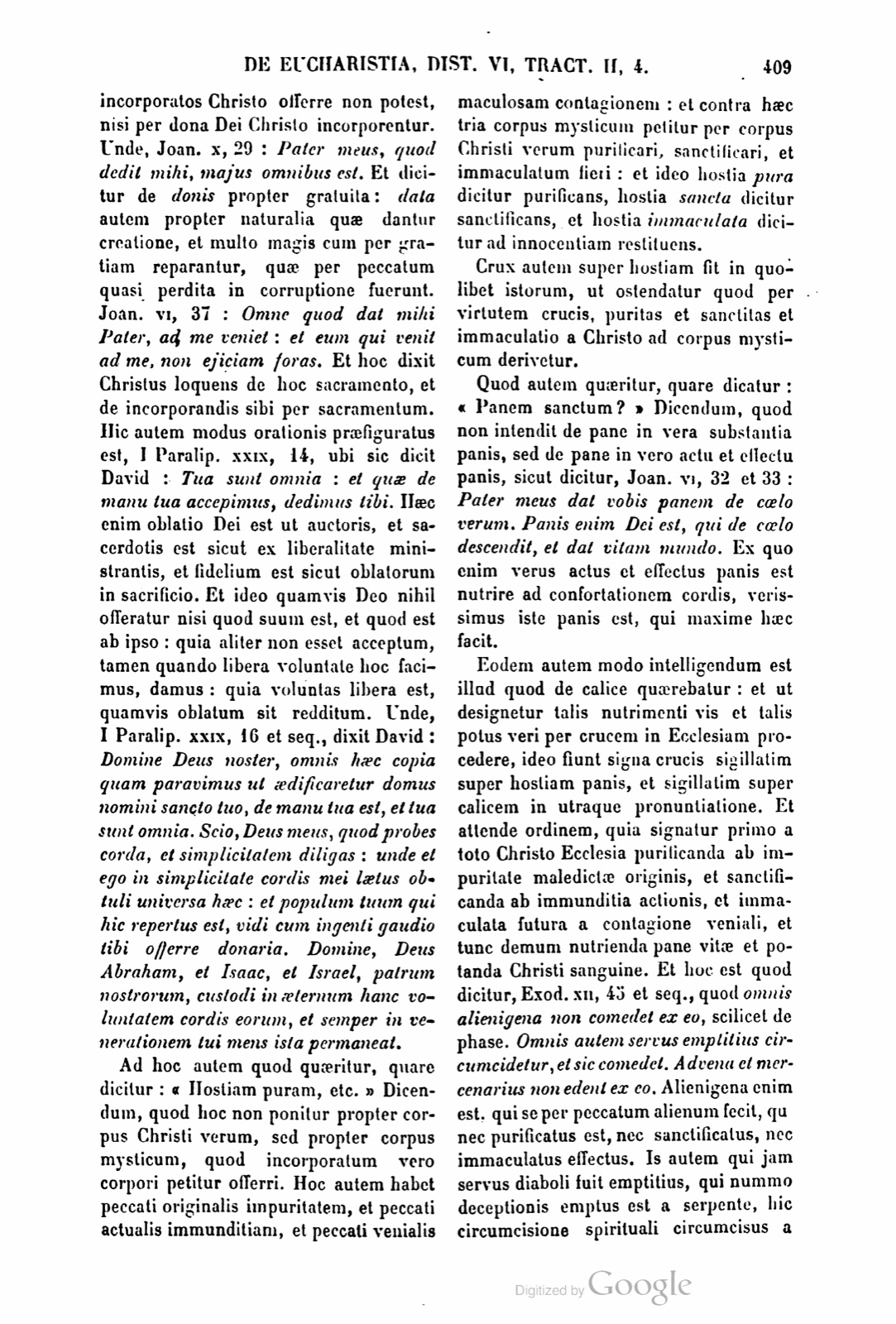
Quod autem quaeritur, quare dicatur: « Panem sanctum? » Dicendum, quod non intendit de pane in vera substantia panis, sed de pane in vero actu et effectu panis, sicut dicitur, Joan. VI, 32 et 33: Pater meus dat vobis panem de caelo verum. Panis enim Dei est, qui de caelo descendit, et dat vitam mundo. Ex quo enim verus actus et effectus panis est nutrire ad confortationem cordis, verissimus iste panis est, qui maxime haec facit.
Eodem autem modo intelligendum est illud quod de calice quaerebatur: et ut designetur talis nutrimenti vis et talis potus veri per crucem in Ecclesiam procedere, ideo fiunt signa crucis sigillatim super hostiam panis, et sigillatim super calicem in utraque pronuntiatione. Et attende ordinem, quia signatur primo a toto Christo Ecclesia purificanda ab impuritate maledictae originis, et sanctificanda ab immunditia actionis, et immaculata futura a contagione veniali, et tunc demum nutrienda pane vitae et potanda Christi sanguine. Et hoc est quod dicitur, Exod. XII, 45 et seq., quod omnis alienigena non comedet ex eo, scilicet de phase. Omnis autem servus emptitius circumcidetur, et sic comedet. Advena et mercenarius non edent ex eo. Alienigena enim est, qui se per peccatum alienum fecit, qui nec purificatus est, nec sanctificatus, nec immaculatus effectus. Is autem qui jam servus diaboli fuit emptitius, qui nummo deceptionis emptus est a serpente, hic circumcisione spirituali circumcisus a peccato comedet. Advena autem qui religionis Christianae virtutem non assumit, etsi solo numero inter fideles habitat, et mercenarius qui spe terrenorum omnia facit, non comedet. Et hoc est quod dicitur, I ad Corinth. XI, 28 et 29: Probet autem seipsum homo: et sic de pane illo edat, et de calice bibat: qui enim manducat et bibit indigne, judicium sibi manducat et bibit, etc.
But as to what is asked, why it is called "holy bread," it must be said that he does not intend this of bread in the true substance of bread, but of bread in the true act and effect of bread, as is said in John 6:32 and 33: My Father gives you true bread from heaven. For the bread of God is he who descends from heaven and gives life to the world. Since therefore the true act and effect of bread is to nourish unto the strengthening of the heart, this bread is the truest, which most greatly does these things.
But that which was asked concerning the chalice must be understood in the same way; and so that the force of such nourishment and of such true drink may be designated as proceeding through the cross into the Church, therefore signs of the cross are made separately over the host of bread and separately over the chalice in each pronouncement. And note the order, because first the Church is signified as to be purified by the whole Christ from the impurity of cursed origin, and to be sanctified from the uncleanness of action, and to be made immaculate from venial contagion, and then at last to be nourished with the bread of life and given drink with the blood of Christ. And this is what is said in Exodus 12:45 and following, that every foreigner shall not eat of it, namely of the Passover. But every bought servant shall be circumcised, and thus he shall eat. The stranger and hireling shall not eat of it. For the foreigner is he who through sin made himself alien, who has been neither purified nor sanctified nor made immaculate. But he who was already a bought servant of the devil, who was bought from the serpent by the coin of deception, this man, circumcised from sin by spiritual circumcision, shall eat. But the stranger who does not assume the virtue of Christian religion, even if he dwells among the faithful only in number, and the hireling who does all things in hope of earthly things, shall not eat. And this is what is said in 1 Corinthians 11:28 and 29: But let a man prove himself, and so let him eat of that bread and drink of the chalice; for he who eats and drinks unworthily eats and drinks judgment to himself, etc.

Notes
- Isaiah 7:14. (Isa. VII, 14.) ↩
If a page does not appear, its photograph has not been uploaded yet.