Works › The Book on the Sacrament of the Eucharist
Volume 38 · pp. 407–408
Chapter IV, 3-4
A marker with ≈ is an approximate page boundary, placed by measure of the text; the page photographs remain the authority. In the paired views, clicking a page marker brings that page into view.
Quarum prima est, ut concordiam indissolubilem inter se et Patrem ostenderet, cum Judaei frequenter dicerent, quia Patri contrarius esset, sicut in Psalmo XXIV, 15, signanter dicitur: Oculi mei semper ad Dominum, quoniam ipse evellet de laqueo pedes meos, hoc est, de laqueo quem sibi Judaei calumniis suis tetenderunt.
Secunda causa est, quia Patri sicut auctori omnia sua attribuebat, qui est fons et principium totius deitatis. I ad Corinth. XV, 24: Deinde finis, cum tradiderit regnum Deo et Patri. Joan. XVII, 10: Et mea omnia tua sunt, et tua mea sunt: et clarificatus sum in eis. Et haec elevatio oculorum fuit in suscitatione Lazari et in confectione sacramenti: quia hoc est gratiarum actionis, quando sua retulit ad Patrem. Unde, Joan. XI, 41 et 42, dicitur: Pater, gratias ago tibi, quoniam audisti me. Ego autem sciebam quia semper me audis.
Tertia causa est, ut ostenderet idem esse boni finem et terminum, quod est omnis boni initium et principium. Pater enim innascibilis est, ut dicit Hilarius, ad quem Filius qui illuminat, dirigit, et ad quem Spiritus sanctus reducit omne quod inspirat, sicut dicit Dionysius in libro de Coelesti hierarchia 1. Et talis est elevatio oculorum quam fecit, Joan. XVII, 1: et ideo dicit ibi: Pater, venit hora, clarifica Filium tuum, scilicet per effluxum bonorum quae per me ex te fluunt. Et sequitur: Ut Filius tuus clarificet te, per omnium quos illuminavit et Spiritu tuo sanctificavit in te reductionem. Et hoc est quod dicitur, Jacobi, I, 17: Omne datum optimum et omne donum perfectum desursum est, descendens a Patre luminum. Quod tractans Dionysius, dicit, quod omnis processio luminis a Patre coelesti mota sive fluens in nos optime et largiter proveniens, nos replet: et sicut virtus quaedam unifica, sive omnia nostra colligens ad unam, et uniens, reducit nos et convertit ad Patris simplicitatem, ut sit idem Alpha et Omega, principium et finis, sicut dicitur, Apocal. XXII, 13. Et hoc est quod dicitur, Eccle. I, 7: Ad locum unde oriuntur flumina revertuntur ut iterum fluant.
Quarta causa est, ut nos instruat in omnibus fiduciam debere ponere in coelestis Patris adjutorio: quia Christi actio nostra est instructio, sicut ipse dicit, Joan. XIII, 15: Exemplum dedi vobis, ut quemadmodum ego feci vobis, ita et vos faciatis. Sic a Domino elevare oculos in caelum Susanna didicit, Daniel. XIII, 35: Quae flens suspexit ad caelum: erat enim cor ejus fiduciam habens in Domino.
Quinta causa est, quod in omnibus faciendis doceat nos illuminationem expetere a Domino Patre, qui est Pater luminum. Et sic Josaphat didicit ad caelum levare oculos, II Paralip. XX, 12, qui dicit: Cum ignoremus quid agere debeamus, hoc solum habemus residui, ut oculos nostros dirigamus ad te. Quamvis enim Christus nihil ignoraverit sciendorum vel agendorum, tamen nostra in se transfigurans, docet nos quid in dubiis et ignoratis agere debeamus.
The first of these is that he might show the indissoluble concord between himself and the Father, since the Jews frequently said that he was contrary to the Father, as in Psalm 24:15 it is said pointedly: My eyes are always toward the Lord, because he will draw my feet out of the snare; that is, out of the snare which the Jews stretched for him by their calumnies.
The second cause is that he attributed all his own things to the Father as to author, who is the fountain and principle of the whole deity. 1 Corinthians 15:24: Then the end, when he shall have handed over the kingdom to God and the Father. John 17:10: And all my things are yours, and yours are mine, and I am glorified in them. And this lifting of the eyes occurred in the raising of Lazarus and in the confection of the sacrament, because this belongs to thanksgiving, when he referred his own things to the Father. Hence John 11:41 and 42 says: Father, I give thanks to you, because you have heard me. But I knew that you always hear me.
The third cause is that he might show that the end and term of the good is the same as the beginning and principle of every good. For the Father is unborn, as Hilary says, to whom the Son who illuminates directs, and to whom the Holy Spirit reduces everything that he inspires, as Dionysius says in the book On the Celestial Hierarchy 1. And such is the lifting of the eyes which he made in John 17:1; and therefore he says there: Father, the hour has come; glorify your Son, namely through the outflow of the goods which through me flow from you. And there follows: That your Son may glorify you, through the reduction into you of all whom he illuminated and sanctified by your Spirit. And this is what is said in James 1:17: Every best gift and every perfect gift is from above, descending from the Father of lights. Treating this, Dionysius says that every procession of light moved or flowing from the heavenly Father, coming forth into us excellently and abundantly, fills us; and as a certain unifying power, or one gathering all our things to one and uniting them, reduces us and converts us to the simplicity of the Father, so that he is the same Alpha and Omega, beginning and end, as is said in Apocalypse 22:13. And this is what is said in Ecclesiastes 1:7: To the place whence the rivers arise they return so that they may flow again.
The fourth cause is that he may instruct us that in all things we ought to place confidence in the aid of the heavenly Father, because Christ's action is our instruction, as he himself says, John 13:15: I have given you an example, that as I have done for you, so you also should do. Thus Susanna learned from the Lord to lift her eyes into heaven, Daniel 13:35: She, weeping, looked up to heaven; for her heart had confidence in the Lord.
The fifth cause is that in all things to be done he may teach us to seek illumination from the Lord Father, who is the Father of lights. And thus Jehoshaphat learned to lift his eyes to heaven, 2 Chronicles 20:12, who says: Since we do not know what we ought to do, this alone we have left, that we may direct our eyes to you. For although Christ was ignorant of none of the things to be known or done, nevertheless, transforming our things in himself, he teaches us what we ought to do in doubtful and unknown things.
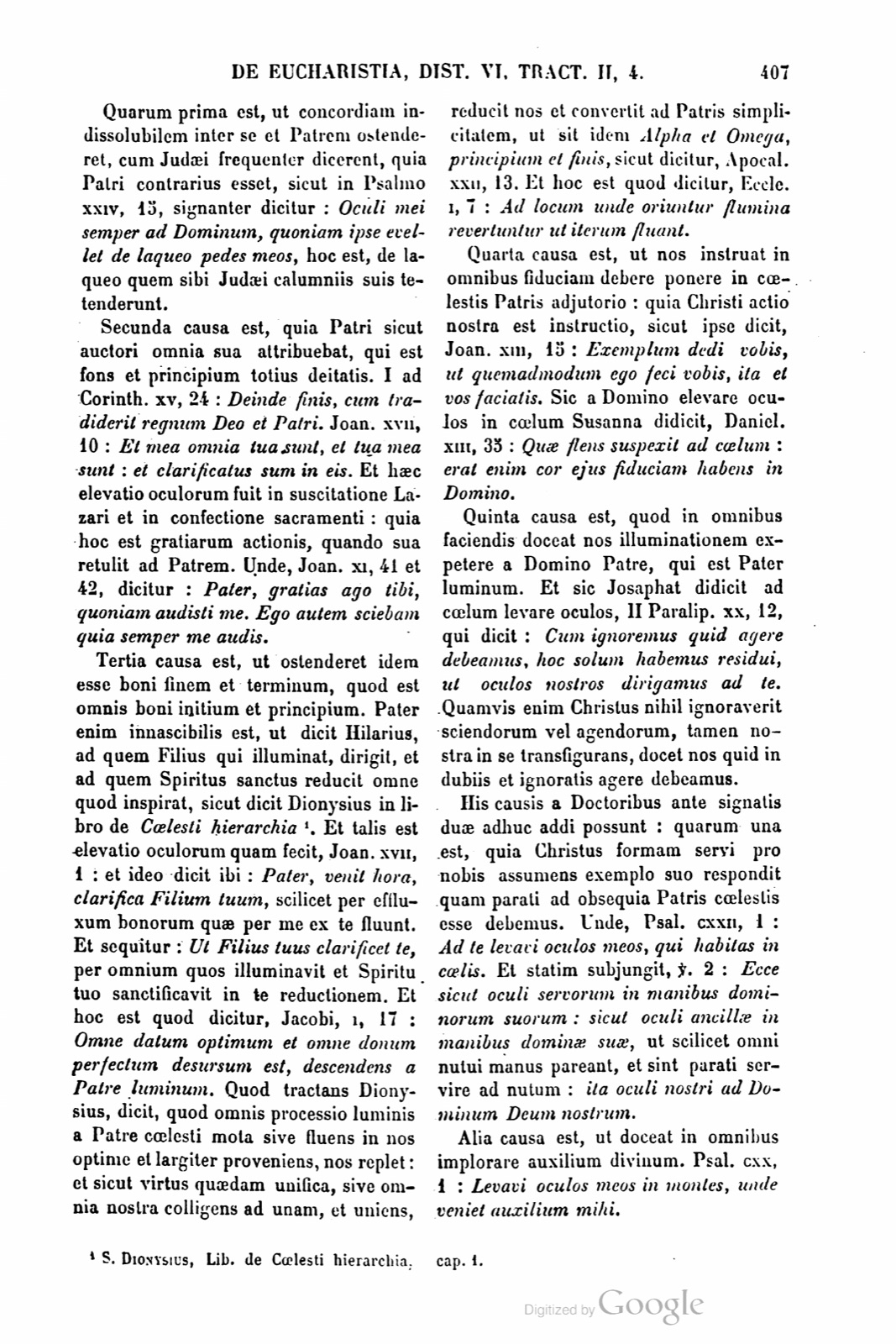
His causis a Doctoribus ante signatis duae adhuc addi possunt: quarum una est, quia Christus formam servi pro nobis assumens exemplo suo respondit quam parati ad obsequia Patris coelestis esse debemus. Unde, Psal. CXXII, 1: Ad te levavi oculos meos, qui habitas in caelis. Et statim subjungit, v. 2: Ecce sicut oculi servorum in manibus dominorum suorum: sicut oculi ancillae in manibus dominae suae, ut scilicet omni nutui manus pareant, et sint parati servire ad nutum: ita oculi nostri ad Dominum Deum nostrum.
Alia causa est, ut doceat in omnibus implorare auxilium divinum. Psal. CXX, 1: Levavi oculos meos in montes, unde veniet auxilium mihi.
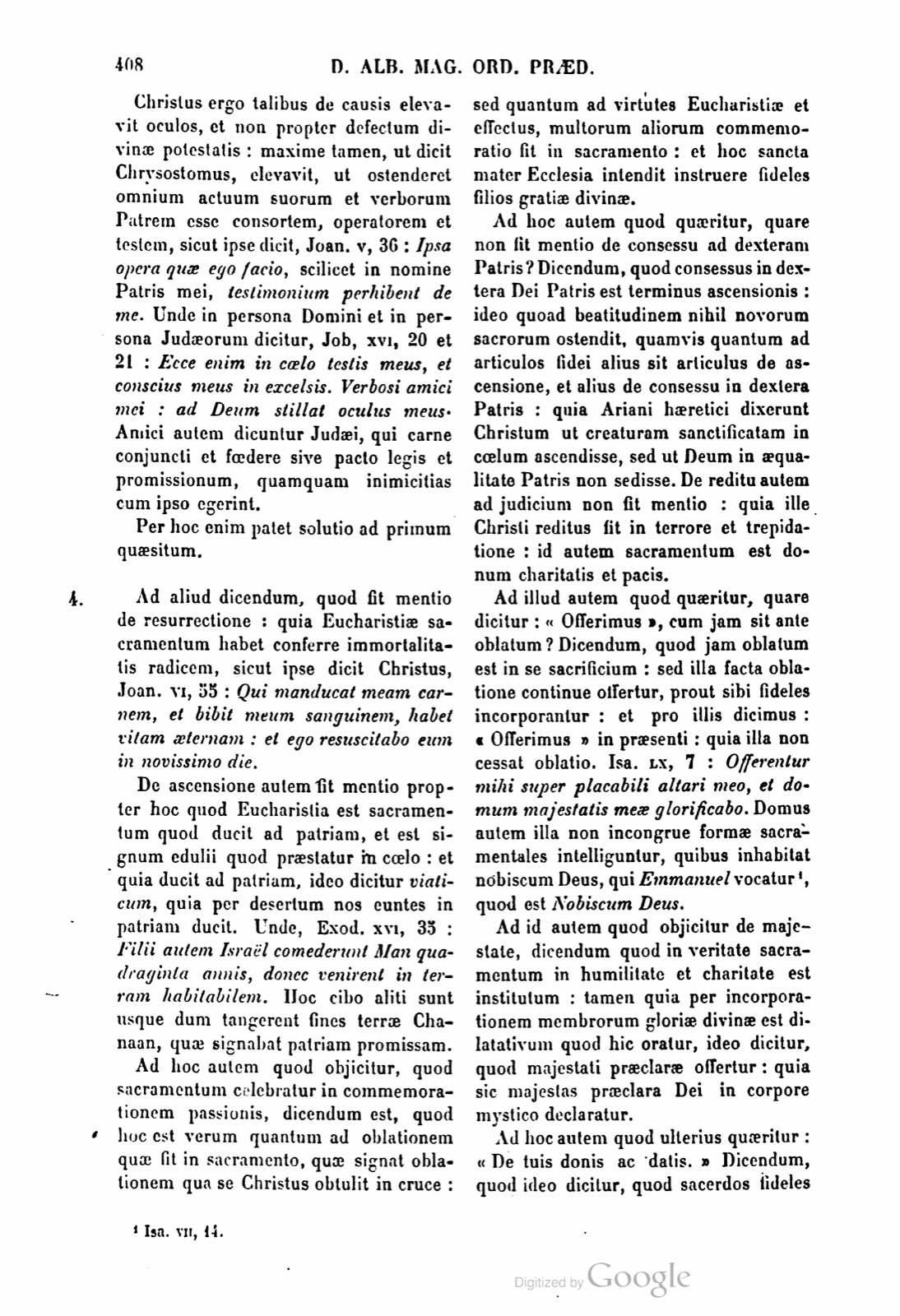
Christus ergo talibus de causis elevavit oculos, et non propter defectum divinae potestatis: maxime tamen, ut dicit Chrysostomus, elevavit, ut ostenderet omnium actuum suorum et verborum Patrem esse consortem, operatorem et testem, sicut ipse dicit, Joan. V, 36: Ipsa opera quae ego facio, scilicet in nomine Patris mei, testimonium perhibent de me. Unde in persona Domini et in persona Judaeorum dicitur, Job, XVI, 20 et 21: Ecce enim in caelo testis meus, et conscius meus in excelsis. Verbosi amici mei: ad Deum stillat oculus meus. Amici autem dicuntur Judaei, qui carne conjuncti et foedere sive pacto legis et promissionum, quamquam inimicitias cum ipso egerint.
Per hoc enim patet solutio ad primum quaesitum.
4. Ad aliud dicendum, quod fit mentio de resurrectione: quia Eucharistiae sacramentum habet conferre immortalitatis radicem, sicut ipse dicit Christus, Joan. VI, 55: Qui manducat meam carnem, et bibit meum sanguinem, habet vitam aeternam: et ego resuscitabo eum in novissimo die.
De ascensione autem fit mentio propter hoc quod Eucharistia est sacramentum quod ducit ad patriam, et est signum edulii quod praestatur in caelo: et quia ducit ad patriam, ideo dicitur viaticum, quia per desertum nos euntes in patriam ducit. Unde, Exod. XVI, 35: Filii autem Israel comederunt Man quadraginta annis, donec venirent in terram habitabilem. Hoc cibo aliti sunt usque dum tangerent fines terrae Chanaan, quae signabat patriam promissam.
Ad hoc autem quod objicitur, quod sacramentum celebratur in commemorationem passionis, dicendum est, quod hoc est verum quantum ad oblationem quae fit in sacramento, quae signat oblationem qua se Christus obtulit in cruce: sed quantum ad virtutes Eucharistiae et effectus, multorum aliorum commemoratio fit in sacramento: et hoc sancta mater Ecclesia intendit instruere fideles filios gratiae divinae.
To these causes previously marked by the Doctors, two more can be added. One of these is because Christ, assuming the form of a servant for us, answered by his own example how ready we ought to be for the services of the heavenly Father. Hence Psalm 122:1: To you I have lifted my eyes, you who dwell in the heavens. And immediately he adds, verse 2: Behold, as the eyes of servants are on the hands of their masters, as the eyes of the maidservant are on the hands of her mistress, so that, namely, they obey every nod of the hand and are ready to serve at a nod; so our eyes are toward the Lord our God.
Another cause is that he may teach us to implore divine help in all things. Psalm 120:1: I have lifted my eyes to the mountains, whence help will come to me.
Therefore Christ lifted his eyes for such causes, and not because of a defect of divine power. Yet above all, as Chrysostom says, he lifted them so that he might show the Father to be the sharer, worker, and witness of all his acts and words, as he himself says, John 5:36: The very works which I do, namely in the name of my Father, bear witness concerning me. Hence in the person of the Lord and in the person of the Jews it is said, Job 16:20 and 21: For behold, my witness is in heaven, and the one conscious of me is on high. My friends are wordy; my eye drips toward God. But the Jews are called friends, who were joined by flesh and by covenant or pact of the law and promises, although they acted with enmities against him.
Through this, therefore, the solution to the first question is clear.
4. To the other it must be said that mention is made of the resurrection because the sacrament of the Eucharist has the power to confer the root of immortality, as Christ himself says, John 6:55: He who eats my flesh and drinks my blood has eternal life, and I will raise him up on the last day.
But mention is made of the ascension for this reason, that the Eucharist is the sacrament that leads to the homeland, and is the sign of the food which is supplied in heaven; and because it leads to the homeland, therefore it is called viaticum, because it leads us, going through the desert, into the homeland. Hence Exodus 16:35: But the children of Israel ate manna forty years, until they came into a habitable land. They were nourished by this food until they touched the borders of the land of Canaan, which signified the promised homeland.
But to this which is objected, that the sacrament is celebrated in commemoration of the passion, it must be said that this is true with respect to the oblation which occurs in the sacrament, which signifies the oblation by which Christ offered himself on the cross; but with respect to the powers and effects of the Eucharist, commemoration of many other things is made in the sacrament; and holy mother Church intends by this to instruct the faithful children of divine grace.
Notes
- Saint Dionysius, Book On the Celestial Hierarchy, chapter 1. (S. Dionysius, Lib. de Coelesti hierarchia, cap. 1.) ↩
If a page does not appear, its photograph has not been uploaded yet.