Works › The Book on the Sacrament of the Eucharist
Volume 38 · pp. 369–370
Chapter I, 6
A marker with ≈ is an approximate page boundary, placed by measure of the text; the page photographs remain the authority. In the paired views, clicking a page marker brings that page into view.
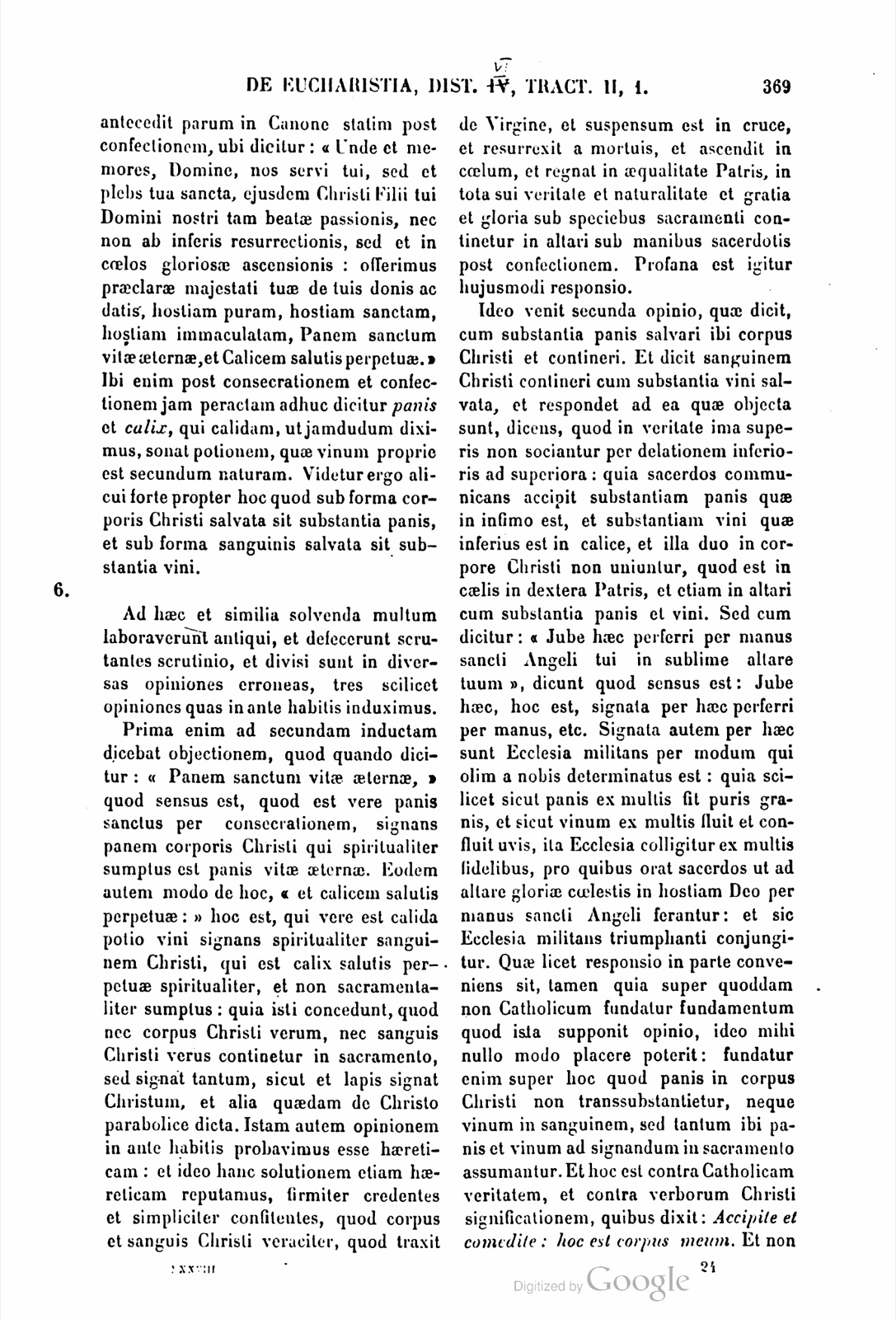
6. Ad haec et similia solvenda multum laboraverunt antiqui, et defecerunt scrutantes scrutinio, et divisi sunt in diversas opiniones erroneas, tres scilicet opiniones quas in ante habitis induximus.
Prima enim ad secundam inductam dicebat objectionem, quod quando dicitur: « Panem sanctum vitae aeternae, » quod sensus est, quod est vere panis sanctus per consecrationem, signans panem corporis Christi qui spiritualiter sumptus est panis vitae aeternae. Eodem autem modo de hoc, « et calicem salutis perpetuae: » hoc est, qui vere est calida potio vini signans spiritualiter sanguinem Christi, qui est calix salutis perpetuae spiritualiter, et non sacramentaliter sumptus: quia isti concedunt, quod nec corpus Christi verum, nec sanguis Christi verus continetur in sacramento, sed signat tantum, sicut et lapis signat Christum, et alia quaedam de Christo parabolice dicta. Istam autem opinionem in ante habitis probavimus esse haereticam: et ideo hanc solutionem etiam haereticam reputamus, firmiter credentes et simpliciter confitentes, quod corpus et sanguis Christi veraciter, quod traxit de Virgine, et suspensum est in cruce, et resurrexit a mortuis, et ascendit in caelum, et regnat in aequalitate Patris, in tota sui veritate et naturalitate et gratia et gloria sub speciebus sacramenti continetur in altari sub manibus sacerdotis post confectionem. Profana est igitur hujusmodi responsio.
Ideo venit secunda opinio, quae dicit, cum substantia panis salvari ibi corpus Christi et contineri. Et dicit sanguinem Christi contineri cum substantia vini salvata, et respondet ad ea quae objecta sunt, dicens, quod in veritate ima superis non sociantur per delationem inferioris ad superiora: quia sacerdos communicans accipit substantiam panis quae in infimo est, et substantiam vini quae inferius est in calice, et illa duo in corpore Christi non uniuntur, quod est in caelis in dextera Patris, et etiam in altari cum substantia panis et vini. Sed cum dicitur: « Jube haec perferri per manus sancti Angeli tui in sublime altare tuum », dicunt quod sensus est: Jube haec, hoc est, signata per haec perferri per manus, etc. Signata autem per haec sunt Ecclesia militans per modum qui olim a nobis determinatus est: quia scilicet sicut panis ex multis fit puris granis, et sicut vinum ex multis fluit et confluit uvis, ita Ecclesia colligitur ex multis fidelibus, pro quibus orat sacerdos ut ad altare gloriae caelestis in hostiam Deo per manus sancti Angeli ferantur: et sic Ecclesia militans triumphanti conjungitur. Quae licet responsio in parte conveniens sit, tamen quia super quoddam non Catholicum fundatur fundamentum quod ista supponit opinio, ideo mihi nullo modo placere poterit: fundatur enim super hoc quod panis in corpus Christi non transsubstantietur, neque vinum in sanguinem, sed tantum ibi panis et vinum ad signandum in sacramento assumantur. Et hoc est contra Catholicam veritatem, et contra verborum Christi significationem, quibus dixit: Accipite et comedite: hoc est corpus meum. Et non dixit: Accipite in hoc, vel cum hoc corpus meum, sicut nos superius ostendimus, ubi de ista secunda opinione est disputatum. Adhuc autem secundum hoc Joannis. VI, 56, non debuisset dixisse: Caro mea vere est cibus, et sanguis meus vere est potus: sed dixisse debuerat: Caro mea signatur, et est cum vero cibo, vel cum vero potu, quorum tamen nihil signatur in sententia verborum Christi, qui tamen veritas est, et de verbis suis dicit Apostolus, II ad Corinth. I, 19: Dei Filius, Jesus Christus,... non fuit Est et non: sed Est in illo fuit. Profanum etiam valde reputo, quod Christus in sacramento veritatis hujusmodi locutionibus tropicis et impropriis utatur, et etiam infidelem judicamus responsionem.
6. To solve these and similar things the ancients labored much, and they failed while searching with scrutiny, and they were divided into diverse erroneous opinions, namely the three opinions which we introduced in what was held before.
For the first, with regard to the second objection brought in, said that when it is said, "the holy Bread of eternal life," the sense is that it is truly holy bread through consecration, signifying the bread of the body of Christ, which, spiritually received, is the bread of eternal life. But in the same mode concerning this, "and the chalice of perpetual salvation," that is, which is truly a hot drink of wine spiritually signifying the blood of Christ, which is the chalice of perpetual salvation spiritually and not sacramentally received; because these persons concede that neither the true body of Christ nor the true blood of Christ is contained in the sacrament, but only signifies, just as stone signifies Christ, and certain other things said parabolically of Christ. But we have proved in what was held before that this opinion is heretical; and therefore we also reckon this solution heretical, firmly believing and simply confessing that the body and blood of Christ truly, which he drew from the Virgin, and was suspended on the cross, and rose from the dead, and ascended into heaven, and reigns in equality of the Father, in all its truth and naturality and grace and glory, is contained under the species of the sacrament on the altar under the hands of the priest after the confection. Therefore a response of this kind is profane.
Therefore the second opinion comes, which says that the body of Christ is preserved there and contained together with the substance of bread. And it says that the blood of Christ is contained with the substance of wine preserved, and it responds to those things which were objected, saying that in truth the lowest things are not joined to the highest things through the carrying of the lower thing to the higher things, because the communicating priest receives the substance of bread which is in the lowest place, and the substance of wine which is lower in the chalice, and those two are not united in the body of Christ, which is in the heavens at the right hand of the Father, and also on the altar with the substance of bread and wine. But when it is said, "Command these things to be carried by the hands of your holy Angel onto your sublime altar," they say that the sense is: Command these things, that is, the things signified through these things, to be carried by the hands, etc. But the things signified through these things are the Church militant, according to the mode which was once determined by us; because, namely, just as bread is made from many pure grains, and just as wine flows and flows together from many grapes, so the Church is gathered from many faithful, for whom the priest prays that they may be carried to the altar of heavenly glory as a host to God by the hands of the holy Angel; and thus the Church militant is joined to the triumphant. Although this response is fitting in part, nevertheless because it is founded upon a certain non-Catholic foundation which this opinion presupposes, therefore it will in no way be able to please me. For it is founded upon this, that bread is not transubstantiated into the body of Christ, nor wine into blood, but only bread and wine are assumed there for signifying in the sacrament. And this is contrary to Catholic truth and contrary to the signification of the words of Christ, by which he said: "Receive and eat: this is my body." And he did not say: Receive my body in this, or with this, as we showed above, where there was disputation concerning this second opinion. Moreover according to this, John 6:56 ought not to have said: "My flesh is truly food, and my blood is truly drink," but ought to have said: My flesh is signified and is with true food, or with true drink, of which nevertheless nothing is signified in the meaning of the words of Christ, who nevertheless is truth; and concerning his words the Apostle says, II Corinthians 1:19: "The Son of God, Jesus Christ, ... was not Yes and No, but Yes was in him." I also reckon it very profane that Christ in the sacrament of truth should use such tropic and improper locutions, and we also judge the response unfaithful.
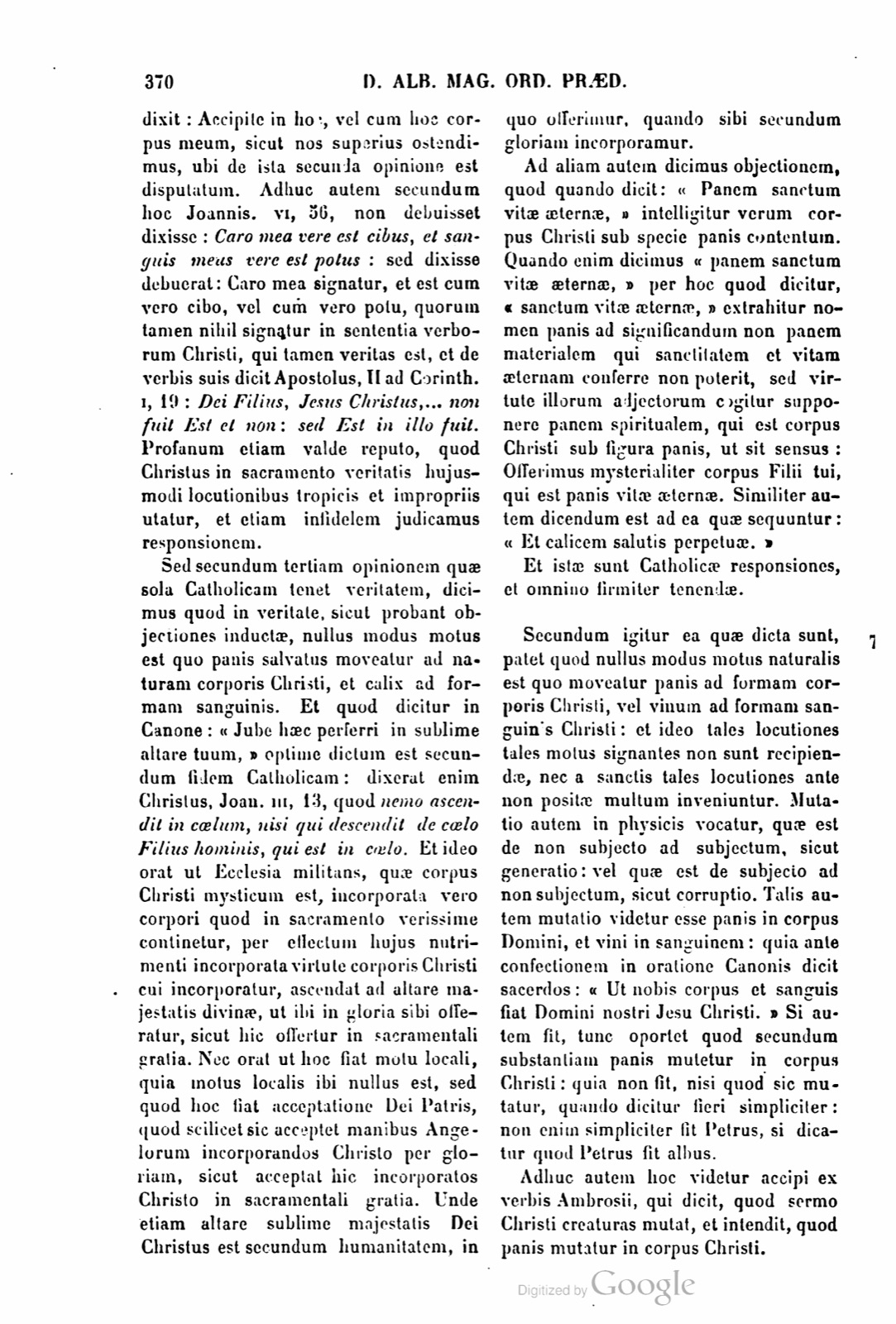
Sed secundum tertiam opinionem quae sola Catholicam tenet veritatem, dicimus quod in veritate, sicut probant objectiones inductae, nullus modus motus est quo panis salvatus moveatur ad naturam corporis Christi, et calix ad formam sanguinis. Et quod dicitur in Canone: « Jube haec perferri in sublime altare tuum, » optime dictum est secundum fidem Catholicam: dixerat enim Christus, Joan. III, 13, quod nemo ascendit in caelum, nisi qui descendit de caelo Filius hominis, qui est in caelo. Et ideo orat ut Ecclesia militans, quae corpus Christi mysticum est, incorporata vero corpori quod in sacramento verissime continetur, per effectum hujus nutrimenti incorporata virtute corporis Christi cui incorporatur, ascendat ad altare majestatis divinae, ut ibi in gloria sibi offeratur, sicut hic offertur in sacramentali gratia. Nec orat ut hoc fiat motu locali, quia motus localis ibi nullus est, sed quod hoc fiat acceptatione Dei Patris, quod scilicet sic acceptet manibus Angelorum incorporandos Christo per gloriam, sicut acceptat hic incorporatos Christo in sacramentali gratia. Unde etiam altare sublime majestatis Dei Christus est secundum humanitatem, in quo offerimur, quando sibi secundum gloriam incorporamur.
Ad aliam autem dicimus objectionem, quod quando dicit: « Panem sanctum vitae aeternae, » intelligitur verum corpus Christi sub specie panis contentum. Quando enim dicimus « panem sanctum vitae aeternae, » per hoc quod dicitur, « sanctum vitae aeternae, » extrahitur nomen panis ad significandum non panem materialem qui sanctitatem et vitam aeternam conferre non poterit, sed virtute illorum adjectorum cogitur supponere panem spiritualem, qui est corpus Christi sub figura panis, ut sit sensus: Offerimus mysterialiter corpus Filii tui, qui est panis vitae aeternae. Similiter autem dicendum est ad ea quae sequuntur: « Et calicem salutis perpetuae. »
Et istae sunt Catholicae responsiones, et omnino firmiter tenendae.
But according to the third opinion, which alone holds Catholic truth, we say that in truth, as the objections brought in prove, there is no mode of motion by which bread preserved is moved to the nature of the body of Christ, and the chalice to the form of blood. And what is said in the Canon, "Command these things to be carried onto your sublime altar," is said best according to the Catholic faith. For Christ had said, John 3:13, that "no one ascends into heaven except he who descended from heaven, the Son of Man who is in heaven." And therefore he prays that the Church militant, which is the mystical body of Christ, incorporated into the true body which is most truly contained in the sacrament, incorporated through the effect of this nourishment by the power of the body of Christ into whom it is incorporated, may ascend to the altar of divine majesty, so that there in glory it may be offered to him, just as here it is offered in sacramental grace. Nor does he pray that this happen by local motion, because there is no local motion there, but that this happen by the acceptance of God the Father, namely that by the hands of Angels he so accept those to be incorporated into Christ through glory, just as he accepts here those incorporated into Christ in sacramental grace. Hence also the sublime altar of the majesty of God is Christ according to humanity, in whom we are offered when according to glory we are incorporated into him.
But to the other objection we say that when he says, "the holy Bread of eternal life," the true body of Christ contained under the species of bread is understood. For when we say "holy bread of eternal life," through this, that "holy of eternal life" is said, the name of bread is drawn out to signify not material bread, which will not be able to confer sanctity and eternal life, but by the power of those adjectives it is compelled to suppose for spiritual bread, which is the body of Christ under the figure of bread, so that the sense is: We mysterially offer the body of your Son, who is the bread of eternal life. But similarly one must speak to those things which follow: "And the chalice of perpetual salvation."
And these are the Catholic responses, and they must in every way be held firmly.
If a page does not appear, its photograph has not been uploaded yet.