Works › The Book on the Sacrament of the Eucharist
Volume 38 · pp. 368–369
Chapter I, 5. What Is the Mode of Transubstantiation of Bread and Wine into the Body and Blood of Christ?
A marker with ≈ is an approximate page boundary, placed by measure of the text; the page photographs remain the authority. In the paired views, clicking a page marker brings that page into view.
Marginal label (printed p. 368): Quis sit modus transsubstantiationis panis et vini in corpus et sanguinem Christi?
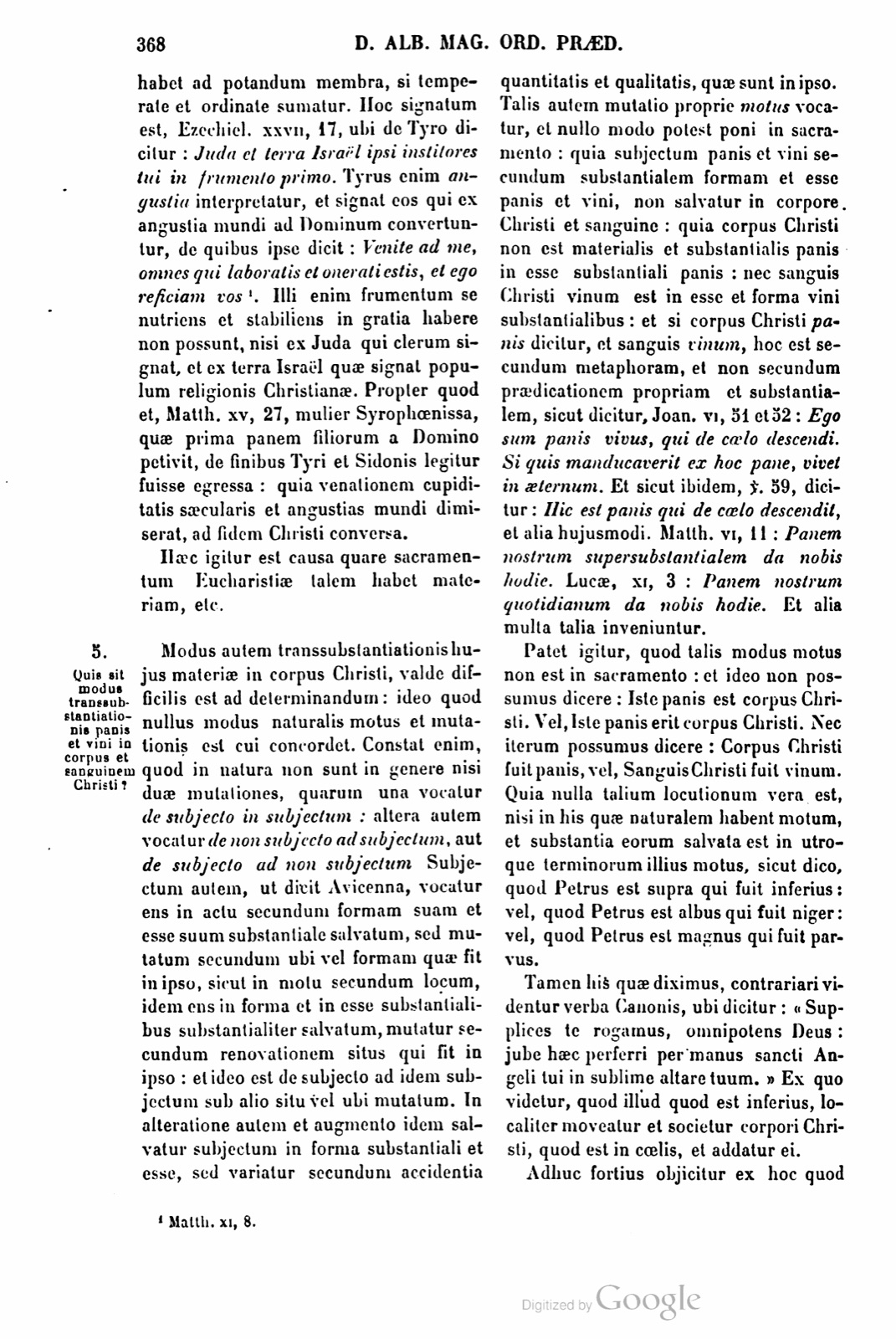
5. Modus autem transsubstantiationis hujus materiae in corpus Christi, valde difficilis est ad determinandum: ideo quod nullus modus naturalis motus et mutationis est cui concordet. Constat enim, quod in natura non sunt in genere nisi duae mutationes, quarum una vocatur de subjecto in subjectum: altera autem vocatur de non subjecto ad subjectum, aut de subjecto ad non subjectum. Subjectum autem, ut dicit Avicenna, vocatur ens in actu secundum formam suam et esse suum substantiale salvatum, sed mutatum secundum ubi vel formam quae fit in ipso, sicut in motu secundum locum, idem ens in forma et in esse substantialibus substantialiter salvatum, mutatur secundum renovationem situs qui fit in ipso: et ideo est de subjecto ad idem subjectum sub alio situ vel ubi mutatum. In alteratione autem et augmento idem salvatur subjectum in forma substantiali et esse, sed variatur secundum accidentia quantitatis et qualitatis, quae sunt in ipso. Talis autem mutatio proprie motus vocatur, et nullo modo potest poni in sacramento: quia subjectum panis et vini secundum substantialem formam et esse panis et vini, non salvatur in corpore Christi et sanguine: quia corpus Christi non est materialis et substantialis panis in esse substantiali panis: nec sanguis Christi vinum est in esse et forma vini substantialibus: et si corpus Christi panis dicitur, et sanguis vinum, hoc est secundum metaphoram, et non secundum praedicationem propriam et substantialem, sicut dicitur, Joan. VI, 51 et 52: Ego sum panis vivus, qui de caelo descendi. Si quis manducaverit ex hoc pane, vivet in aeternum. Et sicut ibidem, v. 59, dicitur: Hic est panis qui de caelo descendit, et alia hujusmodi. Matth. VI, 11: Panem nostrum supersubstantialem da nobis hodie. Lucae, XI, 3: Panem nostrum quotidianum da nobis hodie. Et alia multa talia inveniuntur.
Marginal label (printed p. 368): What is the mode of transubstantiation of bread and wine into the body and blood of Christ?
5. But the mode of transubstantiation of this matter into the body of Christ is very difficult to determine, for the reason that there is no mode of natural motion and change with which it agrees. For it is clear that in nature there are in general only two changes, one of which is called from subject to subject; but the other is called from non-subject to subject, or from subject to non-subject. But subject, as Avicenna says, is called a being in act according to its form and its substantial being preserved, but changed according to where or according to a form which comes to be in it, as in motion according to place, the same being, substantially preserved in form and in substantial being, is changed according to the renewal of position which comes to be in it; and therefore it is from subject to the same subject changed under another position or where. But in alteration and increase the same subject is preserved in substantial form and being, but is varied according to the accidents of quantity and quality which are in it. But such a change is properly called motion, and in no way can be posited in the sacrament, because the subject of bread and wine according to the substantial form and being of bread and wine is not preserved in the body and blood of Christ; because the body of Christ is not material and substantial bread in the substantial being of bread, nor is the blood of Christ wine in the substantial being and form of wine. And if the body of Christ is called bread, and the blood wine, this is according to metaphor and not according to proper and substantial predication, as is said, John 6:51 and 52: "I am the living bread, who came down from heaven. If anyone eats of this bread, he will live forever." And as in the same place, v. 59, it is said: "This is the bread which came down from heaven," and many other things of this kind are found. Matthew 6:11: "Give us today our supersubstantial bread." Luke 11:3: "Give us today our daily bread." And many other such things are found.
Patet igitur, quod talis modus motus non est in sacramento: et ideo non possumus dicere: Iste panis est corpus Christi. Vel, Iste panis erit corpus Christi. Nec iterum possumus dicere: Corpus Christi fuit panis, vel, Sanguis Christi fuit vinum. Quia nulla talium locutionum vera est, nisi in his quae naturalem habent motum, et substantia eorum salvata est in utroque terminorum illius motus, sicut dico, quod Petrus est supra qui fuit inferius: vel, quod Petrus est albus qui fuit niger: vel, quod Petrus est magnus qui fuit parvus.
Tamen his quae diximus, contrariari videntur verba Canonis, ubi dicitur: « Supplices te rogamus, omnipotens Deus: jube haec perferri per manus sancti Angeli tui in sublime altare tuum. » Ex quo videtur, quod illud quod est inferius, localiter moveatur et societur corpori Christi, quod est in caelis, et addatur ei.
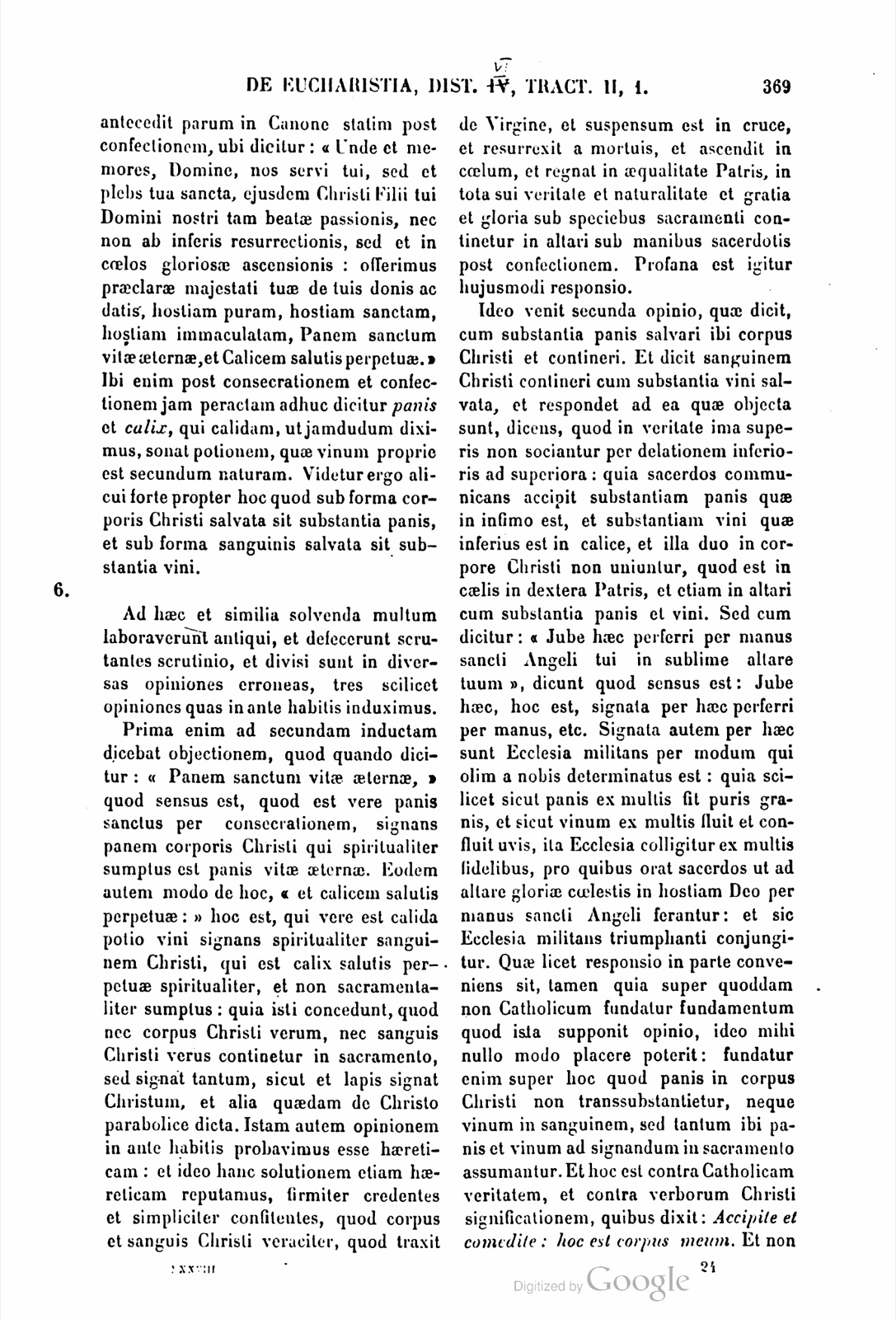
Adhuc fortius objicitur ex hoc quod antecedit parum in Canone statim post confectionem, ubi dicitur: « Unde et memores, Domine, nos servi tui, sed et plebs tua sancta, ejusdem Christi Filii tui Domini nostri tam beatae passionis, nec non ab inferis resurrectionis, sed et in caelos gloriosae ascensionis: offerimus praeclarae majestati tuae de tuis donis ac datis, hostiam puram, hostiam sanctam, hostiam immaculatam, Panem sanctum vitae aeternae, et Calicem salutis perpetuae. » Ibi enim post consecrationem et confectionem jam peractam adhuc dicitur panis et calix, qui calidam, ut jamdudum diximus, sonat potionem, quae vinum proprie est secundum naturam. Videtur ergo alicui forte propter hoc quod sub forma corporis Christi salvata sit substantia panis, et sub forma sanguinis salvata sit substantia vini.
Therefore it is clear that such a mode of motion is not in the sacrament; and therefore we cannot say: This bread is the body of Christ. Or, this bread will be the body of Christ. Nor again can we say: The body of Christ was bread, or, the blood of Christ was wine. Because none of such locutions is true except in those things which have natural motion, and their substance has been preserved in both terms of that motion, as I say that Peter is above who was below, or that Peter is white who was black, or that Peter is large who was small.
Nevertheless the words of the Canon seem to be contrary to the things which we have said, where it is said: "We suppliants ask you, almighty God: command these things to be carried by the hands of your holy Angel onto your sublime altar." From this it seems that that which is lower is moved locally and associated with the body of Christ, which is in heaven, and is added to it.
Moreover, it is objected more strongly from this which precedes a little in the Canon immediately after the confection, where it is said: "Hence also mindful, Lord, we your servants, but also your holy people, of the same Christ your Son our Lord, both of his blessed Passion and also of resurrection from the lower regions and also of glorious ascension into the heavens, offer to your splendid majesty from your gifts and things given a pure host, a holy host, an immaculate host, the holy Bread of eternal life and the Chalice of perpetual salvation." For there after the consecration and confection now carried through, it is still called bread and chalice; and chalice, as I said a little while ago, sounds a hot drink, which according to nature is properly wine. Therefore perhaps because of this it seems to someone that under the form of the body of Christ the substance of bread has been preserved, and under the form of blood the substance of wine has been preserved.
If a page does not appear, its photograph has not been uploaded yet.