Works › The Book on the Sacrament of the Eucharist
Volume 38 · p. 358
Chapter II, 4
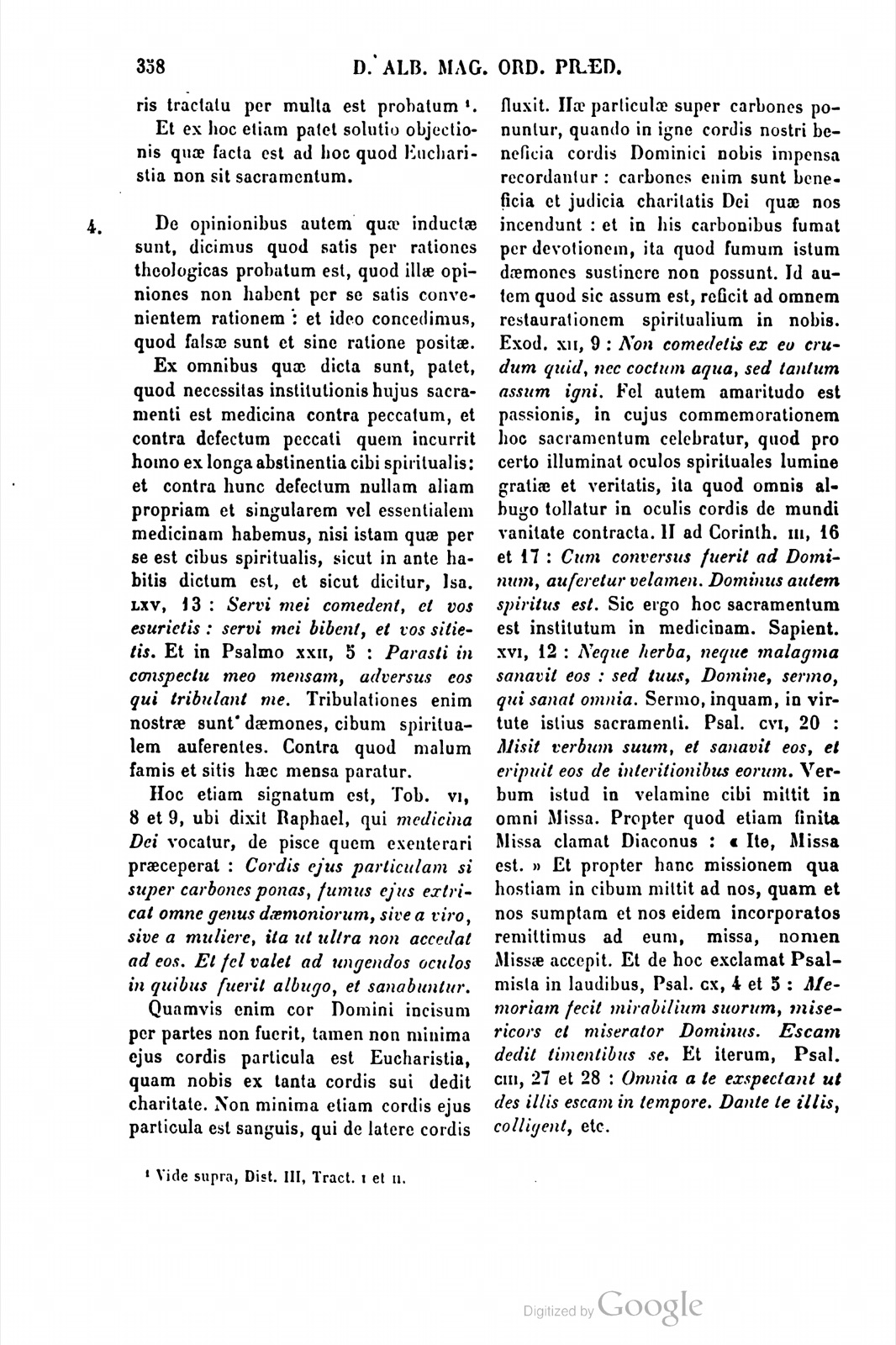
4. De opinionibus autem quae inductae sunt, dicimus quod satis per rationes theologicas probatum est, quod illae opiniones non habent per se satis convenientem rationem: et ideo concedimus, quod falsae sunt et sine ratione positae.
Ex omnibus quae dicta sunt, patet, quod necessitas institutionis hujus sacramenti est medicina contra peccatum, et contra defectum peccati quem incurrit homo ex longa abstinentia cibi spiritualis: et contra hunc defectum nullam aliam propriam et singularem vel essentialem medicinam habemus, nisi istam quae per se est cibus spiritualis, sicut in ante habitis dictum est, et sicut dicitur, Isa. LXV, 13: Servi mei comedent, et vos esurietis: servi mei bibent, et vos sitietis. Et in Psalmo XXII, 5: Parasti in conspectu meo mensam, adversus eos qui tribulant me. Tribulationes enim nostrae sunt daemones, cibum spiritualem auferentes. Contra quod malum famis et sitis haec mensa paratur.
Hoc etiam signatum est, Tob. VI, 8 et 9, ubi dixit Raphael, qui medicina Dei vocatur, de pisce quem exenterari praeceperat: Cordis ejus particulam si super carbones ponas, fumus ejus extricat omne genus daemoniorum, sive a viro, sive a muliere, ita ut ultra non accedat ad eos. Et fel valet ad ungendos oculos in quibus fuerit albugo, et sanabuntur.
Quamvis enim cor Domini incisum per partes non fuerit, tamen non minima ejus cordis particula est Eucharistia, quam nobis ex tanta cordis sui dedit charitate. Non minima etiam cordis ejus particula est sanguis, qui de latere cordis fluxit. Hae particulae super carbones ponuntur, quando in igne cordis nostri beneficia cordis Dominici nobis impensa recordantur: carbones enim sunt beneficia et judicia charitatis Dei quae nos incendunt: et in his carbonibus fumat per devotionem, ita quod fumum istum daemones sustinere non possunt. Id autem quod sic assum est, reficit ad omnem restaurationem spiritualium in nobis. Exod. XII, 9: Non comedetis ex eo crudum quid, nec coctum aqua, sed tantum assum igni. Fel autem amaritudo est passionis, in cujus commemorationem hoc sacramentum celebratur, quod pro certo illuminat oculos spirituales lumine gratiae et veritatis, ita quod omnis albugo tollatur in oculis cordis de mundi vanitate contracta. II ad Corinth. III, 16 et 17: Cum conversus fuerit ad Dominum, auferetur velamen. Dominus autem spiritus est. Sic ergo hoc sacramentum est institutum in medicinam. Sapient. XVI, 12: Neque herba, neque malagma sanavit eos: sed tuus, Domine, sermo, qui sanat omnia. Sermo, inquam, in virtute istius sacramenti. Psal. CVI, 20: Misit verbum suum, et sanavit eos, et eripuit eos de interitionibus eorum. Verbum istud in velamine cibi mittit in omni Missa. Propter quod etiam finita Missa clamat Diaconus: « Ite, Missa est. » Et propter hanc missionem qua hostiam in cibum mittit ad nos, quam et nos sumptam et nos eidem incorporatos remittimus ad eum, missa, nomen Missae accepit. Et de hoc exclamat Psalmista in laudibus, Psal. CX, 4 et 5: Memoriam fecit mirabilium suorum, misericors et miserator Dominus. Escam dedit timentibus se. Et iterum, Psal. CIII, 27 et 28: Omnia a te exspectant ut des illis escam in tempore. Dante te illis, colligent, etc.
4. But concerning the opinions which were introduced, we say that it has been sufficiently proved through theological reasons that those opinions do not have by themselves a sufficiently fitting reason; and therefore we concede that they are false and posited without reason.
From all the things that have been said, it is clear that the necessity of the institution of this sacrament is medicine against sin and against the defect of sin which a human being incurs from long abstinence from spiritual food; and against this defect we have no other proper and singular or essential medicine except that one which by itself is spiritual food, as was said in what was held before, and as is said, Isaiah 65:13: "My servants shall eat, and you shall hunger; my servants shall drink, and you shall thirst." And in Psalm 22:5: "You have prepared a table in my sight, against those who trouble me." For our tribulations are demons taking away spiritual food. Against this evil of hunger and thirst this table is prepared.
This also was signified, Tobit 6:8 and 9, where Raphael, who is called medicine of God, said concerning the fish which he had commanded to be disemboweled: "If you place a little piece of its heart upon coals, its smoke drives out every kind of demons, whether from a man or from a woman, so that thereafter it does not approach them. And the gall avails for anointing eyes in which there has been a white film, and they will be healed."
For although the heart of the Lord was not cut into pieces, nevertheless the Eucharist, which he gave to us from so great a charity of his heart, is not the least little piece of his heart. Also the blood, which flowed from the side of his heart, is not the least little piece of his heart. These little pieces are placed upon coals when, in the fire of our heart, the benefits of the Lordly heart bestowed on us are recalled; for the coals are the benefits and judgments of the charity of God which set us on fire. And on these coals it smokes through devotion, so that demons cannot endure that smoke. But that which is thus roasted restores unto every restoration of spiritual things in us. Exodus 12:9: "You shall not eat any of it raw, nor cooked with water, but only roasted with fire." But the gall is the bitterness of the Passion, in commemoration of which this sacrament is celebrated, which for certain illumines spiritual eyes with the light of grace and truth, so that every white film contracted in the eyes of the heart from the vanity of the world is removed. II Corinthians 3:16 and 17: "When he shall have been converted to the Lord, the veil will be taken away. But the Lord is spirit." Thus therefore this sacrament was instituted as medicine. Wisdom 16:12: "Neither herb nor poultice healed them, but your word, O Lord, which heals all things." The Word, I say, in the power of this sacrament. Psalm 106:20: "He sent his word and healed them, and snatched them from their destructions." He sends this Word in the veil of food in every Mass. On account of which, when the Mass has also been finished, the Deacon cries: "Go, the Mass is." And on account of this mission by which he sends the host to us as food, which, after receiving, we also send back to him, and ourselves incorporated into the same, the missa received the name of Mass. And concerning this the Psalmist exclaims in praises, Psalm 110:4 and 5: "He made a memory of his wonderful things, the merciful and compassionate Lord. He gave food to those fearing him." And again, Psalm 103:27 and 28: "All things expect from you that you give them food in time. When you give it to them, they will gather," etc.
If a page does not appear, its photograph has not been uploaded yet.