Works › The Book on the Sacrament of the Eucharist
Volume 38 · p. 339
Chapter VII. That this sacrament makes the truest communion of divine and human things.
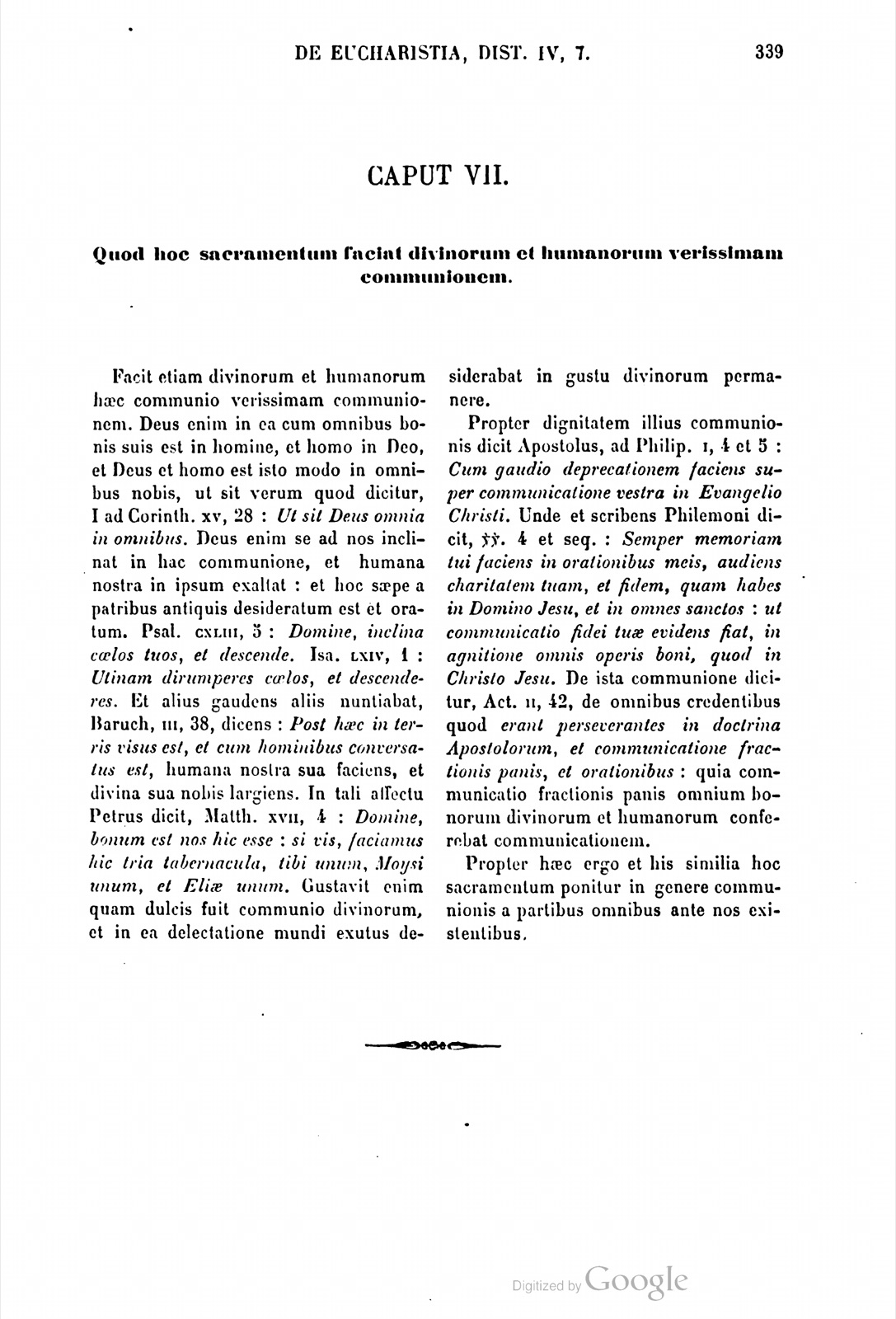
CAPUT VII. Quod hoc sacramentum faciat divinorum et humanorum verissimam communionem.
Facit etiam divinorum et humanorum haec communio verissimam communionem. Deus enim in ea cum omnibus bonis suis est in homine, et homo in Deo, et Deus et homo est isto modo in omnibus nobis, ut sit verum quod dicitur, I ad Corinth. XV, 28: Ut sit Deus omnia in omnibus. Deus enim se ad nos inclinat in hac communione, et humana nostra in ipsum exaltat: et hoc saepe a patribus antiquis desideratum est et oratum. Psal. CXLIII, 5: Domine, inclina caelos tuos, et descende. Isa. LXIV, 1: Utinam dirumperes caelos, et descenderes. Et alius gaudens aliis nuntiabat, Baruch, III, 38, dicens: Post haec in terris visus est, et cum hominibus conversatus est, humana nostra sua faciens, et divina sua nobis largiens. In tali affectu Petrus dicit, Matth. XVII, 4: Domine, bonum est nos hic esse: si vis, faciamus hic tria tabernacula, tibi unum, Moysi unum, et Eliae unum. Gustavit enim quam dulcis fuit communio divinorum, et in ea delectatione mundi exutus desiderabat in gustu divinorum permanere.
Propter dignitatem illius communionis dicit Apostolus, ad Philip. I, 4 et 5: Cum gaudio deprecationem faciens super communicatione vestra in Evangelio Christi. Unde et scribens Philemoni dicit, v. 4 et seq.: Semper memoriam tui faciens in orationibus meis, audiens charitatem tuam, et fidem, quam habes in Domino Jesu, et in omnes sanctos: ut communicatio fidei tuae evidens fiat, in agnitione omnis operis boni, quod in Christo Jesu. De ista communione dicitur, Act. II, 42, de omnibus credentibus quod erant perseverantes in doctrina Apostolorum, et communicatione fractionis panis, et orationibus: quia communicatio fractionis panis omnium bonorum divinorum et humanorum conferebat communicationem.
Propter haec ergo et his similia hoc sacramentum ponitur in genere communionis a patribus omnibus ante nos existentibus.
CHAPTER VII. That this sacrament makes the truest communion of divine and human things.
This communion also makes the truest communion of divine and human things. For in it God with all his goods is in man, and man in God, and God and man is in this way in all of us, so that what is said may be true, I Corinthians 15:28: "That God may be all things in all." For God inclines himself to us in this communion, and exalts our human things into himself; and this was often desired and prayed by the ancient fathers. Psalm 143:5: "Lord, incline your heavens, and descend." Isaiah 64:1: "Would that you would burst the heavens and descend." And another, rejoicing, announced it to others, Baruch 3:38, saying: "After these things he was seen on earth, and conversed with men," making our human things his own and lavishing his divine things on us. In such affection Peter says, Matthew 17:4: "Lord, it is good for us to be here; if you wish, let us make here three tabernacles, one for you, one for Moses, and one for Elijah." For he tasted how sweet was the communion of divine things, and in that delight, stripped of the world, desired to remain in the taste of divine things.
On account of the dignity of that communion the Apostle says, Philippians 1:4 and 5: "With joy making supplication concerning your communication in the Gospel of Christ." Hence also writing to Philemon he says, v. 4 and following: "Always making memory of you in my prayers, hearing your charity and the faith which you have in the Lord Jesus and toward all the saints, that the communication of your faith may become evident in the knowledge of every good work which is in Christ Jesus." Concerning this communion it is said, Acts 2:42, of all believers, that they were persevering "in the doctrine of the Apostles, and the communication of the breaking of bread, and prayers," because the communication of the breaking of bread conferred the communication of all divine and human goods.
Therefore on account of these and things similar to these, this sacrament is placed in the genus of communion by all the fathers existing before us.
If a page does not appear, its photograph has not been uploaded yet.