Works › The Book on the Sacrament of the Eucharist
Volume 38 · pp. 337–338
Chapter VI. That this sacrament makes all our things common, both in spiritual things and in bodily things.
A marker with ≈ is an approximate page boundary, placed by measure of the text; the page photographs remain the authority. In the paired views, clicking a page marker brings that page into view.
CAPUT VI. Quod hoc sacramentum faciat omnia nostra communia tam in spiritualibus quam in corporalibus.
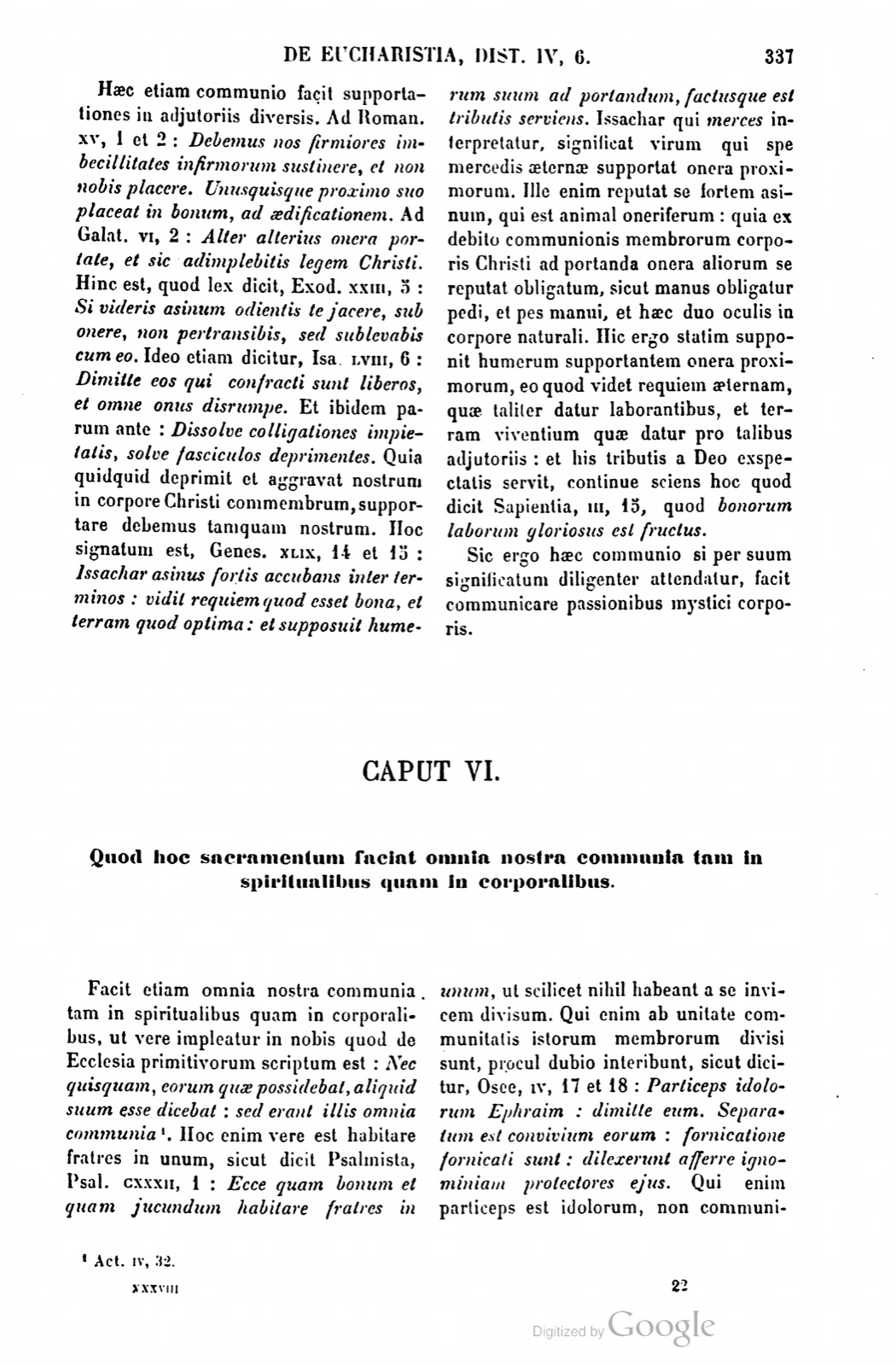
Facit etiam omnia nostra communia, tam in spiritualibus quam in corporalibus, ut vere impleatur in nobis quod de Ecclesia primitivorum scriptum est: Nec quisquam, eorum quae possidebat, aliquid suum esse dicebat: sed erant illis omnia communia.1 Hoc enim vere est habitare fratres in unum, sicut dicit Psalmista, Psal. CXXXI, 1: Ecce quam bonum et quam jucundum habitare fratres in unum, ut scilicet nihil habeant a se invicem divisum. Qui enim ab unitate communitatis istorum membrorum divisi sunt, procul dubio interibunt, sicut dicitur, Osee, IV, 17 et 18: Particeps idolorum Ephraim: dimitte eum. Separatum est convivium eorum: fornicatione fornicati sunt: dilexerunt afferre ignominiam protectores ejus. Qui enim particeps est idolorum, non communicat cum mensa Domini. I ad Corinth. X, 21: Non potestis mensae Domini participes esse, et mensae daemoniorum. Unde refectionem sumens cum diabolo, communionem non habet cum mensa Domini: et ideo talis dimittendus est: quia suum convivium separatum est a communione sanctorum: quia delectatione malae concupiscentiae fornicatus est a Deo suo: et protectores ejus, qui sunt liberum arbitrium et voluntas, dilexerunt illicita, ex quibus ferunt in opere sordis ignominiam. Hinc est quod Psalmista, Psal. XLIX, 5, dicit: Congregate illi sanctos ejus, qui ordinant testamentum ejus super sacrificia. Quia Deus istam omnium bonorum nostrorum communionem super omnia sacrificia diligit. Hoc est quod alibi dicit Psalmista, Psal. CI, 23: In conveniendo populos in unum, et reges ut serviant Domino. Servitium enim nullum Deo acceptum est, nisi quod in unitate communionis sanctorum est: id enim quod sic in unam congregat communionem, amor est, non tantum congregativus, sed unitivus. Et de hac uniente charitate scriptum est, I ad Corinth. XIII, 5, quod charitas non quaerit quae sua sunt, sed quae aliorum. Glossa Augustini dicit: « Quia communia propriis, non propria communibus anteponit. » Ex hac enim communione habet Ecclesia, ut omnibus satisfaciat in indulgentiis: quia quod uni deest, suppletur ex abundantiis aliorum: omnis enim abundantia est in Christi corporis communione, in qua sicut dicitur, ad Coloss. II, 3, omnes thesauri sapientiae et scientiae Dei sunt absconditi. Hinc gratias agit Apostolus, I ad Corinth. I, 4 et seq.: Gratias ago Deo meo semper pro vobis, in gratia Dei quae data est vobis in Christo Jesu, quod in omnibus divites facti estis in illo, in omni verbo, et in omni scientia: sicut testimonium Christi confirmatum est in vobis: ita ut nihil desit vobis in ulla gratia: ibi enim commune meritum Christi, beatae Virginis, Angelorum, Patriarcharum, Apostolorum, Martyrum, et omne meritum electorum Dei: et ideo nullus ibi pauper invenitur: omnes enim, sicut dicitur, Eccli. XLIV, 6, sunt divites in virtute, pulchritudinis studium habentes.
CHAPTER VI. That this sacrament makes all our things common, both in spiritual things and in bodily things.
It also makes all our things common, both in spiritual things and in bodily things, so that what is written concerning the Church of the first ones may truly be fulfilled in us: "Nor did anyone say that anything of the things which he possessed was his own; but all things were common to them."1 For this is truly for brothers to dwell in one, as the Psalmist says, Psalm 131:1: "Behold how good and how pleasant it is for brothers to dwell in one," namely so that they have nothing divided from one another. For those who are divided from the unity of the community of these members will without doubt perish, as is said, Hosea 4:17 and 18: "Ephraim is a participant of idols; leave him. Their banquet has been separated; with fornication they have fornicated; his protectors have loved to bring ignominy." For he who is a participant of idols does not communicate with the table of the Lord. I Corinthians 10:21: "You cannot be participants of the table of the Lord and of the table of demons." Hence one taking refreshment with the devil does not have communion with the table of the Lord; and therefore such a one must be left, because his banquet has been separated from the communion of saints, because by delight of evil concupiscence he has fornicated from his God, and his protectors, which are free choice and will, have loved unlawful things, from which they bear ignominy in the work of filth. Hence the Psalmist says, Psalm 49:5: "Gather to him his saints, who order his testament upon sacrifices." Because God loves this communion of all our goods above all sacrifices. This is what the Psalmist says elsewhere, Psalm 101:23: "In peoples coming together into one, and kings, that they may serve the Lord." For no service is acceptable to God except what is in the unity of the communion of saints; for that which gathers thus into one communion is love, not only gathering but uniting. And concerning this uniting charity it is written, I Corinthians 13:5, that charity "does not seek the things that are its own," but those which are of others. The Gloss of Augustine says: "Because it places common things before its own, not its own before common things." For from this communion the Church has it that she satisfies for all in indulgences, because what is lacking to one is supplied from the abundances of others; for every abundance is in the communion of Christ's body, in which, as is said, Colossians 2:3, "all the treasures of the wisdom and knowledge of God are hidden." Hence the Apostle gives thanks, I Corinthians 1:4 and following: "I give thanks to my God always for you, in the grace of God which has been given to you in Christ Jesus, because in all things you have been made rich in him, in every word and in every knowledge, as the testimony of Christ has been confirmed in you, so that nothing is lacking to you in any grace." For there is the common merit of Christ, of the blessed Virgin, of Angels, of Patriarchs, of Apostles, of Martyrs, and every merit of God's elect; and therefore no poor person is found there. For all, as is said, Ecclesiasticus 44:6, are "rich in virtue, having zeal for beauty."
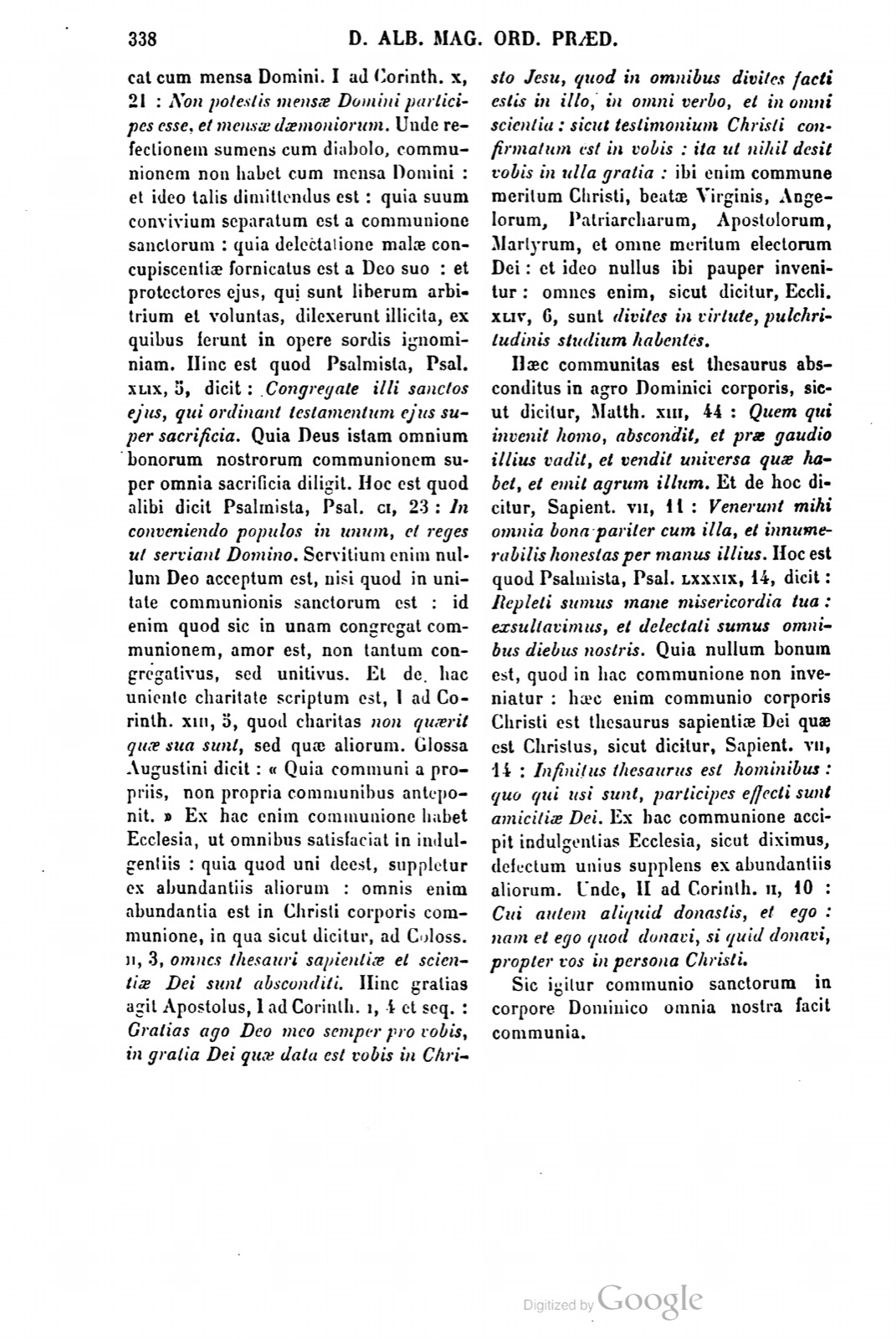
Haec communitas est thesaurus absconditus in agro Dominici corporis, sicut dicitur, Matth. XIII, 44: Quem qui invenit homo, abscondit, et prae gaudio illius vadit, et vendit universa quae habet, et emit agrum illum. Et de hoc dicitur, Sapient. VII, 11: Venerunt mihi omnia bona pariter cum illa, et innumerabilis honestas per manus illius. Hoc est quod Psalmista, Psal. LXXXIX, 14, dicit: Repleti sumus mane misericordia tua: exsultavimus, et delectati sumus omnibus diebus nostris. Quia nullum bonum est, quod in hac communione non inveniatur: haec enim communio corporis Christi est thesaurus sapientiae Dei quae est Christus, sicut dicitur, Sapient. VII, 14: Infinitus thesaurus est hominibus: quo qui usi sunt, participes effecti sunt amicitiae Dei. Ex hac communione accipit indulgentias Ecclesia, sicut diximus, defectum unius supplens ex abundantiis aliorum. Unde, II ad Corinth. II, 10: Cui autem aliquid donastis, et ego: nam et ego quod donavi, si quid donavi, propter vos in persona Christi.
Sic igitur communio sanctorum in corpore Dominico omnia nostra facit communia.
This community is the treasure hidden in the field of the Lord's body, as is said, Matthew 13:44: "When a man finds it, he hides it, and for joy over it goes and sells all that he has and buys that field." And concerning this it is said, Wisdom 7:11: "All goods came to me equally with her, and innumerable honor through her hands." This is what the Psalmist says, Psalm 89:14: "We have been filled in the morning with your mercy; we have exulted and been delighted all our days." Because there is no good which is not found in this communion; for this communion of Christ's body is the treasure of the wisdom of God which is Christ, as is said, Wisdom 7:14: "It is an infinite treasure for men; those who have used it have been made participants of the friendship of God." From this communion the Church receives indulgences, as we have said, supplying the defect of one from the abundances of others. Hence, II Corinthians 2:10: "But to whom you have given anything, I also; for I also, what I have given, if I have given anything, for your sake in the person of Christ."
Thus therefore the communion of saints in the Lord's body makes all our things common.
Notes
- Acts 4:32. (Act. IV, 32.) ↩
If a page does not appear, its photograph has not been uploaded yet.