Works › The Book on the Sacrament of the Eucharist
Volume 38 · pp. 316–321
Chapter II, no. 1: Christ in the sacramental forms as in a place of habitation
A marker with ≈ is an approximate page boundary, placed by measure of the text; the page photographs remain the authority. In the paired views, clicking a page marker brings that page into view.
CAPUT II. Veritatem determinatam ex propriis illustrat.
1. His itaque ad determinationem veritatis expeditis, ludendo in hac veritate, dicimus quod Christus in sacramentalibus formis continetur, ut in loco suae gloriosissimae habitationis, ut in aula dulcissimae refectionis, ut in atrio vel mysterio spiritualis mactationis et immolationis, et sicut in nexu amicissimae connexionis Dei et hominis.
Et de primo horum modorum advertendum est, quod in nullo loco suae habitationis ita certitudinaliter et infallibiliter invenitur, sicut in hujusmodi loco suae habitationis. III Regum, VIII, 12: Dominus dixit ut habitaret in nebula. Nebula autem hostia sacramenti vocatur, ex quo dixit et statuendo fixit, omni tempore gloriosus et certitudinaliter in hoc loco invenitur. Ezechiel. XLII, 7: Fili hominis, locus solii mei, et locus vestigiorum pedum meorum, ubi habito in medio filiorum Israel. Auferant ergo a me abominationes suas: quia non decet ut ad locum gloriae meae, ubi cum eis habito, homo immundus et abominabilis accedat. Dictum est enim Moysi, Exod. III, 5: Ne appropies, inquit, huc, sed solve calceamentum de pedibus tuis: locus enim, in quo stas, terra sancta est. Pedes enim animae sunt intellectus, quo pede graditur ad veritatem: et affectus, quo pede graditur ad virtutem. Quamdiu isti pedes pecuali pelle per placentiam pecorinarum delectationum cincti sunt, ad locum istum non licet appropinquare. Si autem pecorina pellis abjecta est nudo et simplici intellectu per fidem, et nudo et simplici affectu per devotionem, tunc demum admittimur ad gloriosae habitationis accessum: quamvis enim terra sit corpus Christi, quia propter nos de terra sumptum, tamen ad miram sanctitatem hujusmodi terra provecta est, dicente propheta: Scitote quoniam mirificavit Dominus sanctum suum.1 Quia sanctum sanctorum Christum in se et suis ad mirabilem gloriam provexit in hoc loco.
CHAPTER II. He illustrates the determined truth from proper things.
1. Therefore, with these things dispatched for the determination of the truth, playing in this truth, we say that Christ is contained in the sacramental forms as in the place of his most glorious habitation, as in the hall of sweetest refreshment, as in the court or mystery of spiritual slaughter and immolation, and as in the bond of the most friendly connection of God and man.
And concerning the first of these modes it must be attended that in no place of his habitation is he found so certainly and infallibly as in this sort of place of his habitation. III Kings 8:12: "The Lord said that he would dwell in a cloud." But the host of the sacrament is called a cloud; from the time when he spoke and fixed it by establishing it, glorious at every time, he is found certainly in this place. Ezekiel 42:7: "Son of man, the place of my throne and the place of the footsteps of my feet, where I dwell in the midst of the sons of Israel. Therefore let them take away their abominations from me," because it is not fitting that an unclean and abominable man should approach the place of my glory, where I dwell with them. For it was said to Moses, Exodus 3:5: "Do not come near," he says, "here, but loose the shoe from your feet; for the place in which you stand is holy ground." For the feet of the soul are the intellect, by which foot it steps toward truth, and affection, by which foot it steps toward virtue. As long as these feet are bound with cattle-skin through pleasure in beastly delights, it is not permitted to draw near to that place. But if the beastly skin has been cast away by naked and simple intellect through faith, and by naked and simple affection through devotion, then at last we are admitted to the access of the glorious habitation. For although the earth is the body of Christ, because it was taken from earth for our sake, nevertheless earth of this sort has been advanced to marvelous holiness, the prophet saying: "Know that the Lord has made his holy one marvelous."1 Because in this place he advanced Christ, the Holy of Holies, in himself and in his own, to marvelous glory.
Nobiscum est velatus pariete specierum sacramentalium, nostram devotionem prospiciens, et per fenestras revelate nos respiciens. Cantic. II, 9: En ipse stat post parietem nostrum, respiciens per fenestras, prospiciens per cancellos. Per cancellos autem vel fenestras prospiciens non videtur quando videt. Ita in sacramento videt nos Dominus, quamvis non videatur a nobis. Sunt autem fenestrae per quas in sacramento fertur ad nos veritas, et sunt cancelli per quos nobis interlucet virtutum Christi bonitas, quibus viis ad nos suae lucis dirigit radios Christus, quamvis nos eum non nisi velatum videamus.
Hoc est tabernaculum quod fixit Deus, et non homo, sicut dicitur, Isa. XXXII, 20. In quo tabernaculo veraciter habitat Christus Deus et homo. Ad Hebr. IX, 11: Per amplius et perfectius tabernaculum non manufactum, id est, non hujus creationis, ... introivit semel in sancta. Quis enim hoc tabernaculum ita figere potuit, ut starent formae accidentales sacramentales sine subjecto, nisi Deus? Pro certo nemo. Quis in hoc tabernaculum ingredi potuit sine suae quantitatis contractione, quod nullo modo est humanae creationis nisi Deus et homo Christus? Profecto nullus. Apocal. XXI, 3: Ecce tabernaculum Dei cum hominibus, et habitabit cum eis: et ipsi populus ejus erunt, et ipse Deus cum eis erit eorum Deus.
Hoc est tabernaculum admirabile multis mirabilibus depictum, et ad excubias Dei perfectum, de quo dicitur in Psalmo XLI, 5: Transibo in locum tabernaculi admirabilis, usque ad domum Dei. Sic ergo sicut in loco gloriosissimae habitationis Deus homo Christus habitat in his formis, de quo dicitur, Genes. XXVIII, 16: Vere Dominus est in loco isto, et ego nesciebam. Et iterum ibidem, v. 17: Non est hic aliud nisi domus Dei, et porta caeli. De quo, Psalmista, Psal. XXV, 8, dicit: Domine, dilexi decorem domus tuae, et locum habitationis gloriae tuae.
He is with us veiled by the wall of the sacramental species, looking upon our devotion, and through windows looking upon us in revealed fashion. Canticles 2:9: "Behold, he stands behind our wall, looking through the windows, looking through the lattices." But one looking through lattices or windows is not seen when he sees. Thus in the sacrament the Lord sees us, although he is not seen by us. But there are windows through which truth is borne to us in the sacrament, and there are lattices through which the goodness of Christ's powers shines through to us; by these ways Christ directs the rays of his light to us, although we see him only veiled.
This is the tabernacle which God pitched, and not man, as is said, Isaiah 32:20. In this tabernacle Christ, God and man, truly dwells. Hebrews 9:11: "Through a greater and more perfect tabernacle not made by hand, that is, not of this creation, ... he entered once into the holy places." For who could pitch this tabernacle so that the sacramental accidental forms would stand without a subject, except God? Certainly no one. Who could enter this tabernacle without contraction of his own quantity, which in no way belongs to human creation, except Christ, God and man? Certainly no one. Apocalypse 21:3: "Behold the tabernacle of God with men, and he will dwell with them; and they will be his people, and God himself with them will be their God."
This is the admirable tabernacle, painted with many marvels and perfected for the watches of God, concerning which it is said in Psalm 41:5: "I will pass over into the place of the admirable tabernacle, even to the house of God." Thus therefore God-man Christ dwells in these forms as in the place of his most glorious habitation, concerning which it is said, Genesis 28:16: "Truly the Lord is in this place, and I did not know." And again in the same place, v. 17: "This is nothing other than the house of God and the gate of heaven." Concerning this the Psalmist says, Psalm 25:8: "Lord, I have loved the beauty of your house and the place of the habitation of your glory."
2. Haec etiam est aula dulcissimae refectionis. Et hoc est quod dicitur, Luc. XXII, 11: Ubi est diversorium ubi pascha cum discipulis meis manducem? Istud est enim diversorium ad quod in omni Missa divertit Christus, ut in eo refectionem paret discipulis, nec amplius Christus sustinebit illud improperium quod dicitur, Luc. II, 7: Reclinavit eum in praesepio, quia non erat eis locus in diversorio. In hoc enim diversorio semper sibi locus est ut discipulis suis hic paret epulationes: quamvis etiam istae formae sacramentales in quibus Christus ut cibus continetur, significari possint per praesepe in quo reclinatus est Dominus ut cibus jumentorum. Isa. I, 3: Cognovit bos possessorem suum, et asinus praesepe domini sui. Bos enim est sacerdos, et clericus terram cordium fidelium excolens, et asinus est laicus simplex onus Domini portans, et Domino stratus ut vehat et portet Dominum: et uterque cognovit Dominum suum ut cibum in hoc praesepe sibi esse propositum. Ad hoc praesepe ut bonum animal suspiravit dolens, cum dicit, Job, VI, 5: Numquid mugiet bos, cum ante praesepe plenum steterit? Quasi diceret: Non mugiet, sed fruetur dulciter cibo sibi praeparato.
Hoc est coenaculum quod ostendit homo, lagenam vel amphoram aquae bajulans, de quo dicitur, Luc. XXII, 10: Ipse ostendet vobis coenaculum magnum, stratum: et ibi parate.2 Ad hoc enim coenaculum non potest ducere nisi homo: nec mundare potest accedentem, nisi amphoram aquae portans: nec continere potest tantam praeparationem, nisi coenaculum grande: nec dignum est tanto Domino, nisi sit stratum et altum: nec ibi praeparari potest convivium a quoquam, nisi a manibus discipulorum: hoc enim est, de quo dicitur, Eccli. XVII, 1 et 2: Deus creavit de terra hominum, et secundum imaginem suam fecit illum... Et secundum se vestivit illum virtute. Ille enim qui ad imaginem Dei factus est, imitatur Christum faciem Patris in lumine intellectus et in debili memoria ipsius et dulci amore voluntatis: et ille secundum Deum vestitus est virtute, qui nihil brutale ostendit, sed tantum devotionem et contemplationem veritatis qua fertur in Deum: et ille scit ducere ad istam aulam spiritualis refectionis. Amphora autem aquae expiationis est mundatio conscientiae per lacrymas devotionis et compunctionis, ut expiatus et mundatus accedat, qui accedit. Isa. LII, 11: Mundamini, qui fertis vasa Domini. Vera enim vasa in quibus continetur Dominus, sunt formae sacramentales panis et vini. Isa. I, 16: Lavamini, mundi estote. Hoc est quod dixit Abimelech sacerdos ad David, I Regum, XXI, 4: Si mundi sunt pueri, maxime a mulieribus, manducent. Et ibidem post pauca, v. 5: Si de mulieribus agitur, continuimus nos ab heri et nudiustertius, ... et fuerunt vasa puerorum sancta. Coenaculum autem sunt species sacramentales, in quibus coeli et terrae coena continetur. Unde, Genes. VI, 16: Coenacula et tristega facies in arca, quae signat corpus Domini. Coenacula quidem ad coenandum. Tristega autem, hoc est, tricamerata ad ordinem trium mensarum, in quibus tria reficiuntur genera hominum fidelium, scilicet Praelati, continentes, et conjugati. Continentes enim sunt, qui consilia quaedam servantes ad quemdam modum religionis vitam suam ordinaverunt, hoc est architriclinium, in quo Christus exhibet vinum bonum,3 quod filiis gratiae specialiter est in coena Dominica reservatum.
2. This also is the hall of sweetest refreshment. And this is what is said, Luke 22:11: "Where is the inn where I may eat the pasch with my disciples?" For this is the inn to which Christ turns aside in every Mass, so that in it he may prepare refreshment for the disciples; nor will Christ any longer endure that reproach which is said, Luke 2:7: "She laid him in a manger, because there was no place for them in the inn." For in this inn there is always a place for him, so that here he may prepare feasts for his disciples, although even those sacramental forms in which Christ is contained as food can be signified by the manger in which the Lord was laid as the food of beasts. Isaiah 1:3: "The ox knew his owner, and the ass the manger of his lord." For the ox is the priest and cleric cultivating the earth of the hearts of the faithful, and the ass is the simple layman carrying the burden of the Lord, and laid beneath the Lord so that he may carry and bear the Lord; and each has known his Lord as food set forth for himself in this manger. Toward this manger, as a good animal, he sighed in grief when he says, Job 6:5: "Will the ox low when it has stood before a full manger?" As if he were saying: It will not low, but will sweetly enjoy the food prepared for it.
This is the dining room which the man carrying a flask or jar of water shows, concerning whom it is said, Luke 22:10: "He will show you a large dining room, furnished; and there prepare."2 For only a man can lead to this dining room; nor can one cleanse the person approaching unless he carries the jar of water; nor can it contain so great a preparation unless it is a large dining room; nor is it worthy of so great a Lord unless it is furnished and high; nor can a banquet be prepared there by anyone except by the hands of the disciples. For this is that concerning which it is said, Ecclesiasticus 17:1 and 2: "God created man from earth, and made him according to his image... And according to himself he clothed him with virtue." For he who has been made to the image of God imitates Christ, the face of the Father, in the light of intellect and in weak memory of him and in sweet love of will; and he is clothed according to God with virtue who shows nothing brutish, but only devotion and contemplation of truth by which he is borne into God; and he knows how to lead to this hall of spiritual refreshment. But the jar of water of expiation is the cleansing of conscience through tears of devotion and compunction, so that he who approaches may approach expiated and cleansed. Isaiah 52:11: "Be cleansed, you who bear the vessels of the Lord." For the true vessels in which the Lord is contained are the sacramental forms of bread and wine. Isaiah 1:16: "Wash yourselves, be clean." This is what Abimelech the priest said to David, I Kings 21:4: "If the boys are clean, especially from women, let them eat." And in the same place a little after, v. 5: "If it is a matter of women, we have kept ourselves from yesterday and the day before yesterday, ... and the vessels of the boys were holy." But the dining room is the sacramental species, in which the supper of heaven and earth is contained. Hence, Genesis 6:16: "Dining rooms and three-storied chambers you shall make in the ark," which signifies the body of the Lord. Dining rooms indeed are for dining. But three-storied chambers, that is, three-chambered according to the order of three tables, in which three kinds of faithful men are refreshed, namely prelates, continent persons, and married persons. For continent persons are those who, observing certain counsels, have ordered their life to a certain mode of religion; this is the ruler of the banquet, in which Christ provides the good wine,3 which is especially reserved for the sons of grace in the Lord's supper.
Hoc coenaculum est grande: quia grandia continet, quae proponuntur. Isa. LXIV, 4: Oculus non vidit, Deus, absque te, quae praeparasti exspectantibus te. I ad Corinth. II, 9: Oculus non vidit, nec auris audivit, nec in cor hominis ascendit, quae praeparavit Deus iis qui diligunt illum.
Hoc, ut dicunt Patres, coenaculum est altum in admiratione fidei et cognitionis. Unde, Marc. XIV, 13 et 14: Occurret vobis homo lagenam aquae bajulans, sequimini eum, et quocumque introierit, etc. Ibi dicit Glossa: « Sequimini eum qui ducit in altum, ubi est refectio Christi. » Unde, Proverb. IX, 3, ubi sapientia parato convivio suo vocat invitatos, dicit sic: Misit ancillas suas ut vocarent ad arcem et ad moenia civitatis. Ancillae quae dicuntur ab av quod est circum, et cilleo, cilles, quod est moveor, sunt qui continue circummoventur sacerdotes praedicatores et clerici Domini, qui vocantur in arcem admirationis altitudinis consilii Dei, quo ista coena est parata. Moenia autem civitatis sunt virtutum habitus et exercitia, quibus cives in Dei civitate suas conferunt habitationes. Judith, VIII, 5: In superioribus domus suae fecit sibi secretum cubiculum, in quo cum puellis suis clausa morabatur. Puellae ejus fideles animae sunt intellectus et voluntas et memoria et ratio et hujusmodi, cum ascendimus ad arcem coenae Dei. Unde, I Regum, IX, 24, Samuel in triclinio excelso comedit cum Saul postquam inunxerat eum, dicens: Ecce quod remansit, pone ante te, et comede, quia de industria servatum est tibi. Iste enim cibus est, quia nos sibi incorporat, et nos incorporamus ipsum nobis, ut non pereat semper et remaneat fidelibus iterum sumendus, de industria sapientiae Dei sit reservatus.
This dining room is large because it contains great things which are set forth. Isaiah 64:4: "Eye has not seen, O God, besides you, the things which you have prepared for those waiting for you." I Corinthians 2:9: "Eye has not seen, nor ear heard, nor has it ascended into the heart of man, the things which God has prepared for those who love him."
This dining room, as the Fathers say, is high in wonder of faith and knowledge. Hence, Mark 14:13 and 14: "A man carrying a flask of water will meet you; follow him, and wherever he enters," etc. There the Gloss says: "Follow him who leads into the high place, where the refreshment of Christ is." Hence, Proverbs 9:3, where wisdom, after her banquet has been prepared, calls the invited, says thus: "She sent her maidservants that they might call to the citadel and to the walls of the city." Maidservants, who are said from av, which is "around," and cilleo, cilles, which is "I am moved," are those who are continually moved around, the priests, preachers, and clerics of the Lord, who are called into the citadel of wonder at the height of God's counsel, by which this supper has been prepared. But the walls of the city are the habits and exercises of virtues, by which citizens in the city of God bring together their habitations. Judith 8:5: "In the upper parts of her house she made for herself a secret chamber, in which she remained shut in with her maids." Her maids are the faithful powers of the soul, intellect and will and memory and reason and things of this sort, when we ascend to the citadel of God's supper. Hence, I Kings 9:24, Samuel ate in the high dining chamber with Saul after he had anointed him, saying: "Behold what remained; place it before you and eat, because it was kept for you by design." For this food, because it incorporates us to itself and we incorporate it to ourselves, so that it does not ever perish and may remain for the faithful to be received again, has been reserved by the design of God's wisdom.
Hoc coenaculum est stratum picturis lapidum planorum, hoc est, omni genere virtutum. Unde, Ezechiel. XLII, 3: Et contra pavimentum stratum lapide atrii exterioris. Isa. LIV, 11: Ecce ego sternam per ordinem lapides tuos. Cor enim tranquillitate planatum, soliditate confortatum, diversitate virtutum picturatum, est coenaculum stratum: quia sic Christus in atrio specierum sacramentalium contentus est pulcherrime stratus in manibus discipulorum, hoc est, sacerdotum ad ordinem sacerdotalem respicientium. Paratur cibus iste non manibus haereticorum, vel aliorum formam Ecclesiae in praeparando non tenentium. I ad Corinth. X, 21: Non potestis mensae Domini participes esse, et mensae daemoniorum. Officium enim sacerdotum non debent usurpare, nisi qui in forma et unitate Ecclesiae constituti sunt ad hoc quod in hac coena ministrent. Isa. LXI, 6: Vos autem sacerdotes Domini vocabimini: Ministri Dei nostri dicetur vobis. Quod signatum est, I Regum, IX, 13, de Samuele, qui officium sacerdotis habuit: Neque enim comesurus est populus donec ille veniat, quia ipse benedicit hostiae, et deinceps comedunt qui vocati sunt.
Sic ergo istae formae sunt aula dulcissimae refectionis.
This dining room is furnished with pictures of level stones, that is, with every kind of virtues. Hence, Ezekiel 42:3: "And opposite the pavement paved with stone of the outer court." Isaiah 54:11: "Behold, I will lay your stones in order." For a heart leveled by tranquility, strengthened by solidity, painted by diversity of virtues, is a furnished dining room, because thus Christ, contained in the court of the sacramental species, is most beautifully furnished in the hands of the disciples, that is, of the priests looking to the priestly order. This food is not prepared by the hands of heretics, or of others not holding the form of the Church in preparing it. I Corinthians 10:21: "You cannot be participants of the table of the Lord and of the table of demons." For the office of priests ought not to be usurped except by those who have been constituted in the form and unity of the Church for this, that they may minister in this supper. Isaiah 61:6: "But you will be called priests of the Lord; it will be said to you: Ministers of our God." This was signified, I Kings 9:13, concerning Samuel, who had the office of priest: "For the people will not eat until he comes, because he blesses the victim, and thereafter those who have been called eat."
Thus therefore those forms are the hall of sweetest refreshment.
3. Sunt etiam mysterium, hoc est, secretum spiritualis mactationis et immolationis. In hoc enim mysterio regnante coelo aeternaliter devotamus ad aram Ecclesiae omni die mysterialiter mactandum et immolandum manibus ecclesiasticorum sacerdotum. Unde hae species per ostium tabernaculi foederis significantur, Levit. I, 3, et in multis aliis locis: quia illae species atrium sunt sanctum, in quo immolatur Christus: super quam hostiam manus ponunt sacerdotes, qui opus sui exercent ordinis sacerdotalis, sicut praecipitur, Levit. VIII, 18, quod ponunt manus suas super caput hostiae, hoc est, super corporis Christi confectionem, qui est caput omnis hostiae. Ad hoc ostium tabernaculi omnes levatis in coelum manibus respiciunt fideles, ut in illo cum Christo Patri offerantur Christo crucifixi et incorporati. Hoc est quod dicitur, I Regum, II, 36, in desiderio populi hunc cibum esurientis: Dimitte me, obsecro, ad unam partem sacerdotalem, ut comedam buccellam panis. Unica enim et singularis pars sacerdotalis est hostia Christi corporis, ad quam populus admittitur ut buccella Dominici panis saturetur.
Hoc significatum est, Genes. XVIII, 1 et seq., ubi dicitur, quod in ostio tabernaculi sui sedit Abraham, cum vidit tres Angelos descendentes per viam, quibus tria sata farinae similae commixta fecit parari in subcinericios panes azymos. Tabernaculum enim sunt species sacramentales, sub quibus scivit mysterialiter tempore revelatae gratiae spiritualiter immolandum esse Christum, et in serena luce fidei et fervore charitatis stabat quotidie adspiciens, ut particeps illius efficeretur. Et hoc in mysterio praesignavit in specie panis trium satorum, hoc est, corporis et animae et deitatis hanc praesignans oblationem.
Hoc est ostium tabernaculi, de quo dicitur, Levit. IV, 4, ubi dicitur de vitulo qui immolatur pro peccato multitudinis, quod adducet illum, scilicet sacerdos, ad ostium tabernaculi, ponetque manum super caput ejus, et immolabit eum Domino. Et infra, vv. 5 et seq.: Hauriet quoque de sanguine vituli, inferens illum in tabernaculum testimonii: cumque intexerit digitum in sanguine, asperget eo septies coram Domino contra velum sanctuarii. Ponetque de eodem sanguine super cornua altaris thymiamatis gratissimi Domino, quod est in tabernaculo testimonii: omnem autem reliquum sanguinem fundet in basim altaris holocausti in introitu tabernaculi. Hic enim vitulus signat hostiam corporis Dominici in sagina devotionis immolandam pro omnis mundi peccato, quae ad ostium, ubi videri potest in tabernaculo Ecclesiae, adducitur, cum ad videndum a tota multitudine a sacerdote in altari elevatur. Omnes autem seniores sive sapientes manum super caput ejus ponunt, quando omnes manus in devotione ad istam hostiam protendunt et venerantur, ac si omnium manibus Deo offeratur. Infert autem sacerdos, qui unctus est in ordinem sacerdotalem, sanguinem in tabernaculum, quando infert in totam Ecclesiam ab omnibus communicandum. Tangit autem digito, quando omnibus clare demonstrat cujus sanguis sit, et ad quid valeat ejus communicatio: digiti enim opus est demonstrare et dirigere nutu quodam oculum videntis ad rem demonstratam. Aspergit autem septies contra velum, quod velum etiam formas sacramentales signat, corpus Domini verum velantes, quando intra velum illud septem effectus sanguinis esse declarat, qui sunt memoria passionis, opus redemptionis, effectus verae potationis, munditia expiationis, dulcedo naturalis sanguinis in charitate communis, tinctio ad Christum conformitatis, et consignatio sive tutatio sanguinem illum accipientis, qui signatur ne laedatur ab Angelo percussore. Reliquum autem sanguinem, qui multus est, in communem fert Ecclesiam, quae est tabernaculum foederis Domini, cum quo foedus iniit amicitiae perpetuae, fundit ad basim, hoc est, in fundum altaris holocaustorum, hoc est, cordium humanorum in quibus holocaustum istud incenditur in igne sanctae devotionis et charitatis.
3. They are also a mystery, that is, the secret of spiritual slaughter and immolation. For in this mystery, while heaven reigns eternally, we devote him to the altar of the Church to be mystically slaughtered and immolated every day by the hands of ecclesiastical priests. Hence these species are signified by the door of the tabernacle of the covenant, Leviticus 1:3, and in many other places, because those species are the holy court in which Christ is immolated. Upon this victim priests place hands, who exercise the work of their priestly order, as is prescribed, Leviticus 8:18, that they place their hands upon the head of the victim, that is, upon the confection of Christ's body, which is the head of every victim. To this door of the tabernacle all the faithful look with hands raised into heaven, so that in it with Christ they may be offered to the Father, crucified with Christ and incorporated into him. This is what is said, I Kings 2:36, in the desire of the people hungering for this food: "Send me, I beseech, to one priestly portion, that I may eat a morsel of bread." For the one and singular priestly portion is the victim of Christ's body, to which the people are admitted so that they may be satisfied with a morsel of the Lord's bread.
This was signified, Genesis 18:1 and following, where it is said that Abraham sat in the door of his tabernacle, when he saw three Angels descending by the way, for whom he had three measures of fine flour mixed and prepared as unleavened cakes under ashes. For the tabernacle is the sacramental species, under which he knew that Christ was mystically to be spiritually immolated in the time of revealed grace, and he stood daily looking out in the serene light of faith and the fervor of charity, so that he might be made a participant of that one. And this he pre-signified in mystery in the species of bread of three measures, that is, pre-signifying this oblation of body and soul and deity.
This is the door of the tabernacle, concerning which it is said, Leviticus 4:4, where it is said of the calf which is immolated for the sin of the multitude, that he, namely the priest, will bring it to the door of the tabernacle, and will place his hand upon its head, and will immolate it to the Lord. And below, vv. 5 and following: "He will also draw from the blood of the calf, bringing it into the tabernacle of testimony; and when he has dipped his finger in the blood, he will sprinkle with it seven times before the Lord opposite the veil of the sanctuary. And he will place from the same blood upon the horns of the altar of incense most pleasing to the Lord, which is in the tabernacle of testimony; but all the remaining blood he will pour at the base of the altar of holocaust in the entrance of the tabernacle." For this calf signifies the victim of the Lord's body, to be immolated in the fatness of devotion for the sin of the whole world, which is brought to the door, where it can be seen in the tabernacle of the Church, when it is elevated on the altar by the priest for viewing by the whole multitude. But all the elders or wise ones place a hand upon its head when all stretch out their hands in devotion to that victim and venerate it, as if it were offered to God by the hands of all. But the priest, who has been anointed into the priestly order, brings the blood into the tabernacle when he brings it into the whole Church to be communicated by all. But he touches with the finger when he clearly shows to all whose blood it is and what its communication avails; for the work of the finger is to show and to direct by a certain nod the eye of the one seeing to the thing shown. But he sprinkles seven times against the veil, which veil also signifies the sacramental forms veiling the true body of the Lord, when he declares that within that veil there are seven effects of blood, which are the memory of the Passion, the work of redemption, the effect of true drinking, the cleanness of expiation, the natural sweetness of blood common in charity, the dyeing to conformity with Christ, and the signing or protection of the one receiving that blood, who is signed lest he be harmed by the striking Angel. But the remaining blood, which is much, he bears into the common Church, which is the tabernacle of the Lord's covenant, with whom he entered a covenant of perpetual friendship; he pours it at the base, that is, into the foundation of the altar of holocausts, that is, of human hearts in which that holocaust is kindled in the fire of holy devotion and charity.
Sic igitur in speciebus istis Christus est sicut in atrio mystico suae spiritualis mactationis et victimationis sive immolationis.
Thus therefore in these species Christ is as in the mystical court of his spiritual slaughter and victiming or immolation.
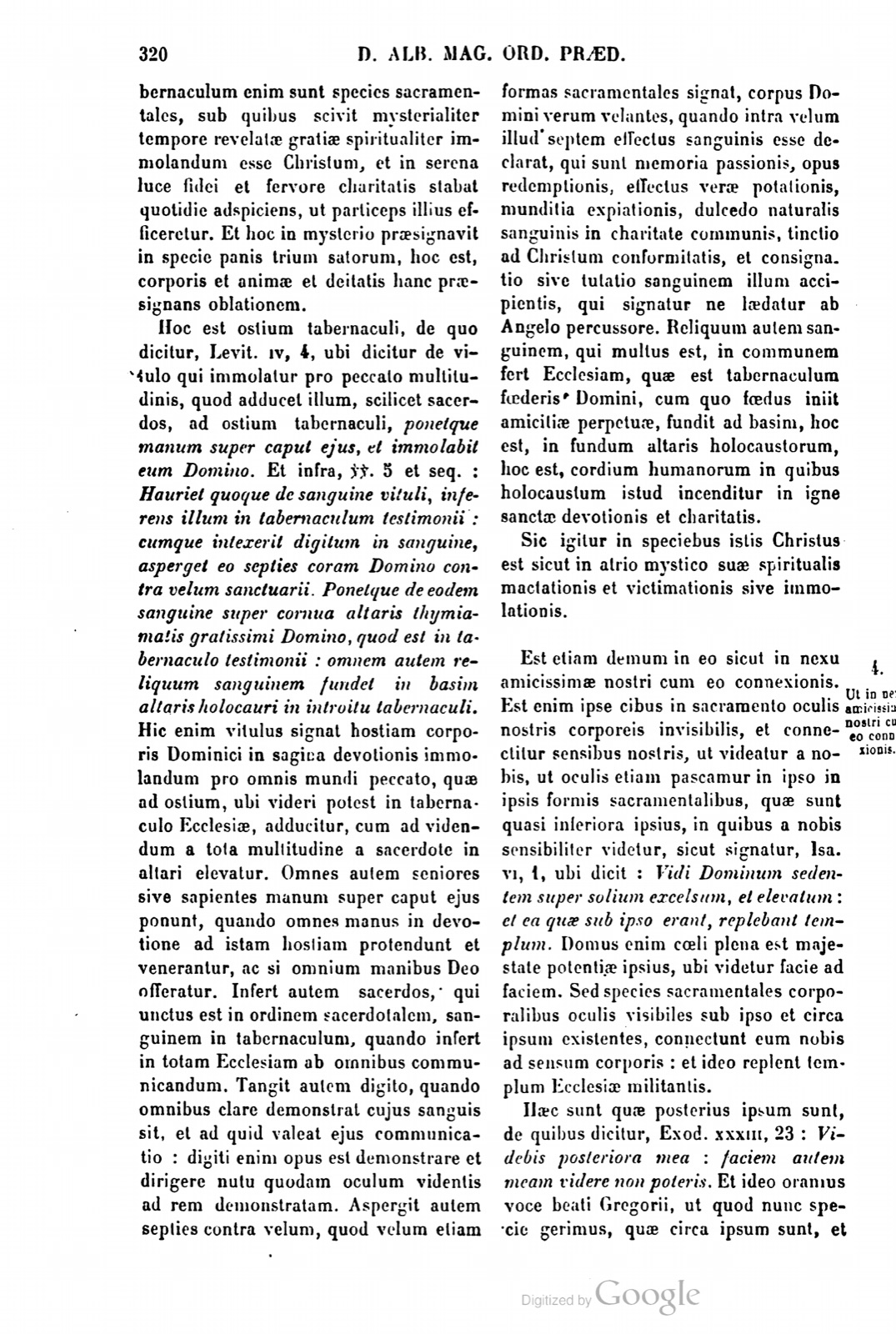
4. Est etiam demum in eo sicut in nexu amicissimae nostri cum eo connexionis. Est enim ipse cibus in sacramento oculis nostris corporeis invisibilis, et connectitur sensibus nostris, ut videatur a nobis, ut oculis etiam pascamur in ipso in ipsis formis sacramentalibus, quae sunt quasi inferiora ipsius, in quibus a nobis sensibiliter videtur, sicut signatur, Isa. VI, 1, ubi dicit: Vidi Dominum sedentem super solium excelsum, et elevatum: et ea quae sub ipso erant, replebant templum. Domus enim coeli plena est majestate potentiae ipsius, ubi videtur facie ad faciem. Sed species sacramentales corporalibus oculis visibiles sub ipso et circa ipsum existentes, connectunt eum nobis ad sensum corporis: et ideo replent templum Ecclesiae militantis.
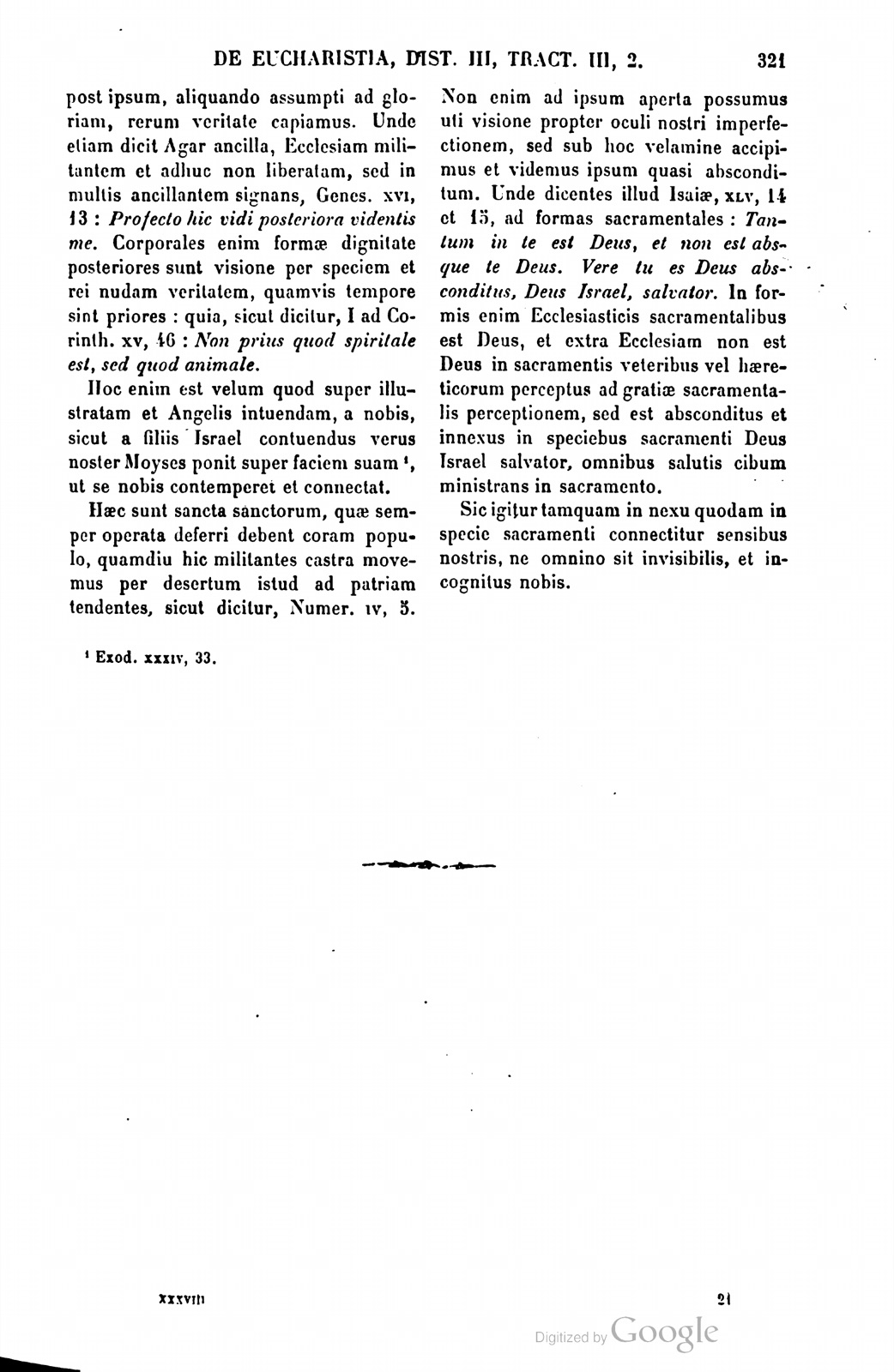
Haec sunt quae posterius ipsum sunt, de quibus dicitur, Exod. XXXIII, 23: Videbis posteriora mea: faciem autem meam videre non poteris. Et ideo oramus voce beati Gregorii, ut quod nunc specie gerimus, quae circa ipsum sunt, et post ipsum, aliquando assumpti ad gloriam, rerum veritate capiamus. Unde etiam dicit Agar ancilla, Ecclesiam militantem et adhuc non liberatam, sed in multis ancillantem signans, Genes. XVI, 13: Profecto hic vidi posteriora videntis me. Corporales enim formae dignitate posteriores sunt visione per speciem et rei nudam veritatem, quamvis tempore sint priores: quia, sicut dicitur, I ad Corinth. XV, 46: Non prius quod spiritale est, sed quod animale.
4. Finally, he is also in it as in the bond of the most friendly connection of us with him. For he himself as food in the sacrament is invisible to our bodily eyes, and he is connected to our senses so that he may be seen by us, so that we may also be fed in him by our eyes in the sacramental forms themselves, which are as it were his lower things, in which he is sensibly seen by us, as is signified, Isaiah 6:1, where he says: "I saw the Lord sitting upon a high and lifted throne, and the things which were beneath him filled the temple." For the house of heaven is full of the majesty of his power, where he is seen face to face. But the sacramental species, visible to bodily eyes, existing under him and around him, connect him to us for bodily sense; and therefore they fill the temple of the Church militant.
These are the things which are after him, concerning which it is said, Exodus 33:23: "You will see my posterior things; but my face you will not be able to see." And therefore we pray in the voice of blessed Gregory, that what we now bear in species, which are around him and after him, we may sometime, having been assumed to glory, receive in the truth of the realities. Hence also Hagar the maidservant, signifying the Church militant and not yet freed but serving as a maid in many things, says, Genesis 16:13: "Surely here I have seen the posterior things of the one seeing me." For bodily forms are posterior in dignity to vision through species and to the naked truth of the reality, although in time they are prior, because, as is said, I Corinthians 15:46: "Not first what is spiritual, but what is animal."
Hoc enim est velum quod super illustratam et Angelis intuendam, a nobis, sicut a filiis Israel contuendus verus noster Moyses ponit super faciem suam,4 ut se nobis contemperet et connectat.
Haec sunt sancta sanctorum, quae semper operata deferri debent coram populo, quamdiu hic militantes castra movemus per desertum istud ad patriam tendentes, sicut dicitur, Numer. IV, 5.
Non enim ad ipsum aperta possumus uti visione propter oculi nostri imperfectionem, sed sub hoc velamine accipimus et videmus ipsum quasi absconditum. Unde dicentes illud Isaiae, XLV, 14 et 15, ad formas sacramentales: Tantum in te est Deus, et non est absque te Deus. Vere tu es Deus absconditus, Deus Israel, salvator. In formis enim Ecclesiasticis sacramentalibus est Deus, et extra Ecclesiam non est Deus in sacramentis veteribus vel haereticorum perceptus ad gratiae sacramentalis perceptionem, sed est absconditus et innexus in speciebus sacramenti Deus Israel salvator, omnibus salutis cibum ministrans in sacramento.
Sic igitur tamquam in nexu quodam in specie sacramenti connectitur sensibus nostris, ne omnino sit invisibilis, et incognitus nobis.
For this is the veil which our true Moses, to be looked upon by us as by the sons of Israel, places over his face,4 illuminated and to be gazed upon by Angels, so that he may temper and connect himself to us.
These are the holy of holies which, once wrought, must always be carried before the people, as long as, soldiering here, we move camp through this desert while tending toward the fatherland, as is said, Numbers 4:5.
For we cannot use open vision toward him because of the imperfection of our eye, but under this veil we receive and see him as if hidden. Hence, saying that of Isaiah 45:14 and 15 to the sacramental forms: "Only in you is God, and there is no God apart from you. Truly you are a hidden God, the God of Israel, savior." For in the ecclesiastical sacramental forms God is, and outside the Church God is not received in the old sacraments or those of heretics for the perception of sacramental grace, but the God of Israel the savior is hidden and bound into the species of the sacrament, ministering the food of salvation to all in the sacrament.
Thus therefore, as in a certain bond in the species of the sacrament, he is connected to our senses, lest he be wholly invisible and unknown to us.
Notes
If a page does not appear, its photograph has not been uploaded yet.