Works › The Book on the Sacrament of the Eucharist
Volume 38 · pp. 297–304
Chapter V. What sort this drink ought to be in the operation of its proper effect
A marker with ≈ is an approximate page boundary, placed by measure of the text; the page photographs remain the authority. In the paired views, clicking a page marker brings that page into view.
Caput V. Qualis debeat esse hic potus in proprii effectus operatione?
1. Utrum sub utraque specie sumatur totus Christus? Sequitur hic ultimo dicendum de hujus potus proprii effectus operatione, de quo quidam faciunt quaestionem.
Quia enim Christus totus cum sanguine et anima spiritu et deitate habetur sub specie istius cibi qui est panis, videri potest alicui, quod nihil operationis habet in sacramento potus in specie vini.1 Si enim dicitur de natura, quod non abundat superfluis, neque deficit in necessariis, cum ordinatior sit gratia quam natura, videtur quod in gratia nihil debet esse superfluum. Cum igitur totus Christus cum suo sanguine habeatur sacramentaliter sub specie panis, videtur quod totum superfluit id quod adjicitur de specie vini.
Sed ad hoc dicimus, quod Christus postquam exhibuit corpus suum sub specie panis, tunc etiam postea exhibuit sanguinem suum sub specie vini, et utrumque sacramentaliter celebrandum esse praecepit in Ecclesia per statuta Apostolica, et ideo Ecclesia instruitur actione Christi, et utrumque celebrat divisum conficiendo corpus sub specie panis, et divisum conficiendo sanguinem sub specie vini. Quod autem sic divisum haec duo exhibuerit, et celebranda instituerit Christus, patet, Matth. XXVI, 26 et seq., ubi primo de pane dicitur: Coenantibus autem eis, accepit Jesus panem, et benedixit, ac fregit, deditque discipulis suis, et ait: Accipite et comedite, hoc est corpus meum. Et post id divisum ab illo dicit de calice: Et accipiens calicem, gratias egit, et dedit illis, dicens: Bibite ex hoc omnes. Hic est sanguis meus novi testamenti, qui pro multis effundetur in remissionem peccatorum. Similiter, Marc. XIV, 22 et seq., divisim unius eorum post aliud dicitur de communione corporis primo, et de sumptione sanguinis secundo. De corpore enim dicit sic: Et manducantibus illis, accepit Jesus panem, et benedicens fregit, et dedit eis, et ait: Sumite, hoc est corpus meum. Quo jam perfecto sequitur de calice sic: Et accepto calice, gratias agens dedit eis, et biberunt ex illo omnes. Et ait illis: Hic est sanguis meus novi testamenti, qui pro multis effundetur. Hoc enim expressius habetur, Luc. XXII, 19 et seq., ubi de confectione corporis ex pane dicit sic: Et accepto pane, gratias egit, et fregit, et dedit eis, dicens: Hoc est corpus meum, quod pro vobis datur: hoc facite in meam commemorationem. Hoc autem toto perfecto iterum dixit de calice sic: Similiter et calicem, postquam coenavit, dicens: Hic est calix novum testamentum in sanguine meo, qui pro vobis fundetur.
Chapter V. What sort this drink ought to be in the operation of its proper effect.
1. Whether the whole Christ is received under each species. It follows here, last, that one must speak of the operation of the proper effect of this drink, about which some make a question.
For because the whole Christ with blood and soul, spirit and deity, is had under the species of this food, which is bread, it can seem to someone that the sacrament of drink under the species of wine has no operation.1 For if it is said of nature that it does not abound in superfluous things, nor fail in necessary things, since grace is more ordered than nature, it seems that in grace nothing ought to be superfluous. Therefore, since the whole Christ with his blood is had sacramentally under the species of bread, it seems that all that is added of the species of wine is superfluous.
But to this we say that Christ, after he exhibited his body under the species of bread, then also afterward exhibited his blood under the species of wine, and commanded that both be sacramentally celebrated in the Church through apostolic statutes; and therefore the Church is instructed by the action of Christ, and celebrates both separately, consecrating the body under the species of bread separately, and consecrating the blood under the species of wine separately. But that Christ exhibited these two thus separately and instituted them to be celebrated is clear, Matthew 26:26 and following, where first it is said of the bread: "But while they were dining, Jesus took bread, and blessed it, and broke it, and gave it to his disciples, and said: Take and eat; this is my body." And after that, divided from it, he says concerning the chalice: "And taking the chalice, he gave thanks and gave it to them, saying: Drink from this, all of you. This is my blood of the new testament, which will be poured out for many unto remission of sins." Similarly, Mark 14:22 and following, one of them after the other is spoken of separately, first concerning the communion of the body and second concerning the reception of the blood. For of the body he speaks thus: "And while they were eating, Jesus took bread, and blessing it, broke it and gave it to them, and said: Take; this is my body." When this had now been completed, it follows thus concerning the chalice: "And having taken the chalice, giving thanks, he gave it to them, and all drank from it. And he said to them: This is my blood of the new testament, which will be poured out for many." For this is had more expressly, Luke 22:19 and following, where concerning the consecration of the body from bread he says thus: "And having taken bread, he gave thanks and broke it and gave it to them, saying: This is my body, which is given for you; do this in my remembrance." But with this whole thing completed, again he said thus concerning the chalice: "Similarly also the chalice, after he had supped, saying: This chalice is the new testament in my blood, which will be poured out for you."
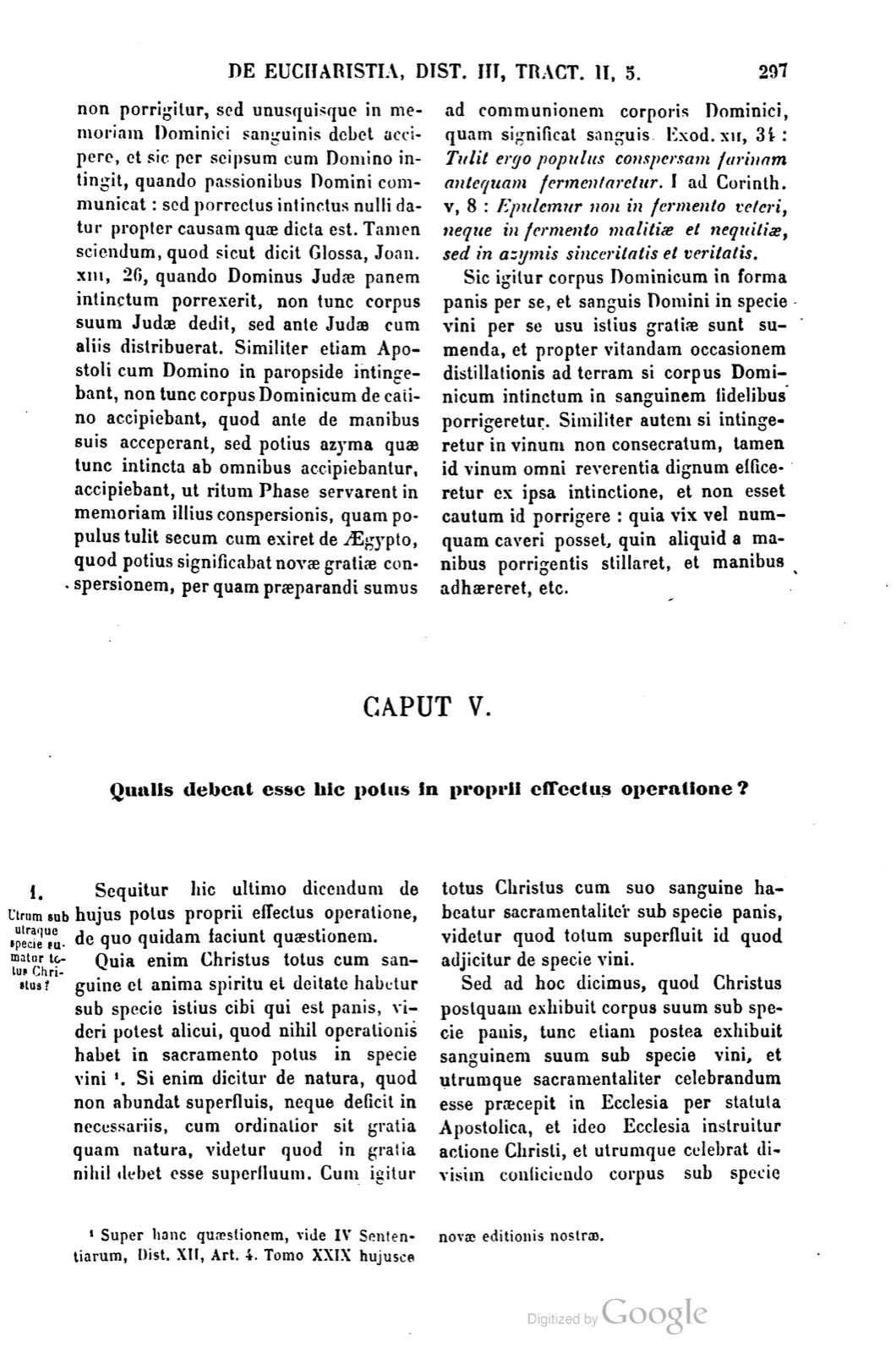
Ex omnibus istis accipitur, quod Christus sub una specie panis corpus suum tradidit, et sub altera specie vini tradidit sanguinem, et sic servandum instituit: et cum Christi actio, nostra sit instructio, pro certo haec duo nobis servanda esse praecepit: et ideo sub una specie corpus, et sub altera tradimus sanguinem.
2. In Eucharistia datur edulium spirituale sub specie panis et vini. Hujus autem facti Christi et Ecclesiae haec causa est: quia quamvis effectus et operationes accidentales multi valde sint in sacramentis, tamen unus effectus est substantialis in omnibus sacramentis, per quem sacramenta ab invicem distinguuntur. In sacramento ergo cibi spiritualis debet attendi aliqua operatio substantialis, per quam ab aliis dividitur sacramentis, cum in baptismo detur esse substantiale spirituale per generationem spiritualem, sicut dicit Dionysius: et in sacramento confirmationis detur incrementum per confirmationem et confortationem virtutis, ita consequenter ad idem esse conservandum et restaurandum et augendum datur in Eucharistia edulium spirituale. Edulium autem spirituale non habet fieri nisi sub elemento visibili, sicut et caetera sacramenta: quia sacramentum Ecclesiae nihil in gratia causat, quod ex similitudine non significat. Signare autem non habet nisi ex elemento visibili et corporali. Cum igitur alimentum ad naturae perfectionem non possit perfecte significari, nisi in elemento cibi et potus, oportet quod elementum cibi et potus sit in sacramento: nutrimentum enim spirituale non perficitur sine potus significatione, sicut et nutrimentum corporale quod sumitur non perficitur sine potu: et sicut post nutrimentum corporale sumitur potus ad perfectionem nutrimenti corporalis, ita post nutrimentum spirituale sumitur potus ad perfectionem nutrimenti spiritualis, qui a nutrimento divisam habet operationem in satisfactione sitis et latione nutrimenti, et hujusmodi aliis, qualia diximus in ante habitis.
Christus dedit corpus in communionem sui et membrorum, sanguinem autem in redemptionem. Adhuc autem divisam habet operationem sanguis a corpore. Corpus enim dedit Christus in communionem sui et membrorum: sanguinem autem dedit in redemptionem, sicut patet in dictis jam ante auctoritatibus. Istae autem sunt divisae operationes: nulla enim existente redemptione facta vel facienda, adhuc esset vel esse posset communio. Iterum posito, quod sit communio capitis et
From all these things it is taken that Christ handed over his body under one species of bread, and under the other species of wine handed over his blood, and instituted that it be observed thus; and since the action of Christ is our instruction, certainly he commanded that these two be observed by us. And therefore under one species we hand over the body, and under the other we hand over the blood.
2. In the Eucharist spiritual food is given under the species of bread and wine. But this is the cause of this deed of Christ and of the Church: because although accidental effects and operations are very many in the sacraments, nevertheless there is one substantial effect in all the sacraments, through which the sacraments are distinguished from each other. Therefore in the sacrament of spiritual food some substantial operation must be attended to, through which it is divided from the other sacraments, since in baptism spiritual substantial being is given through spiritual generation, as Dionysius says; and in the sacrament of confirmation increase is given through confirmation and strengthening of power; so consequently, for the same being to be preserved and restored and increased, spiritual food is given in the Eucharist. But spiritual food cannot happen except under a visible element, just as also the other sacraments; because a sacrament of the Church causes nothing in grace which it does not signify from likeness. But it does not have signifying except from a visible and bodily element. Therefore, since nourishment for the perfection of nature cannot be perfectly signified except in the element of food and drink, it is necessary that the element of food and drink be in the sacrament. For spiritual nourishment is not perfected without the signification of drink, just as also bodily nourishment which is taken is not perfected without drink; and just as after bodily nourishment drink is taken for the perfection of bodily nourishment, so after spiritual nourishment drink is taken for the perfection of spiritual nourishment, which has an operation distinct from nourishment in the satisfaction of thirst and the carrying of nourishment, and other things of this sort, such as we spoke of in what went before.
Christ gave the body for the communion of himself and the members, but the blood for redemption. Moreover blood has an operation distinct from the body. For Christ gave the body for the communion of himself and of the members, but he gave the blood for redemption, as is clear in the authorities already cited before. But these are distinct operations; for with no redemption existing, either made or to be made, there still would be or could be communion. Again, positing that there is communion of head and
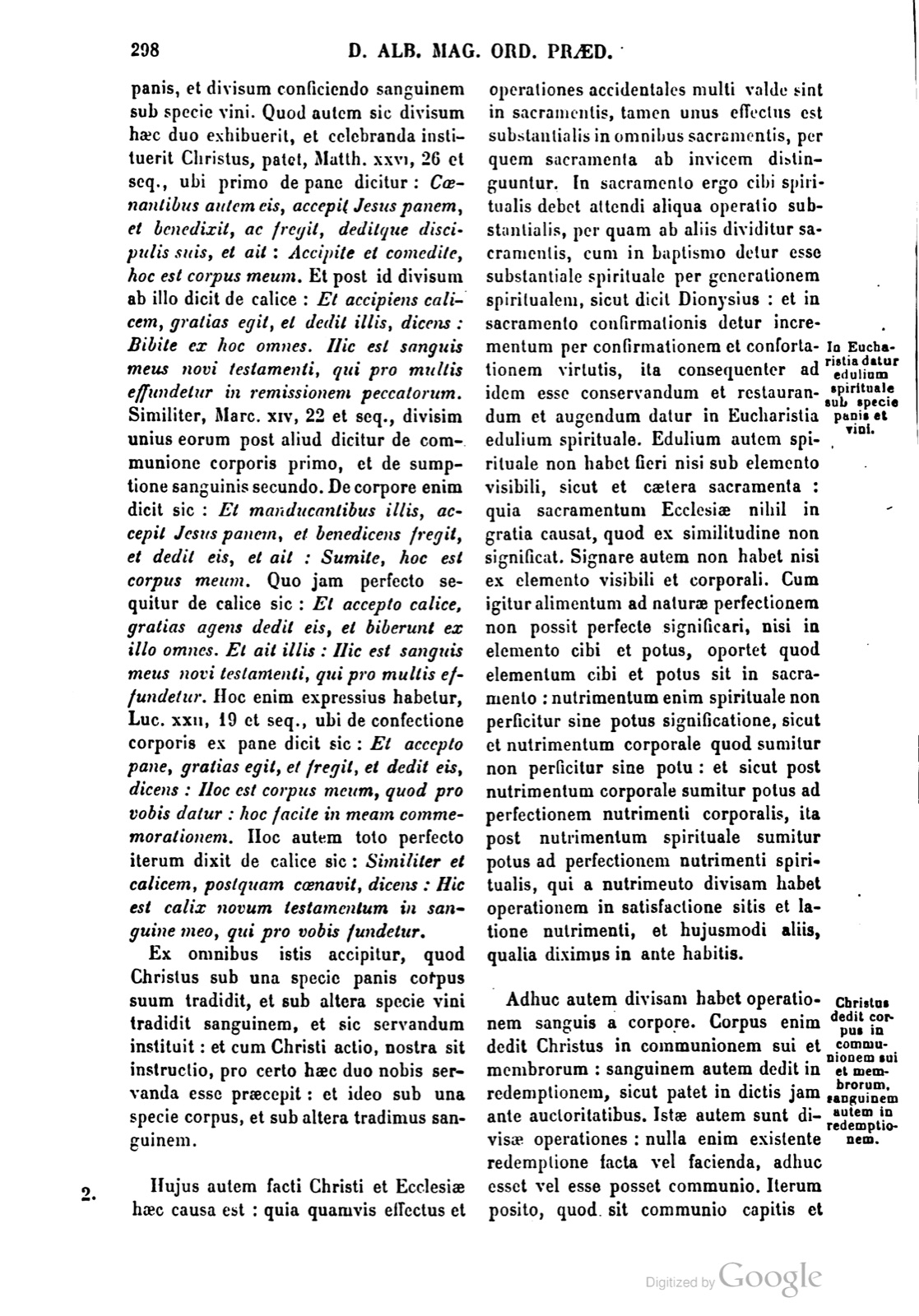
membrorum, non oporteret quod hoc modo sicut modo est, esset redemptio. Divisae ergo essentialiter ab invicem sunt gratia communionis et redemptionis. Cum ergo Dominus sic ordinaverit et multiplicaverit sacramenta, quod omnes gratias sacramentales habeamus in sacramentis, et alia gratia sit redemptionis per sanguinem, quam communionis per corporis sumptionem, non sufficit in sacramento habere elementum significans communionem, nisi etiam haberetur elementum significans redemptionem: et sic Christus hac ratione instituit utrumque.
4. Quod ergo dicit, quod alterum videtur esse superfluum, cum sanguis habeatur in corpore, et corpus in sanguine. Dicendum, quod hoc non est verum: verum quidem est, quod sanguis habetur in corpore, sed non ex virtute sacramentali, sed potius sanguis habetur in corpore ex unione naturali: quia humores uniuntur cum corpore cujus sunt humores. Anima autem habetur per unionem potentiae ad actum. Deitas vero habetur cum istis per unionem gratiae. Tamen nihil horum nisi corpus habetur ex virtute sacramenti. Oportet autem propter effectum sacramentalem, ut sanguis ibi habeatur ex virtute sacramenti ad nutrimentum pertinente: et ideo oportuit ut esset ibi consecratio ex elemento potus, sicut fuit ibi confectio ex elemento cibi: quia aliter sacramentum in virtute et ratione sacramentali esset imperfectum, et non signaret perfectum alimentum: quia nullum alimentum hominis perficitur sine potu, sicut patet satis per ea quae in ante habitis satis bene dicta sunt.
3. Utrum Eucharistia sit unum sacramentum, vel plura? Sed tunc forte adhuc aliquis objiciet et dicet: ex quo sacramentum omne secundum materiam et id quod signat in eo, est corporale elementum, ex quo sumitur significatio ad invisibilem sacramenti spiritualem effectum, sicut in baptismo ex aqua sumitur significatio intinctionis interiorum et ablutionis ab originali peccato: et confirmatione ex oleo et balsamo, ex quibus chrisma componitur, sumitur significatio ad invisibilem Spiritus sancti unctionem, ad confortationem contra debilitatem fomitis: et in hoc sacramento altaris ex cibo sumitur significatio nutrimenti spiritualis, et ex potu sumitur significatio spiritualis potus: tunc videtur, quod duo elementa corporalia ex quibus duae sumuntur significationes, ad duos effectus spirituales, efficiant non unum, sed duo sacramenta: et sic duo et non unum sunt sacramenta altaris.2 Et hoc etiam videtur dicere beatus Gregorius in quadam Collecta, ubi sic dicit: « Perficiant in nobis, quaesumus, Domine, tua sacramenta, quod continent, ut quod nunc specie gerimus, rerum veritate capiamus. »
Ad hoc autem dicimus, quod pro certo illa objectio procederet, si et elementa visibilia in sacramento, et significationes quae ab ipsis sumuntur, et effectus spirituales quos signant, ad unum et idem non referrentur. Jam autem habitum est in antecedentibus, quod naturalis cibus hominis non perficitur calido sicco, nisi referatur ad frigidum humidum: quia sine illo nec subtiliatur, nec per vias ad membra fluit ut nutriatur, nec continuatur nisi humido, nec membris adhaeret nisi per humidum. Similiter autem et potus naturalis non refertur per se, sed ad cibum a quo accipit terminabilitatem, cum per se humidum sit interminabile: et ideo utrumque simul in sacramento unum signant perfectum et completum spirituale nutrimentum, sicut et Christus dicit, Joan. VI, 56: Caro mea vere est cibus, et sanguis meus vere est potus.
Et quod dicit beatus Gregorius: « Perficiant in nobis tua sacramenta, etc. » Attendendum est, quod non dicit duo sacramenta, ut pluralem numerum significet per dictionem numeralem, sed dicit sacramenta pluralitatem quamdam consignificando: et in hoc notat quod est unum sacramentum simpliciter habens quamdam in elementis pluralitatem, quae tamen pluralitas ad idem significandum est relata: et hoc est nutrimentum connaturale et perfectum.
of the members, it would not be necessary that redemption be in this way, as now it is. Therefore the grace of communion and the grace of redemption are essentially divided from each other. Therefore, since the Lord so ordered and multiplied the sacraments that we have all sacramental graces in the sacraments, and since the grace of redemption through blood is other than the grace of communion through reception of the body, it is not sufficient in the sacrament to have an element signifying communion unless there were also an element signifying redemption; and thus for this reason Christ instituted both.
4. As to what he says, therefore, that one of the two seems to be superfluous, since blood is had in the body and the body in the blood, it must be said that this is not true. It is indeed true that blood is had in the body, but not from sacramental power; rather blood is had in the body from natural union, because humors are united with the body whose humors they are. But the soul is had through the union of potency to act. Deity, however, is had with these through the union of grace. Nevertheless none of these except the body is had from the power of the sacrament. But because of the sacramental effect, it is necessary that blood be had there from the power of the sacrament pertaining to nourishment; and therefore it was necessary that there be consecration from the element of drink there, just as there was consecration from the element of food, because otherwise the sacrament in sacramental power and reason would be imperfect, and would not signify perfect nourishment, because no nourishment of man is perfected without drink, as is sufficiently clear from those things which have been said well enough in what went before.
3. Whether the Eucharist is one sacrament or several. But then perhaps someone will still object and say: since every sacrament according to matter, and that which signifies in it, is a bodily element from which signification is taken toward the invisible spiritual effect of the sacrament, as in baptism from water the signification of the dipping of the interior things and of washing from original sin is taken; and in confirmation from oil and balsam, from which chrism is composed, signification is taken toward the invisible anointing of the Holy Spirit, for strengthening against the weakness of the tinder; and in this sacrament of the altar from food is taken the signification of spiritual nourishment, and from drink is taken the signification of spiritual drink: then it seems that two bodily elements, from which two significations are taken toward two spiritual effects, make not one sacrament, but two; and thus there are two sacraments of the altar and not one.2 And blessed Gregory also seems to say this in a certain Collect, where he says thus: "May your sacraments, we ask, Lord, perfect in us what they contain, so that what we now bear in species, we may receive in the truth of the realities."
But to this we say that certainly that objection would proceed if the visible elements in the sacrament, and the significations which are taken from them, and the spiritual effects which they signify, were not referred to one and the same thing. But it has already been held in the preceding matters that man's natural food is not perfected by the hot dry unless it is referred to the cold moist, because without that it is neither subtilized, nor flows through the ways to the members so that it may be nourished, nor is it continued except by the moist, nor does it adhere to the members except through the moist. Similarly also natural drink is not referred to itself, but to food, from which it receives terminability, since the moist by itself is interminable; and therefore both together in the sacrament signify one perfect and complete spiritual nourishment, as also Christ says, John 6:56: "My flesh truly is food, and my blood truly is drink."
And as to what blessed Gregory says, "May your sacraments perfect in us," etc., it must be attended that he does not say "two sacraments" so as to signify plural number by a numeral word, but he says "sacraments" by co-signifying a certain plurality; and in this he notes that it is simply one sacrament having a certain plurality in the elements, which plurality nevertheless is referred to signifying the same thing; and this is connatural and perfect nourishment.
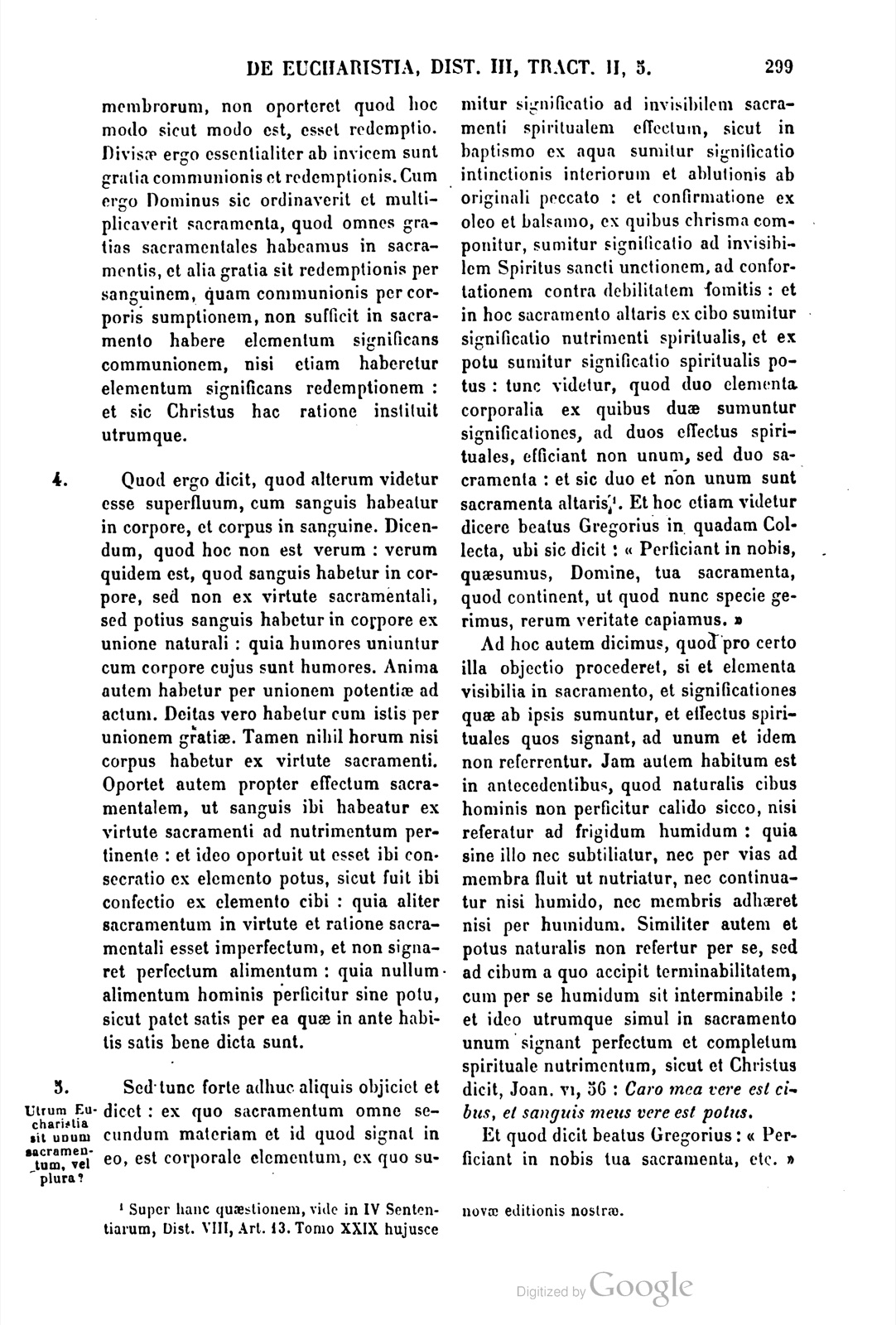
His sic a nobis praedeterminatis, dicimus quod potus iste in sacramento unam habet operationem suae virtutis essentialem et spiritualem, et quinque alias habet operationes adjunctas. Illa autem operatio quae est spiritualis et essentialis est, quae facit operationem veri potus in vita spirituali et esse spirituali, secundum quod esse in baptismo nascimur filii Dei sive Deo, et in confirmatione in eodem esse accipimus confortationis perfectionem. Non enim potest esse inedia spiritualis, quin ex multis occupationibus et negligentiis hominis in hoc esse fiat aliqua deperditio corporis, sicut in confecto fame corporali fit deperditio corporis et virtutis membrorum, quae per alimentum corporale restituitur. Et similiter per potum spiritualem, qui cibum influit membris et deducit, fit spiritualis reparatio in esse spirituali deperdito per famem et carentiam alimenti spiritualis: et haec est sua operatio substantialis: et est, ut diximus, ut Christo et membris ejus perfecte incorporemur, et sibi fortiter adhaereamus et maneamus in ipso, sicut hi qui per humorem sanguinis ejus corpori suo sumus influxi. Unde ipse dicit, Joan. VI, 57: Qui manducat meam carnem, et bibit meum sanguinem, in me manet, et ego in illo. Sic autem sibi influxi et cohaerentes spiritum ipsius participamus et vitam. Joan. VI, 58: Qui manducat me, et ipse vivet propter me. Eccli. IV, 12: Sapientia vitam filiis suis inspirat: et suscipit inquirentes se, et praeibit in via justitiae. Sapientia enim est Christus, qui corpus suum communicando membris suis et sanguinem influendo, et cum sanguine influit, et inspirat eis spiritum et vitam: et sic in suam incorporationem suscipit inquirentes se, praeiens eos in omni via justitiae: quia nisi sic simus in ipso, viam justitiae non possumus tenere. Hoc modo cum Dominus de cibo et potu plenis spiritualibus effectibus loqueretur, non intelligentes quidam quibus durum videbatur, si corporaliter corpus Domini deberent atterere et lacerare, dixit Dominus erudiens illos de perfecto spiritus nutrimento, quod in sacramento accipitur, et ad spiritualis vitae deperditae restaurationem, dixit: Hoc vos scandalizat? Si ergo videritis Filium hominis ascendentem ubi erat prius?3 Ac si dicat: Mirum est, quod hoc vos scandalizat, quod vos vere beatificat. Si vos ergo videritis aliquando oculis fidei mentalibus Filium hominis cum omnibus sibi per cibum et potum incorporatis membris ascendentem in dextera Dei Patris, in qua dextera in persona divina fuit prius ab aeterno? Tunc, inquam, ex hoc non scandalizabimini, sed magis exsultatione et gaudio perfundemini: quia sic incorporati spiritus et vitae et beatitudinis Christi facti estis participes: et ideo subjungit: Verba quae ego locutus sum vobis, spiritus et vita sunt.4 Spiritus est qui in his verbis ad vitam beatam vivificat. Caro autem sola si dentibus discerpatur, sicut vos carnalibus cogitationibus pleni intelligitis, non prodest quidquam,5 sic accipiendo operationem cibi et potus sacramenti. Panem Angelorum manducavit homo: quia Angeli non visibili, sed invisibili divino tantum potu et cibo utuntur. Tob. XII, 18 et 19: Cum essem vobiscum, per voluntatem Dei eram. Videbar quidem vobiscum manducare et bibere: sed ego cibo invisibili, et potu, qui ab hominibus videri non potest, utor: sicut dicitur, Eccli. XV, 3 et 4: Cibabit illum pane vitae et intellectus, et aqua sapientiae salutaris potabit illum: et firmabitur in illo, et non flectetur: et continebit illum, et non confundetur. Sic enim acceptus panis sacramenti secundum intellectum est panis vitae et aqua sapientiae non est aqua insipida: quia sapientia dat ei saporis suavitatem ut fiat vinum gaudii aeterni, sicut fecit in Cana Galilaeae.6 Et sic potabit illum ut influat ad incorporationem Jesu Christi: et sic incorporatus firmetur in illo, et non flectetur ab ipso per aliquem tentationis impulsum: et continebit eum sic in se, et numquam confundetur, jam particeps spiritus et vitae et gratiae et beatitudinis Jesu Christi, exaltandus in ipso ad dexteram Dei, ut ibi fruatur ipso in rerum veritate, sicut hoc signatum est in sacramenti corporalis specie. Sic enim ipse Christus dicit, Joan. III, 13, quod nemo ascendit in caelum, nisi qui descendit de caelo, Filius hominis, qui est in caelo: quia Filius hominis sic de caelo descendit, ut omnes sibi incorporatos et per sanguinem sibi influxos secum ascendere faceret in dexteram Patris, ut ipsi ibi in aeternum divinitate sua perfruantur.
With these things thus predetermined by us, we say that this drink in the sacrament has one operation of its power that is essential and spiritual, and it has five other joined operations. But that operation which is spiritual and essential is the one which makes the operation of true drink in spiritual life and spiritual being, according to which being in baptism we are born sons of God or to God, and in confirmation in the same being we receive the perfection of strengthening. For there cannot be spiritual famine without, from many occupations and negligences of man, some loss of the body happening in this being, just as in one weakened by bodily hunger there happens a loss of the body and of the power of the members, which is restored through bodily nourishment. And similarly through spiritual drink, which flows food into the members and leads it along, spiritual repair happens in spiritual being lost through hunger and lack of spiritual nourishment; and this is its substantial operation, and it is, as we said, that we be perfectly incorporated into Christ and his members, and cling strongly to him and remain in him, like those who have flowed into his body through the humor of his blood. Hence he himself says, John 6:57: "He who eats my flesh and drinks my blood remains in me, and I in him." But having thus flowed into him and cohering with him, we participate in his spirit and life. John 6:58: "He who eats me, he also will live because of me." Ecclesiasticus 4:12: "Wisdom breathes life into her sons, and receives those seeking her, and will go before in the way of justice." For wisdom is Christ, who, by communicating his body to his members and by flowing in blood, flows in also with the blood, and breathes spirit and life into them; and thus he receives those seeking him into his incorporation, going before them in every way of justice, because unless we are thus in him, we cannot hold the way of justice. In this way, when the Lord was speaking of food and drink full of spiritual effects, some not understanding, to whom it seemed hard if they ought corporally to grind and tear the body of the Lord, the Lord, teaching them concerning the perfect nourishment of the spirit which is received in the sacrament and for the restoration of lost spiritual life, said: "Does this scandalize you? If then you shall see the Son of man ascending where he was before?"3 As if he were saying: It is strange that this scandalizes you, which truly beatifies you. Therefore if someday with the mental eyes of faith you see the Son of man, with all members incorporated into him through food and drink, ascending at the right hand of God the Father, at which right hand he was before from eternity in the divine person, then, I say, you will not be scandalized by this, but rather will be flooded with exultation and joy, because thus incorporated you have been made participants of the spirit and life and blessedness of Christ; and therefore he adds: "The words which I have spoken to you are spirit and life."4 It is the spirit which in these words gives life unto blessed life. But flesh alone, if it is torn with teeth, as you, full of carnal thoughts, understand, "profits nothing,"5 taking thus the operation of the food and drink of the sacrament. "Man ate the bread of angels," because angels use only invisible divine drink and food, not visible. Tobit 12:18 and 19: "When I was with you, I was there by the will of God. I seemed indeed to eat and drink with you; but I use invisible food and drink, which cannot be seen by men." As is said, Ecclesiasticus 15:3 and 4: "He will feed him with the bread of life and understanding, and will give him to drink the water of saving wisdom; and he will be strengthened in him and will not be bent; and he will hold him, and he will not be confounded." For thus the sacramental bread received according to understanding is the bread of life, and the water of wisdom is not tasteless water, because wisdom gives to it sweetness of taste so that it becomes the wine of eternal joy, as he did in Cana of Galilee.6 And thus he will give him to drink so that he may flow into the incorporation of Jesus Christ; and thus incorporated, he may be strengthened in him and not bent away from him by any impulse of temptation; and he will hold him thus in himself, and he will never be confounded, now a participant of the spirit and life and grace and blessedness of Jesus Christ, to be exalted in him to the right hand of God, so that there he may enjoy him in the truth of realities, as this is signified in the bodily species of the sacrament. For thus Christ himself says, John 3:13, that no one ascends into heaven except the one who descended from heaven, the Son of man, who is in heaven; because the Son of man so descended from heaven that he would cause all those incorporated into him and flowed into him through blood to ascend with him to the right hand of the Father, so that they may there enjoy his deity forever.
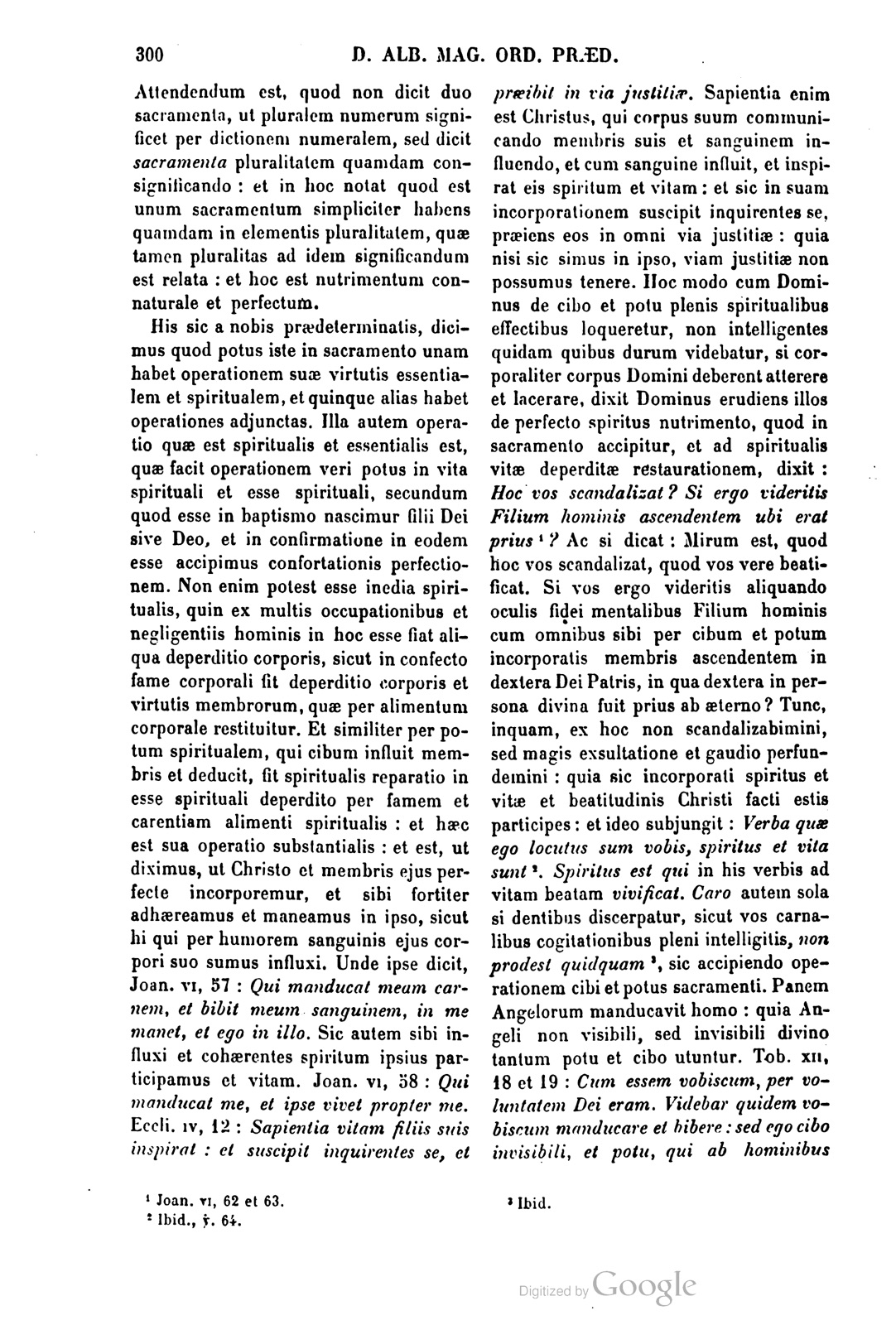
Illud autem nutrimentum quod, sicut diximus, ex cibo spirituali et potu spirituali componitur, ad interiorem hominem nutriendum refertur, de quo dicitur, II ad Corinth. IV, 16: Licet is qui foris est, noster homo corrumpatur, tamen is qui intus est, renovatur de die in diem. Is autem homo in gratia generatur, sicut dicitur, ad Ephes. IV, 23 et 24: Renovamini autem spiritu mentis vestrae, et induite novum hominem, qui secundum Deum creatus est in justitia, et sanctitate veritatis. Et quia, sicut dicit Philosophus, ex eisdem generamur et nutrimur, oportet quod idem interior homo nutrimento gratiae nutriatur. Hoc est edulium quod Eucharistia, hoc est, bona gratia vocatur, sicut per multa in ante habitis ostendimus.
6. Quinque effectus Eucharistiae in quantum est potus sanguinis Christi. Adjunctae autem operationes quas habet sacramentum in quantum est potus sanguinis Jesu Christi, sunt quinque, secundum quinque quae sunt in sanguine Domini: quarum prima est redemptio a debito mortis aeternae, quod habet in quantum sedes animae in sanguine est, quem pro nobis Dominus posuit. Secunda est, quod sanguis a peccato lavat, et hoc habet ex vi deitatis quae conjungitur sanguini. Tertia est, quod rigat arida et infundit, et hoc habet ex humore pietatis propriae. Quarta est, quod tingit, et hanc habet ex roseo purpureo suo colore. Quinta est, quod signat, et hoc habet in quantum defluit e cruce Christi.
De prima quidem quae est sanguis redemptionis, dicitur, Apocal. V, 9: Occisus es, et redemisti nos Deo in sanguine tuo, hoc est, eruisti a diaboli potestate, in cujus potestate pretio pomi venditi fuimus. Hoc est quod dicitur, I Petri, I, 18 et 19: Non corruptibilibus auro vel argento redempti estis de vana vestra conversatione paternae traditionis, sed pretioso sanguine quasi agni immaculati Christi. Hoc etiam praefiguratum est in prophetia Zachariae, IX, 11, ubi dicitur: Tu quoque in sanguine testamenti tui emisisti vinctos tuos de lacu in quo non est aqua: hoc est, per redemptionem sanguinis solvendo pretium pro eis animam tuam, cujus sedes est in sanguine aperto carcere peccati et mortis, omnes vinctos peccatis et clausos in carcere mortis per redemptionem emisisti eos in libertatem gratiae et reconciliationis. Hoc modo sanguis Christi sumptus dicitur pignus redemptionis et salutis: quia sicut homo qui pignus habet vel pecuniam, ab omni redimit se impetitione, sic incorporatus sanguini secum habens Christi animam, tamquam per pignus redimit se ab impetitione debiti et obligationis peccati. Hoc
But that nourishment which, as we said, is composed from spiritual food and spiritual drink is referred to nourishing the interior man, concerning whom it is said, 2 Corinthians 4:16: "Although our man who is outside is corrupted, yet he who is within is renewed from day to day." But that man is generated in grace, as is said, Ephesians 4:23 and 24: "Be renewed in the spirit of your mind, and put on the new man, who according to God has been created in justice and holiness of truth." And because, as the Philosopher says, we are generated and nourished from the same things, it is necessary that the same interior man be nourished by the nourishment of grace. This is the food which is called Eucharist, that is, good grace, as we have shown through many things in what went before.
6. The five effects of the Eucharist insofar as it is the drink of Christ's blood. But the joined operations which the sacrament has insofar as it is the drink of the blood of Jesus Christ are five, according to the five things which are in the Lord's blood. The first of these is redemption from the debt of eternal death, which it has insofar as the seat of the soul is in the blood which the Lord laid down for us. The second is that blood washes from sin, and it has this from the power of deity which is joined to the blood. The third is that it waters dry things and pours in, and it has this from the humor of its own piety. The fourth is that it stains, and it has this from its rosy-purple color. The fifth is that it signs, and it has this insofar as it flows down from Christ's cross.
Of the first, which is the blood of redemption, it is said, Apocalypse 5:9: "You were slain, and you redeemed us to God in your blood," that is, you rescued us from the power of the devil, in whose power we were sold for the price of the apple. This is what is said, 1 Peter 1:18 and 19: "Not with corruptible gold or silver were you redeemed from your vain conduct of paternal tradition, but with the precious blood as of the immaculate lamb Christ." This was also prefigured in the prophecy of Zechariah 9:11, where it is said: "You also, in the blood of your testament, have sent forth your prisoners from the pit in which there is no water," that is, through redemption of blood, by paying your soul as the price for them, whose seat is in the blood, with the prison of sin and death opened, by redemption you sent forth into the liberty of grace and reconciliation all bound by sins and shut in the prison of death. In this way Christ's blood, received, is called the pledge of redemption and salvation, because just as a man who has a pledge or money redeems himself from every claim, so one incorporated into the blood, having Christ's soul with himself, as by a pledge redeems himself from the claim of debt and obligation of sin. This
modo loquitur Apostolus, II ad Corinth. I, 21 et 22: Qui confirmat nos vobiscum in Christo, et qui unxit nos, Deus, qui et signavit nos, et dedit pignus Spiritus in cordibus nostris. Haec omnia facit per sanguinem Christi, cujus sumptio confirmat membrum cum membro in Christi mystico corpore. Hic sanguis ungit ad sanitatem salutis. Hic nos signat contra Angelum percussorem. Per illum datur nobis pignus Spiritus: quia sedes animae Christi est in sanguine, et illi per unionem conjunctus est Spiritus divinus, qui est deitas aeterna, faciens hoc pignus valere in copiosam redemptionem. Psal. CXXIX, 7: Apud Dominum misericordia, et copiosa apud eum redemptio. De ista redemptione dicitur, Osee, VII, 13: Ego redemi eos, et in me locuti sunt mendacia. Osee, XIII, 14: De manu mortis liberabo eos, de morte redimam eos. Et hanc petit Psalmista, Psal. CXXIX, 8, dicens: Et ipse redimet Israel ex omnibus iniquitatibus ejus.
Sic ergo redemptio adjuncta est operationi sanguinis Jesu Christi.
Est etiam operatio ipsius lavare sordes vitiorum, et sordes venialium, et sordes reliquiarum peccatorum. Sanguine enim suo Christus volens lavare peccata mundi, acumen dedit sanguini, ut sordes in nobis profundatas lavare posset: quia sicut hi qui faciunt lixivium, qui acuunt humorem quo fit lixivia, ut sordis profunditas in pannis acumine suo lavari possit: ita Dominus apposuit humori sanguinis acumen deitatis, ut sanguine Christi Dei electi omnes lavarent sordes vitiorum. Hoc est quod dicit Apostolus, ad Galat. II, 20: Quod autem nunc vivo in carne, in fide vivo Filii Dei, qui dilexit me, et tradidit semetipsum pro me. Haec autem traditio fuit in lotione sanguinis. Apocal. I, 29: Qui dilexit nos, et lavit nos a peccatis nostris in sanguine suo. Hoc voluit dicere Joannes Baptista, Joan. I, 29, quando dixit: Ecce Agnus Dei, ecce qui tollit peccatum mundi. Non enim tulit peccata mundi, ut haberet: sed tulit, ut sanguine lavaret, sicut dicitur, Apocal. VII, 14: Laverunt stolas suas, et dealbaverunt eas in sanguine Agni. Stola quae dicitur a στόλον quod est longum, et signat usque in finem totam conversationem, quam a sordibus lavare necesse est totam, et dealbare in sanguine Agni: quia sicut dicitur, Isa. LXIV, 6: Et facti sumus ut immundus omnes nos, et quasi pannus menstruatae universae justitiae nostrae. Et ideo magna et acuta indigent ablutione. Apocal. XXII, 14: Beati qui lavant stolas suas in sanguine Agni, ut sit potestas eorum in ligno vitae, et per portas intrent in civitatem. Soli enim qui abluti sunt in sanguine mundissimae aspersionis Agni immaculati, habent potestatem in ligni vitae fructu, quod est corpus Domini: et illi sunt de unitate corporis mystici, ex quo construitur civitas coelestis, in quam isti ingredientes intrant in gaudium Domini sui, sicut dicitur, Matth. XXV, 21 et 23. Haec lotio signata est, IV Regum, V, 10, ubi dicitur: Vade, et lavare septies in Jordane, et recipiet sanitatem caro tua, atque mundaberis. Jordanis enim humilis descensus interpretatur, et signat torrentem sanguinis, qui descendit ab humilitate crucis, in quo fluxu omnes mundati sunt ab infectione corruptae carnis: ideo Dominus voluit, quod de latere suo flueret aqua expiationis cum sanguine redemptionis, ut ex aqua virtutem ablutivam signaret esse in sanguine. Unde dicitur, ad Hebr. X, 22: Accedamus cum vero corde in plenitudine fidei, aspersi corda a conscientia mala, et abluti corpus aqua munda. Quia a corruptione corporis tota processit corruptio. Zachar. XIII, 1: In die illa erit fons patens domui David et habitantibus Jerusalem, in ablutionem peccatoris et menstruatae, hoc est, in ablutionem corporis et animae.
Et sic patet, quod ablutivus est sordium sanguis Christi.
the Apostle speaks in this way, 2 Corinthians 1:21 and 22: "He who confirms us with you in Christ, and who has anointed us, is God, who also has signed us and given the pledge of the Spirit in our hearts." All these things he does through the blood of Christ, whose reception confirms member with member in Christ's mystical body. This blood anoints unto the health of salvation. This signs us against the striking angel. Through it the pledge of the Spirit is given to us, because the seat of Christ's soul is in the blood, and to it through union is joined the divine Spirit, which is eternal deity, making this pledge avail unto copious redemption. Psalm 129:7: "With the Lord is mercy, and with him copious redemption." Of this redemption it is said, Hosea 7:13: "I redeemed them, and they have spoken lies against me." Hosea 13:14: "From the hand of death I will free them; from death I will redeem them." And the Psalmist seeks this, Psalm 129:8, saying: "And he will redeem Israel from all his iniquities."
Thus therefore redemption is joined to the operation of the blood of Jesus Christ.
It is also an operation of it to wash the filths of vices, and the filths of venial sins, and the filths of the remnants of sins. For Christ, wishing to wash away the sins of the world by his blood, gave sharpness to the blood so that he could wash the filths deepened in us; because as those who make lye sharpen the humor from which lye is made, so that the depth of filth in cloths can be washed by its sharpness, so the Lord applied to the humor of blood the sharpness of deity, so that all the elect of God might wash the filths of vices in the blood of Christ. This is what the Apostle says, Galatians 2:20: "But what I now live in the flesh, I live in the faith of the Son of God, who loved me and handed himself over for me." But this handing over was in the washing of blood. Apocalypse 1:29: "Who loved us and washed us from our sins in his blood." John the Baptist wished to say this, John 1:29, when he said: "Behold the Lamb of God, behold him who takes away the sin of the world." For he did not take the sins of the world so that he would have them, but he took them so that he would wash them in blood, as is said, Apocalypse 7:14: "They washed their robes and made them white in the blood of the Lamb." The robe, which is said from stōlon, which is long, signifies the whole conduct unto the end, which must be washed whole from filths and whitened in the blood of the Lamb, because as is said, Isaiah 64:6: "And we all have become as an unclean thing, and all our justices as the cloth of a menstruating woman." And therefore great and sharp things need washing. Apocalypse 22:14: "Blessed are they who wash their robes in the blood of the Lamb, that their power may be in the tree of life, and that they may enter through the gates into the city." For only those who have been washed in the blood of the cleanest sprinkling of the immaculate Lamb have power in the fruit of the tree of life, which is the Lord's body; and they are of the unity of the mystical body, from which the heavenly city is constructed, into which these, entering, enter into the joy of their Lord, as is said, Matthew 25:21 and 23. This washing was signified, 4 Kings 5:10, where it is said: "Go and wash seven times in the Jordan, and your flesh will receive health, and you will be cleansed." For Jordan is interpreted humble descent and signifies the torrent of blood which descends from the humility of the cross, in whose flow all have been cleansed from the infection of corrupted flesh. Therefore the Lord willed that from his side there should flow water of expiation with blood of redemption, so that from the water he might signify that the washing power is in the blood. Hence it is said, Hebrews 10:22: "Let us approach with a true heart in fullness of faith, having hearts sprinkled from an evil conscience and the body washed with clean water." For from the corruption of the body the whole corruption proceeded. Zechariah 13:1: "On that day there will be a fountain open to the house of David and to the inhabitants of Jerusalem for the washing of the sinner and of the menstruating woman," that is, for the washing of body and soul.
And thus it is clear that the blood of Christ washes away filths.
Tertiam autem adjunctam operationem habet, quod rigat arida et infundit, et per hanc etiam operationem exstinguit incensa a malo calore cupiditatis et concupiscentiae. Naturale enim est, quod nihil ita ad humectandum et foecundandum rigat arida sicut bonus sanguis, et nihil adeo exstinguit mala incendia et substantiam consumentia sicut sanguis subtilis et bonus, quando tali sanguine membra infunduntur. Hoc signatum est, Eccli. XXIV, 42 et 43, ubi dicitur: Dixi, rigabo hortum meum plantationum, et inebriabo prati mei fructum. Et ecce factus est mihi trames abundans, et fluvius meus appropinquavit ad mare. Ex sanguine enim lateris et cordis sui Dominus rigavit Ecclesiae hortum, ut omnes bonae stirpes in eo oriantur, et factus est ei trames sanguinis de quinque decurrens vulneribus, abundans in totius mundi irrigationem, ut arida ipsius humectentur, et incensa exstinguantur: et fluvius iste appropinquavit ad mare amaritudinis passionis Christi. Hinc est quod, Jerem. XVII, 7 et 8, dicit de viro benedicto, qui confidit in Domino, et erit Dominus fiducia ejus. Et erit quasi lignum quod transplantatur super aquas, quod ad humorem mittit radices suas, et non timebit cum venerit aestus. Et erit folium ejus viride, et in tempore siccitatis non erit sollicitum, nec aliquando desinet facere fructum. Naturale enim est, quod nihil ita humectat et rigat ad fructum et virorem sicut sanguis humanus. Quidquid enim sanguine hominis rigatur, statim viret et humectatur ad fructum. Hinc est, quod Balaam videns in figura tabernaculorum filiorum Israel distinctiones Ecclesiarum sanguine Christi rigatas, dixit, Numer. XXIV, 5 et 6: Quam pulchra tabernacula tua, Jacob! et tentoria tua, Israel! Ut valles nemorosae, ut horti juxta fluvios irrigui, etc. Tabernacula enim sunt Ecclesiae contra inimicas potestates militantes. Tentoria autem Israel in refrigerio contemplandae veritatis habitantes. Valles autem sunt nemorosae in humilitate multum fructum afferentes. Horti autem sunt ab oriendo dicti, plantationem virtutum intendentes, qui sunt juxta fluvios vulnerum Christi, sanguine Christi per spiritualem et sacramentalem sanguinis communionem irrigati. Hoc irriguum necessarium est nobis: quia cor nostrum saepe destitutum est humore pietatis et aret in seipso. Psal. CXLII, 6: Anima mea sicut terra sine aqua tibi. Judicum, I, 15, dixit Axa, quae furibunda interpretatur, eo quod irascitur et vindicat in se peccata commissa: Terram arentem dedisti mihi, da et irriguam aquis. Dedit ergo ei Caleb, scilicet Deus Pater, irriguum superius, et irriguum inferius. Irriguum enim inferius est fons sanguinis Jesu Christi: irriguum autem superius est ros gratiae coelestis, descendens a deitate sanguinis Jesu Christi.
Sic ergo et rigat arida et exstinguit incensa: sic enim humore suo exstinguit igneam romphaeam positam ante paradisum ad custodiendam viam ligni vitae,7 ut via sit facilis de caetero ad accedendum ad lignum vitae.
Quarta autem operatio sanguinis quam ex roseo et purpureo suo habet colore, est quod tingit omne illud super quod funditur, et omne tinctum ab ipso rubricatur et securatur ab Angelo percussore. Et ideo etiam sanctum vocatur ab antiquis legibus sanguine tinctum: quia tinctura sanguinis confirmantur leges: et ideo filii Israel utrumque postem et superliminaria domorum suarum sanguine tinxerunt agni, ut Angelus percussor non posset ingredi. Exod. XII, 13: Erit autem sanguis vobis in signum in aedibus in quibus eritis: et videbo sanguinem, et transibo vos: nec erit in vobis plaga disperdens quando percussero terram Aegypti. Aedes enim in quibus habitamus, sunt virtutum et operum conservationes. Ostia autem sunt sensuum apprehensiones et sensibilium ad nos ingressus. Uterque postis est ratio deliberativa in parte una, et libera ad consentiendum, vel dissentiendum voluntas in parte alia. Et superliminare domorum est pars rationis superior, quae contemplandis superioribus inhaerere deberet ad regendam totam domum, et custodiendum ostium in quibus si sanguis agni tinctus fuerit per communionem sancti calicis et considerationem Christi passionis, percussor et nequam angelus appropinquare non audebit, et plaga disperdens non erit in omnibus aedibus nostris. Iste est coccus bis tinctus, de quo dicitur, Exod. XXVIII, 5, quod vestes sacrae tingi debent. Coccus enim conchilium est, quod, ut dicunt Philosophi, de rore nascitur, et murex vel purpura vocatur, a quo etiam murilegi dicuntur, qui talia colligunt. Hunc colorem rubicundissimum habet ante in corpore sub capite, qui est sanguis ejus, quo purpurae regum colorantur, et signat Christum in sanguine suo purpureo nos tingentem et sanctificantem. Dicitur autem coccus sine virili semine conceptus, et natus bis tinctus in suo sanguine: quia et in vita tinctus est plagis manuum et pedum, et post mortem tinctus plaga lateris, et utroque sanguine tinxit Ecclesiam in sanctificationem, nec sanctificata est, nisi esset suo tincta sanguine. Haec est tunica polymita quam patriarcha magnus Joseph filio suo fecit vestimentum,8 scilicet totam vestiens Ecclesiam varietate virtutum, quod vestimentum corpus Christi signat, cui tota incorporatur Ecclesia, quam fratres venditores Joseph sanguine haedi tinxerunt: quia Judaei, fratres Domini, vendentes Dominum in Juda proditore, tunicam corporis Domini et ecclesiasticae conversationis sanguine profuderunt: qui haedi sanguis dicitur, quia et a peccatoribus et pro peccatoribus et a corpore quod per passibilitatem simile fuit corpori peccati, est effusus in talis tunicae tinctura. Isa. LXIII, 2: Quare rubrum est indumentum tuum, et vestimenta tua quasi calcantium in torculari? Sic autem tincti sanctificamur sanguine et conformamur Christo. Exod. IV, 25: Sponsus sanguinum tu mihi es.
But it has the third joined operation, that it waters dry things and pours in, and through this operation also extinguishes things inflamed by the evil heat of cupidity and concupiscence. For it is natural that nothing waters dry things so for moistening and making fruitful as good blood, and nothing so extinguishes evil fires and fires consuming substance as subtle and good blood, when the members are poured into by such blood. This was signified, Ecclesiasticus 24:42 and 43, where it is said: "I said, I will water the garden of my plantings, and I will inebriate the fruit of my meadow. And behold, a plentiful channel was made for me, and my river drew near to the sea." For from the blood of his side and heart the Lord watered the garden of the Church, so that all good shoots might rise in it, and a channel of blood was made for it, running down from the five wounds, plentiful for the irrigation of the whole world, so that its dry things might be moistened and its inflamed things extinguished; and that river drew near to the sea of the bitterness of Christ's passion. Hence Jeremiah 17:7 and 8 speaks of the blessed man who trusts in the Lord, and the Lord will be his confidence. "And he will be like a tree that is transplanted over waters, which sends its roots toward moisture, and will not fear when heat comes. And its leaf will be green, and in the time of dryness it will not be anxious, nor will it ever cease to bear fruit." For it is natural that nothing so moistens and waters unto fruit and greenness as human blood. For whatever is watered with human blood at once grows green and is moistened unto fruit. Hence Balaam, seeing in the figure of the tents of the children of Israel the distinctions of the Churches watered by the blood of Christ, said, Numbers 24:5 and 6: "How beautiful are your tabernacles, Jacob, and your tents, Israel! Like wooded valleys, like gardens watered beside rivers," etc. For the tabernacles are the Churches fighting against enemy powers. But the tents of Israel are those dwelling in the cool refreshment of truth to be contemplated. But the valleys are wooded, bringing much fruit in humility. Gardens are so called from rising, tending toward the planting of virtues, which are beside the rivers of Christ's wounds, irrigated by the blood of Christ through spiritual and sacramental communion of the blood. This watering is necessary for us, because our heart is often deprived of the moisture of piety and dries in itself. Psalm 142:6: "My soul is like earth without water for you." Judges 1:15, Axa, which is interpreted furious, because she is angry and avenges in herself the sins committed, said: "You have given me a dry land; give me also one watered with waters." Therefore Caleb, namely God the Father, gave her the upper watering and the lower watering. For the lower watering is the fountain of the blood of Jesus Christ; but the upper watering is the dew of heavenly grace descending from the deity of the blood of Jesus Christ.
Thus therefore it both waters dry things and extinguishes inflamed things; for thus by its moisture it extinguishes the fiery sword placed before paradise to guard the way of the tree of life,7 so that thereafter the way may be easy for approaching the tree of life.
But the fourth operation of the blood, which it has from its rosy and purple color, is that it stains everything over which it is poured, and everything stained by it is reddened and made secure from the striking angel. And therefore that which has been stained with blood is also called holy by ancient laws, because by the stain of blood laws are confirmed; and therefore the children of Israel stained both doorposts and the lintels of their houses with the blood of the lamb, so that the striking angel could not enter. Exodus 12:13: "But the blood will be for you as a sign in the houses in which you will be; and I will see the blood, and I will pass over you; nor will there be in you a destroying plague when I strike the land of Egypt." For the houses in which we dwell are preservations of virtues and works. But the doors are the apprehensions of the senses and the entrances of sensible things to us. One doorpost is deliberative reason on one side, and on the other side the will free to consent or dissent. And the lintel of the houses is the higher part of reason, which ought to cling to higher things to be contemplated for ruling the whole house and guarding the door. If the blood of the lamb has been stained on these through communion of the holy chalice and consideration of Christ's passion, the striking and wicked angel will not dare to approach, and there will be no destroying plague in all our houses. This is the twice-dyed scarlet of which it is said, Exodus 28:5, that the sacred vestments must be dyed. For scarlet is a shellfish which, as the Philosophers say, is born from dew, and is called murex or purple; from this also those are called murilegi who collect such things. It has this reddest color before, in the body under the head, which is its blood, by which the purples of kings are colored, and it signifies Christ staining and sanctifying us in his purple blood. But scarlet is said to have been conceived without male seed and born twice-dyed in its blood, because both in life it was dyed by the wounds of hands and feet, and after death it was dyed by the wound of the side; and with both bloods he dyed the Church unto sanctification, nor was she sanctified unless she had been dyed with his blood. This is the many-colored tunic which the great patriarch Joseph made as a garment for his son,8 namely clothing the whole Church with the variety of virtues, which garment signifies the body of Christ, into which the whole Church is incorporated, which the brothers who sold Joseph dyed in the blood of a kid; because the Jews, brothers of the Lord, selling the Lord in Judas the betrayer, poured out with blood the tunic of the Lord's body and of ecclesiastical conduct. This is called the blood of a kid because it was poured out both by sinners and for sinners and from a body which through passibility was like the body of sin, in the dyeing of such a tunic. Isaiah 63:2: "Why is your garment red, and your garments like those of people treading in the winepress?" But thus dyed, we are sanctified by blood and conformed to Christ. Exodus 4:25: "You are a spouse of blood to me."
Quinta autem et ultima operatio adjuncta sacramento est, quod signat, et hanc habet a cruce, a qua defluit, per quam omnes in Dei familiam et Christi filii ejus characterizamur, et distinguimur, et signamur. Hinc est quod dicitur, Apocal. VII, 3: Nolite nocere terrae et mari, neque arboribus, quoadusque signemus servos Dei nostri in frontibus eorum. Consignari enim debet Christo, qui est de familia Christi, signo crucis et sanguinis ejus: quia non consignati percutimur, cum terra quae terrenos signat dilectores, et cum mari quod mundanorum signat inquietas sollicitudines, et cum arboribus quae personatuum et honorum signant altas et proceras dignitates. Ezechiel. IX, 4: Transi per mediam civitatem, in medio Jerusalem, et signa Thau super frontes virorum gementium, et dolentium super cunctis abominationibus, quae fiunt in medio ejus. Thau autem est signum crucis et sanguis Christi. In isto signo sanguinis et passionis Christi Paulus gloriabatur, ad Philip. III, 10 et 11: Configuratus morti ejus, si quo modo occuram ad resurrectionem quae est ex mortuis. Ad Galat. VI, 17: De caetero nemo mihi molestus sit: ego enim stigmata Domini Jesu in corpore meo porto. Stigmata enim illa sunt consecrationes passionis et sanguinis Jesu Christi. Turpe enim est caput nostrum signum rosei sanguinis portare, et membra nihil communionis habere cum sanguine. Dicit enim sponsa de sponso in Canticis, V, 10: Dilectus meus candidus innocentia, et rubicundus sanguine. Turpe est ergo nos foeda concupiscentia inquinatos mundo configurari, et pollutum ducere sanguinem Jesu Christi Domini nostri.
But the fifth and last operation joined to the sacrament is that it signs, and it has this from the cross from which it flows down, through which we all are charactered, distinguished, and signed into the family of God and of Christ his Son. Hence it is said, Apocalypse 7:3: "Do not harm the earth and the sea, nor the trees, until we sign the servants of our God on their foreheads." For one who is of Christ's family ought to be consigned to Christ with the sign of the cross and of his blood, because not consigned, we are struck with the earth, which signifies lovers of earthly things, and with the sea, which signifies the restless anxieties of worldly people, and with the trees, which signify the high and lofty dignities of personages and honors. Ezekiel 9:4: "Pass through the middle of the city, in the midst of Jerusalem, and mark Thau upon the foreheads of the men groaning and sorrowing over all the abominations which happen in its midst." But Thau is the sign of the cross and the blood of Christ. In that sign of the blood and passion of Christ Paul gloried, Philippians 3:10 and 11: "Configured to his death, if somehow I may come to the resurrection which is from the dead." Galatians 6:17: "Henceforth let no one be troublesome to me; for I bear the stigmata of the Lord Jesus in my body." For those stigmata are consecrations of the passion and blood of Jesus Christ. For it is shameful that our head bears the sign of rosy blood, and the members have no communion with the blood. For the bride says of the bridegroom in Canticles 5:10: "My beloved is white in innocence and ruddy in blood." Therefore it is shameful for us, stained by foul concupiscence, to be configured to the world, and to consider the blood of Jesus Christ our Lord polluted.
Notes
- On this question, see IV Sentences, Distinction XII, Article 4, in volume XXIX of this new edition of ours. (Super hanc quaestionem, vide IV Sententiarum, Dist. XII, Art. 4. Tomo XXIX hujusce novae editionis nostrae.) ↩
- On this question, see in IV Sentences, Distinction VIII, Article 13, in volume XXIX of this new edition of ours. (Super hanc quaestionem, vide in IV Sententiarum, Dist. VIII, Art. 13. Tomo XXIX hujusce novae editionis nostrae.) ↩
- John 6:62 and 63. (Joan. VI, 62 et 63.) ↩
- Ibid., v. 64. ↩
- Ibid. ↩
- John 2:8. (Joan. II, 8.) ↩
- Compare Genesis 3:24. (Cf. Genes. III, 24.) ↩
- Genesis 37:3. (Genes. XXXVII, 3.) ↩
If a page does not appear, its photograph has not been uploaded yet.