Works › The Book on the Sacrament of the Eucharist
Volume 38 · pp. 275–279
Chapter IX. On the firm adhesiveness of this food to the one fed, from the apprehension of the one fed through the food
A marker with ≈ is an approximate page boundary, placed by measure of the text; the page photographs remain the authority. In the paired views, clicking a page marker brings that page into view.
Caput IX. De cibi hujus ad cibatum firma haesibilitate, ex cibati per cibum apprehensione.
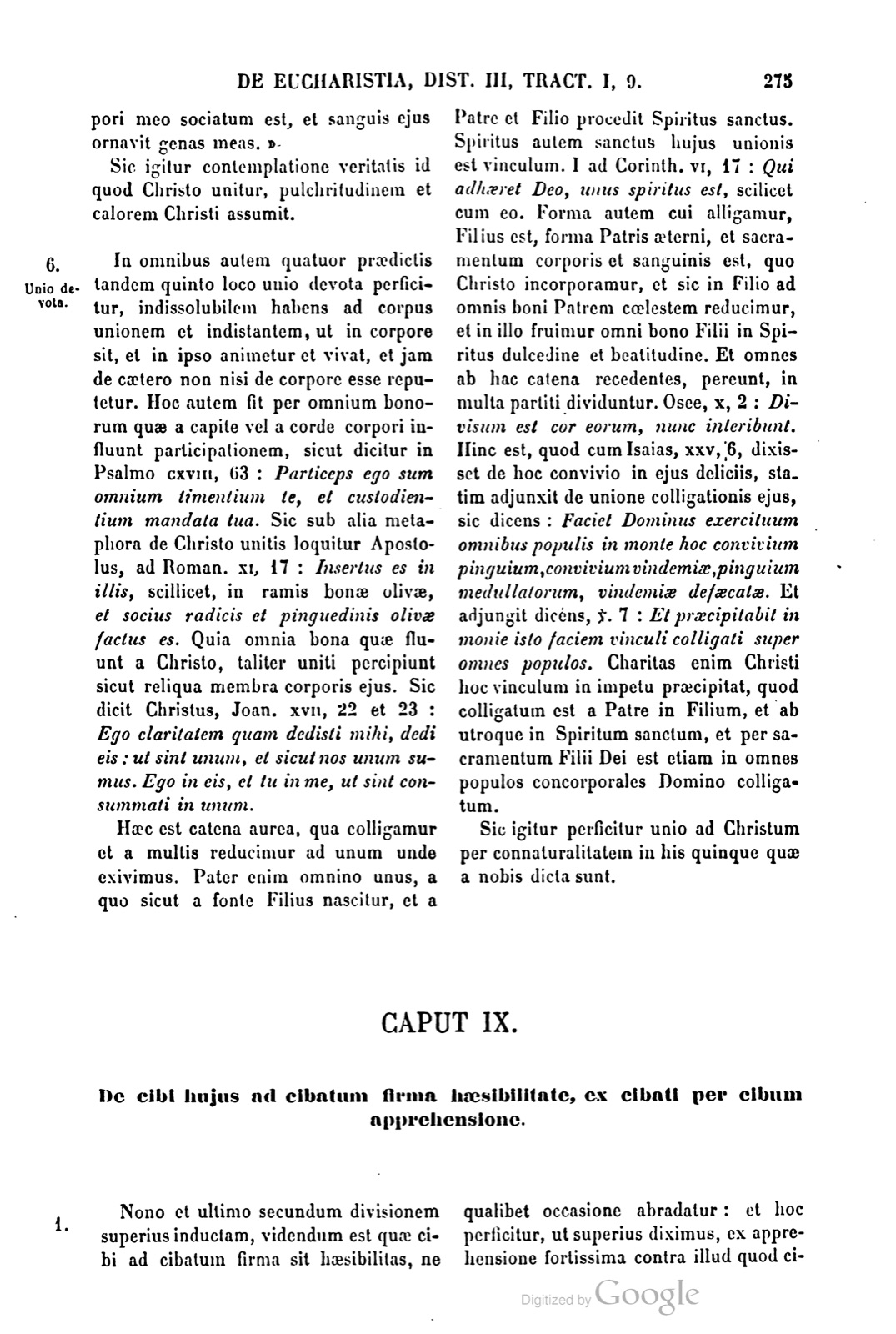
1. Nono et ultimo secundum divisionem superius inductam, videndum est quae cibi ad cibatum firma sit haesibilitas, ne qualibet occasione abradatur: et hoc perficitur, ut superius diximus, ex apprehensione fortissima contra illud quod cibatur, apprehendit et tenet id quod sibi ex cibo est unitum. Sicut enim dicunt Isaac in Dictis, et Constantinus in Pantechne, ex quibusdam cibis generatur nutrimentum, quod parum adhaeret membris, et cito per alterationes sequentes caloris, laboris vel febris a membris abraditur et separatur et consumitur, sicut est cibus generatus ex facile alterabilibus et convertibilibus, sicut sunt ova, et caro subtilis, et herbae. Quidam autem cibus est, ex quo generatur nutrimentum, quod firmiter et fortiter adhaeret membris, sicut nutrimentum generatum ex puro et sincero grano frumenti: quia hoc ex subtilitate sua bene intrat in membri nutriti profundum, et ideo bene a virtutibus membri apprehenditur, et ex puritate optime congruit substantiae membri: et ideo bene unitur, et ex viscositate fortissime adhaeret, et resistit omnibus alterationibus membrorum, ne de facili a membro cui unitum est, separetur, et quasi visco quodam cum membro sit glutinatum.
Ita etiam fit quando Christo incorporamur, cui quidam fortiter adhaerent, quidam autem facile separantur. Adhaesio autem haec fit primo quidem fortitudine apprehensionis. Secundo autem fit glutino amoris. Et tertio fit mansione stabilitatis. Quarto fit perseverantia continuitatis ad Christum. His enim modis etiam cibus adhaeret membris quae cibat. Primo quidem, quod virtutibus membri fortiter apprehendatur. Secundo, quod viscositate propria membri fortiter agglutinetur. Tertio, quod stabiliter in membro manens figatur. Quarto autem, quod nullo laxativo remotum a membro perseveranti continuitate membro nutrito continuetur.
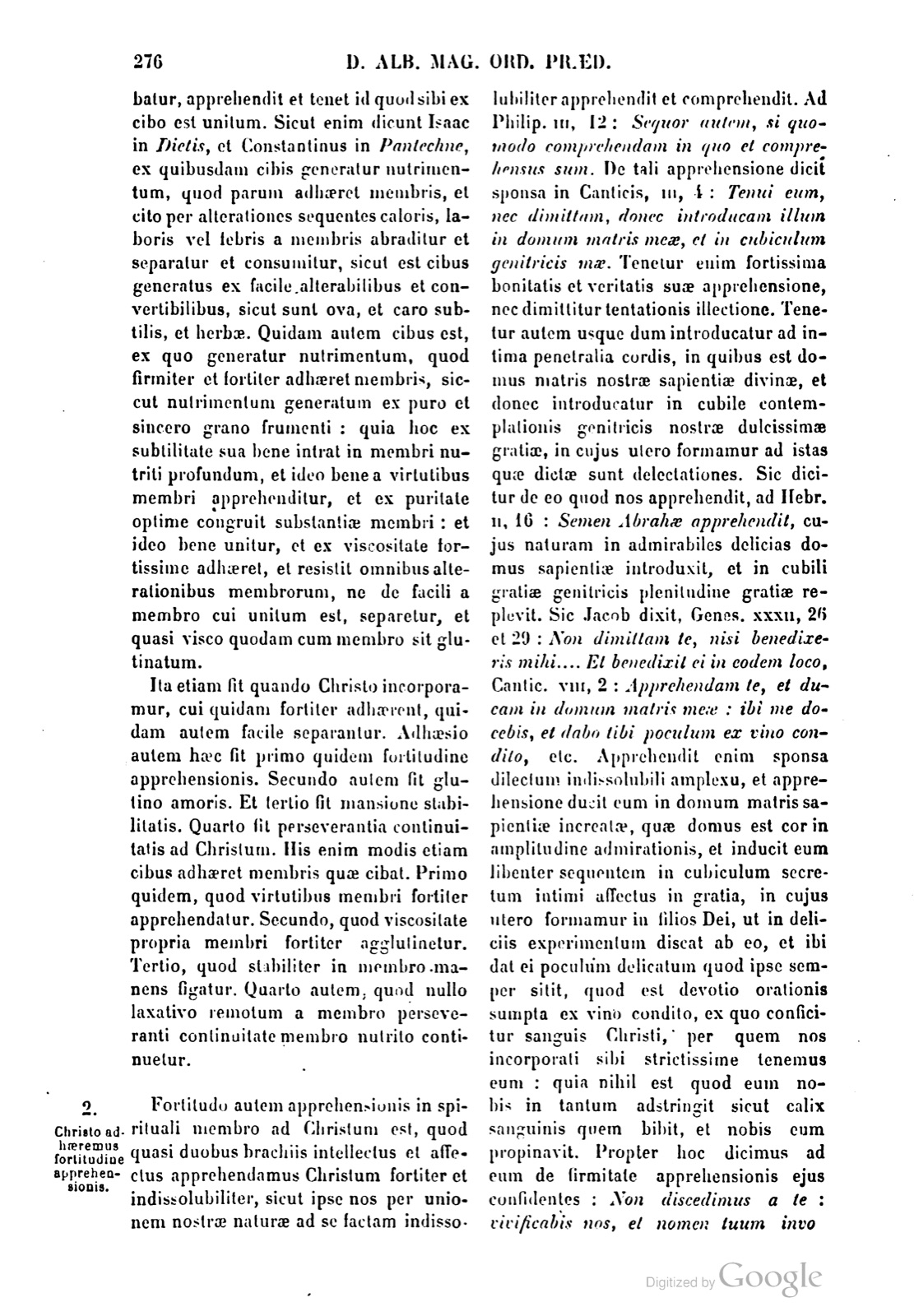
2. Christo adhaeremus fortitudine apprehensionis. Fortitudo autem apprehensionis in spirituali membro ad Christum est, quod quasi duobus brachiis intellectus et affectus apprehendamus Christum fortiter et indissolubiliter, sicut ipse nos per unionem nostrae naturae ad se factam indissolubiliter apprehendit et comprehendit. Ad Philip. III, 12: Sequor autem, si quomodo comprehendam in quo et comprehensus sum. De tali apprehensione dicit sponsa in Canticis, III, 4: Tenui eum, nec dimittam, donec introducam illum in domum matris meae, et in cubiculum genitricis meae. Tenetur enim fortissima bonitatis et veritatis suae apprehensione, nec dimittitur tentationis illectione. Tenetur autem usque dum introducatur ad intima penetralia cordis, in quibus est domus matris nostrae sapientiae divinae, et donec introducatur in cubile contemplationis genitricis nostrae dulcissimae gratiae, in cujus utero formamur ad istas quae dictae sunt delectationes. Sic dicitur de eo quod nos apprehendit, ad Hebr. II, 16: Semen Abrahae apprehendit, cujus naturam in admirabiles delicias domus sapientiae introduxit, et in cubili gratiae genitricis plenitudine gratiae replevit. Sic Jacob dixit, Genes. XXXII, 26 et 29: Non dimittam te, nisi benedixeris mihi.... Et benedixit ei in eodem loco, Cantic. VIII, 2: Apprehendam te, et ducam in domum matris meae: ibi me docebis, et dabo tibi poculum ex vino condito, etc. Apprehendit enim sponsa dilectum indissolubili amplexu, et apprehensione duxit eum in domum matris sapientiae increatae, quae domus est cor in amplitudine admirationis, et inducit eum libenter sequentem in cubiculum secretum intimi affectus in gratia, in cujus utero formamur in filios Dei, ut in deliciis experimentum discat ab eo, et ibi dat ei poculum delicatum quod ipse semper sitit, quod est devotio orationis sumpta ex vino condito, ex quo conficitur sanguis Christi, per quem nos incorporati sibi strictissime tenemus eum: quia nihil est quod eum nobis in tantum adstringit sicut calix sanguinis quem bibit, et nobis cum propinavit. Propter hoc dicimus ad eum de firmitate apprehensionis ejus confidentes: Non discedimus a te: vivificabis nos, et nomen tuum invocabimus.1 Et illud libri IV Regum, II, 2: Vivit Dominus, et vivit anima tua! quia non derelinquam te. Tunc impletur illud Canticorum, VII, 10: Ego dilecto meo, et ad me conversio ejus. Ego enim dilecto meo adstrictus sum fortissima apprehensione, et ideo ad me in omni bonitatis dulcedine est conversio ejus, ut me multo fortius apprehendat. Sic enim consilio sapienti cuidam dicitur, Apocal. III, 11: Tene quod habes, ut nemo accipiat coronam tuam, quam pro certo alius accipiet, nisi eum quem apprehendamus, fortiter et indissolubiliter teneamus.
Chapter IX. On the firm adhesiveness of this food to the one fed, from the apprehension of the one fed through the food.
1. Ninth and last, according to the division introduced above, it must be seen what firm adhesiveness the food has to the one fed, lest it be scraped away by any occasion; and this is perfected, as we said above, from the strongest apprehension, against that which the one who is fed apprehends and holds, namely that which has been united to him from the food. For as Isaac says in the Sayings, and Constantine in the Pantechne, from certain foods a nourishment is generated which clings little to the members, and quickly, through subsequent alterations of heat, labor, or fever, is scraped away from the members and separated and consumed, as is food generated from things easily alterable and convertible, such as eggs, and delicate flesh, and herbs. But there is a certain food from which nourishment is generated that clings firmly and strongly to the members, like nourishment generated from the pure and sincere grain of wheat; because by its subtlety it enters well into the depth of the nourished member, and therefore is well apprehended by the powers of the member, and by its purity is most fittingly suited to the substance of the member; and therefore it is well united, and by its viscosity clings most strongly, and resists all alterations of the members, lest it easily be separated from the member to which it is united, and so that it may be glued with the member as by a certain birdlime.
So too it happens when we are incorporated into Christ; some cling strongly to him, but some are easily separated. This adhesion happens first by strength of apprehension. Second, it happens by the glue of love. And third, it happens by the dwelling of stability. Fourth, it happens by perseverance of continuity with Christ. For in these ways food also clings to the members which it feeds. First, that it be strongly apprehended by the powers of the member. Second, that by the proper viscosity of the member it be strongly glued on. Third, that by remaining stably in the member it be fixed. Fourth, that, removed from the member by no laxative, it be continued to the nourished member with persevering continuity.
2. We cling to Christ by strength of apprehension. But the strength of apprehension in a spiritual member toward Christ is that, as by the two arms of intellect and affection, we apprehend Christ strongly and indissolubly, just as he, through the union of our nature made to himself, apprehends and comprehends us indissolubly. Philippians 3:12: "But I follow, if somehow I may comprehend that in which I have also been comprehended." Of such apprehension the bride says in Canticles 3:4: "I held him, nor will I let him go, until I bring him into the house of my mother and into the chamber of her who bore me." For he is held by the strongest apprehension of his goodness and truth, and he is not let go by the enticement of temptation. But he is held until he is brought into the innermost recesses of the heart, in which is the house of our mother, divine wisdom, and until he is brought into the bedchamber of contemplation of our begetter, sweetest grace, in whose womb we are formed for those delights which have been mentioned. Thus it is said of him who apprehends us, Hebrews 2:16: "He took hold of the seed of Abraham," whose nature he introduced into the admirable delights of the house of wisdom, and in the bedchamber of grace, the begetter, he filled it with fullness of grace. Thus Jacob said, Genesis 32:26 and 29: "I will not let you go unless you bless me.... And he blessed him in the same place." Canticles 8:2: "I will take hold of you and bring you into the house of my mother; there you will teach me, and I will give you a cup from spiced wine," etc. For the bride apprehends the beloved with an indissoluble embrace, and by apprehension she has led him into the house of the mother of uncreated wisdom, which house is the heart in the breadth of admiration, and she brings him, gladly following, into the secret chamber of inmost affection in grace, in whose womb we are formed into sons of God, so that in delights she may learn experience from him; and there she gives him the delicate cup for which he always thirsts, which is the devotion of prayer taken from spiced wine, from which the blood of Christ is consecrated, through which we, incorporated into him, hold him most tightly to ourselves; because there is nothing that binds him so much to us as the chalice of blood which he drank and, with it, offered to us. On account of this we say to him, confident concerning the firmness of his apprehension: "We do not depart from you; you will give us life, and we will call upon your name."1 And that word of the fourth book of Kings, 2:2: "The Lord lives, and your soul lives! for I will not forsake you." Then that word of Canticles 7:10 is fulfilled: "I to my beloved, and his turning is toward me." For I am bound to my beloved by the strongest apprehension, and therefore his turning is toward me in every sweetness of goodness, so that he may apprehend me much more strongly. For thus by wise counsel it is said to a certain man, Apocalypse 3:11: "Hold what you have, that no one may take your crown," which certainly another will take unless we strongly and indissolubly hold him whom we apprehend.
3. Glutino amoris. Secundum autem est, ut glutino viscositatis propriae fortiter conglutinemur membro quod cibatur et nutritur: et hoc in spiritualibus fit conglutino amoris, quando scilicet fortissimo amore glutinatur anima fidelis cum Christo, ne umquam separetur ab ipso. Et hoc est quod dicitur, Eccli. XXV, 16: Timor Dei initium dilectionis ejus: fidei autem initium agglutinandum est ei: quia dilectio quae est gluten conglutinans diligentes se invicem Christum et animam fidelem, incipit in recessu a malo quod facit timor.
3. By the glue of love. The second is that by the glue of its proper viscosity we be strongly glued to the member which is fed and nourished; and this in spiritual matters happens by the gluing together of love, namely when the faithful soul is glued with Christ by the strongest love, lest it ever be separated from him. And this is what is said, Ecclesiasticus 25:16: "The fear of God is the beginning of his love; but the beginning of faith must be glued to him"; because love, which is the glue gluing together those who love each other, Christ and the faithful soul, begins in departure from evil, which fear makes.
In ordine autem ad bonum incipit a cognitione veritatis dilecti. Et sic fit conglutinatio qua anima diligens adhaeret Christo dilecto. Isa. XLI, 7: Confortavit faber aerarius percutiens malleo eum, qui cudebat tunc temporis, dicens: Glutino bonum est. Faber autem aerarius iste est Deus Pater, qui omnia fabricavit. Hic dicitur aerarius: quia omnia domuit sicut ferrum. Et ille faber confortavit Filium qui totum mundum ab initio sicut sapientia cudebat: quia confortavit eum ad hominis dilectionem, quando homines sibi per incarnationem et sui in sacramento collationem agglutinavit, dicens ad Angelos: Glutino bonum est: quia per omnia charitatis nobis exhibitae indicia nihil aliud dixit nisi quod glutinaret sibi homines ut diligerent eum, et sibi glutino amoris conjungerentur. Et ad hoc homines et Angeli responderunt: Bonum est sic conglutinare: quia per hoc homo salvatur, et ruina Angelorum reparatur. Jerem. XIII, 11: Sicut adhaeret lumbare ad lumbos viri, sic agglutinavi mihi omnem domum Israel, et omnem domum Juda, dicit Dominus, ut essent mihi in nomen, et in laudem, et in gloriam. Lumbi enim sunt loca delectationum: quia delectatur Dominus in his qui per amorem sibi agglutinantur, in quibus etiam nomen suum invocatur. Laus autem sua decantatur, et crescit gloria suae magnificentiae et honoris.
But in order toward good it begins from knowledge of the truth of the beloved. And thus the gluing together happens by which the loving soul clings to Christ the beloved. Isaiah 41:7: "The bronze-smith strengthening with the hammer him who was forging then, saying: It is good with glue." But this bronze-smith is God the Father, who fashioned all things. He is called bronze-smith because he subdued all things like iron. And that smith strengthened the Son, who from the beginning was forging the whole world as wisdom, because he strengthened him for love of man, when by the incarnation and by the bestowal of himself in the sacrament he glued men to himself, saying to the angels: "It is good with glue"; because through all the signs of charity shown to us he said nothing else except that he would glue men to himself so that they would love him and be joined to him by the glue of love. And to this men and angels answered: It is good thus to glue together, because through this man is saved and the ruin of the angels is repaired. Jeremiah 13:11: "As the loincloth clings to the loins of a man, so I have glued to myself the whole house of Israel and the whole house of Judah, says the Lord, that they might be to me for a name, and for praise, and for glory." For the loins are places of delights, because the Lord is delighted in those who by love are glued to him, in whom also his name is called upon. Moreover his praise is sung, and the glory of his magnificence and honor increases.
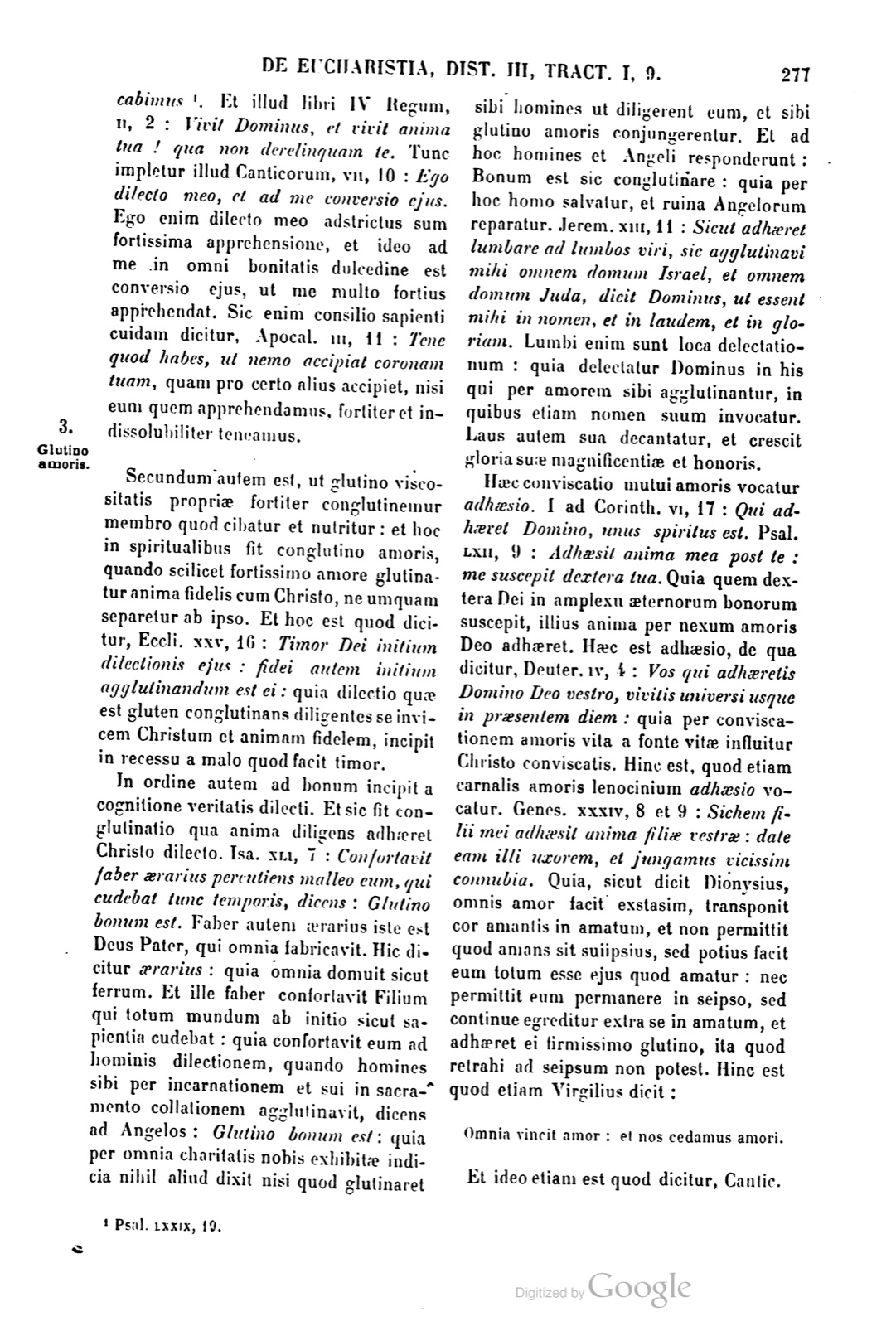
Haec conviscatio mutui amoris vocatur adhaesio. I ad Corinth. VI, 17: Qui adhaeret Domino, unus spiritus est. Psal. LXII, 9: Adhaesit anima mea post te: me suscepit dextera tua. Quia quem dextera Dei in amplexu aeternorum bonorum suscepit, illius anima per nexum amoris Deo adhaeret. Haec est adhaesio, de qua dicitur, Deuter. IV, 4: Vos qui adhaeretis Domino Deo vestro, vivitis universi usque in praesentem diem: quia per conviscationem amoris vita a fonte vitae influitur Christo conviscatis. Hinc est, quod etiam carnalis amoris lenocinium adhaesio vocatur. Genes. XXXIV, 8 et 9: Sichem filii mei adhaesit anima filiae vestrae: date eam illi uxorem, et jungamus vicissim connubia. Quia, sicut dicit Dionysius, omnis amor facit exstasim, transponit cor amantis in amatum, et non permittit quod amans sit suiipsius, sed potius facit eum totum esse ejus quod amatur: nec permittit eum permanere in seipso, sed continue egreditur extra se in amatum, et adhaeret ei firmissimo glutino, ita quod retrahi ad seipsum non potest. Hinc est quod etiam Virgilius dicit: Omnia vincit amor: et nos cedamus amori.
Et ideo etiam est quod dicitur, Cantic. VIII, 6, quia fortis est ut mors dilectio. Quia animam et cor transponit extra amantem in amatum, sicut mors transponit animam, quae conviscata in amatum, redire non potest ad seipsam: et ideo amor optimum glutinum est, quo membrum incorporatum Christo firmiter adhaeret ne a Christo separetur.
This mutual viscation of love is called adhesion. 1 Corinthians 6:17: "He who clings to the Lord is one spirit." Psalm 62:9: "My soul has clung after you; your right hand has received me." For him whom the right hand of God has received in the embrace of eternal goods, that person's soul clings to God through the bond of love. This is the adhesion of which it is said, Deuteronomy 4:4: "You who cling to the Lord your God are all alive until the present day," because through the viscation of love life is poured from the fountain of life into those visced to Christ. Hence it is that even the enticement of carnal love is called adhesion. Genesis 34:8 and 9: "The soul of Shechem my son has clung to your daughter; give her to him as wife, and let us join marriages mutually." For, as Dionysius says, every love makes ecstasy, transfers the heart of the lover into the beloved, and does not permit the lover to belong to himself, but rather makes him wholly belong to what is loved; nor does it permit him to remain in himself, but he continually goes out beyond himself into the beloved, and clings to it by the firmest glue, so that he cannot be drawn back to himself. Hence also Virgil says: "Love conquers all things; and let us yield to love."
And therefore it is also what is said, Canticles 8:6, that love is strong as death. For it transfers soul and heart outside the lover into the beloved, as death transfers the soul, which, visced into the beloved, cannot return to itself; and therefore love is the best glue, by which the member incorporated into Christ firmly clings, lest it be separated from Christ.
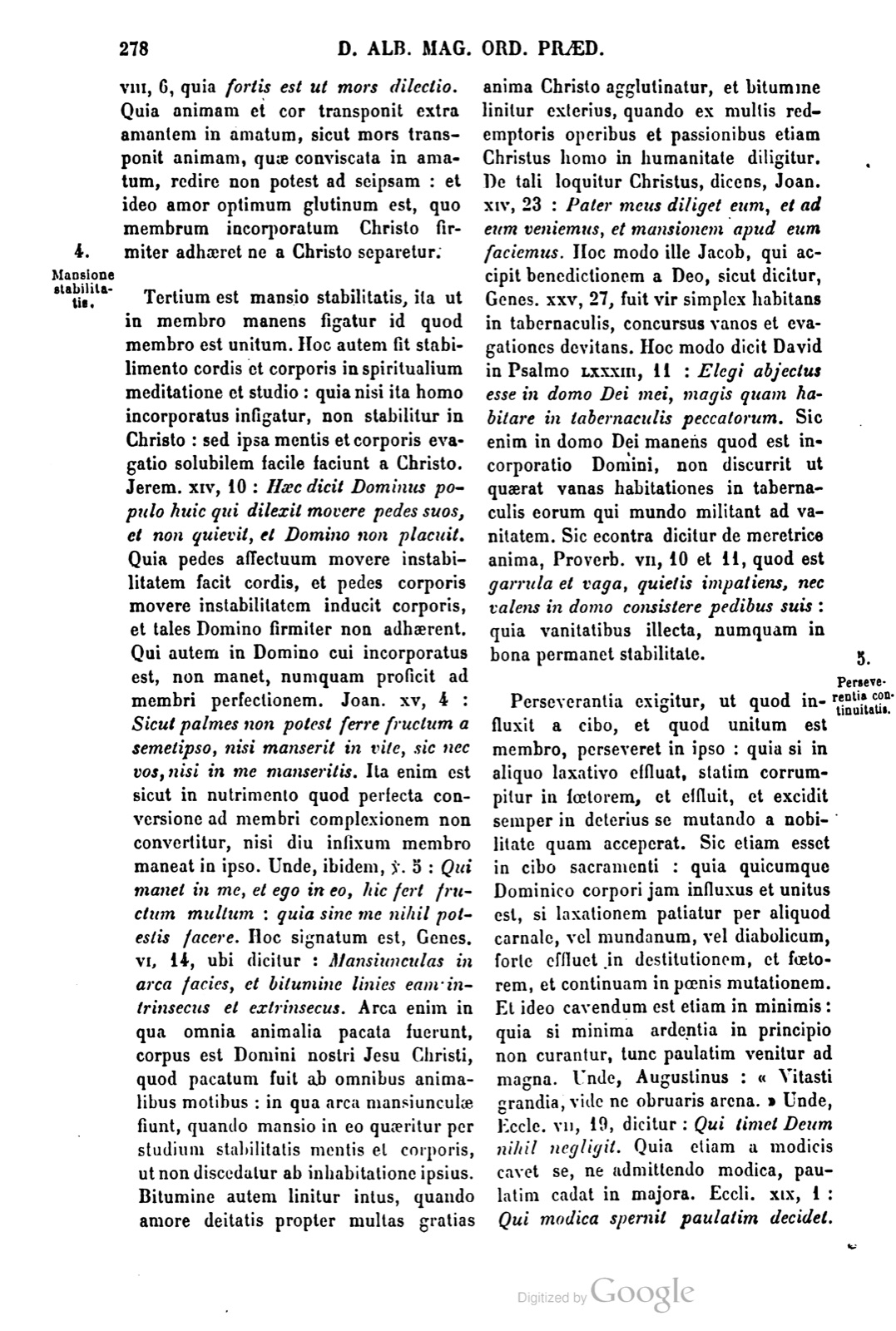
4. Mansione stabilitatis. Tertium est mansio stabilitatis, ita ut in membro manens figatur id quod in membro est unitum. Hoc autem fit stabilimento cordis et corporis in spiritualium meditatione et studio: quia nisi ita homo incorporatus infigatur, non stabilitur in Christo: sed ipsa mentis et corporis evagatio solubilem facile faciunt a Christo. Jerem. XIV, 10: Haec dicit Dominus populo huic qui dilexit movere pedes suos, et non quievit, et Domino non placuit. Quia pedes affectuum movere instabilitatem facit cordis, et pedes corporis movere instabilitatem inducit corporis, et tales Domino firmiter non adhaerent. Qui autem in Domino cui incorporatus est, non manet, numquam proficit ad membri perfectionem. Joan. XV, 4: Sicut palmes non potest ferre fructum a semetipso, nisi manserit in vite, sic nec vos, nisi in me manseritis. Ita enim est sicut in nutrimento quod perfecta conversione ad membri complexionem non convertitur, nisi diu infixum membro maneat in ipso. Unde, ibidem, v. 5: Qui manet in me, et ego in eo, hic fert fructum multum: quia sine me nihil potestis facere. Hoc signatum est, Genes. VI, 14, ubi dicitur: Mansiunculas in arca facies, et bitumine linies eam intrinsecus et extrinsecus. Arca enim in qua omnia animalia pacata fuerunt, corpus est Domini nostri Jesu Christi, quod pacatum fuit ab omnibus animalibus motibus: in qua arca mansiunculae fiunt, quando mansio in eo quaeritur per studium stabilitatis mentis et corporis, ut non discedatur ab inhabitatione ipsius. Bitumine autem linitur intus, quando amore deitatis propter multas gratias anima Christo agglutinatur, et bitumine linitur exterius, quando ex multis redemptoris operibus et passionibus etiam Christus homo in humanitate diligitur. De tali loquitur Christus, dicens, Joan. XIV, 23: Pater meus diliget eum, et ad eum veniemus, et mansionem apud eum faciemus. Hoc modo ille Jacob, qui accipit benedictionem a Deo, sicut dicitur, Genes. XXV, 27, fuit vir simplex habitans in tabernaculis, concursus vanos et evagationes devitans. Hoc modo dicit David in Psalmo LXXXIII, 11: Elegi abjectus esse in domo Dei mei, magis quam habitare in tabernaculis peccatorum. Sic enim in domo Dei manens quod est incorporatio Domini, non discurrit ut quaerat vanas habitationes in tabernaculis eorum qui mundo militant ad vanitatem. Sic econtra dicitur de meretrice anima, Proverb. VII, 10 et 11, quod est garrula et vaga, quietis impatiens, nec valens in domo consistere pedibus suis: quia vanitatibus illecta, numquam in bona permanet stabilitate.
5. Perseverentia continuitatis. Perseverantia exigitur, ut quod influxit a cibo, et quod unitum est membro, perseveret in ipso: quia si in aliquo laxativo effluat, statim corrumpitur in foetorem, et effluit, et excidit semper in deterius se mutando a nobilitate quam acceperat. Sic etiam esset in cibo sacramenti: quia quicumque Dominico corpori jam influxus et unitus est, si laxationem patiatur per aliquod carnale, vel mundanum, vel diabolicum, forte effluet in destitutionem, et foetorem, et continuam in poenis mutationem. Et ideo cavendum est etiam in minimis: quia si minima ardentia in principio non curantur, tunc paulatim venitur ad magna. Unde, Augustinus: « Vitasti grandia, vide ne obruaris arena. » Unde, Eccle. VII, 19, dicitur: Qui timet Deum nihil negligit. Quia etiam a modicis cavet se, ne admittendo modica, paulatim cadat in majora. Eccli. XIX, 1: Qui modica spernit paulatim decidet.
4. By the dwelling of stability. The third is the dwelling of stability, so that what is united in the member, remaining in the member, may be fixed. But this happens by the stabilizing of heart and body in meditation and study of spiritual things; because unless the incorporated man is fixed in this way, he is not stabilized in Christ, but the wandering itself of mind and body easily makes him soluble from Christ. Jeremiah 14:10: "Thus says the Lord to this people who loved to move their feet, and did not rest, and it did not please the Lord." For to move the feet of the affections makes instability of heart, and to move the feet of the body brings instability of body; and such persons do not cling firmly to the Lord. But one who does not remain in the Lord into whom he has been incorporated never advances to the perfection of a member. John 15:4: "As the branch cannot bear fruit of itself unless it has remained in the vine, so neither can you, unless you have remained in me." For it is so with nourishment, which is not converted by perfect conversion to the complexion of the member unless, fixed to the member for a long time, it remains in it. Hence, in the same place, v. 5: "He who remains in me and I in him, he bears much fruit, because without me you can do nothing." This was signified at Genesis 6:14, where it is said: "You shall make little dwellings in the ark, and you shall smear it with bitumen within and without." For the ark in which all the animals were pacified is the body of our Lord Jesus Christ, which was pacified from all animal motions; in this ark little dwellings are made when a dwelling in him is sought through zeal for stability of mind and body, so that one does not depart from his indwelling. But it is smeared with bitumen within when, because of many graces, the soul is glued to Christ by love of deity, and it is smeared with bitumen without when, from the many works and passions of the Redeemer, Christ as man also is loved in humanity. Christ speaks of such a one, saying, John 14:23: "My Father will love him, and we will come to him and make our dwelling with him." In this way that Jacob, who receives the blessing from God, as is said, Genesis 25:27, was a simple man dwelling in tents, avoiding vain assemblies and wanderings. In this way David says in Psalm 83:11: "I chose to be abject in the house of my God rather than to dwell in the tents of sinners." For thus one remaining in the house of God, which is incorporation into the Lord, does not run about to seek vain dwellings in the tents of those who serve the world for vanity. Thus, on the contrary, it is said of the harlot soul, Proverbs 7:10 and 11, that it is talkative and wandering, impatient of quiet, and unable to remain in the house on its feet, because enticed by vanities it never remains in good stability.
5. Perseverance of continuity. Perseverance is required, so that what has flowed in from the food, and what has been united to the member, may persevere in it; because if it flows away through some laxative, it is at once corrupted into stench, and flows away, and falls always into something worse, changing itself from the nobility which it had received. So also it would be in the food of the sacrament, because whoever has now flowed into and been united to the Lord's body, if he suffers relaxation through something carnal, or worldly, or diabolical, perhaps will flow away into destitution, and stench, and continual change in punishments. And therefore one must beware even in the smallest things, because if the smallest burning things are not cared for in the beginning, then little by little one comes to great things. Hence Augustine: "You have avoided great things; see that you are not overwhelmed by sand." Hence, Ecclesiastes 7:19, it is said: "He who fears God neglects nothing." For he also guards himself from small things, lest by admitting small things he gradually fall into greater. Ecclesiasticus 19:1: "He who despises small things will fall little by little."
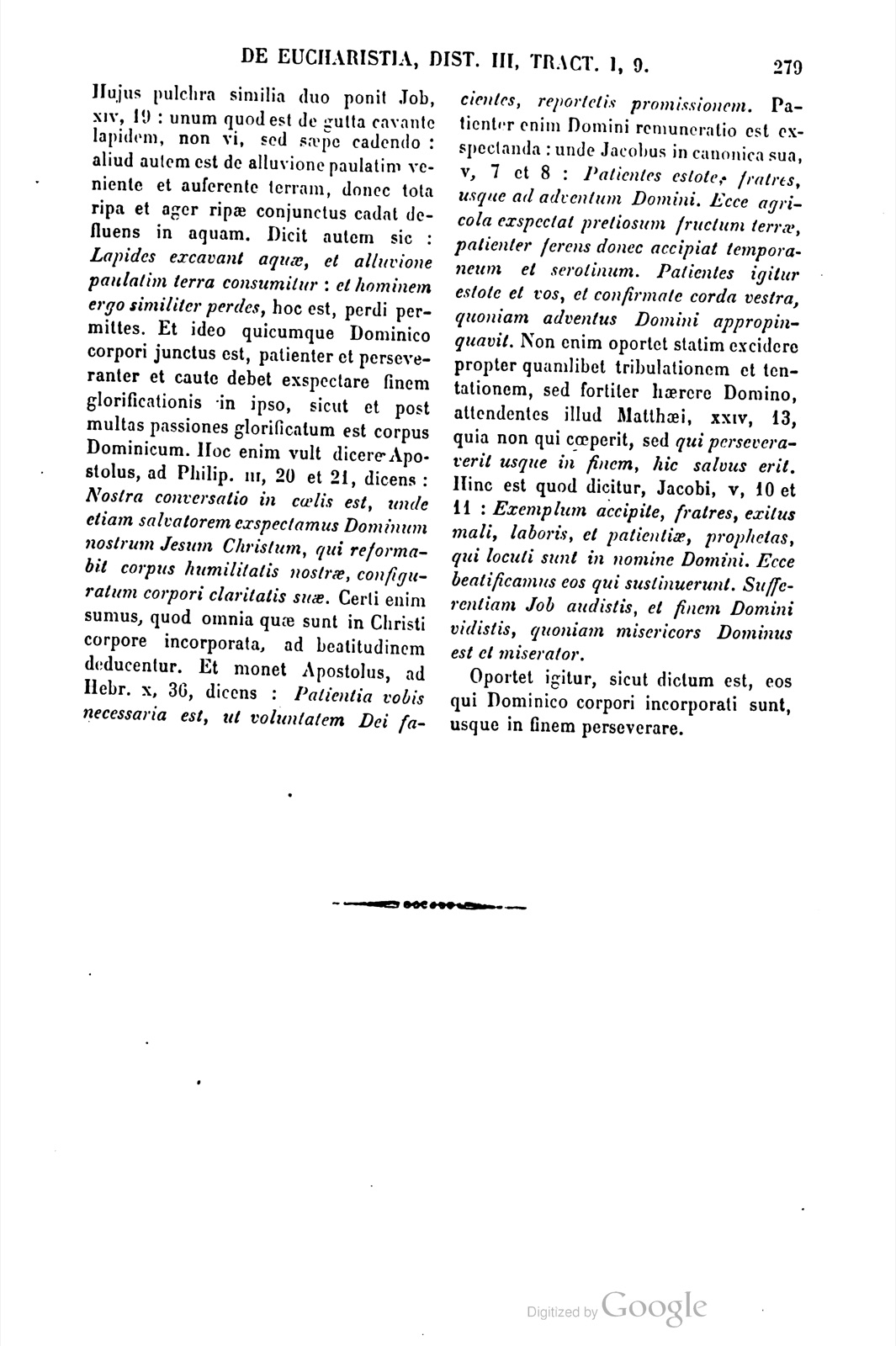
Hujus pulchra similia duo ponit Job, XIV, 19: unum quod est de gutta cavante lapidem, non vi, sed saepe cadendo: aliud autem est de alluvione paulatim veniente et auferente terram, donec tota ripa et ager ripae conjunctus cadat defluens in aquam. Dicit autem sic: Lapides excavant aquae, et alluvione paulatim terra consumitur: et hominem ergo similiter perdes, hoc est, perdi permittes. Et ideo quicumque Dominico corpori junctus est, patienter et perseveranter et caute debet exspectare finem glorificationis in ipso, sicut et post multas passiones glorificatum est corpus Dominicum. Hoc enim vult dicere Apostolus, ad Philip. III, 20 et 21, dicens: Nostra conversatio in caelis est, unde etiam salvatorem exspectamus Dominum nostrum Jesum Christum, qui reformabit corpus humilitatis nostrae, configuratum corpori claritatis suae. Certi enim sumus, quod omnia quae sunt in Christi corpore incorporata, ad beatitudinem deducentur. Et monet Apostolus, ad Hebr. X, 36, dicens: Patientia vobis necessaria est, ut voluntatem Dei facientes, reportetis promissionem. Patienter enim Domini remuneratio est exspectanda: unde Jacobus in canonica sua, V, 7 et 8: Patientes estote, fratres, usque ad adventum Domini. Ecce agricola exspectat pretiosum fructum terrae, patienter ferens donec accipiat temporaneum et serotinum. Patientes igitur estote et vos, et confirmate corda vestra, quoniam adventus Domini appropinquavit. Non enim oportet statim excidere propter quamlibet tribulationem et tentationem, sed fortiter haerere Domino, attendentes illud Matthaei, XXIV, 13, quia non qui coeperit, sed qui perseveraverit usque in finem, hic salvus erit. Hinc est quod dicitur, Jacobi, V, 10 et 11: Exemplum accipite, fratres, exitus mali, laboris, et patientiae, prophetas, qui locuti sunt in nomine Domini. Ecce, beatificamus eos qui sustinuerunt. Sufferentiam Job audistis, et finem Domini vidistis, quoniam misericors Dominus est et miserator.
Oportet igitur, sicut dictum est, eos qui Dominico corpori incorporati sunt, usque in finem perseverare.
Job, 14:19, gives two beautiful likenesses of this: one which concerns a drop hollowing out a stone, not by force, but by often falling; the other concerns a flood gradually coming and carrying away earth, until the whole bank and the field joined to the bank falls, flowing down into the water. But he says thus: "Waters hollow out stones, and by flood the earth is gradually consumed; and therefore you will likewise destroy man," that is, you will permit him to be destroyed. And therefore whoever is joined to the Lord's body ought patiently and perseveringly and cautiously to await the end of glorification in him, just as the Lord's body was glorified after many sufferings. For this is what the Apostle wishes to say, Philippians 3:20 and 21, saying: "Our conversation is in heaven, whence also we await the savior, our Lord Jesus Christ, who will reform the body of our humility, configured to the body of his brightness." For we are certain that all things which are incorporated in Christ's body will be led to blessedness. And the Apostle admonishes, Hebrews 10:36, saying: "Patience is necessary for you, so that, doing the will of God, you may receive the promise." For the Lord's reward must be patiently awaited; hence James in his canonical epistle, 5:7 and 8: "Be patient, brothers, until the coming of the Lord. Behold, the farmer awaits the precious fruit of the earth, patiently bearing until he receives the early and late. Therefore be patient also yourselves, and strengthen your hearts, because the coming of the Lord has drawn near." For one ought not immediately to fall away because of any tribulation and temptation whatsoever, but to cling strongly to the Lord, attending to that word of Matthew 24:13, that not the one who has begun, but "the one who has persevered unto the end, he will be saved." Hence it is said, James 5:10 and 11: "Take an example, brothers, of evil outcome, labor, and patience: the prophets who spoke in the name of the Lord. Behold, we call blessed those who endured. You have heard the endurance of Job, and have seen the end of the Lord, because the Lord is merciful and compassionate."
Therefore, as has been said, those who have been incorporated into the Lord's body must persevere unto the end.
Notes
- Psalm 79:19. (Psal. LXXIX, 19.) ↩
If a page does not appear, its photograph has not been uploaded yet.