Works › The Book on the Sacrament of the Eucharist
Volume 38 · p. 227
Tractate III, Chapter I Conclusion.
Marginal label (printed p. 227): Eucharistia habet unum effectum substantialem et plures adjunctos.
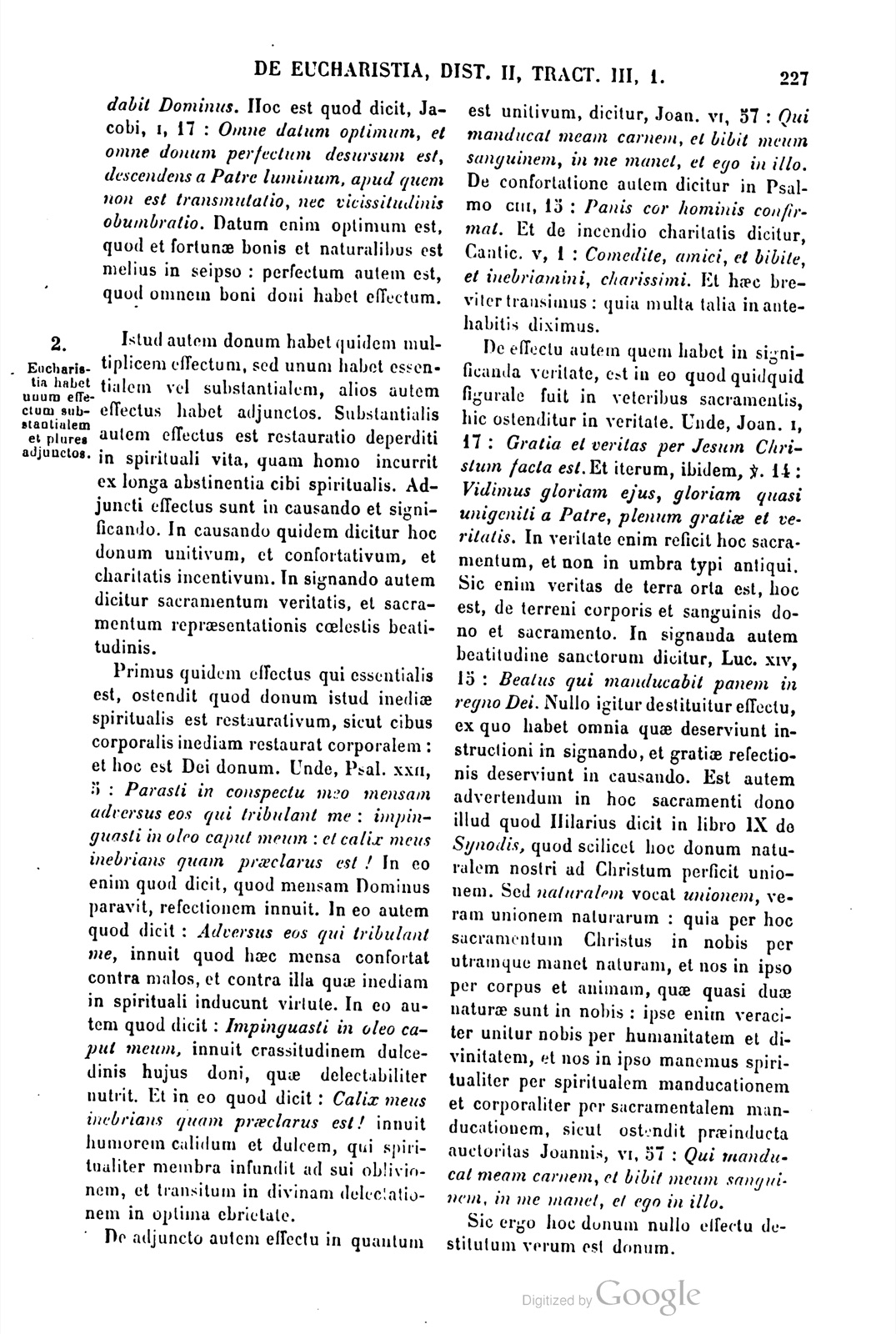
dabit Dominus. Hoc est quod dicit, Jacobi, i, 17: Omne datum optimum, et omne donum perfectum desursum est, descendens a Patre luminum, apud quem non est transmutatio, nec vicissitudinis obumbratio. Datum enim optimum est, quod et fortunae bonis et naturalibus est melius in seipso: perfectum autem est, quod omnem boni doni habet effectum.
2. Istud autem donum habet quidem multiplicem effectum, sed unum habet essentialem vel substantialem, alios autem effectus habet adjunctos. Substantialis autem effectus est restauratio deperditi in spirituali vita, quam homo incurrit ex longa abstinentia cibi spiritualis. Adjuncti effectus sunt in causando et significando. In causando quidem dicitur hoc donum unitivum, et confortativum, et charitatis incentivum. In signando autem dicitur sacramentum veritatis, et sacramentum repraesentationis coelestis beatitudinis.
Primus quidem effectus qui essentialis est, ostendit quod donum istud inediae spiritualis est restaurativum, sicut cibus corporalis inediam restaurat corporalem: et hoc est Dei donum. Unde, Psal. xxii, 5: Parasti in conspectu meo mensam adversus eos qui tribulant me: impinguasti in oleo caput meum: et calix meus inebrians quam praeclarus est! In eo enim quod dicit, quod mensam Dominus paravit, refectionem innuit. In eo autem quod dicit: Adversus eos qui tribulant me, innuit quod haec mensa confortat contra malos, et contra illa quae inediam in spirituali inducunt virtute. In eo autem quod dicit: Impinguasti in oleo caput meum, innuit crassitudinem dulcedinis hujus doni, quae delectabiliter nutrit. Et in eo quod dicit: Calix meus inebrians quam praeclarus est! innuit humorem calidum et dulcem, qui spiritualiter membra infundit ad sui oblivionem, et transitum in divinam delectationem in optima ebrietate.
De adjuncto autem effectu in quantum est unitivum, dicitur, Joan. vi, 57: Qui manducat meam carnem, et bibit meum sanguinem, in me manet, et ego in illo. De confortatione autem dicitur in Psalmo ciii, 15: Panis cor hominis confirmat. Et de incendio charitatis dicitur, Cantic. v, 1: Comedite, amici, et bibite, et inebriamini, charissimi. Et haec breviter transimus: quia multa talia in antehabitis diximus.
De effectu autem quem habet in significanda veritate, est in eo quod quidquid figurale fuit in veteribus sacramentis, hic ostenditur in veritate. Unde, Joan. i, 17: Gratia et veritas per Jesum Christum facta est. Et iterum, ibidem, v. 14: Vidimus gloriam ejus, gloriam quasi unigeniti a Patre, plenum gratiae et veritatis. In veritate enim reficit hoc sacramentum, et non in umbra typi antiqui. Sic enim veritas de terra orta est, hoc est, de terreni corporis et sanguinis dono et sacramento. In signanda autem beatitudine sanctorum dicitur, Luc. xiv, 15: Beatus qui manducabit panem in regno Dei. Nullo igitur destituitur effectu, ex quo habet omnia quae deserviunt instructioni in signando, et gratiae refectionis deserviunt in causando. Est autem advertendum in hoc sacramenti dono illud quod Hilarius dicit in libro IX de Synodis, quod scilicet hoc donum naturalem nostri ad Christum perficit unionem. Sed naturalem vocat unionem, veram unionem naturarum: quia per hoc sacramentum Christus in nobis per utramque manet naturam, et nos in ipso per corpus et animam, quae quasi duae naturae sunt in nobis: ipse enim veraciter unitur nobis per humanitatem et divinitatem, et nos in ipso manemus spiritualiter per spiritualem manducationem et corporaliter per sacramentalem manducationem, sicut ostendit praeinducta auctoritas Joannis, vi, 57: Qui manducat meam carnem, et bibit meum sanguinem, in me manet, et ego in illo.
Sic ergo hoc donum nullo effectu destitutum verum est donum.
Marginal label (printed p. 227): The Eucharist has one substantial effect and several adjoined effects.
the Lord will give. This is what James 1:17 says: Every best given thing, and every perfect gift, is from above, descending from the Father of lights, with whom there is no change, nor shadowing of vicissitude. For the best given thing is that which in itself is better both than the goods of fortune and than natural goods; but the perfect thing is that which has every effect of a good gift.
2. Now that gift indeed has a manifold effect, but it has one essential or substantial effect, and it has other attached effects. But the substantial effect is the restoration of what has been lost in spiritual life, which a man incurs from long abstinence from spiritual food. The attached effects are in causing and in signifying. In causing, this gift is indeed called unitive, strengthening, and an incentive of charity. But in signifying it is called the sacrament of truth and the sacrament of the representation of heavenly blessedness.
The first effect, which is essential, shows that that gift is restorative of spiritual hunger, just as bodily food restores bodily hunger; and this is the gift of God. Hence Psalm 22:5: You have prepared a table in my sight against those who trouble me; you have fattened my head with oil; and my chalice, making drunk, how splendid it is! For in that he says that the Lord prepared a table, he implies refreshment. But in that he says: Against those who trouble me, he implies that this table strengthens against evil men, and against those things which induce hunger in spiritual virtue. But in that he says: You have fattened my head with oil, he implies the thickness of the sweetness of this gift, which delightfully nourishes. And in that he says: My chalice, making drunk, how splendid it is! he implies a warm and sweet moisture which spiritually pours into the members unto forgetfulness of self and passage into divine delight in the best drunkenness.
But concerning the attached effect, insofar as it is unitive, John 6:57 says: He who eats my flesh and drinks my blood remains in me, and I in him. Concerning strengthening, however, it is said in Psalm 103:15: Bread strengthens the heart of man. And concerning the kindling of charity Canticles 5:1 says: Eat, friends, and drink, and be inebriated, dearest ones. And we pass over these things briefly, because we have said many such things in what went before.
But concerning the effect which it has in signifying truth, it consists in this, that whatever was figurative in the old sacraments is here shown in truth. Hence John 1:17: Grace and truth were made through Jesus Christ. And again, in the same place, verse 14: We saw his glory, glory as of the only-begotten from the Father, full of grace and truth. For this sacrament refreshes in truth and not in the shadow of the ancient type. For thus truth has arisen from the earth, that is, from the gift and sacrament of the earthly body and blood. But in signifying the blessedness of the saints, Luke 14:15 says: Blessed is he who shall eat bread in the kingdom of God. Therefore it is deprived of no effect, since it has all things which serve instruction in signifying and serve the refreshment of grace in causing. But in this gift of the sacrament that must be noted which Hilary says in book 9 On Synods, namely that this gift perfects the natural union of us to Christ. But he calls it a natural union, a true union of natures, because through this sacrament Christ remains in us through each nature, and we in him through body and soul, which are as it were two natures in us. For he is truly united to us through humanity and deity, and we remain in him spiritually through spiritual eating and bodily through sacramental eating, as the previously introduced authority of John 6:57 shows: He who eats my flesh and drinks my blood remains in me, and I in him.
Thus therefore this gift, deprived of no effect, is a true gift.
If a page does not appear, its photograph has not been uploaded yet.