Works › The Book on the Sacrament of the Eucharist
Volume 38 · p. 226
Tractate III. On the Property of the Receiver. Chapter I.
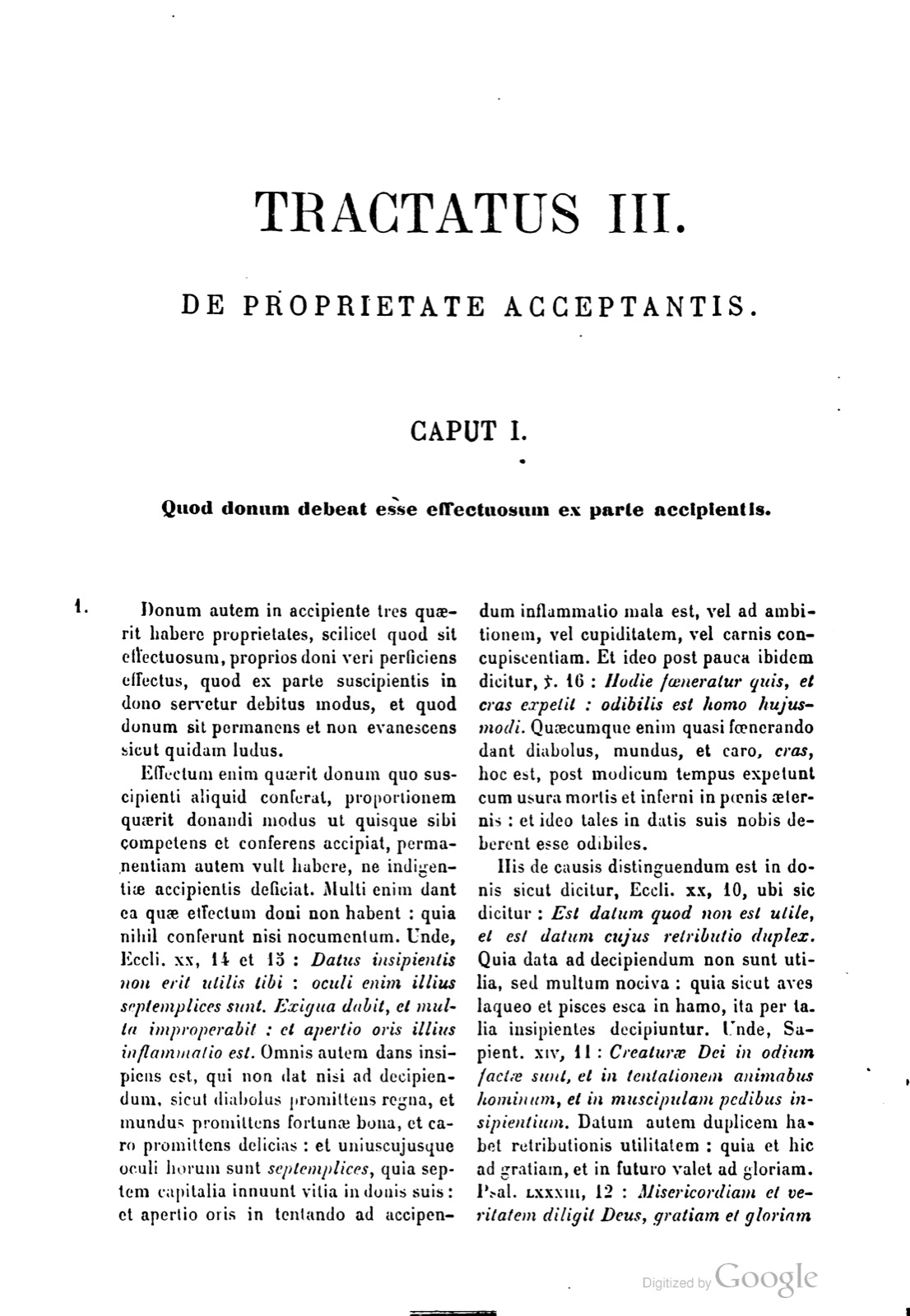
Tractatus III. De proprietate acceptantis.
Caput I. Quod donum debeat esse effectuosum ex parte accipientis.
1. Donum autem in accipiente tres quaerit habere proprietates, scilicet quod sit effectuosum, proprios doni veri perficiens effectus, quod ex parte suscipientis in dono servetur debitus modus, et quod donum sit permanens et non evanescens sicut quidam ludus.
Effectum enim quaerit donum quo suscipienti aliquid conferat, proportionem quaerit donandi modus ut quisque sibi competens et conferens accipiat, permanentiam autem vult habere, ne indigentiae accipientis deficiat. Multi enim dant ea quae effectum doni non habent: quia nihil conferunt nisi nocumentum. Unde, Eccli. xx, 14 et 15: Datus insipientis non erit utilis tibi: oculi enim illius septemplices sunt. Exigua dabit, et multa improperabit: et apertio oris illius inflammatio est. Omnis autem dans insipiens est, qui non dat nisi ad decipiendum, sicut diabolus promittens regna, et mundus promittens fortunae bona, et caro promittens delicias: et uniuscujusque oculi horum sunt septemplices, quia septem capitalia innuunt vitia in donis suis: et apertio oris in tentando ad accipiendum inflammatio mala est, vel ad ambitionem, vel cupiditatem, vel carnis concupiscentiam. Et ideo post pauca ibidem dicitur, v. 16: Hodie faeneratur quis, et cras expetit: odibilis est homo hujusmodi. Quaecumque enim quasi faenerando dant diabolus, mundus, et caro, cras, hoc est, post modicum tempus expetunt cum usura mortis et inferni in paenis aeternis: et ideo tales in datis suis nobis deberent esse odibiles.
His de causis distinguendum est in donis sicut dicitur, Eccli. xx, 10, ubi sic dicitur: Est datum quod non est utile, et est datum cujus retributio duplex. Quia data ad decipiendum non sunt utilia, sed multum nociva: quia sicut aves laqueo et pisces esca in hamo, ita per talia insipientes decipiuntur. Unde, Sapient. xiv, 11: Creaturae Dei in odium factae sunt, et in tentationem animabus hominum, et in muscipulam pedibus insipientium. Datum autem duplicem habet retributionis utilitatem: quia et hic ad gratiam, et in futuro valet ad gloriam. Psal. lxxxiii, 12: Misericordiam et veritatem diligit Deus, gratiam et gloriam
Tractate III. On the property of the receiver.
Chapter I. That the gift ought to be effectual on the part of the receiver.
1. But in the receiver the gift seeks to have three properties, namely that it be effectual, perfecting the proper effects of a true gift; that on the part of the one receiving, the due mode be preserved in the gift; and that the gift be permanent and not vanish like a certain game.
For a gift seeks an effect by which it may confer something on the receiver; the mode of giving seeks proportion, so that each one may receive what is competent and helpful to him; but it wishes to have permanence lest it fail the need of the receiver. For many give those things which do not have the effect of a gift, because they confer nothing except harm. Hence Ecclesiasticus 20:14 and 15: The gift of a fool will not be useful to you; for his eyes are sevenfold. He will give small things and reproach many things; and the opening of his mouth is an inflammation. But every foolish giver is one who gives only in order to deceive, as the devil promising kingdoms, and the world promising the goods of fortune, and the flesh promising delights; and the eyes of each of these are sevenfold, because they hint at the seven capital vices in their gifts. And the opening of the mouth in tempting one to receive is an evil inflammation, either toward ambition, or greed, or the concupiscence of the flesh. And therefore a little later in the same place it is said, verse 16: Today someone lends at interest, and tomorrow he demands it; a man of this sort is hateful. For whatever things the devil, the world, and the flesh give as if by lending at interest, tomorrow, that is, after a little time, they demand with the usury of death and hell in eternal punishments; and therefore such things in their gifts ought to be hateful to us.
For these causes one must distinguish among gifts, as is said in Ecclesiasticus 20:10, where it is said thus: There is a gift which is not useful, and there is a gift whose recompense is double. Because things given for deceiving are not useful, but very harmful: because just as birds are deceived by a snare and fish by bait on a hook, so through such things fools are deceived. Hence Wisdom 14:11: The creatures of God have been made into hatred, and into temptation for the souls of men, and into a trap for the feet of the foolish. But the gift has a double usefulness of recompense, because here it avails for grace, and in the future for glory. Psalm 83:12: God loves mercy and truth, grace and glory
If a page does not appear, its photograph has not been uploaded yet.