Works › Commentary on the Apocalypse of Blessed John
Volume 38 · pp. 763–771
Exposition on Chapter XXI of the Apocalypse, beginning
A marker with ≈ is an approximate page boundary, placed by measure of the text; the page photographs remain the authority. In the paired views, clicking a page marker brings that page into view.
IN CAPUT XXI APOCALYPSIS ENARRATIO.
1. "Et vidi coelum novum et terram novam. Primum enim coelum et terra prima abiit, et mare jam non est."
Supra positae sunt sex visiones, hic ponitur septima et ultima. Et in hac, secundum Bedam, ostenditur ornatus sponsae, id est, sanctae Ecclesiae.
Et dividitur haec pars in duas. In prima, agitur de innovatione elementorum, et glorificatione Sanctorum. In secunda, de pulchritudine civitatis, et ejus dignitate, ibi, v. 9: "Et venit unus."
In prima parte dicuntur duo. Primo, agitur de elementorum innovatione. Secundo, de sanctorum glorificatione, ibi, v. 2: "Et ego Joannes, etc."
NOTA: Haec visio differt a praedicta: quia praecedens continet ea quae circa judicium et post facta sunt circa malos: haec autem quae fient circa bonos.
Dicit ergo:
"Et vidi coelum novum," id est, aerem innovatum, secundum Augustinum: "et terram novam," id est, innovatam. II Petri, III, 13: Novos coelos et novam terram secundum promissa ipsius exspectamus.
"Primum enim coelum et prima terra abiit," id est, per immutationem jam mutata sunt: et pristina figura recessit, sicut dicit Haymo.
"Et mare jam non est." [Marginal label: Mare.] NOTA: Secundum Augustinum in libro XX de Civitate Dei sic exponitur: "Mare jam non est," id est, hoc saeculum vita mortalium turbulentum: unde accipit mare pro mundo, secundum illud Psalmi CIII, 25: Hoc mare magnum, etc.
Vel sic: "Et mare jam non est," scilicet secundum priorem statum: quia amaritudo aquae et grossities aufertur, et remanebit in primo statu, tamen innovato et meliorato.
2. "Et ego Joannes vidi sanctam civitatem, Jerusalem novam, descendentem de coelo a Deo, paratam sicut sponsam ornatam viro suo."
Supra dictum est de immutatione elementorum, hic agitur de gloria Sanctorum.
Et dividitur haec pars in quatuor. In prima, ostendit glorificationem Sanctorum. In secunda, inducit sanctorum Patrum auctoritatem, ibi, v. 3: "Et audivi vocem." In tertia, ponit ipsius Dei auctoritatem ad majorem confirmationem, ibi, v. 5: "Et dixit qui sedebat in throno." In quarta, ponitur jussio de Scriptura ad posterum utilitatem, ibidem, "Et dixit mihi: Scribe."
Dicit ergo: "Ego Joannes vidi civitatem," id est, Ecclesiam. Psal. LXXXVI, 4: Gloriosa dicta sunt de te, civitas Dei.
Haec est civitas cujus rex est veritas, lex est charitas, modus aeternitas. Augustinus: "Vidi," per spiritualem intelligentiam, "civitatem," id est, Ecclesiam habentem in se Deum inhabitantem, "sanctam," per lavacrum regenerationis mundatam, "Jerusalem," id est, Deum, qui est pax vera, plene videntem. I Joannis, III, 2: Videbimus eum sicuti est.
EXPOSITION ON CHAPTER XXI OF THE APOCALYPSE.
1. "And I saw a new heaven and a new earth. For the first heaven and the first earth passed away, and the sea now is not."
Above six visions were set down; here the seventh and last is set down. And in this, according to Bede, the adornment of the bride is shown, that is, of holy Church.
And this part is divided into two. In the first, the renewal of the elements and the glorification of the Saints are treated. In the second, the beauty of the city and its dignity are treated, there at verse 9: "And one came."
In the first part two things are said. First, the renewal of the elements is treated. Secondly, the glorification of the saints, there at verse 2: "And I John, etc."
NOTE: This vision differs from the preceding one, because the preceding contains those things which were done around judgment and afterward concerning the evil; but this one contains those things which will happen concerning the good.
Therefore he says:
"And I saw a new heaven," that is, the renewed air, according to Augustine; "and a new earth," that is, renewed. 2 Peter 3:13: We await new heavens and a new earth according to his promises.
"For the first heaven and the first earth passed away," that is, by alteration they have now been changed; and the former figure withdrew, as Haymo says.
"And the sea now is not." [Marginal label: Sea.] NOTE: According to Augustine in book 20 of The City of God it is expounded thus: "The sea now is not," that is, this age, turbulent with the life of mortals; hence he takes sea for the world, according to that saying of Psalm 103:25: This great sea, etc.
Or thus: "And the sea now is not," namely according to its former state, because the bitterness of the water and its grossness are taken away, and it will remain in its first state, yet renewed and improved.
2. "And I John saw the holy city, the new Jerusalem, descending from heaven from God, prepared like a bride adorned for her husband."
Above it was said about the alteration of the elements; here the glory of the Saints is treated.
And this part is divided into four. In the first, he shows the glorification of the Saints. In the second, he introduces the authority of the holy Fathers, there at verse 3: "And I heard a voice." In the third, he sets down the authority of God himself for greater confirmation, there at verse 5: "And the one who sat on the throne said." In the fourth, the command concerning Scripture for later usefulness is set down, in the same place, "And he said to me: Write."
Therefore he says: "I John saw a city," that is, the Church. Psalm 86:4: Glorious things are said of you, city of God.
This is the city whose king is truth, whose law is charity, whose measure is eternity. Augustine says: "I saw," through spiritual understanding, "a city," that is, the Church having God dwelling in itself, "holy," cleansed through the bath of regeneration, "Jerusalem," that is, fully seeing God, who is true peace. 1 John 3:2: We shall see him as he is.
"Novam," id est, innovatam, immortalem, et impassibilem factam.
"Descendentem de coelo," scilicet per timorem reverentiae quo descendet Ecclesia a Dei magnitudine in suam parvitatem. Vel, "Descendentem de coelo," per humilitatem suam attribuendo Deo non sibi suam gloriam. Vel, "Descendentem de coelo." Augustinus in libro XX de Civitate Dei: "De coelo dicitur descendere civitas: quoniam coelestis gratia est, qua Deus eam fecit. Et de coelo quidem ab initio sui descendit, cum per hujus saeculi tempus gratia Dei de super veniente per lavacrum regenerationis in Spiritu misso de coelo, subinde cives ejus accrescunt 1." Haymo: "Descendentem de coelo," non modo cum est in gloria, sed prius per infusionem gratiae in baptismo. Jacobi, I, 17: Omne datum optimum, etc.
"A Deo paratam," scilicet bonis operibus, "sicut sponsam ornatam." Haymo, omnibus virtutibus compositam, "viro suo," id est, ad honorem viri sui, id est, Christi.
[Marginal label: Quaestio.] Hic quaeritur, Cum Ecclesia dicatur hic sponsa et Christus sit ejus sponsus, quare non dicitur, sponso suo, sed viro suo? RESPONSIO Haymonis: "Sponsa nunc est etiam per fidem, spem, et dilectionem: sed tunc erit uxor, quando ad amplexus viri, id est, ad contemplationem Dei omnipotentis pervenerit."
Ad significandum ergo quod sponsa est haec, et Christus sponsus, dicit eam sponsam. Ad innuendum etiam, quod in futuro erit uxor, dicit, viro suo: nam viro proprie respondet uxor, et sponsa sponso.
"Vidi sanctam civitatem." [Marginal label: Ad gloriam coelestis Jerusalem septem pertinent.] NOTA: Hic tanguntur septem quae pertinent ad Ecclesiae gloriam, quorum quatuor habebit in futuro, et tria habet in praesenti per quae venit ad futura. Quatuor prima sunt haec: unanimitas vel conformitas: et ideo dicit: "Vidi civitatem," id est, civium unitatem. Secundum est securitas, propter quod dicit: "Sanctam," id est, firmam et securam. Tertium est pax: unde dicit: "Jerusalem." Glossa, in omni quiete et pace positam. Quartum, novitas quam habet per dotes: et ideo dicit: "Novam," id est, innovatam, quia immortalem, et impassibilem, etc.: et in his quatuor consistit perfecta gloria: quae sunt uniformitas in appetendo, securitas in possidendo, pax quoad regem et consortes, novitas in se quoad dotes. Alia tria sunt quae habet Ecclesia in praesenti. Primum est, gratiae infusio: unde dicit: "Descendentem." Secundum, bonorum operum multitudo: unde dicit: "A Deo paratam." Tertium, virtutum decor et compositio: unde dicit: "Sicut sponsam ornatam viro suo."
"New," that is, renewed, made immortal and impassible.
"Descending from heaven," namely through the fear of reverence by which the Church will descend from God's greatness into her own smallness. Or, "Descending from heaven," through humility by attributing her glory to God, not to herself. Or, "Descending from heaven." Augustine in book 20 of The City of God says: "The city is said to descend from heaven because the grace by which God made it is heavenly. And indeed from heaven it descended from its beginning, when through the time of this age, by the grace of God coming from above through the bath of regeneration in the Spirit sent from heaven, its citizens continually increase 1." Haymo says: "Descending from heaven," not only when it is in glory, but first through the infusion of grace in baptism. James 1:17: Every best gift, etc.
"Prepared by God," namely with good works, "like a bride adorned." Haymo says, composed with all virtues, "for her husband," that is, for the honor of her husband, that is, Christ.
[Marginal label: Question.] Here it is asked: Since the Church is here called bride and Christ is her bridegroom, why is it not said, for her bridegroom, but for her husband? RESPONSE of Haymo: "She is now bride also through faith, hope, and love; but then she will be wife, when she will have come to the embraces of the man, that is, to the contemplation of almighty God."
Therefore to signify that she is bride and Christ is bridegroom, he calls her bride. To indicate also that in the future she will be wife, he says, for her husband; for wife properly corresponds to husband, and bride to bridegroom.
"I saw the holy city." [Marginal label: Seven things pertain to the glory of the heavenly Jerusalem.] NOTE: Here seven things are touched upon which pertain to the glory of the Church, of which she will have four in the future, and three she has in the present, through which she comes to the future things. The first four are these: unanimity or conformity; and therefore he says: "I saw a city," that is, the unity of citizens. The second is security, on account of which he says: "Holy," that is, firm and secure. The third is peace; hence he says: "Jerusalem." The Gloss says, placed in all quiet and peace. The fourth is newness, which she has through dowries; and therefore he says: "New," that is, renewed, because immortal and impassible, etc.; and perfect glory consists in these four, which are uniformity in desiring, security in possessing, peace with respect to the king and companions, newness in itself with respect to dowries. The other three are those which the Church has in the present. The first is the infusion of grace; hence he says: "Descending." The second, the multitude of good works; hence he says: "Prepared by God." The third, the beauty and composition of virtues; hence he says: "Like a bride adorned for her husband."
3. "Et audivi vocem magnam de throno."
Hic ponit Patrum auctoritatem ad confirmationem.
Et dicuntur duo. Primo, quod Patrum admonitionem audivit. Secundo, quid dixerunt ostendit, ibi, "Ecce tabernaculum Dei."
Dicit ergo: "Et audivi." Quasi dicat: Ita innovabuntur elementa, et glorificabuntur Sancti. Unde: "Et audivi vocem," id est, propheticam admonitionem, "magnam," quia magnorum, et quia de magnis, id est, de coelestibus secretis, "de throno," id est, de Ecclesia in qua Deus sedet.
"Dicentem: Ecce tabernaculum Dei cum hominibus, et habitabit cum eis: et ipsi populus ejus erunt, et ipse Deus cum eis erit eorum Deus."
Hic tangit, quid annuntiaverint Sancti, quoniam duo: jucunditatem gloriae, et amotionem omnis miseriae.
Et secundum hoc hic dicuntur duo. Primo, notatur jucunditas gloriae: secundo, amotio omnis miseriae, ibi, v. 4: "Et absterget Deus."
Primum erit ex praesentia humanitatis Christi, quod ibi est: "Ecce tabernaculum." Secundum, ex praesentia divinitatis, quod ibi est: "Et ipse Deus."
Quasi dicat: "Audivi," id est, prophetatum a Prophetis cognovi: et quid? "Ecce tabernaculum," id est, Christi humanitas, in qua contra diabolum militavit. Psal. XVIII, 6: In sole posuit tabernaculum suum, id est, in Passionis fervore.
Unde sensus est: "Ecce tabernaculum," id est, in evidenti est, quod Christi humanitas in qua militavit, est "cum hominibus," id est, cum Sanctis, in eadem gloria cum ipsis.
"Et habitabit cum eis," scilicet Dominus cum servis, magister cum discipulis, amicus cum amicis. Ezechiel. XLVIII, 35: Nomen civitatis ex illa die: Dominus ibidem.
"Et ipsi populus ejus erunt," Glossa: "In nullo eum offendentes." Levit. XXVI, 12: Ero Deus vester, vosque eritis populus meus.
"Et ipse Deus," id est, secundum divinitatem existens, "cum eis," id est, praesentialiter, "erit eorum Deus," perfecte dilectus et possessus, ut solet dici de re maxime dilecta, quod est ejus Deus.
NOTA: In his duobus, scilicet praesentia Christi Dei, et hominis erit totum bonum nostrum et gloria. Unde Augustinus in libro de Spiritu et anima: "Propter hoc Deus factus est homo, ut totum hominem in se beatificaret, et tota hominis esset ad ipsum conversio, et tota delectatio esset in illo: ut sive ingrederetur, sive egrederetur, pascua inveniret: pascua foris in carne, pascua intus in divinitate Creatoris."
3. "And I heard a great voice from the throne."
Here he sets down the authority of the Fathers for confirmation.
And two things are said. First, that he heard the admonition of the Fathers. Secondly, he shows what they said, there, "Behold the tabernacle of God."
Therefore he says: "And I heard." As if he said: Thus the elements will be renewed, and the Saints will be glorified. Hence: "And I heard a voice," that is, a prophetic admonition, "great," because of great ones, and because concerning great things, that is, concerning heavenly secrets, "from the throne," that is, from the Church in which God sits.
"Saying: Behold the tabernacle of God with men, and he will dwell with them; and they will be his people, and God himself with them will be their God."
Here he touches upon what the Saints announced, namely two things: the pleasantness of glory, and the removal of every misery.
And according to this two things are said here. First, the pleasantness of glory is marked; secondly, the removal of every misery, there at verse 4: "And God will wipe away."
The first will be from the presence of Christ's humanity, which is there: "Behold the tabernacle." The second, from the presence of divinity, which is there: "And God himself."
As if he said: "I heard," that is, I knew what had been prophesied by the Prophets; and what? "Behold the tabernacle," that is, the humanity of Christ, in which he fought against the devil. Psalm 18:6: He placed his tabernacle in the sun, that is, in the fervor of the Passion.
Hence the sense is: "Behold the tabernacle," that is, it is evident that the humanity of Christ, in which he fought, is "with men," that is, with the Saints, in the same glory with them.
"And he will dwell with them," namely the Lord with servants, the master with disciples, a friend with friends. Ezekiel 48:35: The name of the city from that day: The Lord is there.
"And they will be his people." The Gloss says: "Offending him in nothing." Leviticus 26:12: I will be your God, and you will be my people.
"And God himself," that is, existing according to divinity, "with them," that is, present, "will be their God," perfectly loved and possessed, as it is usual to say of a thing most loved, that it is one's God.
NOTE: In these two, namely the presence of Christ as God and man, will be our whole good and glory. Hence Augustine in the book On Spirit and Soul says: "For this reason God became man, so that he might beatify the whole man in himself, and the whole conversion of man might be to him, and the whole delight might be in him; so that whether one entered or went out, he might find pastures: pastures outside in the flesh, pastures inside in the divinity of the Creator."
4. "Et absterget Deus omnem lacrymam ab oculis eorum."
Posita omni affluentia boni quae erit ex praesentia divinitatis et humanitatis, hic removet omnem miseriam, et miseriae causam.
Unde dicit: [Marginal label: Lacrymarum diversae conditiones.] "Et absterget Deus omnem lacrymam," id est, omnem lacrymandi causam, "ab oculis eorum." Psal. CXIV, 8: Eripuit animam meam de morte, oculos meos a lacrymis. Et nota, quod dicit magis omnem lacrymam, etc., quam oculos eorum a lacrymis. Unde Haymo: "Sciendum, quod diversae sunt qualitates lacrymarum, quibus in hac vita affliguntur electi: et ideo in futurum fugatis doloribus, ab oculis eorum omnis lacryma dicitur abstergi."
"Et mors ultra non erit, neque luctus, neque clamor, neque dolor erit ultra, quia prima abierunt."
Hic removet omnem causam lacrymae a Sanctis. Aut enim est lacryma pro necessitate moriendi, quae removetur, cum dicitur, ibi "Et mors." Aut pro aliorum miseriis, quae removetur, cum dicit: "Neque luctus." Aut pro animae et corporis defectibus, quae removetur, cum dicit: "Neque clamor." Aut pro peccatis propriis, quae removetur, cum dicit: "Neque dolor erit ultra." Deinde ostendit ultra, quare hic non erunt, scilicet, "Quia prima abierunt."
Dicit ergo: "Et mors ultra non erit," id est, dissolutio animae et corporis, neque in coelo neque in inferno. Isa. XXV, 8: Praecipitabit Dominus mortem in sempiternum.
"Neque luctus," pro alienis miseriis: "neque clamor," pro pugna spiritus et carnis: "neque dolor erit ultra," scilicet de propriis peccatis: "quia prima," scilicet quatuor praedicta, "abierunt," id est, praeterierunt. Haymo: "Haec prima fuerunt: quia in saeculo haec omnia sancti sustinent: sed cum innovata fuerint coelum et terra, tunc et ipsi electi innovabuntur, et nequaquam praeteritas passiones sustinebunt." Isa. LXV, 16: Oblivioni traditae sunt angustiae priores.
Vel sic secundum Glossam: "Quia," id est, quia ea quae sunt "prima," id est, antecedentia ad ista, et causa eorum, "abierunt," scilicet peccata quae sunt causa eorum. Vel dicitur: "Quia prima abierunt," scilicet quia praedicta antecedunt ad gloriam, sicut via ad terminum. Act. XIV, 21: Per multas tribulationes oportet nos intrare, etc. Matth. V, 5: Beati qui lugent, etc.
4. "And God will wipe away every tear from their eyes."
With every abundance of good that will be from the presence of divinity and humanity having been set down, here he removes every misery and the cause of misery.
Hence he says: [Marginal label: Diverse conditions of tears.] "And God will wipe away every tear," that is, every cause of weeping, "from their eyes." Psalm 114:8: He has rescued my soul from death, my eyes from tears. And note that he says every tear, etc., rather than their eyes from tears. Hence Haymo says: "It must be known that there are diverse qualities of tears by which the elect are afflicted in this life; and therefore in the future, with pains put to flight, every tear is said to be wiped away from their eyes."
"And death will be no more, nor mourning, nor crying, nor pain will be any more, because the first things have passed away."
Here he removes every cause of tears from the Saints. For either there is a tear because of the necessity of dying, which is removed when it is said there, "And death." Or because of the miseries of others, which is removed when he says: "Nor mourning." Or because of defects of soul and body, which is removed when he says: "Nor crying." Or because of one's own sins, which is removed when he says: "Nor pain will be any more." Then he shows further why these things will not be there, namely, "Because the first things have passed away."
Therefore he says: "And death will be no more," that is, the dissolution of soul and body, neither in heaven nor in hell. Isaiah 25:8: The Lord will cast down death forever.
"Nor mourning," for the miseries of others; "nor crying," for the struggle of spirit and flesh; "nor pain will be any more," namely concerning one's own sins; "because the first things," namely the four aforesaid things, "have passed away," that is, have gone by. Haymo says: "These were the first things, because in the age the saints endure all these things; but when heaven and earth have been renewed, then the elect themselves will also be renewed, and they will by no means endure past sufferings." Isaiah 65:16: Former distresses have been handed over to oblivion.
Or thus according to the Gloss: "Because," that is, because those things which are "first," that is, antecedent to these and the cause of them, "have passed away," namely sins, which are their cause. Or it is said: "Because the first things have passed away," namely because the aforesaid things precede to glory, as the way to the end. Acts 14:21: Through many tribulations we must enter, etc. Matthew 5:5: Blessed are those who mourn, etc.
5. "Et dixit qui sedebat in throno: Ecce nova facio omnia."
Hic ponitur auctoritas Dei ad majorem dictorum confirmationem.
Unde dicit: "Et dixit qui sedebat in throno." Haymo: "Deus omnipotens qui praesidet Ecclesiae, vel Christus." "Ecce," quasi evidens, et statim, "nova facio omnia," scilicet quae praedicta sunt. Isa. LXV, 17: Ecce ego creo coelos novos, et terram novam. Glossa: "Hic coelum et terra, Sanctorum animae et corpora."
"Et dixit mihi: Scribe, quia haec verba fidelissima sunt et vera. Et dixit mihi: Factum est."
Hic praecipitur, quod scribat praedicta ad sequentium utilitatem.
Et dicuntur quatuor. Primo, praecipitur ei ut scribat. Secundo dicitur, quod haec cito complebuntur, ne aliquis scripturam contemnat, ibi, v. 6: "Et dixit mihi." Tertio, hoc probat ut omnis amoveatur ambiguitas, ibidem, "Ego sum Alpha." Quarto, hortatur ut omnes ad desiderium innovationis alliciat, ibidem, "Ego sitienti dabo."
Dicit ergo: "Et dixit mihi: Scribe," scilicet quae audivisti ad aliorum utilitatem: "quia haec verba fidelissima sunt," id est, talia quibus omnino adhibenda est fides: quia complent quod promittunt. Psal. CXLIV, 13: Fidelis Dominus in omnibus verbis suis.
"Et vera," quia non fallunt. Numer. XXIII, 19: Non est Deus quasi homo ut mentiatur.
[Marginal label: Quaestio.] Hic quaeritur, Quare non dicit: Fidelissima et verissima? RESPONSIO. Fidelissima dicit per comparationem ad nos, respectu quorum potest fieri comparatio, sed vera refertur ad Deum, in quem non cadit comparatio.
"Et dixit mihi: Factum est,"
Id est, cito fiet quod quasi factum est: vel pro certo fiet, et non dubites, tamquam si factum esset.
"Ego sum Alpha et Omega, initium et finis."
Hic est tertium, ubi probat haec omnia esse vera, et hoc per locum a majori: quia si potuit creare, multo fortius et recreare, vel creatum innovare.
Et est sensus: Et fiet innovatio, sicut dixi, et hanc potero facere: quia omnia creavi, et quantum ad hoc dicit: "Ego sum Alpha," id est, omnium principium. Et omnia in me consummabuntur: et ideo subdit: "Et Omega," id est, finis. Et exponit se subdens: "Initium et finis." Haymo: "Quia ab illo cuncta sumpserunt initium, et in ipso resument terminum: quia omnia consummat et concludit."
5. "And the one who was sitting on the throne said: Behold, I make all things new."
Here the authority of God is set down for greater confirmation of the things said.
Hence he says: "And the one who was sitting on the throne said." Haymo says: "Almighty God who presides over the Church, or Christ." "Behold," as evident and immediately, "I make all things new," namely the things aforesaid. Isaiah 65:17: Behold, I create new heavens and a new earth. The Gloss says: "Here heaven and earth are the souls and bodies of the Saints."
"And he said to me: Write, because these words are most faithful and true. And he said to me: It is done."
Here it is prescribed that he write the aforesaid things for the usefulness of those following.
And four things are said. First, he is commanded to write. Secondly, it is said that these things will quickly be fulfilled, lest anyone despise the Scripture, there at verse 6: "And he said to me." Thirdly, he proves this so that all ambiguity may be removed, in the same place, "I am Alpha." Fourthly, he exhorts so that he may entice all to desire the renewal, in the same place, "To him who thirsts I will give."
Therefore he says: "And he said to me: Write," namely the things which you have heard for the usefulness of others; "because these words are most faithful," that is, such that faith must be applied to them altogether, because they fulfill what they promise. Psalm 144:13: The Lord is faithful in all his words.
"And true," because they do not deceive. Numbers 23:19: God is not like man, so that he should lie.
[Marginal label: Question.] Here it is asked why he does not say: most faithful and most true? RESPONSE. Most faithful is said by comparison to us, with respect to whom comparison can be made; but true is referred to God, into whom comparison does not fall.
"And he said to me: It is done,"
That is, what is as if done will happen quickly; or it will happen certainly, and do not doubt, just as if it had been done.
"I am Alpha and Omega, the beginning and the end."
Here is the third, where he proves that all these things are true, and this by an argument from the greater, because if he was able to create, much more strongly he is able both to recreate and to renew what has been created.
And the sense is: And renewal will happen, as I said, and I will be able to make this, because I created all things; and with respect to this he says: "I am Alpha," that is, the beginning of all things. And all things will be consummated in me; and therefore he adds: "And Omega," that is, the end. And he explains himself by adding: "Beginning and end." Haymo says: "Because from him all things took their beginning, and in him they will resume their end, because he consummates and concludes all things."
"Ego sitienti dabo de fonte aquae vivae gratis. 7. Qui vicerit, possidebit haec, et ero illi Deus, et ille erit mihi filius. 8. Timidis autem, et incredulis, et exsecratis, et homicidis, et fornicatoribus, et veneficis, et idololatris, et omnibus mendacibus, pars illorum erit in stagno ardenti igne et sulphure: quod est mors secunda."
Hic est quartum, ubi ponit exhortationem ut alliciat.
Et dividitur in duas partes. In prima, ponitur praemium Sanctorum. In secunda, poena malorum, ibi, v. 8: "Timidis autem."
Dicit ergo: "Ego sitienti," scilicet justitiam. Matth. V, 6: Beati qui esuriunt et sitiunt justitiam, etc.
"Dabo de fonte aquae vitae," id est, quae facit vivere omnes qui bibunt. Hic fons Christus est. Eccli. I, 5: Fons sapientiae verbum Dei in excelsis. Psal. XXXV, 10: Quoniam apud te est fons vitae.
Vel sic: "Ego sitienti," id est, desideranti, "dabo," non reddam meritis, "de fonte aquae vitae," ut prius, "gratis," quia supra merita remunerabit: vel quia per gratiam gratis infundit quae est radix meriti.
Sed quia non sufficit desiderare, nisi perseveretur in desiderio: ideo subdit:
"Qui vicerit,"
Scilicet mundum, carnem, et diabolum, perseverando in bono, "possidebit haec," id est, firmiter et immobiliter habebit praedicta, sicut dicit Haymo, carnis immortalitatem, et incorruptionem firmiter et immobiliter habebit.
"Et ero illi Deus." Haymo, aeterna satietas et remuneratio. Vel, "Deus," id est, providens, et custodiens.
"Et ipse erit mihi filius," in praesenti per fidem. Joan. I, 12: Dedit eis potestatem filios Dei fieri, etc. In futuro autem per apertam visionem. I Joannis, III, 2: Charissimi, nunc filii Dei sumus, etc.
Vel sic: "Et ille erit mihi filius," id est, casto timore me timens, et filialiter me amplectens.
"Timidis autem, et incredulis, etc."
Quasi dicat: Vincentibus dabo praedicta: sed "timidis," qui timore humano vel mundano peccant: ecce deordinatio irascibilis per defectum spei.
"Et incredulis," qui negant fidem: ecce inordinatio rationalis per defectum fidei. Vel, "Incredulis," id est, de hac innovatione desperantibus.
"Et exsecratis," id est, excommunicatis et sine pudore peccantibus: ecce inordinatio concupiscibilis per defectum charitatis. [Marginal label: Excommunicati.] NOTA: Excommunicati dicuntur exsecrati, id est, extra communionem Sanctorum positi, quam facit charitas: et in his tribus consistit inordinatio actuum interiorum.
In consequentibus consistit inordinatio actuum exteriorum: et primo, ad proximum: "Et homicidis," scilicet corporalibus, et spiritualibus.
Secundo, ad seipsum: "Et fornicatoribus," scilicet corporalibus, et spiritualibus. I ad Corinth. VI, 18: Qui fornicatur, in corpus suum peccat.
Tertio, inordinatio ad Deum, ibi, "Et veneficis," id est, illis ad litteram qui venenum propinant. Vel, illis qui venenum detractionis effundunt. Vel, "Veneficis," id est, maleficis, ut dicit Haymo, quod est contra Dei bonitatem.
"Et idololatris," id est, qui colunt idola, quod est contra Dei majestatem. Psal. XCV, 7: Confundantur omnes qui adorant sculptilia, etc.
"Et omnibus mendacibus," quod est contra Dei veritatem. Glossa, quibus mendacium est in usu. Sapient. I, 11: Os quod mentitur, occidit animam. Et intelligitur de mendacio pernicioso, non jocoso vel otioso, quia talia non sunt mortalia.
"To him who thirsts I will give from the fountain of the living water freely. 7. Whoever conquers will possess these things, and I will be God to him, and he will be a son to me. 8. But to the fearful, and unbelieving, and execrated, and murderers, and fornicators, and poisoners, and idolaters, and all liars, their portion will be in the pool burning with fire and sulfur; this is the second death."
Here is the fourth, where he sets down an exhortation so that he may entice.
And it is divided into two parts. In the first, the reward of the Saints is set down. In the second, the punishment of the evil, there at verse 8: "But to the fearful."
Therefore he says: "To him who thirsts," namely for justice. Matthew 5:6: Blessed are those who hunger and thirst for justice, etc.
"I will give from the fountain of the water of life," that is, which makes all who drink live. This fountain is Christ. Ecclesiasticus 1:5: The fountain of wisdom is the word of God on high. Psalm 35:10: For with you is the fountain of life.
Or thus: "To him who thirsts," that is, desires, "I will give," I will not repay to merits, "from the fountain of the water of life," as before, "freely," because he will reward beyond merits; or because through grace he freely pours in what is the root of merit.
But because it is not enough to desire, unless one perseveres in desire, therefore he adds:
"Whoever conquers,"
Namely the world, the flesh, and the devil, by persevering in the good, "will possess these things," that is, will firmly and immovably have the aforesaid things, as Haymo says; he will firmly and immovably have immortality and incorruption of the flesh.
"And I will be God to him." Haymo says, eternal satisfaction and reward. Or, "God," that is, providing and guarding.
"And he himself will be a son to me," in the present through faith. John 1:12: He gave them power to become children of God, etc. But in the future through open vision. 1 John 3:2: Most beloved, now we are children of God, etc.
Or thus: "And he will be a son to me," that is, fearing me with chaste fear, and embracing me filially.
"But to the fearful, and unbelieving, etc."
As if he said: To the conquerors I will give the aforesaid things; but "to the fearful," who sin from human or worldly fear: behold the disordering of the irascible power through defect of hope.
"And to the unbelieving," who deny faith: behold the disordering of the rational power through defect of faith. Or, "To the unbelieving," that is, those despairing concerning this renewal.
"And to the execrated," that is, to those excommunicated and sinning without shame: behold the disordering of the concupiscible power through defect of charity. [Marginal label: Excommunicated.] NOTE: The excommunicated are called execrated, that is, placed outside the communion of the Saints, which charity makes; and in these three consists the disordering of interior acts.
In the following things consists the disordering of exterior acts: and first, toward neighbor: "And to murderers," namely bodily and spiritual.
Secondly, toward oneself: "And to fornicators," namely bodily and spiritual. 1 Corinthians 6:18: He who fornicates sins against his own body.
Thirdly, disordering toward God, there, "And to poisoners," that is, to those literally who serve poison as drink. Or, to those who pour out the poison of detraction. Or, "To poisoners," that is, to evildoers, as Haymo says, which is against the goodness of God.
"And to idolaters," that is, those who worship idols, which is against the majesty of God. Psalm 95:7: Let all who adore carved images be confounded, etc.
"And to all liars," which is against the truth of God. The Gloss says, those for whom lying is in use. Wisdom 1:11: The mouth which lies kills the soul. And it is understood of pernicious lying, not jocose or idle lying, because such things are not mortal.
"Pars illorum," id est, omnium praedicatorum. Et dicitur pars: quia quidam punientur plus, quidam minus, secundum quantitatem culpae. Psal. X, 7: Ignis, et sulphur, et spiritus procellarum, pars calicis eorum.
"Erit in stagno ardenti igne et sulphure," id est, in profunda inferni damnatione, ubi ignis est ardens, et sulphur foetens.
"Quod est mors secunda," scilicet corporis, et animae. Prima enim mors est in anima per peccatum: secunda est in corpore et anima per aeternum supplicium.
9. "Et venit unus de septem Angelis habentibus phialas plenas septem plagis novissimis: et locutus est mecum, dicens: Veni, et ostendam tibi sponsam, uxorem Agni. 10. Et sustulit me in spiritu in montem magnum et altum."
Supra actum est de Sanctorum glorificatione, hic agitur de pulchritudine et dignitate.
Et primo, introducitur hic Angelus promittens se ostensurum pulchritudinem illius civitatis. Secundo, ponitur elevatio Joannis, ibi, v. 10: "Et sustulit." Tertio, subditur impletio promissionis, ibidem, "Et ostendit mihi civitatem."
Dicit ergo: "Et venit," scilicet ad me, "unus de septem Angelis." NOTA: Secundum Bedam, unus de septem Angelis est ordo Praedicatorum. Joannes ad quem venit est multitudo auditorum, quibus Praedicatores pandunt gaudia futura Ecclesiae: et dicuntur unus propter unam fidem quam praedicant, et propter charitatem per quam invicem adhaerent, secundum illud Actuum, IV, 32: Multitudinis credentium erat cor unum et anima una, etc.
Secundum Haymonem: "Unus de septem Angelis," Christus est, qui nuntius, vel Angelus dicitur: quia nobis nuntiavit paternae voluntatis secretum: unus vero, quia caput est omnium electorum. Hic venit per incarnationem, et per internam inspirationem. Idem autem est, sive dicatur Angelus Christus, sive Praedicatorum ordo: quia cum Praedicatores loquuntur, Christus in eis loquitur.
Dicit ergo: "Et venit unus de septem Angelis," id est, Christus, vel ordo Praedicatorum, et Christus in eis: Christus per incarnationis mysterium vel per inspirationem, Praedicatores per fidei annuntiationem.
"Habentibus septem phialas plenas septem plagis novissimis," sicut supra expositum est, capp. XV et XVI, septem phialae, septem Praedicatores sunt: quae dicuntur plagae, quia quidam auditorum vulnerantur ad salutem, quidam ad perniciem. Dicuntur etiam novissimae: quia in novissima hora mittuntur, hoc est, ab incarnatione Domini usque ad finem mundi. De hoc dicitur, I Joannis, II, 18: Filioli, novissima hora est. Propter quod istae plagae novissimae dicuntur, quia in novissimo tempore mittuntur: vel quia de poenis infligendis novissimo tempore loquuntur.
"Et locutus est mecum," Non dicit, mihi, quia mutua erat locutio.
"Dicens," interius inspirando: "Veni," per fidem et amorem, ut dicit Haymo. Vel, "Veni." Glossa, id est, intellectum amplia, quod fit per intentionem.
"Et ostendam tibi sponsam," id est, Ecclesiam, quae modo sponsa est per fidem, "uxorem Agni," id est, Ecclesiam, quae in futuro traducetur in domum sponsi per gloriam. Quasi dicat: Ostendam tibi qualis Ecclesia sit, et qualis futura sit.
"Their portion," that is, of all the aforesaid persons. And it is called a portion because some will be punished more, some less, according to the quantity of guilt. Psalm 10:7: Fire, and sulfur, and the spirit of storms, the portion of their cup.
"Will be in the pool burning with fire and sulfur," that is, in the deep damnation of hell, where fire is burning and sulfur stinking.
"Which is the second death," namely of body and soul. For the first death is in the soul through sin; the second is in body and soul through eternal punishment.
9. "And one of the seven Angels came, having bowls full of the seven last plagues; and he spoke with me, saying: Come, and I will show you the bride, the wife of the Lamb. 10. And he carried me away in spirit onto a great and high mountain."
Above the glorification of the Saints was treated; here beauty and dignity are treated.
And first, the Angel is here introduced, promising that he will show the beauty of that city. Secondly, the elevation of John is set down, there at verse 10: "And he carried away." Thirdly, the fulfillment of the promise is added, in the same place, "And he showed me the city."
Therefore he says: "And one came," namely to me, "of the seven Angels." NOTE: According to Bede, one of the seven Angels is the order of Preachers. John, to whom he came, is the multitude of hearers to whom Preachers open the future joys of the Church; and they are called one because of one faith which they preach, and because of the charity by which they adhere to one another, according to that saying of Acts 4:32: The multitude of believers was one heart and one soul, etc.
According to Haymo: "One of the seven Angels" is Christ, who is called messenger or Angel, because he announced to us the secret of the Father's will; but one, because he is the head of all the elect. He came through incarnation and through internal inspiration. And it is the same whether Christ is called the Angel or the order of Preachers, because when the Preachers speak, Christ speaks in them.
Therefore he says: "And one of the seven Angels came," that is, Christ, or the order of Preachers, and Christ in them: Christ through the mystery of incarnation or through inspiration, Preachers through the announcement of faith.
"Having the seven bowls full of the seven last plagues," as was expounded above, chapters 15 and 16, the seven bowls are seven Preachers; they are called plagues because some of the hearers are wounded for salvation, some for destruction. They are also called last because they are sent in the last hour, that is, from the incarnation of the Lord until the end of the world. About this it is said, 1 John 2:18: Little children, it is the last hour. For this reason those plagues are called last, because they are sent in the last time; or because they speak concerning punishments to be inflicted in the last time.
"And he spoke with me." He does not say, to me, because the speaking was mutual.
"Saying," by inwardly inspiring: "Come," through faith and love, as Haymo says. Or, "Come." The Gloss says, that is, enlarge your understanding, which happens through intention.
"And I will show you the bride," that is, the Church, which now is bride through faith, "the wife of the Lamb," that is, the Church, which in the future will be brought into the house of the bridegroom through glory. As if he said: I will show you what sort of Church she is, and what sort she will be.
"Et sustulit me in spiritu,"
Id est, sursum tulit per spiritus elevationem majorem, "in montem magnum," id est, Christum, "et altum:" magnum in humanitate, et altum in divinitate. Vel, "magnum" in divinitate, "et altum," id est, insuperabilem in potestate.
"Et ostendit mihi civitatem sanctam Jerusalem, descendentem de coelo a Deo, 11. Habentem claritatem Dei, et lumen ejus simile lapidi pretioso tamquam lapidi jaspidis, sicut crystallum."
Hic est tertia pars, in qua Angelus solvit promissum suum.
Et dicuntur quinque. Primo, ostenditur civitatis pulchritudo. Secundo, ejus munitio, ibi, v. 12: "Et habebat murum." Tertio, civitatis dimensio, ibi, v. 15: "Et qui loquebatur mecum." Quarto, muri aedificatio, ibi, v. 18: "Et erat structura muri." Quinto, ejus dignitas, et illuminatio, ibi, v. 22: "Et templum non vidi in ea."
In prima parte tria dicuntur. Primo, pulchritudo gratiae, vel Ecclesiae innuitur, ibi "Et ostendit mihi." Secundo, a quo habeat eam subditur, ibi, v. 11: "Habentem claritatem." Tertio, describit Christum qui est lumen civitatis illius, ibidem, "Et lumen ejus."
Dicit ergo: "Et ostendit mihi civitatem," id est, Ecclesiam, habentem Deum habitatorem: "sanctam," per gratiae infusionem: "Jerusalem," quia ad hoc laborat ut perveniat ad pacis visionem: "descendentem de coelo," quoad bonorum omnium receptionem. Jacobi, I, 17: Omne datum optimum, etc.
"A Deo," id est, a Filio Dei illuminatam, qui dicit, Joan. VIII, 12: Ego sum lux mundi. Vel, "A Deo," a quo est omne bonum.
"Habentem claritatem Dei,"
Id est, claram cognitionem de Deo quam in hoc mundo habemus obscuram.
"Et lumen ejus," id est, Ecclesiae, scilicet Christus, qui est lumen, "simile lapidi pretioso tamquam lapidi jaspidis, sicut crystallum." [Marginal label: Jaspis. Crystallus.] NOTA: Lapis jaspis est viridis coloris: crystallus albi, et est transparens. In beata autem visione nihil erit quod lateat, nihil erit quod tristitiam inferat. Ad signandum ergo, quod ibi nihil erit tristitiam inferens, imo ex omni parte delectans, dicitur quod lumen ejus est "simile lapidi pretioso tamquam lapidi jaspidis," cujus viriditas maxime delectat visum. Ad signandum vero, quod ibi nihil erit latens, sed totum patens, dicit, "sicut crystallum."
Aliter secundum Glossam: "Et lumen ejus," id est, ipsa civitas, lucens, vel luminosa, "simile lapidi pretioso," id est, Christo, qui fuit firmus in proposito, et lucens miraculo, "tamquam lapidi jaspidis," in quo intelligitur Dei viror et firmitas.
"Sicut crystallum," in quo confessio pura. Sicut enim crystallus transparens est, sic confessio nihil celat.
12. "Et habebat murum magnum et altum, habentem portas duodecim, et in portis angelos duodecim, et nomina inscripta, quae sunt nomina duodecim tribuum filiorum Israel. 13. Ab Oriente portae tres, et ab Aquilone portae tres, et ab Austro portae tres, et ab Occasu portae tres."
"And he carried me away in spirit,"
That is, he bore him upward through a greater elevation of spirit, "onto a great mountain," that is, Christ, "and high:" great in humanity and high in divinity. Or, "great" in divinity, "and high," that is, insuperable in power.
"And he showed me the holy city Jerusalem, descending from heaven from God, 11. having the brightness of God, and its light like a precious stone, as the stone jasper, like crystal."
This is the third part, in which the Angel fulfills his promise.
And five things are said. First, the beauty of the city is shown. Secondly, its fortification, there at verse 12: "And it had a wall." Thirdly, the dimension of the city, there at verse 15: "And he who was speaking with me." Fourthly, the building of the wall, there at verse 18: "And the structure of the wall was." Fifthly, its dignity and illumination, there at verse 22: "And I saw no temple in it."
In the first part three things are said. First, the beauty of grace or of the Church is indicated, there "And he showed me." Secondly, from whom it has this is added, there at verse 11: "Having brightness." Thirdly, he describes Christ who is the light of that city, in the same place, "And its light."
Therefore he says: "And he showed me the city," that is, the Church, having God as inhabitant; "holy," through the infusion of grace; "Jerusalem," because she labors toward this, that she may come to the vision of peace; "descending from heaven," with respect to the reception of all good things. James 1:17: Every best gift, etc.
"From God," that is, illuminated by the Son of God, who says, John 8:12: I am the light of the world. Or, "From God," from whom every good is.
"Having the brightness of God,"
That is, clear knowledge concerning God, which in this world we have obscurely.
"And its light," that is, of the Church, namely Christ, who is light, "like a precious stone, as the stone jasper, like crystal." [Marginal label: Jasper. Crystal.] NOTE: The jasper stone is of green color; crystal is of white, and is transparent. But in the blessed vision there will be nothing that lies hidden, nothing that brings sadness. Therefore to signify that there will be nothing there bringing sadness, but rather delighting from every side, it is said that its light is "like a precious stone, as the stone jasper," whose greenness especially delights the sight. But to signify that there nothing will be hidden, but all open, he says, "like crystal."
Otherwise according to the Gloss: "And its light," that is, the city itself, shining or luminous, "like a precious stone," that is, Christ, who was firm in purpose and shining in miracle, "as the stone jasper," in which the green vigor and firmness of God is understood.
"Like crystal," in which there is pure confession. For just as crystal is transparent, so confession conceals nothing.
12. "And it had a wall great and high, having twelve gates, and in the gates twelve angels, and names written, which are the names of the twelve tribes of the sons of Israel. 13. From the East three gates, and from the North three gates, and from the South three gates, and from the West three gates."
Hic revelatur munitio hujus civitatis.
Et dicuntur quatuor. Primo dicitur, qualis et quantus est murus. Secundo, qualis muri ornatus, ibi, "Habentem portas." Tertio, dispositio portarum tangitur, ibi, v. 13: "Ab Oriente portae tres." Quarto, fundamentum muri subditur, ibi, v. 14: "Et murus civitatis."
Dicit ergo: "Et habebat murum," id est, Ecclesia Christum defensorem. Isa. XXVI, 1: Urbs fortitudinis nostrae Sion, etc.
"Magnum," potestate, "et altum," incomprehensibilitate, vel aeternitate. Vel, "magnum," secundum humanitatem per vitae eminentiam, "et altum," secundum divinitatem omnia excedentem. Psal. XCVII, 2: Dominus in Sion magnus, et excelsus super omnes populos.
"Habentem portas duodecim," id est, duodecim Apostolos et Doctores universos, per quorum ministerium intramus in Ecclesiam secundum Haymonem. Vel, "duodecim portas," id est, duodecim Patriarchas, per quorum exemplum alii introducuntur ad fidem. Isa. XXVI, 2: Aperite portas, et ingrediatur gens justa, faciens veritatem.
"Et in portis," id est, in fide et doctrina Patriarcharum, "Angelos duodecim," id est, Apostolos duodecim qui ad unitatem fidei duos populos vocaverunt. Item, duo praedicaverunt, fidem, et mores. Item, duo servaverunt, praecepta, et consilia. Vel, "Et in portis angulos 2 duodecim," id est, omnes Praelatos et Doctores sub Apostolis, qui anguli dicuntur, quia sicut angulus conjungit duos parietes, sic isti populum debent adunare doctrina et praedicatione in una fide. Item, quia duo praecepta charitatis servare debent, et aliis praedicare, et in signum hujus misit Dominus binos discipulos ante faciem suam 3. In portis ergo duodecim sunt duodecim Apostoli, quando Doctores et Praelati imitantur fidem Apostolorum et vestigia eorum.
"Et nomina inscripta," supple, in portis, hoc est, in Apostolis et Patriarchis, etc., "quae sunt nomina duodecim tribuum filiorum Israel," id est, memoria et auctoritas et sanctitas Patrum Veteris Testamenti: quae conservant Apostoli, et Apostolici viri, quia praedicant jam factum quod illi futurum.
"Ab Oriente portae tres, etc."
[Marginal label: Oriens. Auster. Aquilo.] NOTA: Secundum Haymonem, per Orientem signatur populus Judaeorum, de quo Christus natus: per portas tres fides Trinitatis, quae est eis nuntiata per Apostolos. Act. XIII, 46: Vobis oportebat primum loqui verbum Dei. Ergo ab Oriente portae sunt tres, quando Judaeis per Apostolos praedicata est fides Trinitatis.
"Et ab Aquilone portae tres." NOTA: Secundum Haymonem, per Aquilonem intelliguntur Gentiles, in frigore infidelitatis et ignorantiae manentes. Ibi sunt tres portae: quia Gentiles per doctrinam Apostolorum et aliorum Doctorum fidem Trinitatis receperunt. Et quoniam primo receperunt fidem Dei Judaei, deinde Gentiles, ideo primo dicit: "Ab Oriente portae tres:" deinde, "Ab Aquilone portae tres."
"Et ab Austro portae tres." NOTA: Per Austrum intelligitur claritas fidei, quae in toto orbe terrarum lucet: quia dum sol ad Austrum vertitur, illuminat totum mundum, et signat Christum qui luce fidei suae illuminat Ecclesiam suam. Ab Austro ergo portae tres: quia modo dicto fideles illuminantur splendore fidei sanctae Trinitatis.
Here the fortification of this city is revealed.
And four things are said. First, it is said what sort and how great the wall is. Secondly, what sort the adornment of the wall is, there, "Having gates." Thirdly, the arrangement of the gates is touched upon, there at verse 13: "From the East three gates." Fourthly, the foundation of the wall is added, there at verse 14: "And the wall of the city."
Therefore he says: "And it had a wall," that is, the Church has Christ as defender. Isaiah 26:1: Zion, the city of our strength, etc.
"Great," in power, "and high," in incomprehensibility or eternity. Or, "great," according to humanity through the eminence of life, "and high," according to divinity exceeding all things. Psalm 97:2: The Lord is great in Zion, and high above all peoples.
"Having twelve gates," that is, the twelve Apostles and all Doctors, through whose ministry we enter into the Church according to Haymo. Or, "twelve gates," that is, the twelve Patriarchs, through whose example others are introduced to faith. Isaiah 26:2: Open the gates, and let the just nation enter, doing truth.
"And in the gates," that is, in the faith and doctrine of the Patriarchs, "twelve Angels," that is, the twelve Apostles who called two peoples to the unity of faith. Likewise, they preached two things, faith and morals. Likewise, they kept two things, precepts and counsels. Or, "And in the gates twelve corners 2," that is, all Prelates and Doctors under the Apostles, who are called corners because, just as a corner joins two walls, so they ought to unite the people by doctrine and preaching in one faith. Likewise, because they ought to keep the two precepts of charity, and preach them to others, and as a sign of this the Lord sent disciples two by two before his face 3. Therefore in the twelve gates there are twelve Apostles, when Doctors and Prelates imitate the faith of the Apostles and their footsteps.
"And names written," supply, in the gates, that is, in the Apostles and Patriarchs, etc., "which are the names of the twelve tribes of the sons of Israel," that is, the memory and authority and holiness of the Fathers of the Old Testament, which the Apostles and apostolic men preserve, because they preach as already done what those Fathers preached as future.
"From the East three gates, etc."
[Marginal label: East. South. North.] NOTE: According to Haymo, by the East the people of the Jews are signified, from whom Christ was born; by the three gates, the faith of the Trinity, which was announced to them by the Apostles. Acts 13:46: It was necessary that the word of God first be spoken to you. Therefore from the East there are three gates, when the faith of the Trinity was preached to the Jews by the Apostles.
"And from the North three gates." NOTE: According to Haymo, by the North the Gentiles are understood, remaining in the cold of unbelief and ignorance. There are three gates there, because the Gentiles received the faith of the Trinity through the doctrine of the Apostles and other Doctors. And since the Jews first received the faith of God, then the Gentiles, therefore he first says: "From the East three gates;" then, "From the North three gates."
"And from the South three gates." NOTE: By the South is understood the brightness of faith, which shines in the whole world; because when the sun is turned to the South, it illuminates the whole world and signifies Christ who illuminates his Church with the light of his faith. Therefore from the South there are three gates, because in the way said the faithful are illuminated by the splendor of the faith of the holy Trinity.
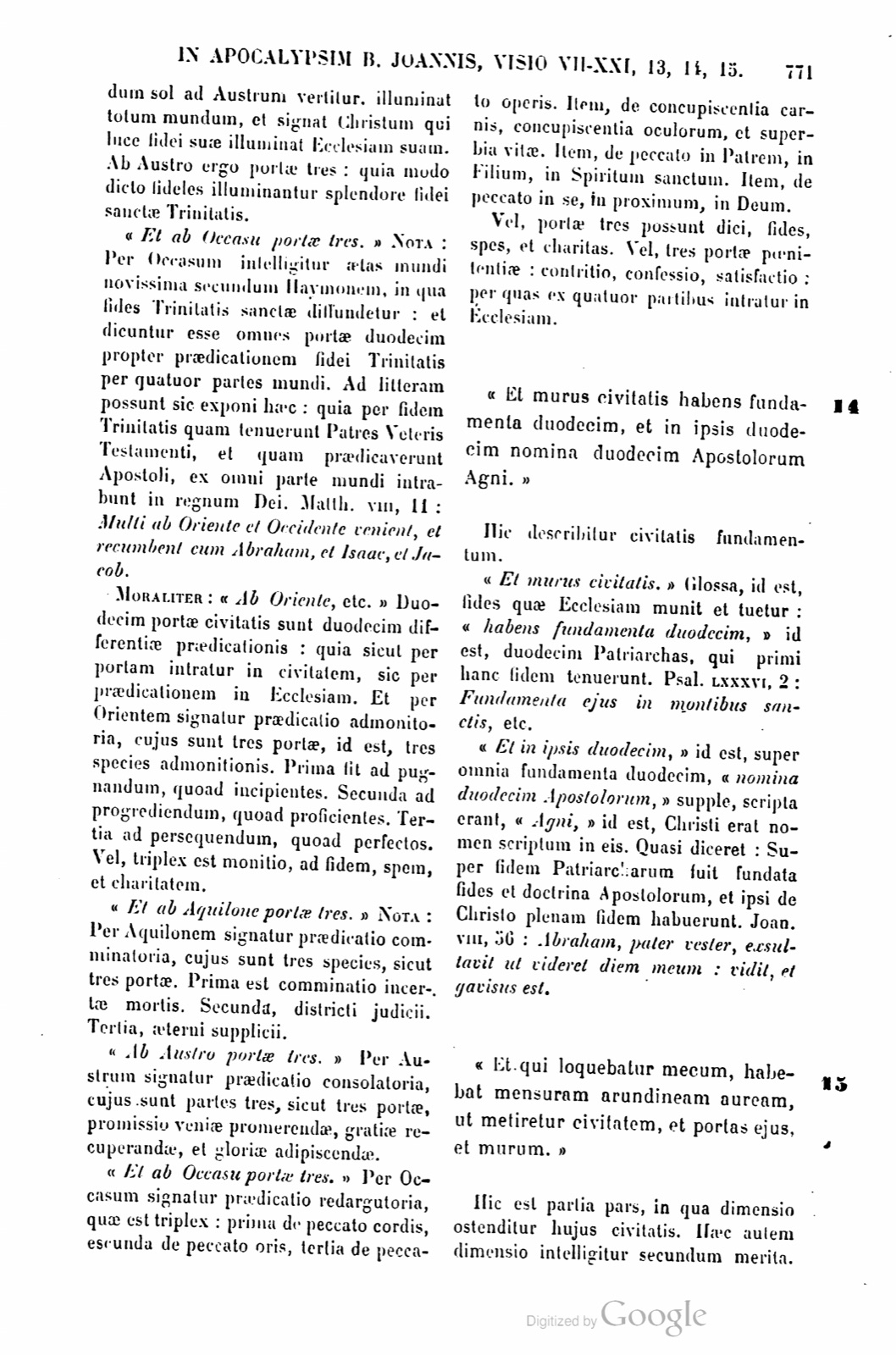
"Et ab Occasu portae tres." NOTA: Per Occasum intelligitur aetas mundi novissima secundum Haymonem, in qua fides Trinitatis sanctae diffundetur: et dicuntur esse omnes portae duodecim propter praedicationem fidei Trinitatis per quatuor partes mundi. Ad litteram possunt sic exponi haec: quia per fidem Trinitatis quam tenuerunt Patres Veteris Testamenti, et quam praedicaverunt Apostoli, ex omni parte mundi intrabunt in regnum Dei. Matth. VIII, 11: Multi ab Oriente et Occidente venient, et recumbent cum Abraham, et Isaac, et Jacob.
MORALITER: "Ab Oriente, etc." Duodecim portae civitatis sunt duodecim differentiae praedicationis: quia sicut per portam intratur in civitatem, sic per praedicationem in Ecclesiam. Et per Orientem signatur praedicatio admonitoria, cujus sunt tres portae, id est, tres species admonitionis. Prima fit ad pugnandum, quoad incipientes. Secunda ad progrediendum, quoad proficientes. Tertia ad persequendum, quoad perfectos. Vel, triplex est monitio, ad fidem, spem, et charitatem.
"Et ab Aquilone portae tres." NOTA: Per Aquilonem signatur praedicatio comminatoria, cujus sunt tres species, sicut tres portae. Prima est comminatio incertae mortis. Secunda, districti judicii. Tertia, aeterni supplicii.
"Ab Austro portae tres." Per Austrum signatur praedicatio consolatoria, cujus sunt partes tres, sicut tres portae, promissio veniae promerendae, gratiae recuperandae, et gloriae adipiscendae.
"Et ab Occasu portae tres." Per Occasum signatur praedicatio redargutoria, quae est triplex: prima de peccato cordis, secunda de peccato oris, tertia de peccato operis. Item, de concupiscentia carnis, concupiscentia oculorum, et superbia vitae. Item, de peccato in Patrem, in Filium, in Spiritum sanctum. Item, de peccato in se, in proximum, in Deum.
Vel, portae tres possunt dici, fides, spes, et charitas. Vel, tres portae poenitentiae: contritio, confessio, satisfactio: per quas ex quatuor partibus intratur in Ecclesiam.
14. "Et murus civitatis habens fundamenta duodecim, et in ipsis duodecim nomina duodecim Apostolorum Agni."
Hic describitur civitatis fundamentum.
"Et murus civitatis." Glossa, id est, fides quae Ecclesiam munit et tuetur: "habens fundamenta duodecim," id est, duodecim Patriarchas, qui primi hanc fidem tenuerunt. Psal. LXXXVI, 2: Fundamenta ejus in montibus sanctis, etc.
"Et in ipsis duodecim," id est, super omnia fundamenta duodecim, "nomina duodecim Apostolorum," supple, scripta erant, "Agni," id est, Christi erat nomen scriptum in eis. Quasi diceret: Super fidem Patriarcharum fuit fundata fides et doctrina Apostolorum, et ipsi de Christo plenam fidem habuerunt. Joan. VIII, 56: Abraham, pater vester, exsultavit ut videret diem meum: vidit, et gavisus est.
15. "Et qui loquebatur mecum, habebat mensuram arundineam auream, ut metiretur civitatem, et portas ejus, et murum."
Hic est quarta pars, in qua dimensio ostenditur hujus civitatis. Haec autem dimensio intelligitur secundum merita.
"And from the West three gates." NOTE: By the West is understood the last age of the world according to Haymo, in which the faith of the holy Trinity will be diffused; and all the gates are said to be twelve because of the preaching of the faith of the Trinity through the four parts of the world. Literally these things can be expounded thus: because through the faith of the Trinity which the Fathers of the Old Testament held, and which the Apostles preached, people from every part of the world will enter into the kingdom of God. Matthew 8:11: Many will come from East and West, and will recline with Abraham, and Isaac, and Jacob.
MORALLY: "From the East, etc." The twelve gates of the city are twelve differences of preaching, because just as one enters into the city through a gate, so one enters into the Church through preaching. And by the East admonitory preaching is signified, of which there are three gates, that is, three species of admonition. The first is made for fighting, with respect to beginners. The second for advancing, with respect to those making progress. The third for pursuing, with respect to the perfect. Or, there is a threefold warning, to faith, hope, and charity.
"And from the North three gates." NOTE: By the North is signified threatening preaching, of which there are three species, like three gates. The first is the threat of uncertain death. The second, of strict judgment. The third, of eternal punishment.
"From the South three gates." By the South is signified consolatory preaching, of which there are three parts, like three gates: the promise of pardon to be merited, grace to be recovered, and glory to be attained.
"And from the West three gates." By the West is signified reproving preaching, which is threefold: the first concerning sin of the heart, the second concerning sin of the mouth, the third concerning sin of deed. Likewise, concerning the concupiscence of the flesh, the concupiscence of the eyes, and the pride of life. Likewise, concerning sin against the Father, against the Son, against the Holy Spirit. Likewise, concerning sin against oneself, against neighbor, against God.
Or, the three gates can be called faith, hope, and charity. Or, three gates of penitence: contrition, confession, satisfaction; through these one enters the Church from the four parts.
14. "And the wall of the city had twelve foundations, and in them the twelve names of the twelve Apostles of the Lamb."
Here the foundation of the city is described.
"And the wall of the city." The Gloss says, that is, the faith which fortifies and protects the Church; "having twelve foundations," that is, the twelve Patriarchs, who first held this faith. Psalm 86:2: Its foundations are in the holy mountains, etc.
"And in the twelve themselves," that is, above all the twelve foundations, "the names of the twelve Apostles," supply, were written, "of the Lamb," that is, the name of Christ was written in them. As if he said: Upon the faith of the Patriarchs the faith and doctrine of the Apostles was founded, and they had full faith concerning Christ. John 8:56: Abraham, your father, rejoiced that he might see my day; he saw, and was glad.
15. "And he who was speaking with me had a golden reed measure, so that he might measure the city, and its gates, and the wall."
Here is the fourth part, in which the dimension of this city is shown. Now this dimension is understood according to merits.
If a page does not appear, its photograph has not been uploaded yet.