Works › Commentary on the Apocalypse of Blessed John
Volume 38 · pp. 760–761
Doubtful Points on Chapter XX, end
A marker with ≈ is an approximate page boundary, placed by measure of the text; the page photographs remain the authority. In the paired views, clicking a page marker brings that page into view.
In prima parte dicuntur duo. Primo, quod omnes tunc vivi in judicio praesentabuntur. Secundo, quod omnes mortui prius vitae restituentur, ibi, "Et mors."
Unde dicit: "Et mare," id est, hic mundus, "dedit mortuos suos," id est, dabit in judicio illos quos habebit mortuos, bonos et malos: boni enim dicuntur mortui culpae. Ad Coloss. III, 3: Mortui estis, et vita vestra est abscondita, etc. Mali similiter sunt mortui in peccato. Matth. VIII, 22: Dimitte mortuos sepelire mortuos suos.
"Qui in illo erant," id est, qui vivi reperientur in eo. Hoc modo legit Augustinus in libro II de Civitate Dei.
Vel sic: "Et mare," id est, saeculum, "dedit," id est, dabit, "suos mortuos," scilicet in peccatis, "qui in eo erant," quia nondum obierunt. Vel, ad litteram: "Mare dedit mortuos suos," id est, corpora mortuorum, "qui erant in eo," id est, quae submersa sunt in mari.
"Et mors," id est, diabolus, "et infernus," id est, tenebrarum locus, ut dicit Glossa, "dederunt mortuos suos," id est, animas mortuorum, "qui in ipsis erant," id est, quos violenter detinebant.
"Et judicatum est de singulis secundum opera eorum," id est, sine acceptione personarum.
"Et infernus et mors missi sunt in stagnum ignis, etc."
"Et infernus," id est, omnes mali qui se fecerunt loca tenebrosa diaboli, "et mors," id est, diabolus, primus auctor mortis. Sapient. II, 24: Invidia diaboli, etc.
"Missi sunt," id est, mittentur, "in stagnum ignis," id est, in profundam damnationem, stabilem sive perpetuam, et acerbam.
"Haec est mors secunda," id est, corporum et animarum simul damnatio. Prima enim mors est culpae, secunda gehennae.
"Et qui non est inventus in Libro vitae scriptus,"
Scilicet per praedestinationem, "missus est in stagnum ignis," id est, simili damnatione damnatus, sicut diabolus et angeli ejus. Et sic per mortem intelligitur diabolus, per infernum angeli ejus: per eum qui non est inventus in Libro vitae, omnes mali intelliguntur. Matth. XXV, 41: Discedite a me, maledicti, in ignem aeternum qui paratus est diabolo et angelis ejus.
Hic sunt dubitabilia.
Primo, super illo verbo v. 1: "Et vidi Angelum descendentem de coelo, habentem clavem abyssi." [Marginal label: Dub. 1.] CONTRA: Supra, IX, 1, dicitur diabolo data clavis putei abyssi: si ergo habet clavem abyssi, Christus non habet eamdem.
RESPONSIO. [Marginal label: Duplex clavis.] Duplex est clavis. Una qua aperitur ad culpam, et haec est tentatio, vel mala suggestio: et hanc habet diabolus permissive. Alia qua aperitur ad poenam, et haec est justitia malos puniens. Hanc habet Christus a Deo Patre: haec non aperit ad culpam, sed tantum ad poenam, etc.
Secundo, super illo verbo v. 2: "Et ligavit eum per annos mille." [Marginal label: Dub. 2.] Haymo: "A tempore Passionis Domini usque ad finem mundi." CONTRA: Statim subditur, v. 3: "Oportet illum solvi modico tempore," id est, tempore Antichristi: et tamen tunc non erit finis mundi: ergo Haymo male exponit.
In the first part two things are said. First, that all the living will then be presented in judgment. Secondly, that all the dead will first be restored to life, there, "And death."
Hence he says: "And the sea," that is, this world, "gave up its dead," that is, it will give in judgment those whom it will have as dead, the good and the evil; for the good are called dead to guilt. Colossians 3:3: You are dead, and your life is hidden, etc. The evil similarly are dead in sin. Matthew 8:22: Let the dead bury their dead.
"Who were in it," that is, who will be found alive in it. In this way Augustine reads it in book 2 of The City of God.
Or thus: "And the sea," that is, the age, "gave," that is, will give, "its dead," namely in sins, "who were in it," because they had not yet died. Or, literally: "The sea gave up its dead," that is, the bodies of the dead, "who were in it," that is, which were submerged in the sea.
"And death," that is, the devil, "and hell," that is, the place of darkness, as the Gloss says, "gave up their dead," that is, the souls of the dead, "who were in them," that is, whom they were violently detaining.
"And judgment was made concerning each according to their works," that is, without acceptance of persons.
"And hell and death were cast into the pool of fire, etc."
"And hell," that is, all the evil who made themselves dark places of the devil, "and death," that is, the devil, the first author of death. Wisdom 2:24: By the envy of the devil, etc.
"They were cast," that is, they will be cast, "into the pool of fire," that is, into deep damnation, stable or perpetual, and bitter.
"This is the second death," that is, the damnation of bodies and souls together. For the first death is of guilt; the second is of Gehenna.
"And whoever was not found written in the Book of life,"
Namely through predestination, "was cast into the pool of fire," that is, condemned with like damnation, as the devil and his angels. And thus by death the devil is understood, by hell his angels; by him who is not found in the Book of life, all the evil are understood. Matthew 25:41: Depart from me, accursed ones, into eternal fire which has been prepared for the devil and his angels.
Here are the doubtful points.
First, concerning that word in verse 1: "And I saw an Angel descending from heaven, having the key of the abyss." [Marginal label: Dub. 1.] TO THE CONTRARY: Above, 9:1, the key of the pit of the abyss is said to have been given to the devil; therefore if he has the key of the abyss, Christ does not have the same one.
RESPONSE. [Marginal label: A twofold key.] The key is twofold. One by which opening is made to guilt, and this is temptation or evil suggestion; and the devil has this permissively. Another by which opening is made to punishment, and this is justice punishing the evil. Christ has this from God the Father; this does not open to guilt, but only to punishment, etc.
Secondly, concerning that word in verse 2: "And he bound him for a thousand years." [Marginal label: Dub. 2.] Haymo says: "From the time of the Lord's Passion until the end of the world." TO THE CONTRARY: Immediately it is added, verse 3: "He must be loosed for a short time," that is, in the time of Antichrist; and yet then it will not be the end of the world; therefore Haymo explains badly.
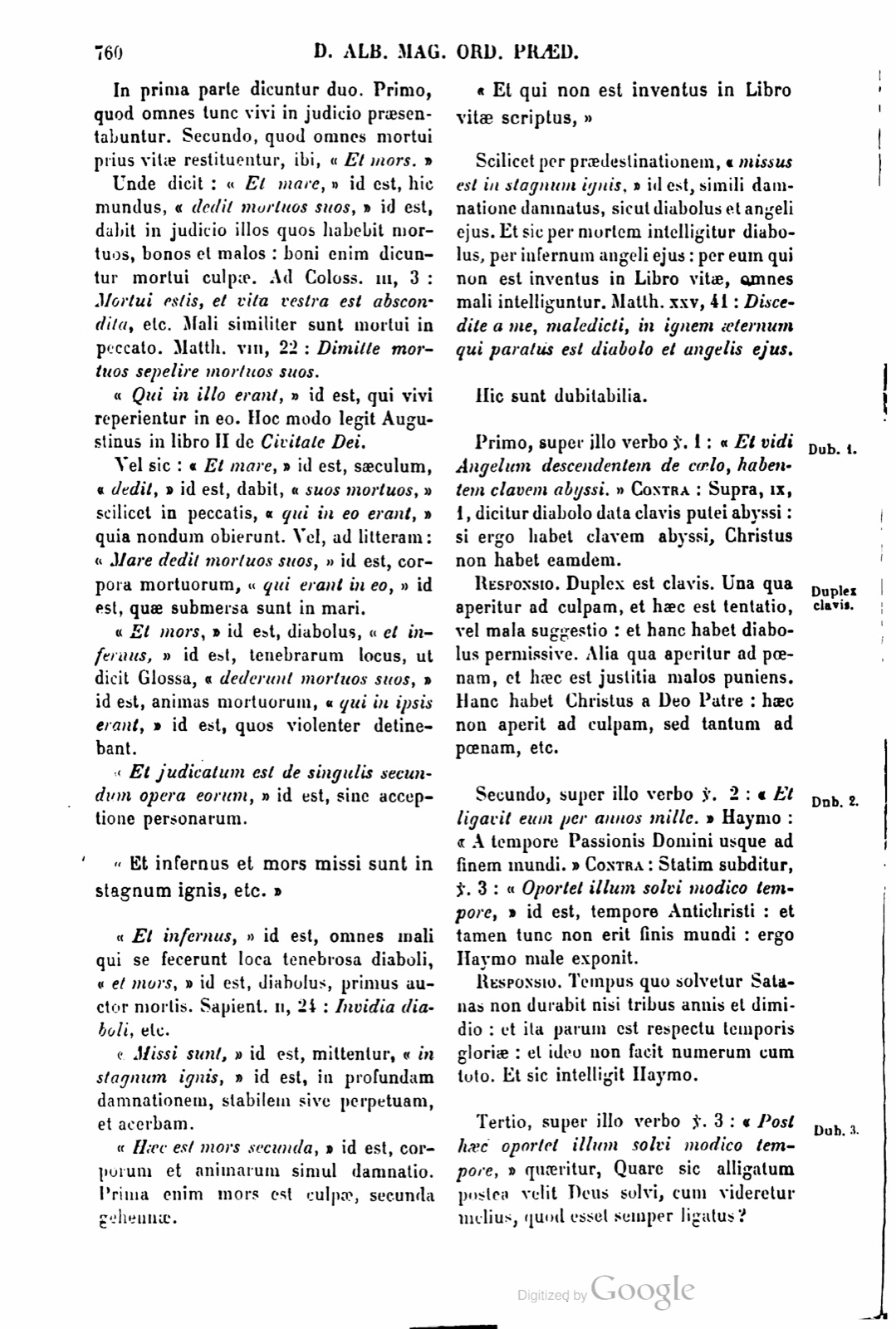
RESPONSIO. Tempus quo solvetur Satanas non durabit nisi tribus annis et dimidio: et ita parum est respectu temporis gloriae: et ideo non facit numerum cum toto. Et sic intelligit Haymo.
Tertio, super illo verbo v. 3: "Post haec oportet illum solvi modico tempore," [Marginal label: Dub. 3.] quaeritur, Quare sic alligatum postea velit Deus solvi, cum videretur melius, quod esset semper ligatus?
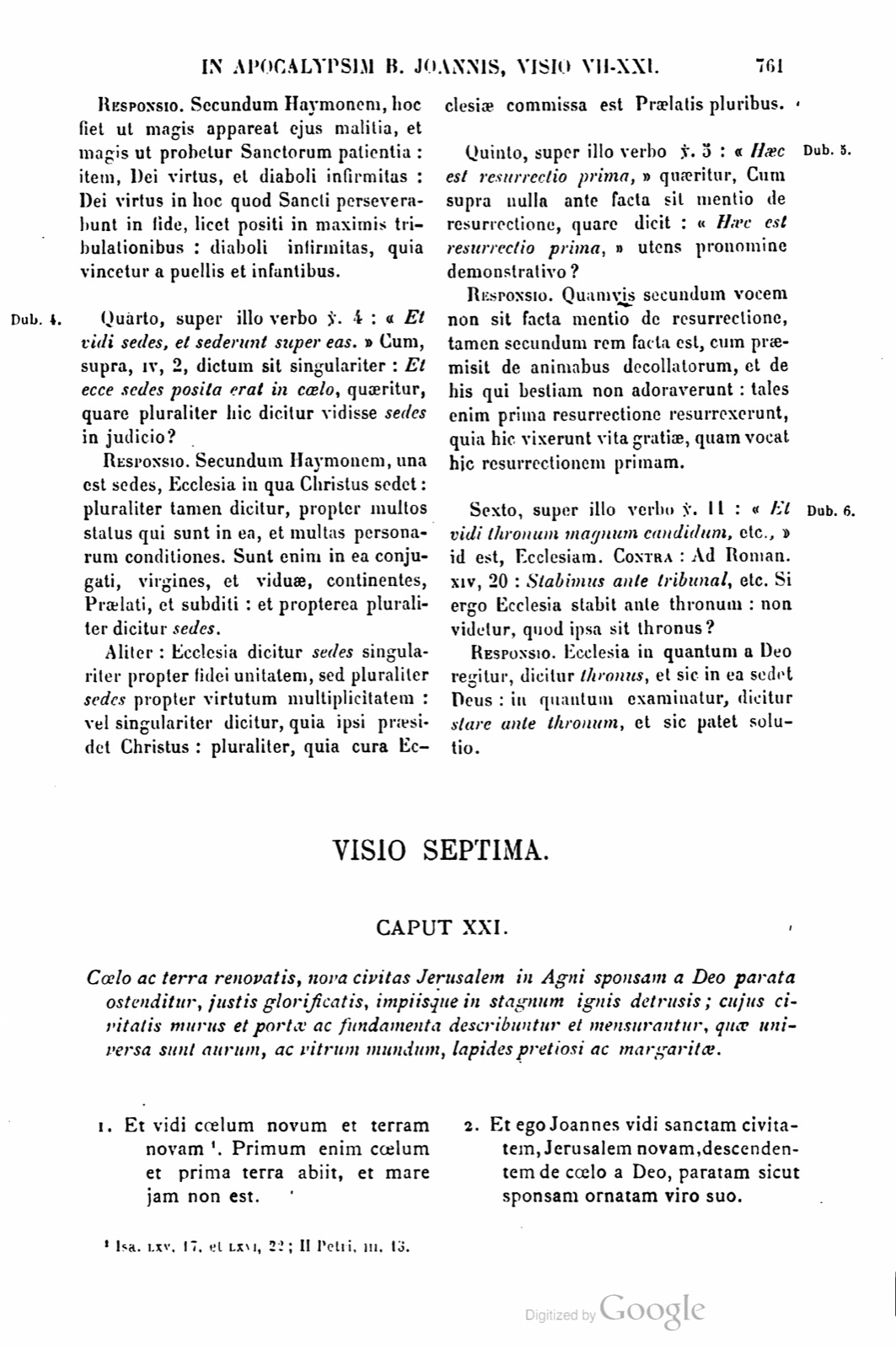
RESPONSIO. Secundum Haymonem, hoc fiet ut magis appareat ejus malitia, et magis ut probetur Sanctorum patientia: item, Dei virtus, et diaboli infirmitas: Dei virtus in hoc quod Sancti perseverabunt in fide, licet positi in maximis tribulationibus: diaboli infirmitas, quia vincetur a puellis et infantibus.
Quarto, super illo verbo v. 4: "Et vidi sedes, et sederunt super eas." [Marginal label: Dub. 4.] Cum, supra, IV, 2, dictum sit singulariter: Et ecce sedes posita erat in caelo, quaeritur, quare pluraliter hic dicitur vidisse sedes in judicio?
RESPONSIO. Secundum Haymonem, una est sedes, Ecclesia in qua Christus sedet: pluraliter tamen dicitur, propter multos status qui sunt in ea, et multas personarum conditiones. Sunt enim in ea conjugati, virgines, et viduae, continentes, Praelati, et subditi: et propterea pluraliter dicitur sedes.
Aliter: Ecclesia dicitur sedes singulariter propter fidei unitatem, sed pluraliter sedes propter virtutum multiplicitatem: vel singulariter dicitur, quia ipsi praesidet Christus: pluraliter, quia cura Ecclesiae commissa est Praelatis pluribus.
Quinto, super illo verbo v. 5: "Haec est resurrectio prima," [Marginal label: Dub. 5.] quaeritur, Cum supra nulla ante facta sit mentio de resurrectione, quare dicit: "Haec est resurrectio prima," utens pronomine demonstrativo?
RESPONSIO. Quamvis secundum vocem non sit facta mentio de resurrectione, tamen secundum rem facta est, cum praemisit de animabus decollatorum, et de his qui bestiam non adoraverunt: tales enim prima resurrectione resurrexerunt, quia hic vixerunt vita gratiae, quam vocat hic resurrectionem primam.
Sexto, super illo verbo v. 11: "Et vidi thronum magnum candidum, etc.," [Marginal label: Dub. 6.] id est, Ecclesiam. CONTRA: Ad Roman. XIV, 20: Stabimus ante tribunal, etc. Si ergo Ecclesia stabit ante thronum: non videtur, quod ipsa sit thronus?
RESPONSIO. Ecclesia in quantum a Deo regitur, dicitur thronus, et sic in ea sedet Deus: in quantum examinatur, dicitur stare ante thronum, et sic patet solutio.
RESPONSE. The time in which Satan will be loosed will last only three and a half years, and thus it is little with respect to the time of glory; and therefore it does not make a reckoning with the whole. And Haymo understands it thus.
Thirdly, concerning that word in verse 3: "After this he must be loosed for a short time," [Marginal label: Dub. 3.] it is asked why God would wish him, thus bound, afterward to be loosed, since it would seem better that he were always bound.
RESPONSE. According to Haymo, this will happen so that his malice may appear more, and the patience of the Saints may be tested more; likewise the power of God and the weakness of the devil: the power of God in this, that the Saints will persevere in faith, although placed in the greatest tribulations; the weakness of the devil, because he will be conquered by girls and infants.
Fourthly, concerning that word in verse 4: "And I saw seats, and they sat upon them." [Marginal label: Dub. 4.] Since above, 4:2, it was said in the singular: And behold, a seat had been placed in heaven, it is asked why here he is said in the plural to have seen seats in judgment.
RESPONSE. According to Haymo, there is one seat, the Church in which Christ sits; nevertheless it is said in the plural because of the many states which are in it, and the many conditions of persons. For in it there are the married, virgins, widows, continent persons, Prelates, and subjects; and for that reason seats is said in the plural.
Otherwise: the Church is called a seat in the singular because of the unity of faith, but seats in the plural because of the multiplicity of virtues; or it is said in the singular because Christ himself presides over it; in the plural, because the care of the Church has been committed to many Prelates.
Fifthly, concerning that word in verse 5: "This is the first resurrection," [Marginal label: Dub. 5.] it is asked, Since no mention of resurrection was previously made above, why does he say, "This is the first resurrection," using a demonstrative pronoun?
RESPONSE. Although according to the word no mention of resurrection was made, nevertheless according to the thing it was made, when he premised concerning the souls of those beheaded, and concerning those who did not adore the beast; for such persons rose again in the first resurrection, because here they lived the life of grace, which he here calls the first resurrection.
Sixthly, concerning that word in verse 11: "And I saw a great white throne, etc.," [Marginal label: Dub. 6.] that is, the Church. TO THE CONTRARY: Romans 14:10 says: We shall stand before the tribunal, etc. Therefore if the Church will stand before the throne, it does not seem that it itself is the throne.
RESPONSE. The Church, insofar as it is ruled by God, is called a throne, and thus God sits in it; insofar as it is examined, it is said to stand before the throne, and thus the solution is clear.
If a page does not appear, its photograph has not been uploaded yet.