Works › Commentary on the Apocalypse of Blessed John
Volume 38 · pp. 754–759
Exposition on Chapter XX of the Apocalypse, opening
A marker with ≈ is an approximate page boundary, placed by measure of the text; the page photographs remain the authority. In the paired views, clicking a page marker brings that page into view.
IN CAPUT XX APOCALYPSIS ENARRATIO.
1. "Et vidi Angelum descendentem de coelo, habentem clavem abyssi, et catenam magnam in manu sua. 2. Et apprehendit draconem, serpentem antiquum, qui est diabolus et Satanas, et ligavit eum per annos mille: 3. Et misit eum in abyssum, et clausit, et signavit super illum, ut non seducat amplius Gentes donec consummentur mille anni: et post hoc oportet illum solvi modico tempore."
Hic est tertia pars sextae visionis, ubi agitur de damnatione diaboli. Duplex est autem damnatio ejus. Prima, ipsius ligatio quae facta fuit in primo adventu. Secunda erit per secundum adventum ad judicium. Unde haec pars dividitur in duas partes. In prima agit de damnatione facta per primum adventum Christi. In secunda, de damnatione facienda per secundum adventum, ibi, v. 7: "Et cum consummati fuerint." Prima damnatio sic describitur: Primo, tangitur ipsius ligatio. Secundo, post ligationem animarum liberatio, ibi, v. 4: "Et vidi sedes." In prima, primo auctor ligationis describitur. Secundo, damnationis modus, ibi, v. 2: "Et apprehendit." Tertio, tempus, "Per annos mille." Quarto, locus, ibidem, "Et misit eum." Quinto, finis, ibi, v. 3: "Ut non seducat." In prima, primo describit illum ab adventu humili. Secundo, a potentia inevitabili, ibi, "Habentem clavem abyssi."
Dicit ergo: "Et vidi Angelum," id est, Christum, "descendentem," per carnis assumptionem, "de coelo," id est, de sinu Patris secreto. Psal. XVII, 7: A summo coelo egressio ejus. "Habentem clavem abyssi," id est, potestatem super diabolum, ligandi scilicet, et solvendi eum. Ipse enim nihil potest nisi permissus. "Et catenam magnam in manu sua." Glossa: "Inevitabilem potentiam quae constringit omnia." "In manu sua," id est, in divinitate Verbi, per quam Pater fecit omnia, et per quam Christus operatus est virtutes et miracula. Vel, "In manu sua," id est, in opere Passionis, ubi abscondebatur sua potentia: et tamen ea diabolus ligabatur. Habacuc, III, 4 et 5: Ibi abscondita est fortitudo ejus. Et tamen ante faciem ejus ibit mors, id est, diabolus.
"Et apprehendit draconem," id est, Christus diabolum, qui dicitur draco secundum Glossam, propter nocendi violentiam, "serpentem antiquum," propter consuetudinem longam. "Qui est diabolus," id est, deorsum fluens, scilicet de coelo in infernum. Vel, "Diabolus," id est, duos bolos faciens de peccatoribus: unum de anima, alterum de corpore. "Et Satanas." Glossa: "Adversarius qui semper adversatur omni bono." NOTA: Quoad illos qui pereunt, vel peccant ex infirmitate, dicitur draco per tentationis violentiam: quoad illos qui peccant ex ignorantia, serpens per deceptionis astutiam: quoad illos qui peccant ex certa malitia, diabolus, id est, deorsum fluens per malitiam: quoad bonos recipit ultimum nomen, scilicet Satanas, quia talibus semper adversatur per tentationis impugnationem. "Et ligavit eum," id est, potestatem diminuit, ne tantum saeviret, quantum vellet: "per annos mille." NOTA: Mille numerus est perfectus, et signat totum tempus vitae praesentis a Passione Domini usque in finem saeculi, sicut dicit Haymo.
EXPOSITION ON CHAPTER XX OF THE APOCALYPSE.
1. "And I saw an Angel descending from heaven, having the key of the abyss and a great chain in his hand. 2. And he seized the dragon, the ancient serpent, who is the devil and Satan, and bound him for a thousand years; 3. and he cast him into the abyss, and shut and sealed over him, so that he might not seduce the Nations any more until the thousand years are consummated; and after this he must be loosed for a short time."
This is the third part of the sixth vision, where the damnation of the devil is treated. Now his damnation is twofold. The first is his binding, which was done in the first advent. The second will be through the second advent for judgment. Hence this part is divided into two parts. In the first he treats the damnation done through the first advent of Christ. In the second, the damnation to be done through the second advent, there at verse 7: "And when they have been consummated." The first damnation is described thus: First, his binding is touched upon. Secondly, after the binding, the liberation of souls, there at verse 4: "And I saw seats." In the first, first the author of the binding is described. Secondly, the mode of damnation, there at verse 2: "And he seized." Thirdly, the time, "For a thousand years." Fourthly, the place, in the same place, "And he cast him." Fifthly, the end, there at verse 3: "So that he might not seduce." In the first, first he describes him from his humble advent. Secondly, from inevitable power, there, "having the key of the abyss."
Therefore he says: "And I saw an Angel," that is, Christ, "descending," through the assumption of flesh, "from heaven," that is, from the secret bosom of the Father. Psalm 17:7: His going forth is from the highest heaven. "Having the key of the abyss," that is, power over the devil, namely of binding and loosing him. For he can do nothing unless permitted. "And a great chain in his hand." The Gloss says: "The inevitable power which constrains all things." "In his hand," that is, in the divinity of the Word, through which the Father made all things, and through which Christ worked powers and miracles. Or, "in his hand," that is, in the work of the Passion, where his power was hidden; and yet by it the devil was bound. Habakkuk 3:4 and 5: There his strength was hidden. And yet before his face death, that is, the devil, will go.
"And he seized the dragon," that is, Christ seized the devil, who according to the Gloss is called dragon because of violence in harming, "the ancient serpent," because of long custom. "Who is the devil," that is, flowing downward, namely from heaven into hell. Or, "devil," that is, making two morsels from sinners, one from the soul, the other from the body. "And Satan." The Gloss says: "The adversary who always opposes every good." NOTE: As to those who perish or sin from weakness, he is called dragon through the violence of temptation; as to those who sin from ignorance, serpent through the craftiness of deception; as to those who sin from certain malice, devil, that is, flowing downward through malice; as to the good he receives the last name, namely Satan, because he always opposes such persons through the assault of temptation. "And he bound him," that is, diminished his power, lest he rage as much as he wished: "for a thousand years." NOTE: The number one thousand is perfect and signifies the whole time of the present life from the Passion of the Lord until the end of the age, as Haymo says.
"Et misit eum in abyssum," id est, in infernum qui est sine candore aeternae lucis, et ubi est profunditas interminabilis. Vel, "In abyssum," id est, in cordibus profundis reproborum. Et dicitur ibi a Deo missus, id est, permissus dominari in eis. "Et clausit," id est, potestatem exeundi subtraxit, ne alibi malitiam exerceat, nisi quantum Deus permiserit: "et signavit super illum," id est, tempus suae solutionis non manifestavit. Sicut litteris signatis, nescitur earum tenor: sic nescitur tempus solutionis suae. Vel sic: "Signavit super illum," id est, signum crucis posuit, quo eum superavit, ut a fidelibus possit expelli: omnino enim subjacet cruci, et nihil potest nisi permissus a Christo. "Ut non seducat amplius Gentes," sicut ante, "donec consummentur mille anni," id est, usque ad adventum Antichristi. "Et post hoc," id est, mille annos, hoc est, appropinquante fine mundi, "oportet," secundum Dei ordinationem ad electorum purgationem, "illum solvi," id est, relaxari ejus potestatem "modico tempore," id est, tribus annis et dimidio, quantum regnabit Antichristus.
4. "Et vidi sedes, et sederunt super eas, et judicium datum est illis: et animas decollatorum propter testimonium Jesu, et propter Verbum Dei, et qui non adoraverunt bestiam, neque imaginem ejus, nec acceperunt characterem ejus in frontibus aut in manibus suis, et vixerunt, et regnaverunt cum Christo mille annis."
Hic agitur de liberatione Ecclesiae, quae post ligationem Satanae secuta est. Unde dicit: "Et vidi," scilicet, ligato diabolo, "sedes," id est, fideles subditos ad obediendum paratos. "Et sederunt super eas," scilicet, majores bene regendo. Vel, Apostoli, et Praedicatores eorum imitatores. "Et judicium," id est, auctoritas judicandi, vel potestas ligandi et solvendi, "datum est illis," id est, Praelatis, et hoc a Deo, quia, ad Roman. XIII, 1: Non est potestas nisi a Deo. Vel, "judicium," id est, discretio et exsecutio justi judicii in praesenti. "Et vidi animas decollatorum," id est, martyrum, "propter testimonium Jesu, et propter Verbum Dei," id est, propter fidem humanitatis et divinitatis Christi. Sicut enim dicit Haymo, in Jesu intelligitur Christi humanitas, in Verbo Dei ejus divinitas. "Qui non adoraverunt bestiam," id est, Antichristum, "neque imaginem ejus," id est, statuam ejus, vel ejus apostolos, vel qui non consenserunt infidelibus qui sunt bestiae imago per imitationem. "Et qui non acceperunt characterem," id est, conformitatem in vita et doctrina: vel notam criminis, vel signum ostensivum quod essent de familia ejus: "in frontibus suis." Glossa: In manifesta confessione: "aut in manibus suis," id est, in operatione. "Et vixerunt," et in praesenti per gratiam, et post mortem corporis per gloriam, "et regnaverunt cum Christo mille annis," id est, toto tempore a Passione Christi usque ad finem mundi, ante receptionem corporum quae fiet in resurrectione generali. Vel sic: "Et vixerunt," per gratiam in praesenti saeculo, "et regnaverunt," scilicet carnem, mundum, et diabolum vincendo. Ad Hebr. XI, 33: Sancti per fidem vicerunt regna.
"And he cast him into the abyss," that is, into hell, which is without the brightness of eternal light and where there is interminable depth. Or, "into the abyss," that is, into the deep hearts of the reprobate. And he is said to be sent there by God, that is, permitted to dominate in them. "And he shut," that is, took away the power of going out, lest he exercise malice elsewhere except insofar as God permits; "and sealed over him," that is, did not make manifest the time of his loosing. As with sealed letters their content is not known, so the time of his loosing is not known. Or thus: "He sealed over him," that is, placed the sign of the cross, by which he overcame him, so that he can be expelled by the faithful; for he is wholly subject to the cross and can do nothing unless permitted by Christ. "So that he might not seduce the Nations any more," as before, "until the thousand years are consummated," that is, until the advent of Antichrist. "And after this," that is, the thousand years, that is, as the end of the world approaches, "he must," according to God's ordination for the cleansing of the elect, "be loosed," that is, his power be relaxed, "for a short time," that is, for three and a half years, as long as Antichrist will reign.
4. "And I saw seats, and they sat upon them, and judgment was given to them; and the souls of those beheaded because of the testimony of Jesus and because of the Word of God, and those who did not adore the beast nor his image, nor receive his character on their foreheads or on their hands, lived and reigned with Christ for a thousand years."
Here the liberation of the Church is treated, which followed after the binding of Satan. Hence he says: "And I saw," namely when the devil had been bound, "seats," that is, faithful subjects prepared for obedience. "And they sat upon them," namely the greater ones by ruling well. Or, the Apostles and Preachers who were their imitators. "And judgment," that is, authority of judging, or the power of binding and loosing, "was given to them," that is, to Prelates, and this by God, because Romans 13:1 says: There is no power except from God. Or, "judgment," that is, discretion and execution of just judgment in the present. "And I saw the souls of those beheaded," that is, of martyrs, "because of the testimony of Jesus and because of the Word of God," that is, because of faith in the humanity and divinity of Christ. For as Haymo says, in Jesus the humanity of Christ is understood, in the Word of God his divinity. "Who did not adore the beast," that is, Antichrist, "nor his image," that is, his statue, or his apostles, or those who did not consent to unbelievers who are the image of the beast through imitation. "And who did not receive the character," that is, conformity in life and doctrine; or the mark of crime, or the demonstrative sign that they belonged to his household: "on their foreheads." The Gloss says: In manifest confession; "or on their hands," that is, in operation. "And they lived," both in the present through grace and after the death of the body through glory, "and reigned with Christ for a thousand years," that is, for the whole time from the Passion of Christ until the end of the world, before the reception of bodies which will happen in the general resurrection. Or thus: "And they lived," through grace in the present age, "and reigned," namely by conquering flesh, world, and devil. Hebrews 11:33: The Saints through faith conquered kingdoms.
5. "Caeteri mortuorum non vixerunt, donec consummentur mille anni." Supra dictum est de libertate quae secuta est ex alligatione draconis, id est, diaboli: hic dicitur, quod illa libertate carebunt omnes alii. Et dicuntur duo hic. Primo, quod mali hac libertate carebunt: quia non vivent in perpetuum. Secundo, ratio hujus tangitur, ibi, "Haec est resurrectio prima." Continua: Vidi animas interfectorum pro Christo regnare et vivere, et "caeteri mortuorum," id est, illi inter mortuos qui non fuerunt de praedictis, "non vixerunt," id est, vita naturali prout anima vivit in corpore, "donec consummentur mille anni," id est, donec veniat finis mundi: et tunc resument corpora, ut puniantur aeternaliter in eis. Et sic ly donec sumitur exclusive. Aliter secundum Haymonem, exponitur de morte spirituali, id est, peccati. Et est sensus: "Et caeteri mortuorum," id est, qui mortui sunt anima per peccatum, "non vixerunt, donec consummentur mille anni," id est, in peccato fuerunt mortui toto tempore, quod signatur per mille annos, et sic tenetur ly donec inclusive, et cum negatione. Quasi dicat: Nec ante nec post vivent. Haymo: "Quia enim non vivunt hic per fidem et operationem bonam, illic non vivent per resurrectionem."
"Haec est resurrectio prima. 6. Beatus et sanctus qui habet partem in resurrectione prima: in his secunda mors non habet potestatem, sed erunt sacerdotes Dei et Christi, et regnabunt cum illo mille annis. 7. Et cum consummati fuerint mille anni, solvetur Satanas de carcere suo, et exibit, et seducet gentes quae sunt super quatuor angulos terrae, Gog et Magog: et congregabit eos in praelium, quorum numerus est sicut arena maris. 8. Et ascenderunt super latitudinem terrae et circuierunt castra Sanctorum et civitatem dilectam. 9. Et descendit ignis a Deo de coelo, et devoravit eos: et diabolus, qui seducebat eos, missus est in stagnum ignis et sulphuris, ubi et bestia 10. Et pseudopropheta cruciabuntur die ac nocte in saecula saeculorum."
Hic ponitur ratio, quare mali non vivent in futuro. Et dicuntur duo. Primo, quod mali non vivent in futuro: quia noluerunt vivere spiritualiter in hac vita, quae est resurrectio prima. Secundo, ostenditur resurrectionis dignitas, ibi, v. 6: "Beatus et sanctus." Quasi dicat: Primo, mali non vixerunt per gratiam, ideo in futuro non vivent, quia haec est resurrectio prima, scilicet resurgere a peccato per poenitentiam, et vivere per gratiam; secunda autem erit in die judicii. "Beatus et sanctus qui habet partem in resurrectione prima," id est, qui hic resurgit in anima per gratiam: unde beatus, id est, felix, "et sanctus," id est, firmus propter gloriae securitatem, "qui habet partem in resurrectione prima," id est, qui hic a peccato resurgunt per gratiam, et in hoc perseverant. Matth. X, 22: Qui perseveraverit usque in finem, hic salvus erit. Vel sic: "Beatus," per gloriam animae jam adeptam, "et sanctus," propter securitatem non amittendi eam, "qui habet partem in resurrectione prima." Et dicit partem, quia haec resurrectio fit tantum secundum partem, hoc est, in anima. Secunda vero fiet secundum totum, id est, in corpore et in anima. "In his secunda mors." Quasi dicat: Beatus est qui habet partem in resurrectione prima, quia "in his," scilicet quia habent partem in resurrectione prima, "secunda mors." Glossa, aeterna damnatio, "non habet potestatem," supple, sicut in aliis de quibus praedictum est, v. 5: "Caeteri mortuorum non vixerunt." "Sed erunt sacerdotes Dei," id est, laudes offerentes divinitati, "et Christi," referendo laudes humanitati. Vel, "Sacerdotes Dei," id est, Patris, "et Christi," id est, Filii, qui fuit actor nostrae redemptionis et minister. [Marginal label: Mille anni.] "Et regnabunt cum illo mille annis," id est, in aeternum. Haymo: "In mille annis in quibus regnabunt electi cum Christo, omne tempus futurum intelligitur." Glossa exponit sic de praesenti: "Et regnabunt cum illo," id est, cum Deo homine, seipsos bene regendo, et alios, "mille annis," id est, toto tempore a Passione Christi usque ad finem saeculi, vel usque ad adventum Christi.
5. "The rest of the dead did not live until the thousand years are consummated." Above, it was said about the liberty which followed from the binding of the dragon, that is, the devil; here it is said that all others will lack that liberty. And two things are said here. First, that the evil will lack this liberty, because they will not live forever. Secondly, the reason for this is touched upon, there, "This is the first resurrection." Continue: I saw the souls of those killed for Christ reign and live, and "the rest of the dead," that is, those among the dead who were not among the aforesaid, "did not live," that is, with natural life as the soul lives in the body, "until the thousand years are consummated," that is, until the end of the world comes; and then they will resume bodies so that they may be punished eternally in them. And thus the term until is taken exclusively. Otherwise, according to Haymo, it is expounded of spiritual death, that is, of sin. And the sense is: "And the rest of the dead," that is, those who are dead in soul through sin, "did not live until the thousand years are consummated," that is, they were dead in sin for the whole time which is signified by the thousand years; and thus the term until is held inclusively and with negation. As if he said: Neither before nor after will they live. Haymo says: "Because they do not live here through faith and good operation, there they will not live through resurrection."
"This is the first resurrection. 6. Blessed and holy is he who has a part in the first resurrection; over these the second death has no power, but they will be priests of God and of Christ, and they will reign with him for a thousand years. 7. And when the thousand years have been consummated, Satan will be loosed from his prison, and will go out and seduce the nations which are upon the four corners of the earth, Gog and Magog; and he will gather them into battle, whose number is like the sand of the sea. 8. And they ascended over the breadth of the earth and surrounded the camp of the Saints and the beloved city. 9. And fire descended from God from heaven and devoured them; and the devil who was seducing them was cast into the pool of fire and sulfur, where also the beast 10. and the false prophet will be tortured day and night for ages of ages."
Here the reason is set down why the evil will not live in the future. And two things are said. First, that the evil will not live in the future because they refused to live spiritually in this life, which is the first resurrection. Secondly, the dignity of the resurrection is shown, there at verse 6: "Blessed and holy." As if he said: First, the evil did not live through grace, therefore in the future they will not live, because this is the first resurrection, namely to rise from sin through penance and to live through grace; the second, however, will be on the day of judgment. "Blessed and holy is he who has a part in the first resurrection," that is, who rises here in soul through grace; hence blessed, that is, happy, "and holy," that is, firm because of the security of glory, "who has a part in the first resurrection," that is, those who here rise from sin through grace and persevere in this. Matthew 10:22: He who perseveres to the end will be saved. Or thus: "Blessed," through glory of the soul already obtained, "and holy," because of security of not losing it, "who has a part in the first resurrection." And he says part because this resurrection happens only according to part, that is, in the soul. But the second will happen according to the whole, that is, in body and soul. "Over these the second death." As if he said: Blessed is he who has a part in the first resurrection, because "over these," namely because they have a part in the first resurrection, "the second death," the Gloss says, eternal damnation, "has no power," supply, as over the others about whom it was said above, verse 5: "The rest of the dead did not live." "But they will be priests of God," that is, offering praises to divinity, "and of Christ," by referring praises to humanity. Or, "priests of God," that is, of the Father, "and of Christ," that is, of the Son, who was author and minister of our redemption. [Marginal label: Thousand years.] "And they will reign with him for a thousand years," that is, eternally. Haymo says: "In the thousand years in which the elect will reign with Christ, all future time is understood." The Gloss expounds it thus of the present: "And they will reign with him," that is, with God-man, by ruling themselves well and others, "for a thousand years," that is, for the whole time from the Passion of Christ until the end of the age, or until the advent of Christ.
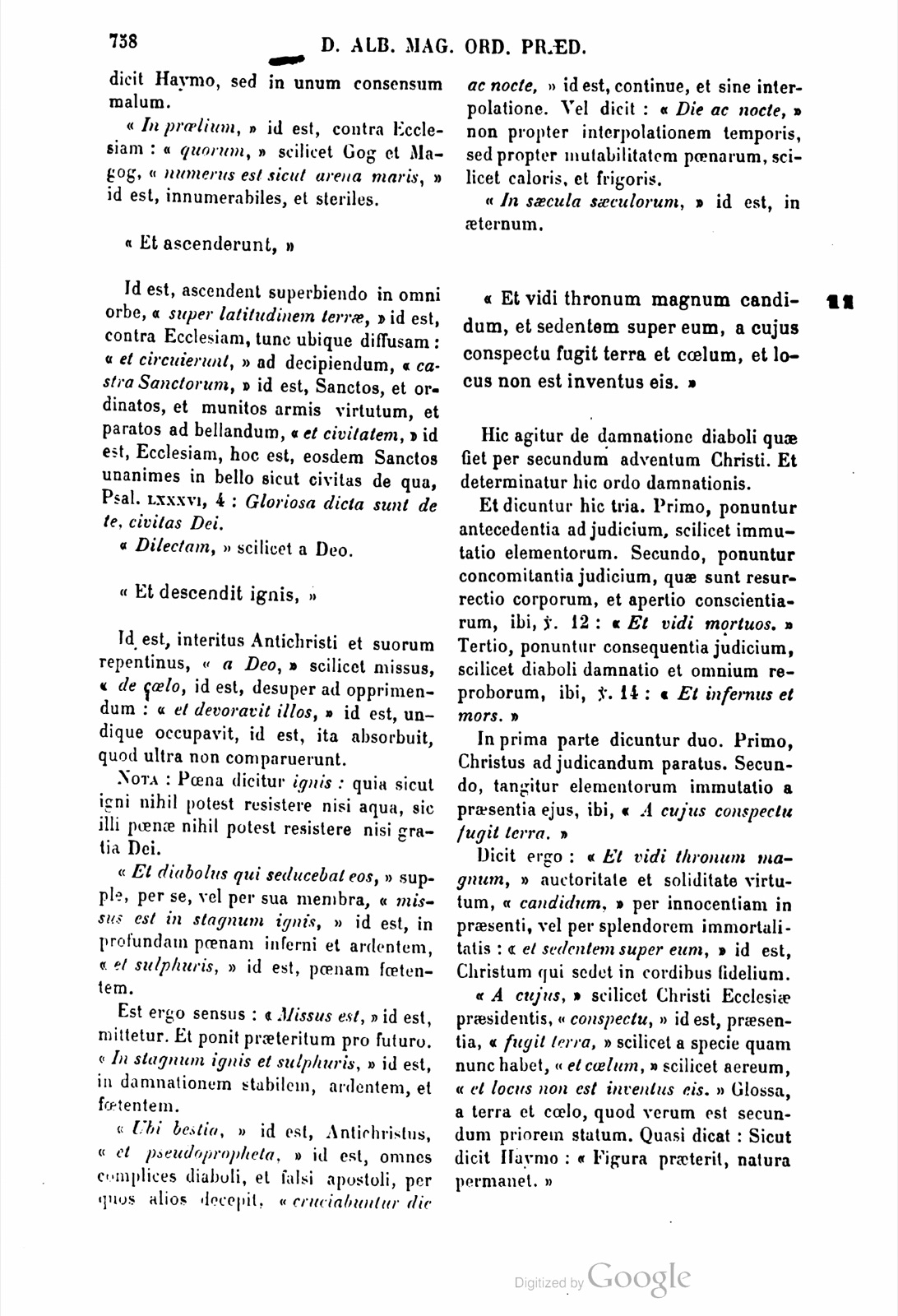
"Et cum consummati fuerint mille anni, etc." Illa pars mille annorum quae est ab adventu Christi usque ad tempus Antichristi: et ponitur totum pro parte. "Solvetur Satanas," id est, relaxabitur ejus potestas, quae modo quasi inclusa et ligata tenetur in cordibus reproborum, "de carcere suo," id est, de reprobis, ubi est modo quasi in carcere. Vel, de inferno. Vel, carcer intelligitur cohibitio suae potestatis. "Et exibit," scilicet de occulto in manifestationem: de occulta tentatione in persecutionem: "et seducet," id est, a Christo ad se ducet per erroris seminationem, "gentes quae sunt super quatuor angulos terrae," id est, aliquos de illis, "Gog et Magog." [Marginal label: Gog et Magog.] NOTA: Augustinus in libro XX de Civitate Dei 1 vult, quod Gog referatur ad Gentes, ut sit nomen exercitus diaboli, id est, omnium malorum, quia Gog interpretatur tectum diaboli, et gentes malae sunt tectum diaboli. Et Magog refertur ad diabolum. Nam interpretatur de tecto: et ipse de tecto, id est, reprobis exibit, Ecclesiam impugnando. Sensus ergo est secundum Augustinum: "Et exibit," scilicet de malis, potentiam suam exercendo contra bonos, "et seducet omnes gentes," id est, aliquos de omnibus, "quae sunt super quatuor angulos terrae," id est, super quatuor partes terrae, ut dicit Haymo: Orientem, Occidentem, Aquilonem, et Meridiem. "Gog," id est, tectum, id est, omnes malos: quia in eis prius latebit persequendo bonos occulte: "et Magog," id est, de tecto, hoc est, de eis aperte procedens, quando per eos aperte persequetur bonos. Et sic per Gog et Magog accipitur populus malorum, et diabolus exiens ab eis. "Et congregabit eos," id est, gentes illos per quos occulte, et illos per quos aperte impugnabit Ecclesiam. Non congregabit autem eos in unum locum sicut dicit Haymo, sed in unum consensum malum. "In praelium," id est, contra Ecclesiam: "quorum," scilicet Gog et Magog, "numerus est sicut arena maris," id est, innumerabiles, et steriles.
"Et ascenderunt," id est, ascendent superbiendo in omni orbe, "super latitudinem terrae," id est, contra Ecclesiam, tunc ubique diffusam: "et circuierunt," ad decipiendum, "castra Sanctorum," id est, Sanctos, et ordinatos, et munitos armis virtutum, et paratos ad bellandum, "et civitatem," id est, Ecclesiam, hoc est, eosdem Sanctos unanimes in bello sicut civitas de qua, Psal. LXXXVI, 4: Gloriosa dicta sunt de te, civitas Dei. "Dilectam," scilicet a Deo. "Et descendit ignis," id est, interitus Antichristi et suorum repentinus, "a Deo," scilicet missus, "de coelo," id est, desuper ad opprimendum: "et devoravit illos," id est, undique occupavit, id est, ita absorbuit, quod ultra non comparuerunt. NOTA: Poena dicitur ignis: quia sicut igni nihil potest resistere nisi aqua, sic illi poenae nihil potest resistere nisi gratia Dei. "Et diabolus qui seducebat eos," supple, per se, vel per sua membra, "missus est in stagnum ignis," id est, in profundam poenam inferni et ardentem, "et sulphuris," id est, poenam foetentem. Est ergo sensus: "Missus est," id est, mittetur. Et ponit praeteritum pro futuro. "In stagnum ignis et sulphuris," id est, in damnationem stabilem, ardentem, et foetentem. "Ubi bestia," id est, Antichristus, "et pseudopropheta," id est, omnes complices diaboli, et falsi apostoli, per quos alios decepit, "cruciabuntur die ac nocte," id est, continue, et sine interpolatione. Vel dicit: "Die ac nocte," non propter interpolationem temporis, sed propter mutabilitatem poenarum, scilicet caloris, et frigoris. "In saecula saeculorum," id est, in aeternum.
"And when the thousand years have been consummated, etc." That part of the thousand years which is from the advent of Christ until the time of Antichrist; and the whole is put for the part. "Satan will be loosed," that is, his power will be relaxed, which now is held as if enclosed and bound in the hearts of the reprobate, "from his prison," that is, from the reprobate, where he now is as if in prison. Or, from hell. Or, prison is understood as the restraint of his power. "And he will go out," namely from hiddenness into manifestation, from hidden temptation into persecution; "and will seduce," that is, lead from Christ to himself through the sowing of error, "the nations which are upon the four corners of the earth," that is, some of them, "Gog and Magog." [Marginal label: Gog and Magog.] NOTE: Augustine in book 20 of The City of God 1 wills that Gog be referred to the nations, so that it is the name of the army of the devil, that is, of all the evil, because Gog is interpreted covering of the devil, and evil nations are the covering of the devil. And Magog is referred to the devil. For it is interpreted from the covering; and he will go out from the covering, that is, from the reprobate, by attacking the Church. Therefore the sense according to Augustine is: "And he will go out," namely from the evil, by exercising his power against the good, "and he will seduce all nations," that is, some from all, "which are upon the four corners of the earth," that is, upon the four parts of the earth, as Haymo says: East, West, North, and South. "Gog," that is, covering, that is, all the evil, because in them he will first hide while persecuting the good secretly; "and Magog," that is, from the covering, that is, proceeding openly from them, when through them he will persecute the good openly. And thus by Gog and Magog the people of the evil and the devil going out from them are taken. "And he will gather them," that is, those nations through whom he will secretly and openly attack the Church. But he will not gather them into one place, as Haymo says, but into one evil consent. "Into battle," that is, against the Church; "whose," namely Gog and Magog's, "number is like the sand of the sea," that is, innumerable and sterile.
"And they ascended," that is, they will ascend through pride in the whole world, "over the breadth of the earth," that is, against the Church, then diffused everywhere; "and they surrounded," for deceiving, "the camp of the Saints," that is, the Saints, ordered and fortified with the arms of virtues and prepared to fight, "and the city," that is, the Church, that is, the same Saints unanimous in war like a city, of which Psalm 86:4 says: Glorious things are said of you, city of God. "Beloved," namely by God. "And fire descended," that is, the sudden destruction of Antichrist and his own, "from God," namely sent, "from heaven," that is, from above to crush them; "and devoured them," that is, occupied them on every side, that is, absorbed them so that they appeared no more. NOTE: Punishment is called fire because, as nothing can resist fire except water, so nothing can resist that punishment except the grace of God. "And the devil who was seducing them," supply, by himself or by his members, "was cast into the pool of fire," that is, into the deep and burning punishment of hell, "and of sulfur," that is, fetid punishment. Therefore the sense is: "He was cast," that is, will be cast; and he puts the past for the future. "Into the pool of fire and sulfur," that is, into stable, burning, and fetid damnation. "Where the beast," that is, Antichrist, "and the false prophet," that is, all accomplices of the devil and false apostles through whom he deceived others, "will be tortured day and night," that is, continually and without interruption. Or he says: "day and night," not because of interruption of time, but because of change of punishments, namely heat and cold. "For ages of ages," that is, forever.
11. "Et vidi thronum magnum candidum, et sedentem super eum, a cujus conspectu fugit terra et coelum, et locus non est inventus eis."
Hic agitur de damnatione diaboli quae fiet per secundum adventum Christi. Et determinatur hic ordo damnationis. Et dicuntur hic tria. Primo, ponuntur antecedentia ad judicium, scilicet immutatio elementorum. Secundo, ponuntur concomitantia judicium, quae sunt resurrectio corporum, et apertio conscientiarum, ibi, v. 12: "Et vidi mortuos." Tertio, ponuntur consequentia judicium, scilicet diaboli damnatio et omnium reproborum, ibi, v. 14: "Et infernus et mors." In prima parte dicuntur duo. Primo, Christus ad judicandum paratus. Secundo, tangitur elementorum immutatio a praesentia ejus, ibi, "A cujus conspectu fugit terra."
Dicit ergo: "Et vidi thronum magnum," auctoritate et soliditate virtutum, "candidum," per innocentiam in praesenti, vel per splendorem immortalitatis: "et sedentem super eum," id est, Christum qui sedet in cordibus fidelium. "A cujus," scilicet Christi Ecclesiae praesidentis, "conspectu," id est, praesentia, "fugit terra," scilicet a specie quam nunc habet, "et coelum," scilicet aereum, "et locus non est inventus eis." Glossa, a terra et coelo, quod verum est secundum priorem statum. Quasi dicat: Sicut dicit Haymo: "Figura praeterit, natura permanet."
12. "Et vidi mortuos, magnos et pusillos, stantes in conspectu throni: et libri aperti sunt, et alius Liber apertus est qui est vitae, et judicati sunt mortui ex his quae scripta erant in libris secundum opera ipsorum."
11. "And I saw a great white throne, and the one sitting upon it; from his sight earth and heaven fled, and a place was not found for them."
Here the damnation of the devil which will happen through the second advent of Christ is treated. And here the order of damnation is determined. And three things are said here. First, the antecedents to judgment are set down, namely the changing of the elements. Secondly, the things accompanying judgment are set down, which are the resurrection of bodies and the opening of consciences, there at verse 12: "And I saw the dead." Thirdly, the things consequent upon judgment are set down, namely the damnation of the devil and of all the reprobate, there at verse 14: "And hell and death." In the first part two things are said. First, Christ prepared to judge. Secondly, the changing of the elements from his presence is touched upon, there, "From whose sight earth fled."
Therefore he says: "And I saw a great throne," in authority and solidity of virtues, "white," through innocence in the present, or through the splendor of immortality; "and the one sitting upon it," that is, Christ who sits in the hearts of the faithful. "From whose," namely Christ presiding over the Church, "sight," that is, presence, "earth fled," namely from the appearance which it now has, "and heaven," namely the aerial heaven, "and a place was not found for them." The Gloss says, for earth and heaven, which is true according to their former state. As if he said, as Haymo says: "The figure passes away; the nature remains."
12. "And I saw the dead, great and small, standing in the sight of the throne; and the books were opened, and another Book was opened, which is of life, and the dead were judged from those things which were written in the books according to their works."
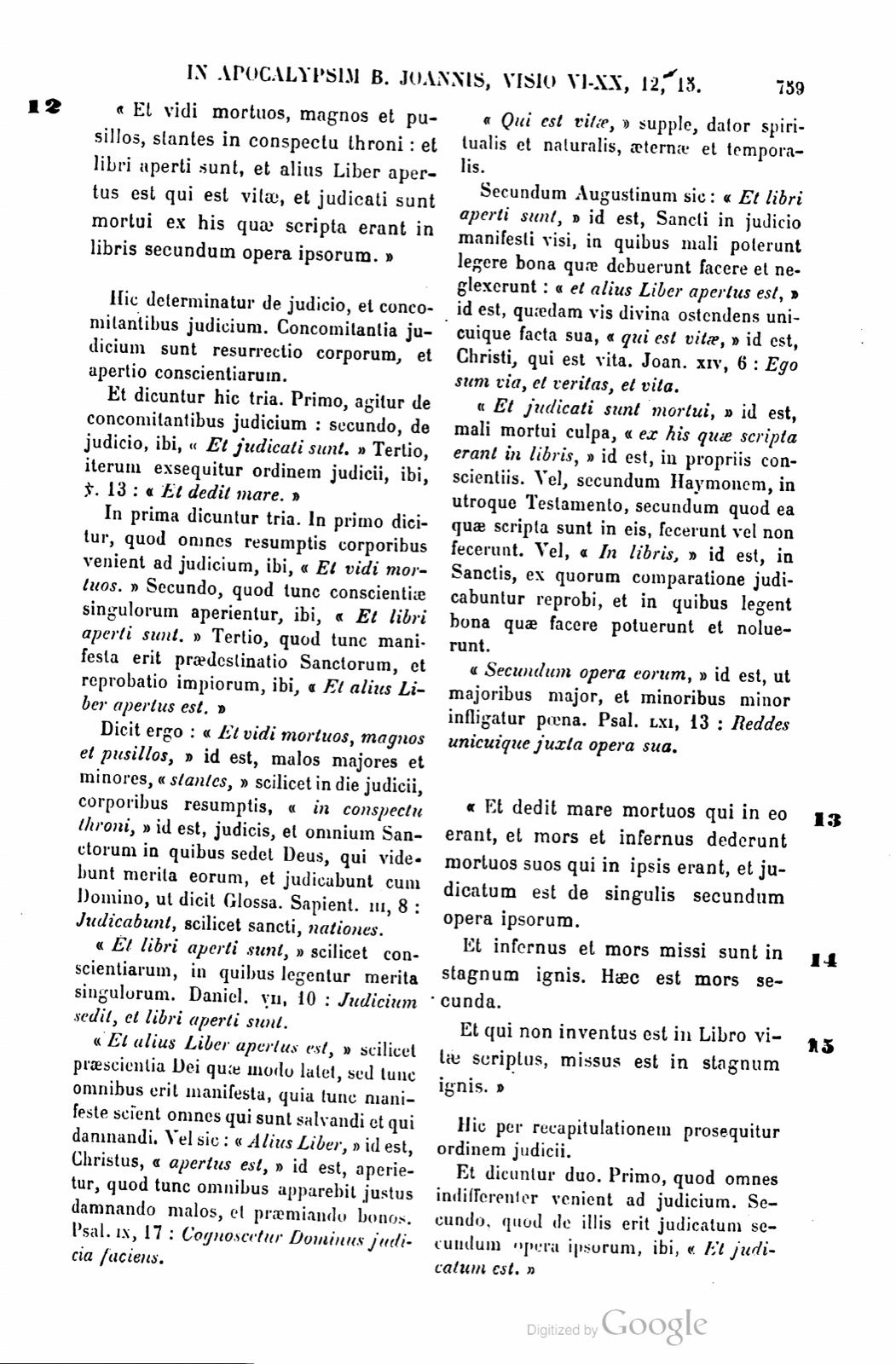
Hic determinatur de judicio, et concomitantibus judicium. Concomitantia judicium sunt resurrectio corporum, et apertio conscientiarum. Et dicuntur hic tria. Primo, agitur de concomitantibus judicium: secundo, de judicio, ibi, "Et judicati sunt." Tertio, iterum exsequitur ordinem judicii, ibi, v. 13: "Et dedit mare." In prima dicuntur tria. In primo dicitur, quod omnes resumptis corporibus venient ad judicium, ibi, "Et vidi mortuos." Secundo, quod tunc conscientiae singulorum aperientur, ibi, "Et libri aperti sunt." Tertio, quod tunc manifesta erit praedestinatio Sanctorum, et reprobatio impiorum, ibi, "Et alius Liber apertus est." Dicit ergo: "Et vidi mortuos, magnos et pusillos," id est, malos majores et minores, "stantes," scilicet in die judicii, corporibus resumptis, "in conspectu throni," id est, judicis, et omnium Sanctorum in quibus sedet Deus, qui videbunt merita eorum, et judicabunt cum Domino, ut dicit Glossa. Sapient. III, 8: Judicabunt, scilicet sancti, nationes. "Et libri aperti sunt," scilicet conscientiarum, in quibus legentur merita singulorum. Daniel. VII, 10: Judicium sedit, et libri aperti sunt. "Et alius Liber apertus est," scilicet praescientia Dei quae modo latet, sed tunc omnibus erit manifesta, quia tunc manifeste scient omnes qui sunt salvandi et qui damnandi. Vel sic: "Alius Liber," id est, Christus, "apertus est," id est, aperietur, quod tunc omnibus apparebit justus damnando malos, et praemiando bonos. Psal. IX, 17: Cognoscetur Dominus judicia faciens. "Qui est vitae," supple, dator spiritualis et naturalis, aeternae et temporalis. Secundum Augustinum sic: "Et libri aperti sunt," id est, Sancti in judicio manifesti visi, in quibus mali poterunt legere bona quae debuerunt facere et neglexerunt: "et alius Liber apertus est," id est, quaedam vis divina ostendens unicuique facta sua, "qui est vitae," id est, Christi, qui est vita. Joan. XIV, 6: Ego sum via, et veritas, et vita. "Et judicati sunt mortui," id est, mali mortui culpa, "ex his quae scripta erant in libris," id est, in propriis conscientiis. Vel, secundum Haymonem, in utroque Testamento, secundum quod ea quae scripta sunt in eis, fecerunt vel non fecerunt. Vel, "In libris," id est, in Sanctis, ex quorum comparatione judicabuntur reprobi, et in quibus legent bona quae facere potuerunt et noluerunt. "Secundum opera eorum," id est, ut majoribus major, et minoribus minor infligatur poena. Psal. LXI, 13: Reddes unicuique juxta opera sua.
13. "Et dedit mare mortuos qui in eo erant, et mors et infernus dederunt mortuos suos qui in ipsis erant, et judicatum est de singulis secundum opera ipsorum. 14. Et infernus et mors missi sunt in stagnum ignis. Haec est mors secunda. 15. Et qui non inventus est in Libro vitae scriptus, missus est in stagnum ignis."
Hic per recapitulationem prosequitur ordinem judicii. Et dicuntur duo. Primo, quod omnes indifferenter venient ad judicium. Secundo, quod de illis erit judicatum secundum opera ipsorum, ibi, "Et judicatum est."
Here judgment and the things accompanying judgment are determined. The things accompanying judgment are the resurrection of bodies and the opening of consciences. And three things are said here. First, the things accompanying judgment are treated; secondly, judgment, there, "And they were judged." Thirdly, again he pursues the order of judgment, there at verse 13: "And the sea gave." In the first, three things are said. In the first it is said that all, when their bodies have been resumed, will come to judgment, there, "And I saw the dead." Secondly, that then the consciences of individuals will be opened, there, "And the books were opened." Thirdly, that then the predestination of the Saints and the reprobation of the impious will be manifest, there, "And another Book was opened." Therefore he says: "And I saw the dead, great and small," that is, the evil, greater and lesser, "standing," namely on the day of judgment, their bodies having been resumed, "in the sight of the throne," that is, of the judge and of all the Saints in whom God sits, who will see their merits and will judge with the Lord, as the Gloss says. Wisdom 3:8: They, namely the saints, will judge the nations. "And the books were opened," namely of consciences, in which the merits of individuals will be read. Daniel 7:10: The judgment sat, and the books were opened. "And another Book was opened," namely the foreknowledge of God which now lies hidden, but then will be manifest to all, because then all will know manifestly who are to be saved and who are to be damned. Or thus: "Another Book," that is, Christ, "was opened," that is, will be opened, because then he will appear just to all by damning the evil and rewarding the good. Psalm 9:17: The Lord will be known making judgments. "Which is of life," supply, giver of spiritual and natural, eternal and temporal life. According to Augustine thus: "And the books were opened," that is, the Saints were seen manifest in judgment, in whom the evil will be able to read the good things which they ought to have done and neglected; "and another Book was opened," that is, a certain divine force showing to each one his deeds, "which is of life," that is, of Christ, who is life. John 14:6: I am the way, and the truth, and the life. "And the dead were judged," that is, the evil dead by guilt, "from those things which were written in the books," that is, in their own consciences. Or, according to Haymo, in both Testaments, according as they did or did not do those things which are written in them. Or, "in the books," that is, in the Saints, from comparison with whom the reprobate will be judged, and in whom they will read the good things which they could do and refused. "According to their works," that is, so that greater punishment may be inflicted on the greater, and lesser on the lesser. Psalm 61:13: You will render to each one according to his works.
13. "And the sea gave up the dead who were in it, and death and hell gave up their dead who were in them, and judgment was made concerning each according to their works. 14. And hell and death were cast into the pool of fire. This is the second death. 15. And whoever was not found written in the Book of life was cast into the pool of fire."
Here through recapitulation he pursues the order of judgment. And two things are said. First, that all without distinction will come to judgment. Secondly, that judgment will be made concerning them according to their own works, there, "And judgment was made."
Notes
- St. Augustine, book 20 of The City of God, chapter 11. (S. AUGUSTINUS, Lib. XX de Civitate Dei, cap. 11.) ↩
If a page does not appear, its photograph has not been uploaded yet.