Works › Commentary on the Apocalypse of Blessed John
Volume 38 · p. 752
Doubtful Questions on Chapter XIX
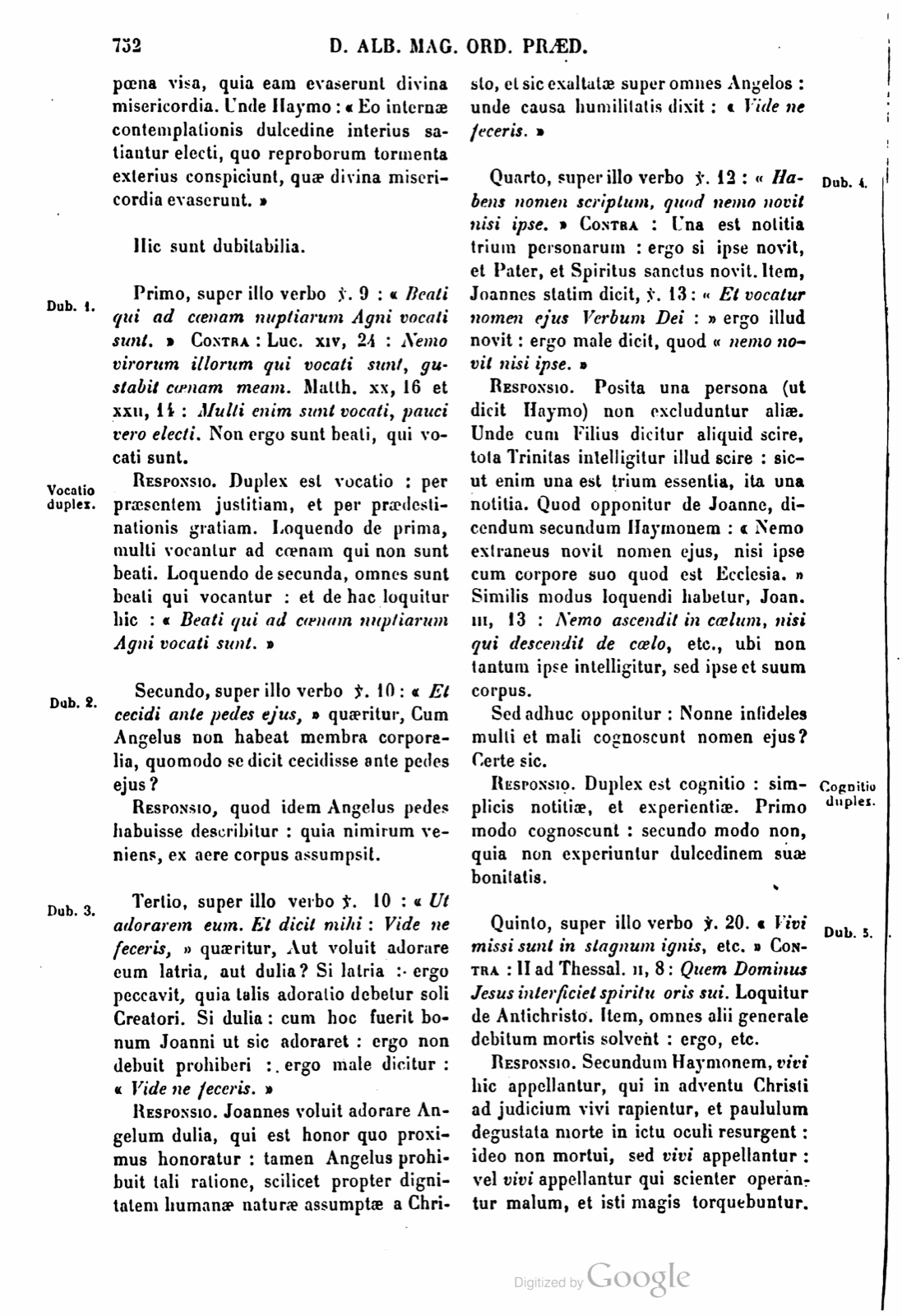
Hic sunt dubitabilia.
[Marginal label: Dub. 1.] Primo, super illo verbo v. 9: "Beati qui ad coenam nuptiarum Agni vocati sunt." CONTRA: Luc. XIV, 24: Nemo virorum illorum qui vocati sunt, gustabit coenam meam. Matth. XX, 16 et XXII, 14: Multi enim sunt vocati, pauci vero electi. Non ergo sunt beati, qui vocati sunt. [Marginal label: Vocatio duplex.] RESPONSIO. Duplex est vocatio: per praesentem justitiam, et per praedestinationis gratiam. Loquendo de prima, multi vocantur ad coenam qui non sunt beati. Loquendo de secunda, omnes sunt beati qui vocantur: et de hac loquitur hic: "Beati qui ad coenam nuptiarum Agni vocati sunt."
[Marginal label: Dub. 2.] Secundo, super illo verbo v. 10: "Et cecidi ante pedes ejus," quaeritur, Cum Angelus non habeat membra corporalia, quomodo se dicit cecidisse ante pedes ejus? RESPONSIO, quod idem Angelus pedes habuisse describitur: quia nimirum veniens, ex aere corpus assumpsit.
[Marginal label: Dub. 3.] Tertio, super illo verbo v. 10: "Ut adorarem eum. Et dicit mihi: Vide ne feceris," quaeritur, Aut voluit adorare eum latria, aut dulia? Si latria: ergo peccavit, quia talis adoratio debetur soli Creatori. Si dulia: cum hoc fuerit bonum Joanni ut sic adoraret: ergo non debuit prohiberi: ergo male dicitur: "Vide ne feceris." RESPONSIO. Joannes voluit adorare Angelum dulia, qui est honor quo proximus honoratur: tamen Angelus prohibuit tali ratione, scilicet propter dignitatem humanae naturae assumptae a Christo, et sic exaltatae super omnes Angelos: unde causa humilitatis dixit: "Vide ne feceris."
[Marginal label: Dub. 4.] Quarto, super illo verbo v. 12: "Habens nomen scriptum, quod nemo novit nisi ipse." CONTRA: Una est notitia trium personarum: ergo si ipse novit, et Pater, et Spiritus sanctus novit. Item, Joannes statim dicit, v. 13: "Et vocatur nomen ejus Verbum Dei:" ergo illud novit: ergo male dicit, quod "nemo novit nisi ipse." RESPONSIO. Posita una persona, ut dicit Haymo, non excluduntur aliae. Unde cum Filius dicitur aliquid scire, tota Trinitas intelligitur illud scire: sicut enim una est trium essentia, ita una notitia. Quod opponitur de Joanne, dicendum secundum Haymonem: "Nemo extraneus novit nomen ejus, nisi ipse cum corpore suo quod est Ecclesia." Similis modus loquendi habetur, Joan. III, 13: Nemo ascendit in coelum, nisi qui descendit de coelo, etc., ubi non tantum ipse intelligitur, sed ipse et suum corpus. Sed adhuc opponitur: Nonne infideles multi et mali cognoscunt nomen ejus? Certe sic. [Marginal label: Cognitio duplex.] RESPONSIO. Duplex est cognitio: simplicis notitiae, et experientiae. Primo modo cognoscunt: secundo modo non, quia non experiuntur dulcedinem suae bonitatis.
[Marginal label: Dub. 5.] Quinto, super illo verbo v. 20: "Vivi missi sunt in stagnum ignis, etc." CONTRA: II ad Thessal. II, 8: Quem Dominus Jesus interficiet spiritu oris sui. Loquitur de Antichristo. Item, omnes alii generale debitum mortis solvent: ergo, etc. RESPONSIO. Secundum Haymonem, vivi hic appellantur, qui in adventu Christi ad judicium vivi rapientur, et paululum degustata morte in ictu oculi resurgent: ideo non mortui, sed vivi appellantur: vel vivi appellantur qui scienter operantur malum, et isti magis torquebuntur.
Here there are doubtful matters.
[Marginal label: Dub. 1.] First, on that word of verse 9: "Blessed are those who have been called to the supper of the marriage of the Lamb." ON THE CONTRARY: Luke 14:24: None of those men who were called will taste my supper. Matthew 20:16 and 22:14: For many are called, but few are chosen. Therefore those who are called are not blessed. [Marginal label: Calling is twofold.] RESPONSE. Calling is twofold: through present justice and through the grace of predestination. Speaking of the first, many are called to the supper who are not blessed. Speaking of the second, all who are called are blessed; and he speaks of this here: "Blessed are those who have been called to the supper of the marriage of the Lamb."
[Marginal label: Dub. 2.] Secondly, on that word of verse 10: "And I fell before his feet," it is asked: Since an Angel does not have bodily members, how does he say that he fell before his feet? RESPONSE: the same Angel is described as having had feet because, evidently, when he came, he assumed a body from air.
[Marginal label: Dub. 3.] Thirdly, on that word of verse 10: "That I might adore him. And he says to me: See that you do not do it," it is asked: Did he wish to adore him with latria or dulia? If with latria, then he sinned, because such adoration is owed to the Creator alone. If with dulia, since this was good for John, that he adore in this way, then he ought not to have been forbidden; therefore it is badly said: "See that you do not do it." RESPONSE. John wished to adore the Angel with dulia, which is the honor by which one's neighbor is honored; nevertheless the Angel forbade it for this reason, namely because of the dignity of human nature assumed by Christ, and thus exalted above all Angels; hence for the sake of humility he said: "See that you do not do it."
[Marginal label: Dub. 4.] Fourthly, on that word of verse 12: "Having a written name, which no one knows except he himself." ON THE CONTRARY: The knowledge of the three persons is one; therefore if he himself knows it, the Father and the Holy Spirit know it. Likewise, John immediately says, verse 13: "And his name is called the Word of God"; therefore he knows it; therefore he says badly that "no one knows except he himself." RESPONSE. When one person is posited, as Haymo says, the others are not excluded. Hence when the Son is said to know something, the whole Trinity is understood to know it; for as the essence of the three is one, so also the knowledge is one. As to what is objected from John, it must be said according to Haymo: "No stranger knows his name except he himself with his body, which is the Church." A similar manner of speaking is found in John 3:13: No one has ascended into heaven except he who descended from heaven, etc.; there not only he himself is understood, but he himself and his body. But it is still objected: Do not many unbelievers and evil people know his name? Certainly they do. [Marginal label: Knowledge is twofold.] RESPONSE. Knowledge is twofold: of simple knowing and of experience. In the first way they know; in the second way not, because they do not experience the sweetness of his goodness.
[Marginal label: Dub. 5.] Fifthly, on that word of verse 20: "They were cast alive into the pool of fire, etc." ON THE CONTRARY: 2 Thessalonians 2:8: Whom the Lord Jesus will slay by the spirit of his mouth. He is speaking of Antichrist. Likewise, all others will pay the general debt of death; therefore, etc. RESPONSE. According to Haymo, those are here called living who at the advent of Christ for judgment will be caught up alive, and, after tasting death a little, will rise in the blink of an eye; therefore they are not called dead, but living; or those are called living who knowingly work evil, and these will be tortured more.
If a page does not appear, its photograph has not been uploaded yet.