Works › Commentary on the Apocalypse of Blessed John
Volume 38 · pp. 742–751
Exposition on Chapter XIX of the Apocalypse, vv. 1-10
A marker with ≈ is an approximate page boundary, placed by measure of the text; the page photographs remain the authority. In the paired views, clicking a page marker brings that page into view.
IN CAPUT XIX APOCALYPSIS ENARRATIO.
1. "Post haec audivi quasi vocem turbarum multarum in coelo dicentium: Alleluia: salus, et gloria, et virtus Deo nostro est: 2. Quia vera et justa judicia sunt ejus, qui judicavit de meretrice magna, quae corrupit terram in prostitutione sua, et vindicavit sanguinem servorum suorum de manibus ejus. 3. Et iterum dixerunt: Alleluia. Et fumus ejus ascendit in saecula saeculorum."
SUPRA actum est de damnatione civitatis Babylonis, hic agitur de consequentibus damnationem ejus. Et dividitur haec pars in duas. Primo, ponitur gratiarum actio pro effectu justitiae in damnatione impiae civitatis. Secundo, pro effectu misericordiae in salvatione, v. 6: "Et audivi quasi vocem turbae magnae." In prima tanguntur tria. In primo, ponitur gratiarum actio exhibita a Praedicatoribus. Secundo, a Doctoribus et judicibus, ibi, v. 4: "Et ceciderunt." Tertio, fit monitio ut Deus laudetur communiter ab omnibus, ibi, v. 5: "Et vox de throno exivit." Dicit ergo: "Post haec," scilicet praedictam visionem. "Post" non est diversitas temporis, sed ordo narrationis. "Audivi quasi vocem," id est, Sanctorum magnum desiderium, ut dicit Haymo. "Tubarum multarum," id est, praedicatorum multorum, qui dicuntur tubae propter sonum evidentem, et propter similem impletionem. [Marginal label: Tuba praedicatio est.] NOTA: Sicut tuba recipit sonum sine strepitu, quem postea emittit: sic Praedicatores primo recipiunt in corde interius per internam inspirationem, quod postea effundunt exterius per Praedicationem. Et ideo dicitur, Isa. LVIII, 1: Quasi tuba exalta vocem tuam. "In coelo," id est, in Ecclesia Sanctorum. Et dicit: "Vocem," in singulari ad innuendum, quod omne quod praedicant illi in unius concordia consistit. [Marginal label: Alleluia.] "Dicentium: Alleluia." Beda: "Laudate Deum." Sed si Alleluia idem est quod laudate Deum, quare postea subditur: Salus, et gloria? RESPONSIO. Quae sequuntur, expositio sunt ejus quod dicitur Alleluia. Unde Haymo: "Hoc est, Alleluia dicere est idem quod laus."
Deinde exponit Alleluia sic: [Marginal label: Laus. Gloria. Virtus.] "Et gloria," id est, honor et exaltatio, "et virtus," quia vicit diabolum, et sanctis dat vincendi potestatem. Vel sic: "Alleluia," quod est laus humanis verbis inexplicabilis, refertur ad essentiae unitatem quae non potest comprehendi propter sui immensitatem, nec digne laudari. "Salus, et gloria, et virtus," propter personarum Trinitatem: sed "salus," ratione bonitatis quae attribuitur Spiritui sancto, "et gloria," ratione sapientiae quae attribuitur Filio, "et virtus," ratione potentiae quae attribuitur Patri, "Deo nostro est," qui est trinus et unus. Vel, "Salus," pro operibus creationis, "et virtus," pro opibus retributionis, "et gloria," pro operibus recreationis. Vel sic: "Salus," pro Ascensione et Spiritus sancti missione, "et gloria," pro nativitate. Luc. II, 14: Gloria in Altissimis, etc. "Et virtus," pro diaboli dejectione, ut dicit Glossa. Vel sic: "Salus," in Ascensione et Spiritus sancti missione, "et gloria" immortalitatis in Resurrectione, "et virtus," in Passione, "Deo nostro est," id est, Christo, qui datus est nobis. Isa. IX, 6: Parvulus natus est nobis, et filius datus est nobis.
EXPOSITION ON CHAPTER XIX OF THE APOCALYPSE.
1. "After these things I heard as it were the voice of many crowds in heaven saying: Alleluia: salvation, and glory, and strength belong to our God; 2. because true and just are his judgments, who judged concerning the great harlot, who corrupted the earth in her prostitution, and avenged the blood of his servants from her hands. 3. And again they said: Alleluia. And her smoke ascended for ages of ages."
ABOVE, the damnation of the city of Babylon has been treated; here the things consequent upon her damnation are treated. And this part is divided into two. First, thanksgiving is set down for the effect of justice in the damnation of the impious city. Secondly, for the effect of mercy in salvation, verse 6: "And I heard as it were the voice of a great crowd." In the first, three things are touched. In the first, thanksgiving offered by Preachers is set down. Secondly, by Doctors and judges, there at verse 4: "And they fell down." Thirdly, an admonition is made that God be praised commonly by all, there at verse 5: "And a voice went out from the throne." Therefore he says: "After these things," namely the aforesaid vision. "After" is not diversity of time, but order of narration. "I heard as it were a voice," that is, the great desire of the Saints, as Haymo says. "Of many trumpets," that is, of many preachers, who are called trumpets because of evident sound and because of a similar filling. [Marginal label: Preaching is a trumpet.] NOTE: As a trumpet receives sound without clamor, which afterward it emits, so Preachers first receive inwardly in the heart through inward inspiration what afterward they pour out outwardly through preaching. And therefore it is said, Isaiah 58:1: Lift up your voice like a trumpet. "In heaven," that is, in the Church of the Saints. And he says: "voice," in the singular, to suggest that everything which they preach consists in the concord of unity. [Marginal label: Alleluia.] "Saying: Alleluia." Bede says: "Praise God." But if Alleluia is the same as praise God, why is it added afterward: Salvation and glory? RESPONSE. The things which follow are the exposition of that which is said, Alleluia. Hence Haymo: "This is it: to say Alleluia is the same as praise."
Then he expounds Alleluia thus: [Marginal label: Praise. Glory. Strength.] "And glory," that is, honor and exaltation, "and strength," because he conquered the devil and gives the saints the power of conquering. Or thus: "Alleluia," which is praise inexplicable by human words, is referred to the unity of essence, which cannot be comprehended because of its immensity, nor worthily praised. "Salvation, and glory, and strength," because of the Trinity of persons: but "salvation," by reason of goodness, which is attributed to the Holy Spirit; "and glory," by reason of wisdom, which is attributed to the Son; "and strength," by reason of power, which is attributed to the Father, "belong to our God," who is three and one. Or, "Salvation," for the works of creation; "and strength," for the resources of retribution; "and glory," for the works of re-creation. Or thus: "Salvation," for the Ascension and the mission of the Holy Spirit; "and glory," for the nativity. Luke 2:14: Glory in the highest, etc. "And strength," for the casting down of the devil, as the Gloss says. Or thus: "Salvation," in the Ascension and mission of the Holy Spirit, "and glory" of immortality in the Resurrection, "and strength," in the Passion, "belong to our God," that is, to Christ, who was given to us. Isaiah 9:6: A little child has been born to us, and a son has been given to us.
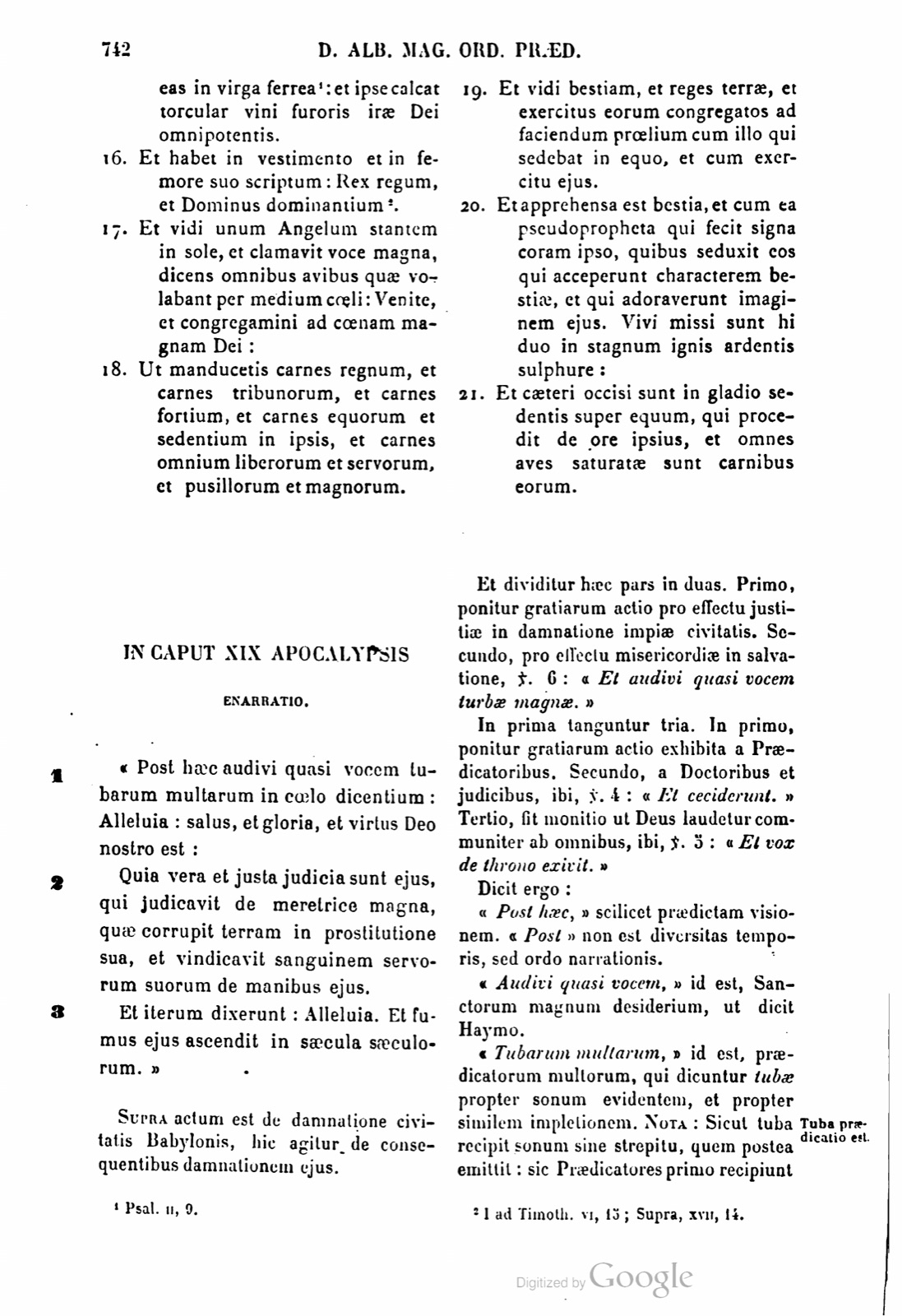
"Quia vera et justa judicia sunt ejus, etc." "Quia vera," promissa reddendo, et praedicta implendo, "et justa judicia sunt ejus," unicuique secundum merita retribuendo. Psal. CXVIII, 137: Justus es, Domine, et rectum judicium tuum. "Qui judicavit," scilicet judicio condemnationis, "de meretrice magna," id est, malorum congregatione, "quae corrupit terram," id est, habitantes in terra suo exemplo, id est persuasione. Vel, "Terram," id est, seipsos. "In prostitutione sua," id est, in carnis immunditia, vel se venalem faciendo pro rebus temporalibus. Eccli. X, 10: Nihil est iniquius quam amare pecuniam. Item, luxuriando. Jacobi, V, 5: Epulati estis super terram, in luxuriis enutristis corda vestra. "Et vindicavit sanguinem servorum suorum," quem effudit impia multitudo. Deuter. XXXII, 43: Sanguinem servorum suorum ulciscetur. "De manibus ejus," quae illum fuderunt occidendo. Psal. LXXVIII, 3: Effuderunt sanguinem eorum tamquam aquam in circuitu Jerusalem. Item, bona necessaria subtrahendo. Eccli. XXXIV, 23: Panis egentium, vita pauperum est: qui defraudat illum, homo sanguinis est.
[Marginal label: Alleluia.] "Et iterum dixerunt: Alleluia," id est, Deum laudaverunt. Et sicut dicit Glossa, per hanc iterationem debemus intelligere laudem Dei esse aeternam. Psal. LXXXIII, 3: Beati qui habitant in domo tua, Domine, in saecula saeculorum laudabunt te. Vel bis ponitur Alleluia, pro vindicta peccatorum quae in se commiserunt, et pro vindicta peccatorum quae persequendo Sanctos commiserunt. Vel, propter duplicem damnationem, animae scilicet, et corporis. Vel, propter duplicem naturam ipsius judicii, vel judicis. "Et fumus ejus," id est, poena damni et sensus, quae bene dicitur fumus, quia sicut fumus relinquitur ex applicatione ignis ad ligna, sic poena relinquitur ex applicatione ignis inferni ad peccata: "ascendit in saecula saeculorum," id est, aeternaliter durabit. Isa. LXVI, 24: Vermis eorum non morietur.
"Because true and just are his judgments, etc." "Because true," by rendering promised things and fulfilling foretold things, "and just are his judgments," by rendering to each one according to merits. Psalm 118:137: You are just, Lord, and your judgment is right. "Who judged," namely by a judgment of condemnation, "concerning the great harlot," that is, the congregation of the evil, "who corrupted the earth," that is, those dwelling on the earth by her example, that is, persuasion. Or, "the earth," that is, themselves. "In her prostitution," that is, in the uncleanness of the flesh, or by making herself saleable for temporal things. Ecclesiasticus 10:10: Nothing is more wicked than to love money. Likewise, by living luxuriously. James 5:5: You feasted upon the earth; in luxuries you nourished your hearts. "And he avenged the blood of his servants," which the impious multitude poured out. Deuteronomy 32:43: He will avenge the blood of his servants. "From her hands," which poured it out by killing. Psalm 78:3: They poured out their blood like water around Jerusalem. Likewise, by withdrawing necessary goods. Ecclesiasticus 34:23: The bread of the needy is the life of the poor; he who defrauds him is a man of blood.
[Marginal label: Alleluia.] "And again they said: Alleluia," that is, they praised God. And, as the Gloss says, through this repetition we ought to understand that the praise of God is eternal. Psalm 83:3: Blessed are those who dwell in your house, Lord; they will praise you for ages of ages. Or Alleluia is put twice, for the vengeance of the sins which they committed in themselves and for the vengeance of the sins which they committed by persecuting the Saints. Or, because of the twofold damnation, namely of soul and body. Or, because of the twofold nature of the judgment itself, or of the judge. "And her smoke," that is, the punishment of loss and of sense, which is well called smoke, because as smoke is left from the application of fire to wood, so punishment is left from the application of infernal fire to sins: "ascended for ages of ages," that is, it will last eternally. Isaiah 66:24: Their worm will not die.
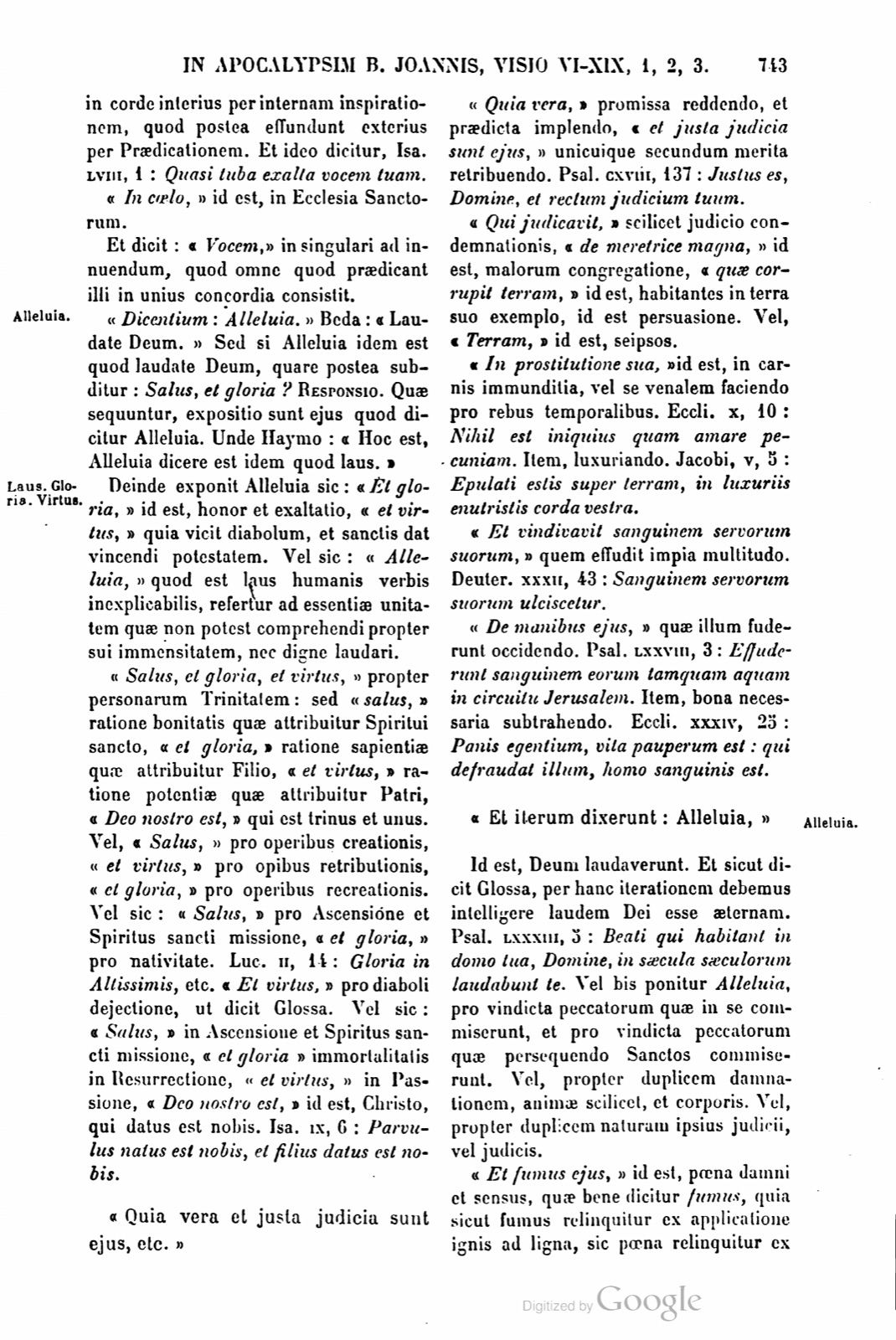
4. "Et ceciderunt seniores viginti quatuor et quatuor animalia, et adoraverunt Deum sedentem super thronum, dicentes: Amen, alleluia."
Hic redditur gratiarum actio a Sanctis Doctoribus et judicibus. Unde dicit: "Et ceciderunt," se scilicet humiliando, "viginti quatuor seniores," id est, omnes sancti judices, qui dicuntur seniores propter sapientiam. [Marginal label: Seniores viginti quatuor.] Job, XII, 12: In antiquis est sapientia. Dicuntur etiam viginti et quatuor, propter patres Veteris et Novi Testamenti. Fuerunt enim duodecim Patriarchae in Veteri, et duodecim Apostoli in Novo. "Et quatuor animalia," id est, universi qui signantur per quatuor animalia, quae gerunt figuram quatuor Evangelistarum, et quorum doctrina fundatur in quatuor Evangeliis. "Et adoraverunt sedentem super thronum," id est, illum cujus est potestas judiciaria. Vel, "Super thronum," id est, super Sanctos in quibus judicat: "dicentes: Amen, alleluia." [Marginal label: Alleluia. Amen.] Per Alleluia intelligitur laudis exhibitio: per Amen ejus confirmatio. Amen enim interpretatur verum est: Alleluia, laudate Deum. Unde Glossa: "Verum est: quia Deus est gloriosus, et laudandus vere de hoc quod punit malos." Et ly Amen refertur ad minores: Alleluia quod est laus inexplicabilis, ad majores refertur.
5. "Et vox de throno exivit, dicens: Laudem dicite Deo nostro omnes servi ejus, et qui timetis eum pusilli et magni."
Haec est tertia pars, in qua ponitur admonitio ut Deus laudetur ab omnibus. Unde dicit: "Et vox," id est, admonitio, "exivit de throno," id est, de Ecclesia Sanctorum in quibus Deus sedet, "dicens," scilicet ad conservos suos: "Laudem dicite Deo nostro," id est, Christo qui creavit, recrevit, et glorificabit, "omnes servi ejus," non peccatores. Joan. VIII, 34: Qui facit peccatum, servus est peccati. Eccli. XV, 9: Non est speciosa laus in ore peccatoris. "Et qui timetis eum," scilicet timore filiali, "pusilli et magni," supple, laudem dicite. "Pusilli," id est, minores: "magni," majores. Job, III, 19: Parvus et magnus ibi sunt. Unde "Pusilli," simplices, "et magni," Doctores: quia, Matth. V, 19: Qui fecerit et docuerit, hic magnus vocabitur regno coelorum.
4. "And the twenty-four elders and the four living creatures fell down, and adored God sitting upon the throne, saying: Amen, alleluia."
Here thanksgiving is rendered by the holy Doctors and judges. Hence he says: "And they fell down," namely by humbling themselves, "the twenty-four elders," that is, all the holy judges, who are called elders because of wisdom. [Marginal label: The twenty-four elders.] Job 12:12: Wisdom is among the ancient. They are also called twenty-four because of the fathers of the Old and New Testament. For there were twelve Patriarchs in the Old, and twelve Apostles in the New. "And the four living creatures," that is, all who are signified by the four living creatures, which bear the figure of the four Evangelists and whose doctrine is founded on the four Gospels. "And they adored the one sitting upon the throne," that is, him whose is judicial power. Or, "upon the throne," that is, upon the Saints in whom he judges: "saying: Amen, alleluia." [Marginal label: Alleluia. Amen.] By Alleluia is understood the offering of praise; by Amen its confirmation. For Amen is interpreted it is true; Alleluia, praise God. Hence the Gloss says: "It is true, because God is glorious and truly to be praised for this, that he punishes the evil." And the term Amen is referred to the lesser ones; Alleluia, which is inexplicable praise, is referred to the greater ones.
5. "And a voice went out from the throne, saying: Speak praise to our God, all his servants, and you who fear him, small and great."
This is the third part, in which the admonition is set down that God should be praised by all. Hence he says: "And a voice," that is, an admonition, "went out from the throne," that is, from the Church of the Saints in whom God sits, "saying," namely to his fellow-servants: "Speak praise to our God," that is, to Christ who created, re-created, and will glorify, "all his servants," not sinners. John 8:34: He who commits sin is a slave of sin. Ecclesiasticus 15:9: Praise is not beautiful in the mouth of a sinner. "And you who fear him," namely with filial fear, "small and great," supply, speak praise. "Small," that is, lesser ones; "great," greater ones. Job 3:19: The small and the great are there. Hence "small," simple persons, "and great," Doctors, because Matthew 5:19 says: He who shall do and teach, he will be called great in the kingdom of heaven.
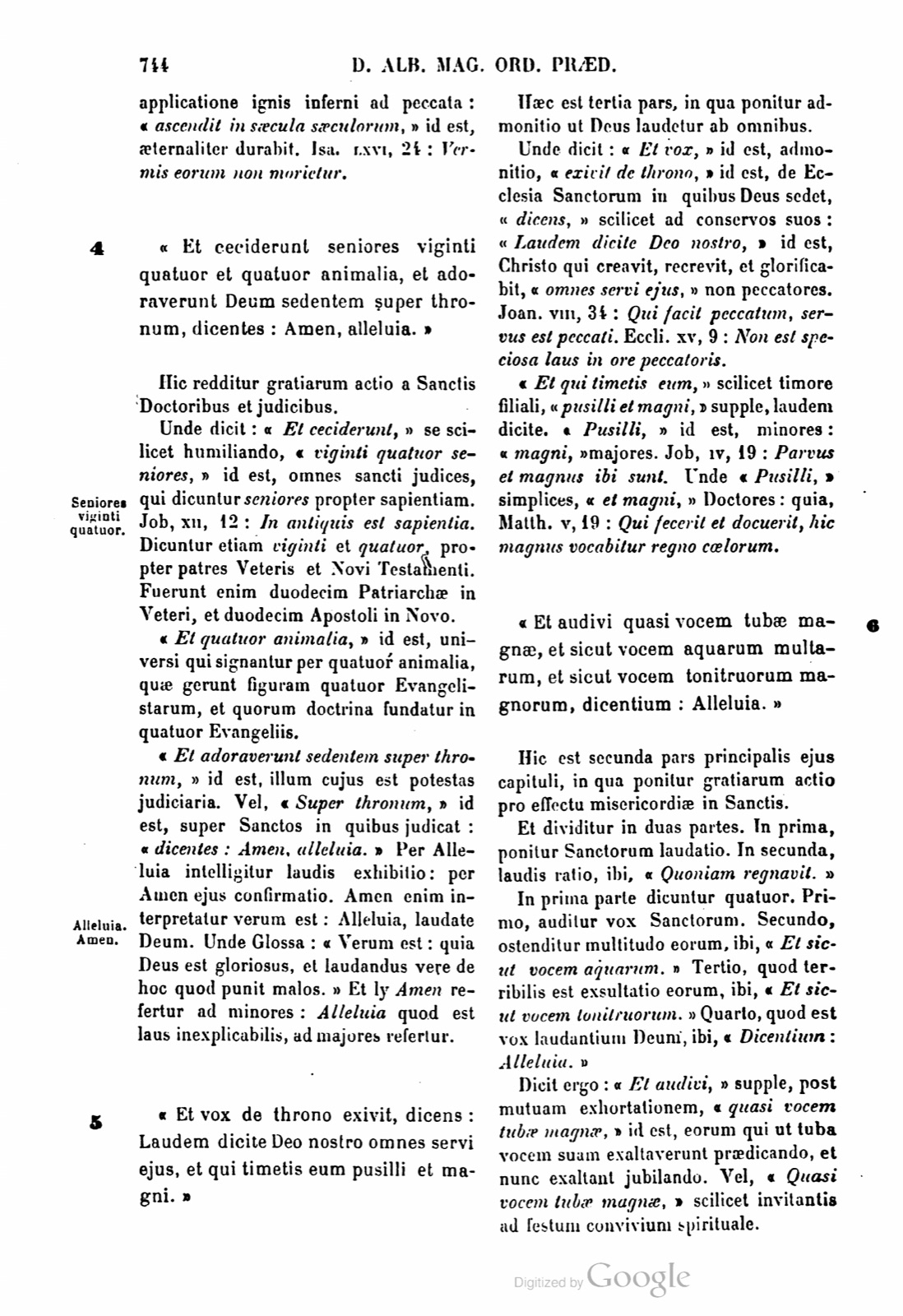
6. "Et audivi quasi vocem tubae magnae, et sicut vocem aquarum multarum, et sicut vocem tonitruorum magnorum, dicentium: Alleluia."
Hic est secunda pars principalis ejus capituli, in qua ponitur gratiarum actio pro effectu misericordiae in Sanctis. Et dividitur in duas partes. In prima, ponitur Sanctorum laudatio. In secunda, laudis ratio, ibi, "Quoniam regnavit." In prima parte dicuntur quatuor. Primo, auditur vox Sanctorum. Secundo, ostenditur multitudo eorum, ibi, "Et sicut vocem aquarum." Tertio, quod terribilis est exsultatio eorum, ibi, "Et sicut vocem tonitruorum." Quarto, quod est vox laudantium Deum, ibi, "Dicentium: Alleluia." Dicit ergo: "Et audivi," supple, post mutuam exhortationem, "quasi vocem tubae magnae," id est, eorum qui ut tuba vocem suam exaltaverunt praedicando, et nunc exaltant jubilando. Vel, "Quasi vocem tubae magnae," scilicet invitantis ad festum convivium spirituale. "Et sicut vocem aquarum multarum," id est, populorum multorum Deum laudantium: "et sicut vocem tonitruorum magnorum." Glossa: Quia Sanctorum exsultatio terret impios. Sapient. V, 2: Videntes turbabuntur timore horribili, etc. [Marginal label: Tuba.] NOTA: Dicit: "Vox tubae," propter sonum evidentem: "vox aquarum," propter laudantium multitudinem: "vox tonitruorum," propter malorum terrorem. "Dicentium: Alleluia." Quasi dicat: Audivi vocem laudantium Deum. Hi sunt de quibus dicitur, Isa. XLIII, 21: Populum istum formavi mihi, laudem meam narrabit.
"Quoniam regnavit Dominus Deus noster omnipotens. 7. Gaudeamus, et exsultemus, et demus gloriam ei." Hic ponitur ratio laudis Sanctorum. Et dicuntur duo. Primo dicitur, quod Sancti laudant Christum, eo quod advenit regnum ejus. Secundo, hoc probatur, ibi, v. 7: "Quia venerunt nuptiae Agni." Dicit ergo: Audivi vocem laudantium: et ideo laudabant, "quoniam regnavit," id est, se regnare manifestavit, quod prius erat quasi occultum, "Dominus," quia potenter, "Deus," quia sapienter, "noster," ratione creationis, "omnipotens," ratione retributionis. Vel sic: "Dominus," qui regnavit, "Deus," qui creavit, "noster," qui redemit, "omnipotens," qui glorificabit. Vel, "Dominus," excellentia, "Deus," natura, "noster," gratia, "omnipotens," potentia. [Marginal label: Alleluia quater ponitur.] NOTA, quod jam quater positum est Alleluia propter laudem Trinitatis et unitatis: vel propter quatuor effectus qui tacti sunt in his verbis: "Dominus Deus noster omnipotens."
6. "And I heard as it were the voice of a great trumpet, and like the voice of many waters, and like the voice of great thunders, saying: Alleluia."
This is the second principal part of this chapter, in which thanksgiving is set down for the effect of mercy in the Saints. And it is divided into two parts. In the first, the praise of the Saints is set down. In the second, the reason for the praise, there, "Because he has reigned." In the first part four things are said. First, the voice of the Saints is heard. Secondly, their multitude is shown, there, "And like the voice of waters." Thirdly, that their exultation is terrifying, there, "And like the voice of thunders." Fourthly, that it is the voice of those praising God, there, "Saying: Alleluia." Therefore he says: "And I heard," supply, after the mutual exhortation, "as it were the voice of a great trumpet," that is, of those who, like a trumpet, exalted their voice by preaching, and now exalt it by rejoicing. Or, "As it were the voice of a great trumpet," namely inviting to the spiritual festive banquet. "And like the voice of many waters," that is, of many peoples praising God; "and like the voice of great thunders." The Gloss says: Because the exultation of the Saints terrifies the impious. Wisdom 5:2: Seeing, they will be troubled with horrible fear, etc. [Marginal label: Trumpet.] NOTE: He says: "voice of a trumpet," because of evident sound; "voice of waters," because of the multitude of those praising; "voice of thunders," because of the terror of the evil. "Saying: Alleluia." As if he said: I heard the voice of those praising God. These are those of whom it is said, Isaiah 43:21: This people I formed for myself; it will narrate my praise.
"Because the Lord our God almighty has reigned. 7. Let us rejoice and exult, and give glory to him." Here the reason for the praise of the Saints is set down. And two things are said. First, it is said that the Saints praise Christ because his kingdom has come. Secondly, this is proved, there at verse 7: "Because the marriage of the Lamb has come." Therefore he says: I heard the voice of those praising, and therefore they were praising, "because he has reigned," that is, he manifested himself to reign, which before was as it were hidden; "Lord," because powerfully; "God," because wisely; "our," by reason of creation; "almighty," by reason of retribution. Or thus: "Lord," who has reigned; "God," who created; "our," who redeemed; "almighty," who will glorify. Or, "Lord," in excellence; "God," in nature; "our," in grace; "almighty," in power. [Marginal label: Alleluia is put four times.] NOTE that Alleluia has now been put four times because of the praise of the Trinity and unity; or because of the four effects which have been touched in these words: "The Lord our God almighty."
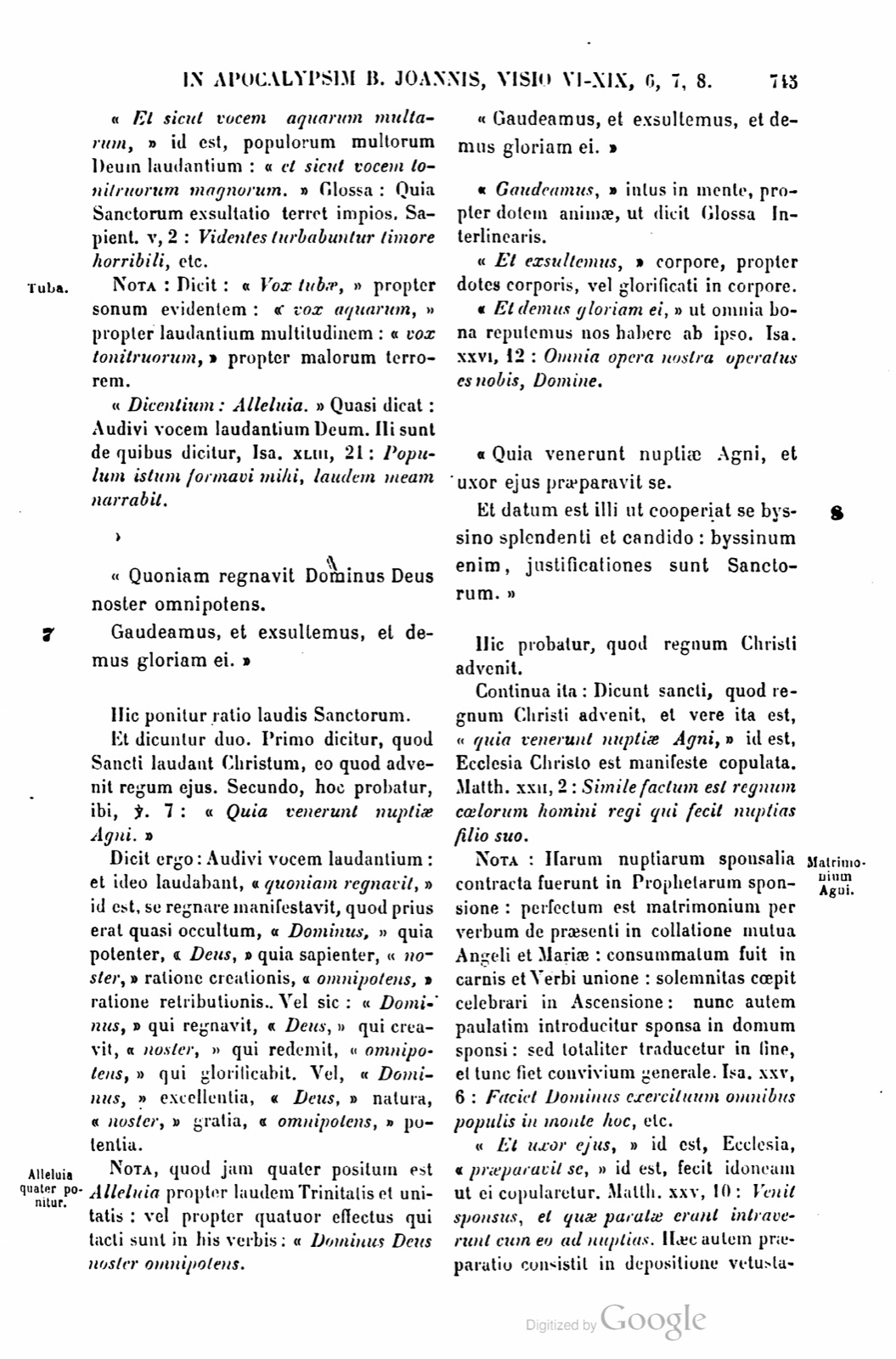
"Gaudeamus, et exsultemus, et demus gloriam ei." "Gaudeamus," intus in mente, propter dotem animae, ut dicit Glossa Interlinearis. "Et exsultemus," corpore, propter dotes corporis, vel glorificati in corpore. "Et demus gloriam ei," ut omnia bona reputemus nos habere ab ipso. Isa. XXVI, 12: Omnia opera nostra operatus es nobis, Domine.
7. "Quia venerunt nuptiae Agni, et uxor ejus praeparavit se. 8. Et datum est illi ut cooperiat se byssino splendenti et candido: byssinum enim, justificationes sunt Sanctorum."
Hic probatur, quod regnum Christi advenit. Continua ita: Dicunt sancti, quod regnum Christi advenit, et vere ita est, "quia venerunt nuptiae Agni," id est, Ecclesia Christo est manifeste copulata. Matth. XXII, 2: Simile factum est regnum coelorum homini regi qui fecit nuptias filio suo. [Marginal label: Matrimonium Agni.] NOTA: Harum nuptiarum sponsalia contracta fuerunt in Prophetarum sponsione: perfectum est matrimonium per verbum de praesenti in collatione mutua Angeli et Mariae: consummatum fuit in carnis et Verbi unione: solemnitas coepit celebrari in Ascensione: nunc autem paulatim introducitur sponsa in domum sponsi: sed totaliter traducetur in fine, et tunc fiet convivium generale. Isa. XXV, 6: Faciet Dominus exercituum omnibus populis in monte hoc, etc. "Et uxor ejus," id est, Ecclesia, "praeparavit se," id est, fecit idoneam ut ei copularetur. Matth. XXV, 10: Venit sponsus, et quae paratae erant intraverunt cum eo ad nuptias. Haec autem praeparatio consistit in depositione vetustatis et induitione novitatis. Ad Roman. XIII, 12: Abjiciamus ergo opera tenebrarum, etc.
Sed ne istam dignitatem meritis suis attribuat, subditur: "Et datum est illi ut cooperiat se byssino splendenti, etc." "Et datum est illi," scilicet a Deo, a quo est omne datum optimum, etc. 1. "Ut cooperiat se," id est, ornet, [Marginal label: Byssinum.] "byssino," id est, justitia Sanctorum. Psal. CXXXI, 9: Sacerdotes tui induantur justitiam. "Candido," in se, et "splendenti," quoad alios. Vel sic: "Byssino" bonae vitae, "candido," per puritatem conscientiae, "et splendenti," honesta conversatione. "Byssinum enim, justificationes sunt Sanctorum," quae candidae sunt interius in conscientia quoad se, et splendidae exterius quoad alios. Et bene hoc dicitur, quia sicut byssus per multas tunsiones ad candorem perducitur, sic Sancti per multas tribulationes ad gloriam perducuntur.
"Let us rejoice, and exult, and give glory to him." "Let us rejoice," inwardly in the mind, because of the dowry of the soul, as the Interlinear Gloss says. "And let us exult," in body, because of the dowries of the body, or as glorified in the body. "And let us give glory to him," so that we may reckon that we have all good things from him. Isaiah 26:12: You have worked all our works for us, Lord.
7. "Because the marriage of the Lamb has come, and his wife has prepared herself. 8. And it was given to her that she should cover herself with shining and white fine linen; for fine linen is the justifications of the Saints."
Here it is proved that the kingdom of Christ has come. The continuation is thus: The saints say that the kingdom of Christ has come, and truly it is so, "because the marriage of the Lamb has come," that is, the Church has been manifestly joined to Christ. Matthew 22:2: The kingdom of heaven has become like a man, a king, who made a marriage for his son. [Marginal label: The marriage of the Lamb.] NOTE: The betrothal of this marriage was contracted in the promise of the Prophets; the marriage was perfected through a word in the present tense in the mutual conference of the Angel and Mary; it was consummated in the union of flesh and Word; the solemnity began to be celebrated in the Ascension; now, however, the bride is gradually introduced into the house of the bridegroom, but she will be brought over totally at the end, and then there will be a general banquet. Isaiah 25:6: The Lord of hosts will make for all peoples on this mountain, etc. "And his wife," that is, the Church, "prepared herself," that is, made herself fit to be joined to him. Matthew 25:10: The bridegroom came, and those who were prepared entered with him to the wedding. Now this preparation consists in the putting off of oldness and the putting on of newness. Romans 13:12: Therefore let us cast off the works of darkness, etc.
But lest she attribute that dignity to her own merits, it is added: "And it was given to her that she should cover herself with shining fine linen, etc." "And it was given to her," namely by God, from whom every best gift is, etc. 1. "That she should cover herself," that is, adorn herself, [Marginal label: Fine linen.] "with fine linen," that is, the justice of the Saints. Psalm 131:9: Let your priests be clothed with justice. "White," in itself, and "shining," as to others. Or thus: "with fine linen" of a good life, "white," through purity of conscience, "and shining," by honorable conduct. "For fine linen is the justifications of the Saints," which are white inwardly in conscience as to themselves and shining outwardly as to others. And this is well said, because as fine linen is brought to whiteness through many beatings, so the Saints are brought to glory through many tribulations.
9. "Et dixit mihi: Scribe: Beati qui ad coenam nuptiarum Agni vocati sunt." Hic dicitur Joanni ut scribat gaudium conjunctionis Christi et Ecclesiae. Unde: "Et dixit mihi," scilicet Angelus: "Scribe," scilicet in libro, vel in tuo corde: "Beati," quia nihil eis deficiet, "qui ad coenam nuptiarum Agni," id est, convivium coeleste, cui nullum aliud succedet, "vocati sunt," scilicet per praedestinationem.
"Et dixit mihi: Haec verba Dei vera sunt." Hic ostendit quare scribere debeat. Unde dicit: "Et dixit mihi," Angelus scilicet Joanni: "Haec verba Dei vera sunt." Quasi dicat: Non sunt ista mea, sed Dei, ideo credenda. "Vera sunt," ideo quae praenuntiant, infallibiliter ventura. Numer. XXIII, 19: Dixit, et non faciet? locutus est, et non implebit? Quasi dicat: Non.
10. "Et cecidi ante pedes ejus, ut adorarem eum. Et dixit mihi: Vide ne feceris: conservus tuus sum, et fratrum tuorum habentium testimonium Jesu. Deum adora: testimonium enim Jesu est spiritus prophetiae."
Hic ostenditur Joannis obedientia. Unde: "Et cecidi," scilicet mente et corpore volens ei gratias agere, "ante pedes ejus," scilicet Angeli mihi revelantis, [Marginal label: Angelus noluit adorari a Joanne.] "ut adorarem eum," scilicet dulia, quasi majorem honorando et reverendo. "Et dixit mihi," scilicet volenti me ita humiliare: "Vide," id est, cave, "ne feceris," id est, ne me adoraveris ut meliorem et digniorem te. "Conservus tuus sum, et fratrum tuorum." Quasi dicat: Ego et tu et fratres tui sumus servi ejusdem Domini. "Fratrum," dico "habentium testimonium Jesu," id est, fidem et gratiam Spiritus sancti, quae testificatur ipsos esse filios Dei et servos Jesu. Ad Roman. VIII, 16: Spiritus testimonium reddit spiritui nostro, quod sumus filii Dei. Hoc testimonium habendum est in corde per fidem, in ore per confessionem, in opere per imitationem. "Deum adora," cui soli debetur adoratio. Matth. IV, 10: Dominum Deum tuum adorabis, etc. Consequenter exponit quod dixerat: "Habentium testimonium Jesu," et dicit: "Testimonium enim Jesu est spiritus prophetiae." Glossa: "Quidquid dixerunt prophetiae, testimonium perhibet de Jesu." Vel sic, quod aliquis habeat testimonium est spiritus prophetiae, id est, habet spiritum prophetiae. Joan. XV, 26: Cum venerit Paraclitus, quem ego mittam vobis a Patre, Spiritum veritatis, etc., ille testimonium perhibebit de me.
9. "And he said to me: Write: Blessed are those who have been called to the supper of the marriage of the Lamb." Here it is said to John that he should write the joy of the union of Christ and the Church. Hence: "And he said to me," namely the Angel: "Write," namely in a book, or in your heart; "Blessed," because nothing will be lacking to them, "are those who have been called to the supper of the marriage of the Lamb," that is, to the heavenly banquet, to which no other will succeed, "called," namely through predestination.
"And he said to me: These words of God are true." Here he shows why he ought to write. Hence he says: "And he said to me," namely the Angel to John: "These words of God are true." As if he said: These are not mine, but God's, therefore to be believed. "They are true," therefore the things which they foretell will come infallibly. Numbers 23:19: He has said, and will he not do it? He has spoken, and will he not fulfill it? As if he said: No.
10. "And I fell before his feet to adore him. And he said to me: See that you do not do it; I am your fellow-servant and of your brothers who have the testimony of Jesus. Adore God: for the testimony of Jesus is the spirit of prophecy."
Here the obedience of John is shown. Hence: "And I fell," namely in mind and body, wishing to give thanks to him, "before his feet," namely of the Angel revealing to me, [Marginal label: The Angel refused to be adored by John.] "so that I might adore him," namely with dulia, as honoring and reverencing one greater. "And he said to me," namely when I wished to humble myself thus: "See," that is, beware, "that you do not do it," that is, that you do not adore me as better and worthier than you. "I am your fellow-servant and of your brothers." As if he said: I and you and your brothers are servants of the same Lord. I say, "of brothers having the testimony of Jesus," that is, faith and grace of the Holy Spirit, which testifies that they are sons of God and servants of Jesus. Romans 8:16: The Spirit bears testimony to our spirit that we are sons of God. This testimony must be had in the heart through faith, in the mouth through confession, in work through imitation. "Adore God," to whom alone adoration is owed. Matthew 4:10: You shall adore the Lord your God, etc. Consequently he explains what he had said: "Having the testimony of Jesus," and he says: "For the testimony of Jesus is the spirit of prophecy." The Gloss says: "Whatever prophecies have said bears testimony concerning Jesus." Or thus: that someone have testimony is the spirit of prophecy, that is, he has the spirit of prophecy. John 15:26: When the Paraclete comes, whom I will send to you from the Father, the Spirit of truth, etc., he will bear testimony concerning me.
11. "Et vidi coelum apertum: et ecce equus albus, et qui sedebat super eum vocabatur Fidelis et Verax, et cum justitia judicat et pugnat. 12. Oculi autem ejus sicut flamma ignis, et in capite ejus diademata multa, habens nomen scriptum quod nemo novit nisi ipse. 13. Et vestitus erat veste aspersa sanguine, et vocabatur nomen ejus Verbum Dei. 14. Et exercitus qui sunt in coelo sequebantur eum in equis albis, vestiti byssino albo et mundo. 15. Et de ore ejus procedit gladius ex utraque parte acutus, ut in ipso percutiat Gentes: et ipse reget eas in virga ferrea, et ipse calcat torcular vini furoris irae Dei omnipotentis. 16. Et habet in vestimento et in femore suo scriptum: Rex regum, et Dominus dominantium."
Hic est secunda pars principalis sextae visionis, ubi agitur de damnatione Antichristi et Pseudoprophetae: et durat haec pars usque ad vigesimum capitulum. Et dividitur in tres partes. In prima parte describitur adventus Christi cum exercitu suo ad perdendum Antichristum. In secunda, introducitur Antichristus ad praeliandum cum exercitu contra Christum, ibi, v. 19: "Et vidi bestiam." Tertio, ponitur apprehensio bestiae et suorum, et damnatio eorum, ibi, v. 20: "Et apprehensa est bestia." In prima dicuntur duo. Primo, describitur adventus Christi cum exercitu suo. Secundo, invitantur sancti ad gaudendum de damnatione eorum qui adhaeserunt Antichristo, ibi, v. 17: "Et vidi unum Angelum."
Dicit ergo: "Et vidi coelum apertum," id est, januam paradisi quae prius fuerat clausa per peccatum hominis, sed aperta fuit per meritum Christi. "Et ecce equus albus," id est, humana natura portans Verbum Dei ad bellandum contra diabolum: [Marginal label: Equus albus est humanitas Christi.] de quo, Proverb. XXI, 31: Equus paratur ad diem belli: Dominus autem salutem tribuit. Ergo equus albus est humanitas Christi munda et immaculata. "Et qui sedebat super eum," id est, super humanam naturam velut super equum, "vocabatur Fidelis:" quia, sicut dicit Haymo, quidquid promittit, adimplebit. "Et Verax," quia ipse est veritas Patris. Vel, sicut dicit Glossa quia ipse veritas est, et veraces facit. Vel, "Fidelis," in adventu primo, "et Verax," in secundo: quia tunc plene retribuet merita bonis et malis. "Et cum justitia judicat," auctoritate in quantum Deus, ministerio in quantum homo. Joan. V, 22: Pater non judicat quemquam: sed omne judicium dedit Filio. Et infra, v. 27: Et potestatem dedit ei judicium facere, quia Filius hominis est. "Et pugnat," contra diabolum. "Judicat" enim secundum merita omnibus reddendo, "pugnat," scilicet contra adversarios. Deuter. I, 30: Dominus Deus... pro vobis ipse pugnabit.
"Oculi autem ejus, etc." "Oculi ejus." Glossa: "Dona Spiritus sancti, quibus Ecclesiam suam respicit.
11. "And I saw heaven opened, and behold a white horse, and he who sat upon it was called Faithful and True, and with justice he judges and fights. 12. And his eyes were like a flame of fire, and on his head were many diadems, having a written name which no one knows except he himself. 13. And he was clothed in a garment sprinkled with blood, and his name was called the Word of God. 14. And the armies which are in heaven followed him on white horses, clothed in white and clean fine linen. 15. And from his mouth proceeds a sword sharp on both sides, so that in it he may strike the Nations; and he will rule them with an iron rod, and he treads the winepress of the wine of the fury of the wrath of almighty God. 16. And on his garment and on his thigh he has written: King of kings and Lord of lords."
This is the second principal part of the sixth vision, where the damnation of Antichrist and the False Prophet is treated; and this part lasts up to the twentieth chapter. And it is divided into three parts. In the first part, the advent of Christ with his army for destroying Antichrist is described. In the second, Antichrist is introduced to fight with his army against Christ, there at verse 19: "And I saw the beast." Thirdly, the seizure of the beast and his own is set down, and their damnation, there at verse 20: "And the beast was seized." In the first, two things are said. First, the advent of Christ with his army is described. Secondly, the saints are invited to rejoice concerning the damnation of those who adhered to Antichrist, there at verse 17: "And I saw one Angel."
Therefore he says: "And I saw heaven opened," that is, the gate of paradise, which previously had been closed through the sin of man, but was opened through the merit of Christ. "And behold a white horse," that is, human nature bearing the Word of God to fight against the devil; [Marginal label: The white horse is the humanity of Christ.] concerning which Proverbs 21:31 says: The horse is prepared for the day of battle, but the Lord grants salvation. Therefore the white horse is the humanity of Christ, clean and immaculate. "And he who sat upon it," that is, upon human nature as upon a horse, "was called Faithful," because, as Haymo says, whatever he promises, he will fulfill. "And True," because he himself is the truth of the Father. Or, as the Gloss says, because he himself is truth and makes truthful persons. Or, "Faithful," in the first advent, "and True," in the second, because then he will repay fully the merits to good and evil. "And with justice he judges," with authority insofar as he is God, with ministry insofar as he is man. John 5:22: The Father judges no one, but has given all judgment to the Son. And below, verse 27: And he gave him power to make judgment, because he is the Son of man. "And he fights," against the devil. For he "judges" by rendering to all according to merits; he "fights," namely against adversaries. Deuteronomy 1:30: The Lord God himself will fight for you.
"And his eyes, etc." "His eyes." The Gloss says: "The gifts of the Holy Spirit, with which he looks upon his Church."
respicit." Psal. XXXIII, 16: Oculi Domini super justos.
[Marginal label: Igne proprietates per quas dona Spiritus sancti signantur.] "Sicut flamma ignis." NOTA: Ignis illuminat et accendit, rubiginem consumit, durum ferrum emollit, frigidum calefacit, liquidum consolidat et connectit: sic dona Spiritus sancti inflammant ad amorem Dei et proximi, illuminant ad cognitionem veri et falsi, boni et mali: consumunt rubiginem peccati, emolliunt duritiam cordis, cor frigidum calefaciunt, mentes fragiles fortes faciunt: propter hoc missus est Spiritus sanctus in specie ignis. Item, Flamma ignis gratuita est suae speciei: sic dona Spiritus sancti Dei imaginem per gratiam imprimunt in Sanctis.
"Et in capite ejus," id est, in deitate. I ad Corinth. XI, 3: Caput Christi, Deus. [Marginal label: Diadema.] "Diademata multa," id est, multae victoriae et coronae pro triumpho multiplici de inimicis: virtute enim divinitatis Christus et sui triumphant de inimicis. Sapient. V, 17: Accipient regnum decoris, et diadema speciei de manu Domini. In hoc autem quod dicitur: "Diademata," notatur coronae perpetuitas: quia diadema dicitur, quasi duo demens, id est, principium et finem: in quo notatur aeternitas praemii. "Habens nomen scriptum," scilicet quod Deus, et homo. Ad Philip. II, 9: Donavit illi nomen quod est super omne nomen. "Quod nemo novit nisi ipse," scilicet ad plenum.
"Et vestitus erat veste aspersa sanguine," id est, carne proprio sanguine rubricata. Isa. LXIII, 2: Quare rubrum est indumentum tuum? "Et vocabitur nomen ejus Verbum Dei," id est, Filius Dei. Joan. I, 14: Verbum caro factum est. Hoc est Verbum per quod Pater omnia creavit. Joan. I, 3: Omnia per ipsum facta sunt. Item, quod Patrem occultum nobis nuntiavit. Joan. XVII, 6: Pater, manifestavi nomen tuum hominibus.
"Et exercitus," scilicet Angelorum, martyrum, et omnium bonorum qui pugnaverunt contra mundum, carnem, et diabolum, "qui sunt in coelo," id est, in Ecclesia numero et merito. Vel, "In coelis," id est, qui pro coelestibus habendis pugnant, non pro terrenis et vanis. "Sequebantur eum," scilicet per viam paupertatis, humilitatis, et charitatis, "eum," ut servi dominum, ut filii patrem suum, "in equis albis." Glossa, in corporibus mundis. "Vestiti byssino," id est, justitia, "albo," per operationem boni, "et mundo," per declinationem mali.
[Marginal label: Gladius acutus.] "Et de ore ejus," id est, Christi, "procedit gladius." Glossa: "Divina sententia, dividens bonos a malis 2." "Acutus," id est, pertingens usque ad punitionem animae et corporis. Supra, I, 16: De ore ejus gladius ex utraque parte acutus exibat. "Ut in ipso percutiat Gentes," id est, gentiliter viventes, sicut sunt carnales. Deuter. XXXII, 42: Et gladius meus devorabit carnes. MORALITER: Os Domini est Praedicator. Gladius est verbum Dei. In hoc debet percutere Gentes. "In virga ferrea." Glossa, inflexibili justitia: quia irrevocabiliter puniet eas. Psal. II, 9: Reges eos in virga ferrea, et tamquam vas figuli confringes eos, id est, simul in corpore et anima punies. [Marginal label: Torcular.] "Et ipse calcat," id est, destruxit in sua resurrectione, "torcular," id est, mortem aeternam, "vini furoris irae Dei omnipotentis," quia de ira furoris Dei procedit. Vel, "Torcular," id est, mortem temporalem, quae dicitur vinum irae, quia pro peccato primi hominis est inflicta, pro quo iratus fuit Deus. Vel sic: Secundum Haymonem, per torcular intelligitur mors, per calcationem superatio: ergo torcular calcavit, quando superavit mortem resurgendo a mortuis. Et dicitur mors vinum furoris irae Dei omnipotentis, quia Christus mortuus est propter peccatum humani generis, quo iram Dei et furorem promeruit. Vel sic: "Et ipse calcat torcular," id est, poenam infernalem infligit, "vini furoris irae Dei omnipotentis," id est, quae videntur infligi ex ira indignationis Dei. Sicut si pater projiceret filium in ignem, videretur furor: sic cum Deus projicit in ignem rationalem creaturam, videtur furor.
looks upon." Psalm 33:16: The eyes of the Lord are upon the just.
[Marginal label: Properties in fire by which the gifts of the Holy Spirit are signified.] "Like a flame of fire." NOTE: Fire illumines and kindles, consumes rust, softens hard iron, warms what is cold, solidifies and binds what is liquid; so the gifts of the Holy Spirit inflame toward love of God and neighbor, illumine toward knowledge of true and false, good and evil; they consume the rust of sin, soften hardness of heart, warm the cold heart, make fragile minds strong; for this reason the Holy Spirit was sent in the appearance of fire. Likewise, the flame of fire is gratuitous in its own appearance; so the gifts of the Holy Spirit imprint the image of God in the Saints through grace.
"And on his head," that is, in deity. 1 Corinthians 11:3: The head of Christ is God. [Marginal label: Diadem.] "Many diadems," that is, many victories and crowns for a multiple triumph over enemies; for by the power of divinity Christ and his own triumph over enemies. Wisdom 5:17: They will receive a kingdom of beauty, and a diadem of splendor from the hand of the Lord. Now in this which is said, "Diadems," the perpetuity of the crown is marked, because diadem is said as if taking two, that is, beginning and end; in this the eternity of the reward is marked. "Having a written name," namely that he is God and man. Philippians 2:9: He gave him the name which is above every name. "Which no one knows except he himself," namely fully.
"And he was clothed in a garment sprinkled with blood," that is, in flesh reddened with his own blood. Isaiah 63:2: Why is your garment red? "And his name will be called the Word of God," that is, the Son of God. John 1:14: The Word was made flesh. This is the Word through whom the Father created all things. John 1:3: All things were made through him. Likewise, because he announced to us the hidden Father. John 17:6: Father, I have manifested your name to men.
"And the army," namely of Angels, martyrs, and all the good who fought against the world, the flesh, and the devil, "who are in heaven," that is, in the Church in number and merit. Or, "In the heavens," that is, those who fight for obtaining heavenly things, not for earthly and vain things. "They followed him," namely through the way of poverty, humility, and charity, "him," as servants their lord, as sons their father, "on white horses." The Gloss says, in clean bodies. "Clothed in fine linen," that is, justice, "white," through the operation of good, "and clean," through the declining of evil.
[Marginal label: A sharp sword.] "And from his mouth," that is, Christ's, "a sword proceeds." The Gloss says: "The divine sentence, dividing the good from the evil 2." "Sharp," that is, reaching all the way to the punishment of soul and body. Above, 1:16: From his mouth a sword sharp on both sides went out. "So that in it he may strike the Nations," that is, those living gentile-wise, as carnal people are. Deuteronomy 32:42: And my sword will devour flesh. MORALLY: The mouth of the Lord is the Preacher. The sword is the word of God. In this he ought to strike the Nations. "With an iron rod." The Gloss says, with inflexible justice, because he will punish them irrevocably. Psalm 2:9: You will rule them with an iron rod and will break them like a potter's vessel, that is, you will punish them together in body and soul. [Marginal label: Winepress.] "And he himself treads," that is, he destroyed in his resurrection, "the winepress," that is, eternal death, "of the wine of the fury of the wrath of almighty God," because it proceeds from the wrath of the fury of God. Or, "winepress," that is, temporal death, which is called the wine of wrath, because it was inflicted for the sin of the first man, for which God was angry. Or thus: According to Haymo, by winepress death is understood, by treading overcoming; therefore he trod the winepress when he overcame death by rising from the dead. And death is called the wine of the fury of the wrath of almighty God, because Christ died because of the sin of the human race, by which it merited the wrath and fury of God. Or thus: "And he treads the winepress," that is, he inflicts infernal punishment, "of the wine of the fury of the wrath of almighty God," that is, the punishment which seems to be inflicted from the wrath of God's indignation. As if a father were to throw his son into fire, it would seem fury; so when God casts a rational creature into fire, it seems fury.
"Et habet in vestimento," id est, in electis de Gentibus. Isa. XLIX, 18: Omnibus his velut ornamento vestieris. Et loquitur de Gentibus. [Marginal label: Femur.] "Et in femore suo," id est, in electis de Judaeis, a quibus secundum carnem originem traxit, quae intelligitur in femore. "Scriptum," scilicet in cordibus eorum per fidem. Vel sic: "Et habet in vestimento," in humanitate in quantum assumpta, "et in femore suo," id est, in humanitate, in quantum a parentibus propagata, "scriptum" indelebiliter: "Rex regum," quia omnia subjacent regimini suo, "et Dominus dominantium," quia omnia subjacent suo imperio. Vel, "Rex regum," id est, sanctorum qui se et alios bene regunt, "et Dominus dominantium," id est, Sanctorum qui dominantur terrenis per contemptum.
17. "Et vidi unum Angelum stantem in sole, et clamavit voce magna, dicens omnibus avibus quae volabant per medium coeli: Venite, et congregamini ad coenam magnam Dei: 18. Ut manducetis carnes regum, et carnes tribunorum, et carnes fortium, et carnes equorum et sedentium in ipsis, et carnes omnium liberorum et servorum, et pusillorum et magnorum."
Supra descripsit Christum et exercitum ejus, hic invitantur Sancti ad gaudendum de poenis reproborum. Et dicuntur duo. Primo, ponitur Sanctorum invitatio sub specie avium. Secundo, dicit ad quid invitantur, ibi, v. 18: "Ut comedatis." Dicit ergo: "Et vidi unum Angelum," id est, coetum Praedicatorum, qui dicuntur Angelus, quia verba Dei nuntiant. [Marginal label: Angelus est Praedicator.] Isa. XXXIII, 7: Angeli pacis amare flebunt. Dicuntur autem unus, quia nuntiant unam fidem. "Stantem," per rectam intentionem, vel per contemptum terrenorum, vel contemplationem, "in sole," id est, in plenitudine cognitionis, et ardore dilectionis divinae, et in fervore zeli animarum: vel in lumine fidei, et calore charitatis: in sole enim est lux, et calor. Vel, "Stantem in sole," id est, in Christo, qui est verus sol justitiae 3. Angelus ergo stat in sole, quando Praedicatores solidantur in Christi amore et fide, ut non avellantur ab eo aliqua persecutione. Ad Roman. VIII, 35: Quis nos separabit a charitate Christi? "Et clamavit voce magna," id est, praedicatione aperta, secura, promittente magna. Vel, "Magna," id est, confirmata per Scripturas. Vox enim parva est, quae Scripturis non confirmatur. "Dicens omnibus avibus." Glossa: [Marginal label: Aves sunt fideles.] "Omnibus fidelibus qui sunt agiles et leves:" agiles ad bonum, leves per terrenorum contemptum, et quia mente coelum petunt. Ad Philip. III, 20: Nostra conversatio in coelis est. "Quae volant," scilicet pennis virtutum, "per medium coeli," id est, per communitatem fidei, quae est in coelo Ecclesiae militantis. Vel, "Per medium coeli," quia non elevantur in prosperitate, nec dejiciuntur in adversitate, sed semper tenent se in medio. Vel, "Per medium coeli," quia non ascendunt ad majorum rebellionem, neque descendunt ad minorum objurgationem. Vel, "Quae volant," per contemplationem, "per medium coeli," considerando ordines Angelorum, status, et collegia Sanctorum, dulcedinem divinae misericordiae, et rigorem justitiae, et caetera hujusmodi, per fidem, et desideria mentis.
"And he has on his garment," that is, in the elect from the Gentiles. Isaiah 49:18: You will be clothed with all these as with an ornament. And he is speaking about the Gentiles. [Marginal label: Thigh.] "And on his thigh," that is, in the elect from the Jews, from whom according to the flesh he drew origin, which is understood in the thigh. "Written," namely in their hearts through faith. Or thus: "And he has on his garment," in humanity insofar as assumed, "and on his thigh," that is, in humanity insofar as propagated from parents, "written" indelibly: "King of kings," because all things are subject to his rule, "and Lord of lords," because all things are subject to his command. Or, "King of kings," that is, of saints who rule themselves and others well; "and Lord of lords," that is, of Saints who dominate earthly things through contempt.
17. "And I saw one Angel standing in the sun, and he cried with a great voice, saying to all the birds which were flying through the midst of heaven: Come, and gather yourselves to the great supper of God, 18. so that you may eat the flesh of kings, and the flesh of tribunes, and the flesh of the strong, and the flesh of horses and of those sitting on them, and the flesh of all free persons and slaves, and of small and great."
Above he described Christ and his army; here the Saints are invited to rejoice concerning the punishments of the reprobate. And two things are said. First, the invitation of the Saints is set down under the appearance of birds. Secondly, he says to what they are invited, there at verse 18: "That you may eat." Therefore he says: "And I saw one Angel," that is, the company of Preachers, who are called Angel because they announce the words of God. [Marginal label: An Angel is a Preacher.] Isaiah 33:7: The Angels of peace will weep bitterly. They are called one, because they announce one faith. "Standing," through right intention, or through contempt of earthly things, or contemplation, "in the sun," that is, in fullness of knowledge, and in the ardor of divine love, and in the fervor of zeal for souls; or in the light of faith and the heat of charity, for in the sun there is light and heat. Or, "standing in the sun," that is, in Christ, who is the true sun of justice 3. Therefore the Angel stands in the sun when Preachers are made solid in Christ's love and faith, so that they are not torn away from him by any persecution. Romans 8:35: Who will separate us from the charity of Christ? "And he cried with a great voice," that is, with open and secure preaching promising great things. Or, "great," that is, confirmed by the Scriptures. For the voice which is not confirmed by the Scriptures is small. "Saying to all the birds." The Gloss says: [Marginal label: The birds are the faithful.] "To all the faithful who are agile and light:" agile for good, light through contempt of earthly things, and because they seek heaven in mind. Philippians 3:20: Our conversation is in heaven. "Which fly," namely with the wings of virtues, "through the midst of heaven," that is, through the commonality of faith, which is in the heaven of the militant Church. Or, "through the midst of heaven," because they are not lifted up in prosperity nor cast down in adversity, but always hold themselves in the middle. Or, "through the midst of heaven," because they do not ascend to rebellion against greater persons, nor descend to reproach of lesser persons. Or, "which fly," through contemplation, "through the midst of heaven," considering the orders of Angels, the states and companies of Saints, the sweetness of divine mercy, and the rigor of justice, and other things of this sort, through faith and desires of the mind.
"Venite, et congregamini," per operationem bonam, et in unitate charitatis, "ad coenam magnam Dei," id est, Christi, hoc est, ad convivium Ecclesiae aeternae retributionis, quae coena appellatur, quia post illam alia non sequetur: magna, propter vocantis auctoritatem, propter invitatoris nobilitatem. Luc. XII, 37: Transiens ministrabit illis. Propter convivarum dignitatem et multitudinem, propter ferculorum diversitatem. Pater parabit locum gloriae. Matth. XX, 23: Sed quibus paratum est a Patre meo. Filius ministrabit cibum vitae. Luc. XII, 37: Transiens ministrabit illis. Spiritus sanctus afferet pigmenta charitatis. Psal. LXVII, 11: Parasti in dulcedine tua pauperi, Deus. Angeli canticum laudis. Isa. VI, 3: Clamabant alter ad alterum, etc.
"Ut manducetis carnes regum, etc." Ut delectemini in cruciatu tam majorum quam minorum impiorum, non gaudendo de poena in se, sed de justitia divina. Psal. LVII, 11: Laetabitur justus, cum viderit vindictam, etc. "Carnes regum," id est, majorum in dignitatibus saeculi: [Marginal label: Tribuni.] "et carnes tribunorum," id est, judicum aliorum. Isidorus: "Sunt qui jura, vel opem tribuunt subditorum." "Et carnes fortium," qui confidunt in fortitudine temporali: "et carnes equorum," id est, subditorum aliis, "et sedentium in ipsis," id est, Praelatorum: "et carnes omnium liberorum et servorum, et pusillorum et magnorum," omnis generis hominum. Vel sic: "Carnes hominum liberorum," a justitia, "et servorum" peccati, "et pusillorum," id est, acediosorum, "et magnorum," id est, superborum.
19. "Et vidi bestiam, et reges terrae, et exercitus eorum congregatos ad faciendum praelium cum illo qui sedebat in equo, et cum exercitu ejus."
Supra posuit Christi descriptionem, et exercitus ejus: hic ponitur pugna Antichristi contra Christum, et exercitum ejus. Unde dicit: [Marginal label: Antichristus contra Christum.] "Et vidi bestiam," id est, Antichristum bestialem, et effraenatum, "et reges terrae." Glossa: Apostolos ejus sola terrena quaerentes. "Et exercitus eorum," Glossa: Omnes servientes eis. "Congregatos," unanimi malitia et crudelitate, "ad faciendum praelium cum illo," id est, contra Christum, "qui sedebat in equo," id est, in humanitate assumpta, vel in Praedicatorum choro, qui sunt equus Christi, portantes eum per mundum. Job, XXXIX, 19: Numquid praebebis equo fortitudinem, id est, Praedicatori? "Et cum exercitu ejus," id est, contra exercitum ejus, hoc est, contra Sanctos. Haymo: "Facient bellum contra Christum, et ejus fideles, blasphemiis, opprobriis, et miraculis pugnantes."
20. "Et apprehensa est bestia, et cum ea pseudopropheta qui fecit signa coram ipso, quibus seduxit eos qui acceperunt characterem bestiae, et qui adoraverunt imaginem ejus. Vivi missi sunt hi duo in stagnum ignis ardentis sulphure: 21. Et caeteri occisi sunt in gladio sedentis super equum, qui procedit de ore ipsius, et omnes aves saturatae sunt carnibus eorum."
"Come, and gather yourselves," through good operation and in the unity of charity, "to the great supper of God," that is, of Christ, that is, to the banquet of the Church of eternal retribution, which is called a supper because no other will follow after it: great because of the authority of the one calling, because of the nobility of the inviter. Luke 12:37: Passing by, he will minister to them. Because of the dignity and multitude of the guests, because of the diversity of dishes. The Father will prepare the place of glory. Matthew 20:23: But for those for whom it has been prepared by my Father. The Son will minister the food of life. Luke 12:37: Passing by, he will minister to them. The Holy Spirit will bring the spices of charity. Psalm 67:11: You prepared in your sweetness for the poor, O God. The Angels will bring the song of praise. Isaiah 6:3: They cried one to another, etc.
"That you may eat the flesh of kings, etc." That you may delight in the torment of both greater and lesser impious persons, not by rejoicing in punishment in itself, but in divine justice. Psalm 57:11: The just person will rejoice when he has seen vengeance, etc. "The flesh of kings," that is, of greater persons in the dignities of the age; [Marginal label: Tribunes.] "and the flesh of tribunes," that is, of judges of others. Isidore says: "They are those who distribute laws or help to subjects." "And the flesh of the strong," who trust in temporal strength; "and the flesh of horses," that is, of those subject to others, "and of those sitting on them," that is, of Prelates; "and the flesh of all free persons and slaves, and of small and great," of every kind of men. Or thus: "The flesh of free men," free from justice, "and of slaves" of sin, "and of small ones," that is, the slothful, "and of great ones," that is, the proud.
19. "And I saw the beast, and the kings of the earth, and their armies gathered to make war with him who sat on the horse and with his army."
Above he set down the description of Christ and of his army; here the fight of Antichrist against Christ and his army is set down. Hence he says: [Marginal label: Antichrist against Christ.] "And I saw the beast," that is, the beastly and unbridled Antichrist, "and the kings of the earth." The Gloss says: His apostles seeking earthly things alone. "And their armies," the Gloss says: All those serving them. "Gathered," in unanimous malice and cruelty, "to make war with him," that is, against Christ, "who sat on the horse," that is, in assumed humanity, or in the choir of Preachers, who are Christ's horse, carrying him through the world. Job 39:19: Will you give strength to the horse, that is, to the Preacher? "And with his army," that is, against his army, that is, against the Saints. Haymo says: "They will make war against Christ and his faithful, fighting with blasphemies, reproaches, and miracles."
20. "And the beast was seized, and with it the false prophet who performed signs before him, by which he seduced those who received the character of the beast and those who adored his image. These two were cast alive into the pool of fire burning with sulfur. 21. And the rest were slain by the sword of the one sitting on the horse, which proceeds from his mouth, and all the birds were filled with their flesh."
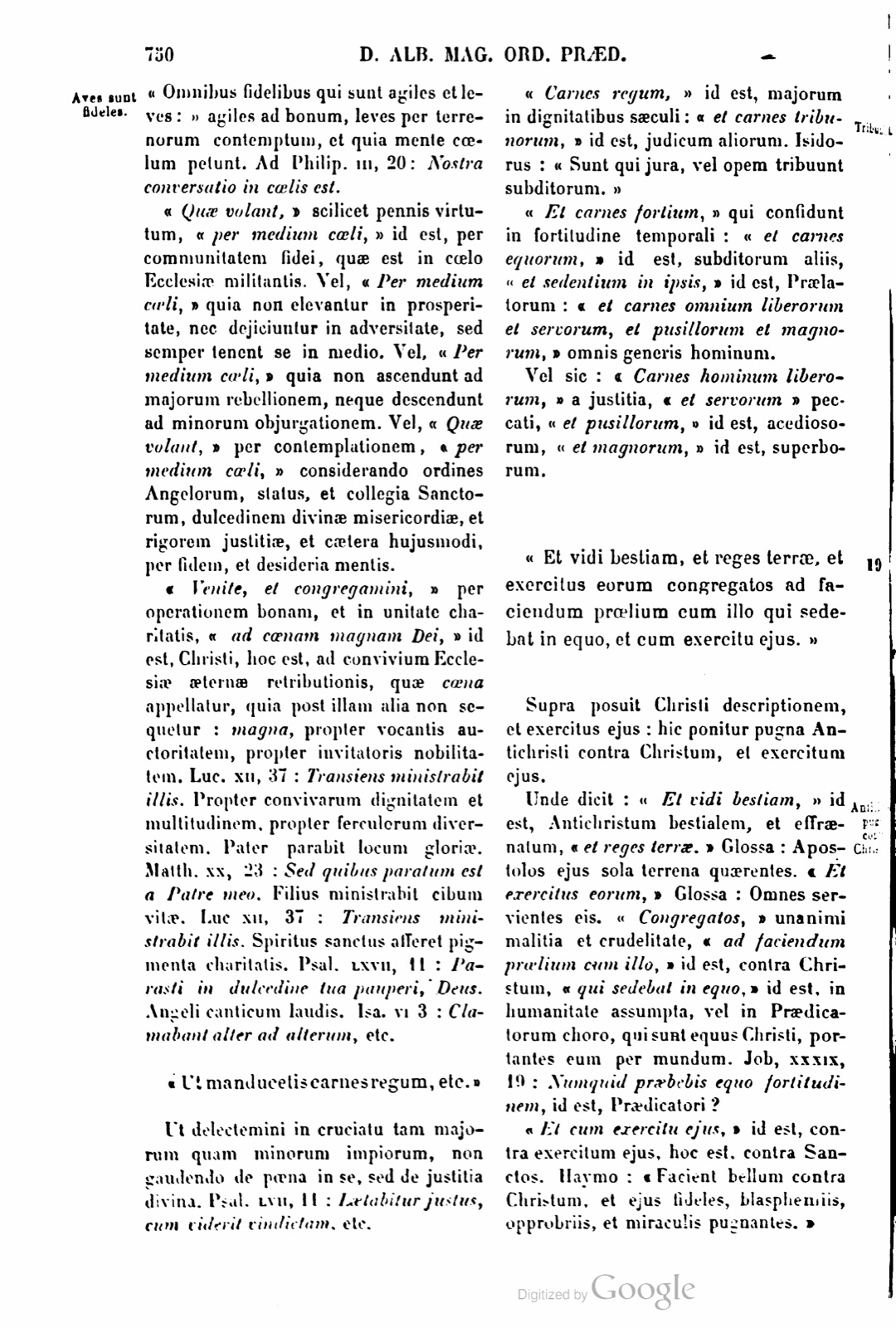
[Marginal label: Damnatio Antichristi.] Hic ostenditur damnatio Antichristi, et suorum. Et dicuntur tria. Primo, determinatur damnatio Antichristi, et suorum. Secundo, damnatio aliorum malorum, ibi, v. 21: "Et caeteri." Tertio, pro damnatione omnium malorum ponitur exsultatio Sanctorum, ibidem, "Et omnes aves." In prima parte dicuntur duo. Primo, ponitur apprehensio Antichristi, et suorum. Secundo damnatio eorum, ibi, "Vivi missi sunt." Dicit ergo: "Et apprehensa est bestia," id est, apprehendetur: praeteritum pro futuro, id est, aeternaliter punietur. "Et cum illa pseudopropheta," id est, Praedicatores Antichristi, qui bona futura promittebant servis Antichristi: "qui fecit signa coram ipso," id est, quicumque fecit signa coram Antichristo: "quibus seduxit," id est, seorsum a via fidei duxit, "eos qui acceperunt characterem bestiae," id est, conformaverunt se Antichristo in vita et doctrina: vel qui crediderunt in eum. "Et qui adoraverunt imaginem ejus," id est, illos qui eum imitabantur. Ad litteram, statuam. "Vivi missi sunt hi duo," scilicet caput, et corpus: pseudopropheta, et Antichristus: vel diabolus, et omnes mali: "in stagnum ignis ardentis et sulphure," id est, tormentum inferni stabile et immobile, ut stagnum, plenum ardore et foetore. [Marginal label: Poena inferni dicitur stagnum, ignis, sulphur.] NOTA: Poena inferni dicitur stagnum, quia demergit illos qui voluptatem hujus mundi quasi aquam biberunt: item, propter stabilitatem et immobilitatem suam: ignis, quia exurit illos qui in foetore luxuriae vixerunt. Unde, infra, XXI, 8: Pars illorum erit in stagno ardenti igne, et sulphure.
"Et caeteri occisi sunt in gladio, etc." "Et caeteri," scilicet sequaces Antichristi, qui per praedicationem pseudoapostolorum seducti sunt, "occisi sunt," id est, occidentur, "in gladio," id est, in ictu gladii, "sedentis super equum," id est, in sententia Christi, "qui," scilicet gladius, "procedit," id est, procedet in die judicii, "de ore ipsius." Supra, v. 15, idem de hoc. Job, XIX, 29: Fugite a facie gladii, etc. [Marginal label: Sententia Christi dicitur gladius.] NOTA: Sententia Christi dicitur gladius propter duo: quia separat a vita aeterna, et quia vulnus infligit poenae aeternae: quoniam gladius separat, et vulnerat. "Et omnes aves saturatae sunt carnibus eorum, etc." Hic ostenditur exsultatio Sanctorum de visa poena malorum. Unde dicit: "Et omnes aves," id est, omnes Sancti qui elevantur a terra pennis virtutum, et cum hoc conversantur in coelis. Ad Philip. III, 20: Nostra conversatio in coelis est. "Saturatae sunt," id est, delectati sunt in cordibus suis, "carnibus eorum," videndo poenas inflictas pro opere carnali. NOTA: Non est intelligendum, quod delectentur in poena, ut poena est, sed ut vindicta est, exiens a divina justitia. Psal. LVII, 11: Laetabitur justus, cum viderit vindictam. Item, gaudebunt tali poena visa, quia eam evaserunt divina misericordia. Unde Haymo: "Eo internae contemplationis dulcedine interius satiantur electi, quo reproborum tormenta exterius conspiciunt, quae divina misericordia evaserunt."
[Marginal label: The damnation of Antichrist.] Here the damnation of Antichrist and of his own is shown. And three things are said. First, the damnation of Antichrist and of his own is determined. Secondly, the damnation of the other evil persons, there at verse 21: "And the rest." Thirdly, for the damnation of all the evil, the exultation of the Saints is set down, in the same place, "And all the birds." In the first part two things are said. First, the seizure of Antichrist and of his own is set down. Secondly, their damnation, there, "They were cast alive." Therefore he says: "And the beast was seized," that is, will be seized; the past is put for the future, that is, he will be punished eternally. "And with it the false prophet," that is, the Preachers of Antichrist, who were promising future goods to the servants of Antichrist; "who performed signs before him," that is, whoever performed signs before Antichrist; "by which he seduced," that is, led apart from the way of faith, "those who received the character of the beast," that is, conformed themselves to Antichrist in life and doctrine; or who believed in him. "And those who adored his image," that is, those who imitated him; according to the letter, a statue. "These two were cast alive," namely head and body: the false prophet and Antichrist; or the devil and all the evil: "into the pool of fire burning with sulfur," that is, the stable and immovable torment of hell, like a pool, full of heat and stench. [Marginal label: The punishment of hell is called pool, fire, sulfur.] NOTE: The punishment of hell is called a pool because it submerges those who drank the pleasure of this world as if water; likewise because of its stability and immovability; fire, because it burns those who lived in the stench of lust. Hence below, 21:8: Their portion will be in the pool burning with fire and sulfur.
"And the rest were slain by the sword, etc." "And the rest," namely followers of Antichrist, who were seduced through the preaching of false apostles, "were slain," that is, will be slain, "by the sword," that is, by the blow of the sword, "of the one sitting on the horse," that is, by the sentence of Christ, "which," namely the sword, "proceeds," that is, will proceed on the day of judgment, "from his mouth." Above, verse 15, the same is said about this. Job 19:29: Flee from the face of the sword, etc. [Marginal label: The sentence of Christ is called a sword.] NOTE: The sentence of Christ is called a sword for two reasons: because it separates from eternal life, and because it inflicts the wound of eternal punishment, since a sword separates and wounds. "And all the birds were filled with their flesh, etc." Here the exultation of the Saints over the seen punishment of the evil is shown. Hence he says: "And all the birds," that is, all the Saints who are lifted from earth by the wings of virtues and, with this, have their conversation in heaven. Philippians 3:20: Our conversation is in heaven. "Were filled," that is, were delighted in their hearts, "with their flesh," by seeing the punishments inflicted for carnal work. NOTE: It must not be understood that they are delighted in punishment as it is punishment, but as it is vengeance coming forth from divine justice. Psalm 57:11: The just person will rejoice when he has seen vengeance. Likewise, they will rejoice when such punishment is seen, because they escaped it by divine mercy. Hence Haymo says: "The elect are inwardly satisfied by that sweetness of internal contemplation by which they outwardly behold the torments of the reprobate, which they escaped by divine mercy."
If a page does not appear, its photograph has not been uploaded yet.