Works › Commentary on the Apocalypse of Blessed John
Volume 38 · pp. 657–658
The Woman Flees and Michael Battles
A marker with ≈ is an approximate page boundary, placed by measure of the text; the page photographs remain the authority. In the paired views, clicking a page marker brings that page into view.
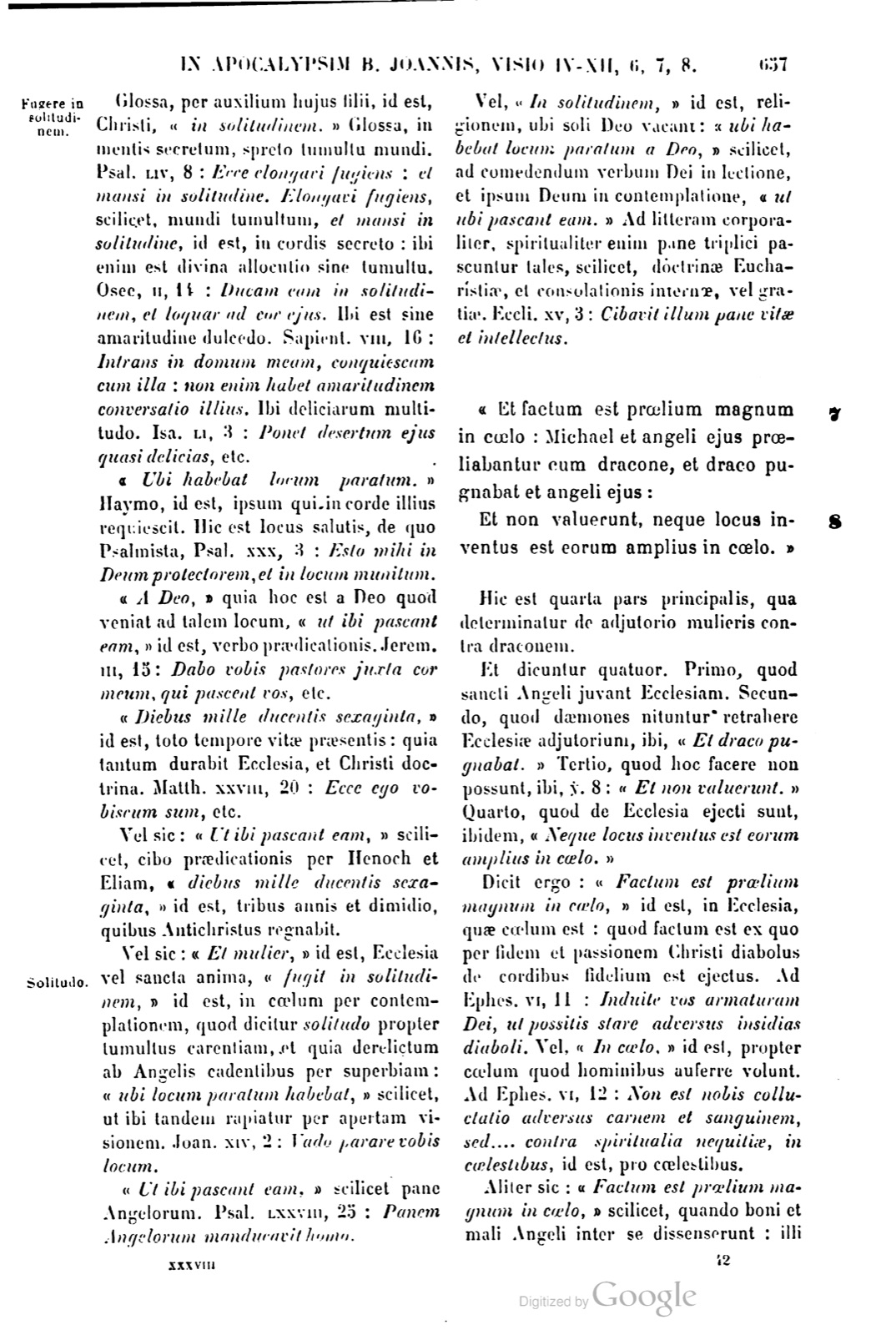
Glossa, per auxilium hujus filii, id est, Christi, « in solitudinem. » Glossa, in mentis secretum, spreto tumultu mundi. Psal. LIV, 8: Ecce elongavi fugiens: et mansi in solitudine. Elongavi fugiens, scilicet, mundi tumultum, et mansi in solitudine, id est, in cordis secreto: ibi enim est divina allocutio sine tumultu. Osee, II, 14: Ducam eam in solitudinem, et loquar ad cor ejus. Ibi est sine amaritudine dulcedo. Sapient. VIII, 16: Intrans in domum meam, conquiescam cum illa: non enim habet amaritudinem conversatio illius. Ibi deliciarum multitudo. Isa. LI, 3: Ponet desertum ejus quasi delicias, etc.
« Ubi habebat locum paratum. » Haymo, id est, ipsum qui in corde illius requiescit. Hic est locus salutis, de quo Psalmista, Psal. XXX, 3: Esto mihi in Deum protectorem, et in locum munitum.
« A Deo, » quia hoc est a Deo quod veniat ad talem locum, « ut ibi pascant eam, » id est, verbo praedicationis. Jerem. III, 15: Dabo vobis pastores juxta cor meum, qui pascent vos, etc.
« Diebus mille ducentis sexaginta, » id est, toto tempore vitae praesentis: quia tantum durabit Ecclesia, et Christi doctrina. Matth. XXVIII, 20: Ecce ego vobiscum sum, etc.
Vel sic: « Ut ibi pascant eam, » scilicet, cibo praedicationis per Henoch et Eliam, « diebus mille ducentis sexaginta, » id est, tribus annis et dimidio, quibus Antichristus regnabit.
Vel sic: « Et mulier, » id est, Ecclesia vel sancta anima, « fugit in solitudinem, » id est, in caelum per contemplationem, quod dicitur solitudo propter tumultus carentiam, et quia derelictum ab Angelis cadentibus per superbiam: « ubi locum paratum habebat, » scilicet, ut ibi tandem rapiatur per apertam visionem. Joan. XIV, 2: Vado parare vobis locum.
« Ut ibi pascant eam, » scilicet pane Angelorum. Psal. LXXVIII, 25: Panem Angelorum manducavit homo.
Vel, « In solitudinem, » id est, religionem, ubi soli Deo vacant: « ubi habebat locum paratum a Deo, » scilicet, ad comedendum verbum Dei in lectione, et ipsum Deum in contemplatione, « ut ibi pascant eam. » Ad litteram corporaliter, spiritualiter enim pane triplici pascuntur tales, scilicet, doctrinae Eucharistiae, et consolationis internae, vel gratiae. Eccli. XV, 3: Cibavit illum pane vitae et intellectus.
7. « Et factum est praelium magnum in caelo: Michael et angeli ejus praeliabantur cum dracone, et draco pugnabat et angeli ejus:
8. Et non valuerunt, neque locus inventus est eorum amplius in caelo. »
Hic est quarta pars principalis, qua determinatur de adjutorio mulieris contra draconem.
Et dicuntur quatuor. Primo, quod sancti Angeli juvant Ecclesiam. Secundo, quod daemones nituntur retrahere Ecclesiae adjutorium, ibi, « Et draco pugnabat. » Tertio, quod hoc facere non possunt, ibi, V. 8: « Et non valuerunt. » Quarto, quod de Ecclesia ejecti sunt, ibidem, « Neque locus inventus est eorum amplius in caelo. »
The Gloss says, by the help of this son, that is, of Christ, “into solitude.” The Gloss says: into the secret of the mind, with the tumult of the world despised. Psalm LIV, 8: Behold, I fled far away, and I remained in solitude. “I fled far away,” namely from the tumult of the world, “and I remained in solitude,” that is, in the secrecy of the heart; for there divine speech is without tumult. Hosea II, 14: I will lead her into solitude, and I will speak to her heart. There there is sweetness without bitterness. Wisdom VIII, 16: Entering into my house, I shall rest with her, for her conversation has no bitterness. There is a multitude of delights there. Isaiah LI, 3: He will set her desert like delights, etc.
“Where she had a place prepared.” Haymo says, that is, the very one who rests in her heart. This is the place of salvation, concerning which the Psalmist says, Psalm XXX, 3: Be to me a protector God, and a fortified place.
“By God,” because this is from God, that she should come to such a place, “so that there they may feed her,” that is, with the word of preaching. Jeremiah III, 15: I will give you shepherds according to my heart, who will feed you, etc.
“For one thousand two hundred sixty days,” that is, for the whole time of the present life, because so long the Church and the doctrine of Christ will endure. Matthew XXVIII, 20: Behold, I am with you, etc.
Or thus: “So that there they may feed her,” namely with the food of preaching through Enoch and Elijah, “for one thousand two hundred sixty days,” that is, for three years and a half, during which Antichrist will reign.
Or thus: “And the woman,” that is, the Church or the holy soul, “fled into solitude,” that is, into heaven through contemplation, which is called solitude because of the lack of tumults and because it was deserted by the Angels falling through pride; “where she had a prepared place,” namely so that there at last she may be snatched up through open vision. John XIV, 2: I go to prepare a place for you.
“So that there they may feed her,” namely with the bread of Angels. Psalm LXXVIII, 25: Man ate the bread of Angels.
Or, “Into solitude,” that is, into religion, where they are free for God alone; “where she had a place prepared by God,” namely for eating the word of God in reading, and God himself in contemplation, “so that there they may feed her.” Literally, bodily; for spiritually such persons are fed with threefold bread, namely of Eucharistic doctrine, and of inner consolation, or of grace. Ecclesiasticus XV, 3: He fed him with the bread of life and understanding.
7. “And a great battle was made in heaven: Michael and his angels were battling with the dragon, and the dragon was fighting, and his angels.
8. And they did not prevail, nor was their place found any longer in heaven.”
This is the fourth principal part, in which the help of the woman against the dragon is determined.
And four things are said. First, that the holy Angels help the Church. Second, that demons strive to draw back the help of the Church, there, “And the dragon was fighting.” Third, that they cannot do this, there, V. 8: “And they did not prevail.” Fourth, that they were cast out from the Church, in the same place, “Nor was their place found any longer in heaven.”
Dicit ergo: « Factum est praelium magnum in caelo, » id est, in Ecclesia, quae caelum est: quod factum est ex quo per fidem et passionem Christi diabolus de cordibus fidelium est ejectus. Ad Ephes. VI, 11: Induite vos armaturam Dei, ut possitis stare adversus insidias diaboli. Vel, « In caelo, » id est, propter caelum quod hominibus auferre volunt. Ad Ephes. VI, 12: Non est nobis colluctatio adversus carnem et sanguinem, sed... contra spiritualia nequitiae, in caelestibus, id est, pro caelestibus.
Aliter sic: « Factum est praelium magnum in caelo, » scilicet, quando boni et mali Angeli inter se dissenserunt: illi voluerunt exaltari, isti voluerunt humiliari.
Unde sequitur: « Michael, » qui est princeps Ecclesiae specialiter et custos, « et Angeli ejus, » id est, minores, qui sunt singulis hominibus deputati, et sunt sub illo. Vel, « Angeli ejus, » id est, concives ejus, « praeliabantur, » pro Ecclesia orando, adjutoria ministrando, bona desideria inspirando, impetum daemonum reprimendo, « cum dracone, » id est, contra Luciferum principem daemonum.
« Et draco pugnabat et angeli ejus, »
Supple, pugnabant contra Ecclesiam, scilicet noxia consulendo, perversa suggerendo, bonorum Angelorum exercitium impugnando.
« Et non valuerunt. »
Supple, draco et angeli ejus, removere suffragia bonorum Angelorum.
« Neque locus inventus est eorum amplius in caelo, » id est, in Ecclesia. Quoad bonos, dicit Glossa. Sed contra: Post baptismum multi peccant, et sic decipiuntur a diabolo. Responsio Haymonis: « Licet videantur praevalere ad tempus: tamen in eos qui ad vitam praedestinati sunt, non praevalent: quia non regnat peccatum in eis. Tolle ergo regnum peccati, et non invenietur locus diabolo. » Item, in malis non habet diabolus locum et quietam mansionem, sicut habebat ante Christi adventum: frequenter enim inquietatur a Praedicatoribus.
Sensus ergo est: « Neque locus inventus est eorum amplius in caelo, » id est, in Ecclesia quoad Sanctos: quia licet per ipsos quandoque transeant tentando, non tamen in eis habent locum, id est, mansionem.
Vel potest dici, quod illud quod dicitur hic: « Et non valuerunt, » refertur ad illum statum in fine mundi: quoniam in fine certaminis succumbent: « neque locus eorum amplius inventus est in caelo, » quia ultra non habebunt tempus tentandi: unde funditus erunt a fidelibus exclusi.
Therefore he says: “A great battle was made in heaven,” that is, in the Church, which is heaven; this has been done from the time when through the faith and Passion of Christ the devil was cast out from the hearts of the faithful. Ephesians VI, 11: Put on the armor of God, that you may be able to stand against the snares of the devil. Or, “In heaven,” that is, on account of the heaven that they wish to take away from human beings. Ephesians VI, 12: Our wrestling is not against flesh and blood, but... against spiritual wickedness in heavenly places, that is, for heavenly things.
Otherwise thus: “A great battle was made in heaven,” namely when the good and evil Angels dissented among themselves: those wished to be exalted, these wished to be humbled.
Hence there follows: “Michael,” who is especially the prince and guardian of the Church, “and his Angels,” that is, the lesser ones, who are deputed to individual human beings and are under him. Or, “his Angels,” that is, his fellow citizens, “were battling,” by praying for the Church, by administering helps, by inspiring good desires, by restraining the assault of demons, “with the dragon,” that is, against Lucifer the prince of demons.
“And the dragon was fighting, and his angels,”
Supply: they were fighting against the Church, namely by counseling harmful things, suggesting perverse things, and attacking the exercise of good Angels.
“And they did not prevail.”
Supply: the dragon and his angels, to remove the suffrages of the good Angels.
“Nor was their place found any longer in heaven,” that is, in the Church. With respect to the good, says the Gloss. But on the contrary: after baptism many sin, and thus are deceived by the devil. The response of Haymo: “Although they seem to prevail for a time, nevertheless they do not prevail against those who are predestined to life, because sin does not reign in them. Therefore take away the reign of sin, and a place will not be found for the devil.” Likewise, in the evil the devil does not have a place and a quiet dwelling, as he had before the advent of Christ, for he is frequently troubled by Preachers.
Therefore the sense is: “Nor was their place found any longer in heaven,” that is, in the Church with respect to the Saints, because although at times they pass through them by tempting, nevertheless they do not have a place in them, that is, a dwelling.
Or it can be said that what is said here, “And they did not prevail,” is referred to that state at the end of the world, since they will succumb at the end of the contest; “nor was their place found any longer in heaven,” because they will no longer have time for tempting; hence they will be entirely excluded from the faithful.
If a page does not appear, its photograph has not been uploaded yet.