Works › Commentary on the Apocalypse of Blessed John
Volume 38 · pp. 654–656
The Red Dragon and the Male Child
A marker with ≈ is an approximate page boundary, placed by measure of the text; the page photographs remain the authority. In the paired views, clicking a page marker brings that page into view.
3. « Et visum est aliud signum in caelo: et ecce draco magnus rufus. »
Hic describitur draco, id est, diabolus qui cum muliere, id est, Ecclesia est pugnaturus.
Et primo, describitur ab his quae in se conveniunt. Secundo, ab his per quos impugnat Ecclesiam Sanctorum, ibi, « Habens septem capita. »
Illa quae ei in se conveniunt, sunt tria. Primum est astutia: unde dicitur « draco. » Secundum est potentia: unde dicitur « magnus. » Tertium saevitia: unde dicitur « rufus. »
Dicit ergo: « Et visum est aliud signum, » scilicet, a primo, et illi contrarium. Et dicitur aliud: quia primum fuit signum salutis, et clementiae: secundum est perditionis, et malitiae: illud fuit signum bonitatis Dei, et misericordiae: hoc est signum malitiae diaboli, et invidiae.
« In caelo, » id est, in Ecclesia.
« Et ecce. » Nota: Ecce est adverbium demonstrandi, in quo notatur quod semper praesto est ad nocendum.
« Draco, » id est, diabolus qui dicitur draco propter astutiam et calliditatem nocendi: « magnus, » propter potentiam. Job, XLI, 24: Non est super terram potestas quae comparetur ei, etc.
Et « rufus, » propter saevitiam. Jerem. VI, 23: Crudelis est, et non miserebitur. Vel, « Rufus, » propter homicidium. Joan. VIII, 44: Ille homicida erat ab initio, et adhuc sitit sanguinem.
Hic quaeritur, Quomodo dicitur esse in caelo hoc signum, id est, in Ecclesia?
Responsio Haymonis: « In caelo videtur, non quod caelum possideat, sed quod caelo adversetur. »
« Habens capita septem, et cornua decem: et in capitibus ejus diademata septem:
4. Et cauda ejus trahebat tertiam partem stellarum caeli, et misit eas in terram. »
Unde dicit: « Habens capita septem, » id est, septem spiritus malos contra septem dona Spiritus sancti. Matth. XII, 45: Tunc vadit, et assumit septem alios spiritus nequiores se. Hi sunt hujusmodi: spiritus insipientiae contra sapientiam, spiritus stultitiae contra intellectum, spiritus imprudentiae contra consilium, spiritus ignaviae contra fortitudinem, spiritus ignorantiae contra scientiam, spiritus impietatis contra pietatem, spiritus temeritatis contra timorem. His impugnat diabolus Ecclesiam spiritualiter et aperte.
Et subdit ea quibus impugnat eam corporaliter: unde dicit: « Et cornua decem, » id est, principes quibus diabolus extollitur, et impugnat Ecclesiam quasi cornibus. Daniel. VII, 24: Cornua decem ipsius regni, decem reges erunt.
Et quia diabolus plures vincet in bello spirituali, quam in corporali, ideo subdit: « Et in capitibus suis septem diademata, » id est, septem victoriae quas obtinet de succumbentibus in bello spirituali, vel septem vitia principalia.
3. “And another sign was seen in heaven: and behold, a great red dragon.”
Here the dragon is described, that is, the devil, who is going to fight with the woman, that is, with the Church.
And first he is described from those things that belong to him in himself. Second, from those through whom he attacks the Church of the Saints, there, “Having seven heads.”
Those things that belong to him in himself are three. The first is craftiness; hence he is called “dragon.” The second is power; hence he is called “great.” The third is savagery; hence he is called “red.”
Therefore he says: “And another sign was seen,” namely different from the first and contrary to it. And it is called another because the first was a sign of salvation and clemency; the second is a sign of perdition and malice; that was a sign of the goodness of God and of mercy; this is a sign of the malice of the devil and of envy.
“In heaven,” that is, in the Church.
“And behold.” Note: Behold is an adverb of demonstrating, in which it is noted that he is always ready at hand for doing harm.
“A dragon,” that is, the devil, who is called a dragon because of craftiness and cunning in harming; “great,” because of power. Job XLI, 24: There is no power upon earth that can be compared to him, etc.
And “red,” because of savagery. Jeremiah VI, 23: He is cruel and will not have mercy. Or, “red,” because of homicide. John VIII, 44: He was a murderer from the beginning, and still thirsts for blood.
Here it is asked: How is this sign said to be in heaven, that is, in the Church?
The response of Haymo: “He is seen in heaven, not because he possesses heaven, but because he is opposed to heaven.”
“Having seven heads and ten horns; and on his heads seven diadems.
4. And his tail was drawing the third part of the stars of heaven, and he cast them onto the earth.”
Hence he says: “Having seven heads,” that is, the seven evil spirits opposed to the seven gifts of the Holy Spirit. Matthew XII, 45: Then he goes and takes seven other spirits more wicked than himself. These are of this sort: the spirit of foolishness against wisdom, the spirit of stupidity against understanding, the spirit of imprudence against counsel, the spirit of cowardice against fortitude, the spirit of ignorance against knowledge, the spirit of impiety against piety, the spirit of rashness against fear. With these the devil attacks the Church spiritually and openly.
And he adds those things with which he attacks her bodily; hence he says: “And ten horns,” that is, princes through whom the devil is lifted up and attacks the Church as if with horns. Daniel VII, 24: The ten horns of that kingdom will be ten kings.
And because the devil will conquer more in spiritual warfare than in bodily warfare, therefore he adds: “And on his heads seven diadems,” that is, seven victories that he obtains over those succumbing in spiritual war, or the seven principal vices.
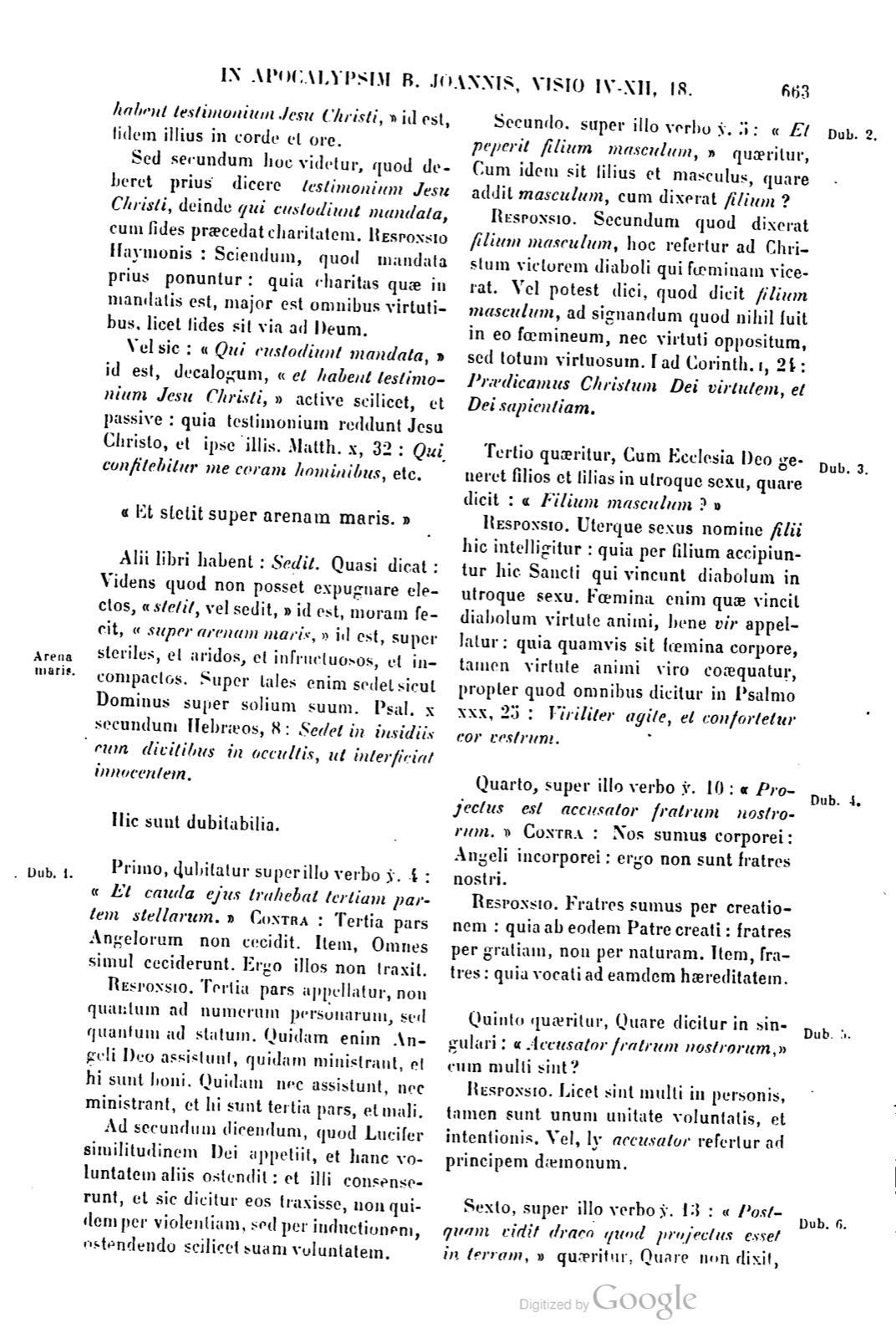
Vel sic: « Habens septem capita, » id est, omnes principes hujus mundi per quos operatur, « et cornua decem. » Glossa, id est, regna, vel divitias quibus principes decalogum legis impugnant. Et dicuntur divitiae cornua, quia per has homines elevantur in superbiam.
« Et in capitibus suis, » id est, in principibus saeculi, « septem diademata, » id est, universalis victoria de submersis in bello.
« Et cauda ejus, etc. »
Nota: Per caudam ejus signantur hypocritae, vel falsi Praedicatores. Nam sicut turpitudo animalis per caudam tegitur, sic diabolus per illos tegit suam malitiam.
Et est sensus: « Et cauda ejus, » id est, deceptio simulata, vel hypocrisis, « trahebat. » Glossa, de fide ad infidelitatem, « tertiam partem stellarum caeli, » id est, illorum qui sunt in Ecclesia constituti.
Nota: Quidam sunt in Ecclesia stellae lucentes vita, et doctrina, ut Praedicatores boni: quidam vita, et non doctrina, sicut simplices: multi quidem doctrina, et non vita, ut Praelati, et praedicatores mali: et isti trahuntur cauda diaboli. Job, III, 9: Obtenebrentur stellae caligine ejus, id est, diaboli.
« Et misit eas in terram, » id est, involvit in terrenorum amorem.
Vel sic: « Et cauda ejus, » id est, conversio diaboli super bona naturalia per quae superbivit, quae cauda dicuntur, quia vilia sunt respectu gratuitorum: « trahebat tertiam partem stellarum caeli, » id est, Angelorum qui cum Lucifero ceciderunt.
Nota: Prima pars Angelorum sunt assistentes. Secunda pars, boni ministrantes. Tertia pars, qui nec assistere Deo voluerunt, nec ministrare propter Deum, sed Lucifero consenserunt: et dicitur istos trahere cauda sua, quia ei consenserunt.
« Et misit eas in terram, » id est, in istum aerem caliginosum, in quo usque in diem judicii sunt ad electorum probationem.
Et dicit: « Trahebat, » quia quodammodo fuit motus violentus, et quasi contra naturam: magis enim naturale est illis converti ad suum Creatorem, quam consentire in diaboli suggestionem.
« Et draco stetit ante mulierem quae erat paritura, ut cum peperisset, filium ejus devoraret.
5. Et peperit filium masculum, qui recturus erat omnes gentes in virga ferrea. »
Hic est tertia pars, in qua agitur de praeparatione diaboli ad pugnam contra Ecclesiam.
Et dicuntur sex. Primo, ostenditur diaboli diligentia ad nocendum, ibi, « Stetit. » Secundo, status mulieris, ibi, « Quae erat paritura. » Tertio, diaboli mala intentio, ibi, « Ut cum peperisset. » Quarto, mulieris partus, ibi, V. 5: « Et peperit masculum. » Quinto, conservatio ejus, ibidem, « Et raptus est filius. » Sexto, quod mulier per auxilium filii liberatur, ibi, V. 6: « Et mulier fugit. »
Or thus: “Having seven heads,” that is, all the princes of this world through whom he works, “and ten horns.” The Gloss says: that is, kingdoms or riches by which princes attack the Decalogue of the law. And riches are called horns because through them human beings are raised up into pride.
“And on his heads,” that is, in the princes of the age, “seven diadems,” that is, universal victory over those submerged in battle.
“And his tail, etc.”
Note: By his tail hypocrites or false Preachers are signified. For as the shamefulness of an animal is covered by the tail, so the devil through them covers his malice.
And the sense is: “And his tail,” that is, simulated deception, or hypocrisy, “was drawing.” The Gloss says, from faith to unbelief, “the third part of the stars of heaven,” that is, of those who are established in the Church.
Note: Some in the Church are stars shining in life and doctrine, as good Preachers; some in life and not doctrine, as simple people; many indeed in doctrine and not in life, as evil Prelates and preachers; and these are drawn by the tail of the devil. Job III, 9: Let the stars be darkened by his mist, that is, by the devil’s.
“And he cast them onto the earth,” that is, he wrapped them in love of earthly things.
Or thus: “And his tail,” that is, the devil’s turning toward natural goods through which he became proud, which are called a tail because they are vile in respect to gratuitous goods; “was drawing the third part of the stars of heaven,” that is, of the Angels who fell with Lucifer.
Note: The first part of the Angels are those assisting. The second part, the good ministering ones. The third part, those who neither wished to stand by God nor to minister on account of God, but consented to Lucifer; and he is said to draw these with his tail because they consented to him.
“And he cast them onto the earth,” that is, into this gloomy air, in which they remain until the day of judgment for the proving of the elect.
And he says, “was drawing,” because in a certain way it was a violent movement and, as it were, against nature; for it is more natural for them to be converted to their Creator than to consent to the devil’s suggestion.
“And the dragon stood before the woman who was about to give birth, so that when she had given birth he might devour her son.
5. And she brought forth a male son, who was to rule all nations with an iron rod.”
This is the third part, in which the preparation of the devil for battle against the Church is treated.
And six things are said. First, the devil’s diligence in doing harm is shown, there, “He stood.” Second, the condition of the woman, there, “Who was about to give birth.” Third, the evil intention of the devil, there, “So that when she had given birth.” Fourth, the childbirth of the woman, there, V. 5: “And she brought forth a male.” Fifth, his preservation, in the same place, “And the son was snatched away.” Sixth, that the woman is freed through the help of the son, there, V. 6: “And the woman fled.”
Dicit ergo: « Et draco, » supple, sic armatus potentia, astutia, saevitia, « stetit: » in quo notatur sollicitudo ejus ad nocendum, et diligentia: « ante mulierem, » id est, contra Ecclesiam. Genes. III, 15: Inimicitias ponam inter te et mulierem.
« Quae erat paritura, » scilicet aliquos in Christi fide et amore: « ut cum peperisset, filium ejus devoraret, » id est, traheret ad peccatum, et postea ad infernum. Hoc est enim quod maxime intendit diabolus, scilicet, tentare novitios et infirmos, et si non potest partum boni operis impedire, tamen nititur per vanam gloriam devorare. Zachar. III, 1: Satan stabat a dextris ejus, scilicet Jesu, sacerdotis magni, ut adversaretur ei.
« Et peperit filium, »
Id est, Christum quem solum peperit in Virgine secundum carnem, et parit quotidie per fidem in cordibus auditorum.
« Masculum, » id est, fortem, et virtuosum ad vincendum diabolum: « qui recturus erat omnes gentes in virga ferrea, » id est, in inflexibili justitia.
Vel, Per virgam intelligitur misericordia, per ferream justitia. Est ergo sensus: « Qui recturus erat omnes gentes in virga, » per misericordiam, « ferrea, » per justitiam. Quia virga, ideo corripit. Psal. LXXXVIII, 33: Visitabo in virga iniquitates eorum. Quia ferrea, ideo malos confringit. Psal. II, 9: Reges eos in virga ferrea, et tamquam vas figuli confringes eos.
« Et raptus est filius ejus ad Deum, et ad thronum ejus:
6. Et mulier fugit in solitudinem, ubi habebat locum paratum a Deo, ut ibi pascant eam diebus mille ducentis sexaginta. »
Hic ostenditur, quod filio nato, diabolus nocere non potest, quia ad Deum raptus est. Et potest exponi de Christo et membris ejus.
De Christo sic: « Et raptus est filius ad Deum, » id est, ad unionem Dei in quantum homo, « et ad thronum ejus, » id est, aequalitatem potestatis ut cum Patre regat et judicet. Item, « Raptus est filius ejus, » in Ascensione, « ad Deum, » id est, ad aequalitatem judiciariae potestatis: et est intelligendum de raptu quantum ad manifestationem, non secundum rei veritatem, cum sit ab aeterno aequalis et consubstantialis Patri.
De membris exponitur sic: « Et raptus est ad Deum, » per fidem, « filius ejus, » scilicet Ecclesiae, « et ad thronum ejus, » per charitatem et spem.
« Et mulier fugit, etc. »
Therefore he says: “And the dragon,” supply, thus armed with power, craftiness, and savagery, “stood”; in this his solicitude and diligence for doing harm are noted: “before the woman,” that is, against the Church. Genesis III, 15: I will put enmities between you and the woman.
“Who was about to give birth,” namely to some persons in Christ’s faith and love; “so that when she had given birth, he might devour her son,” that is, he might draw him to sin and afterward to hell. For this is what the devil chiefly intends, namely to tempt novices and the weak, and if he cannot impede the birth of a good work, nevertheless he strives to devour it through vainglory. Zechariah III, 1: Satan was standing at his right hand, namely of Jesus, the great priest, so that he might oppose him.
“And she brought forth a son,”
That is, Christ, whom she alone brought forth in the Virgin according to the flesh, and whom she daily brings forth through faith in the hearts of hearers.
“Male,” that is, strong and virtuous for conquering the devil; “who was to rule all nations with an iron rod,” that is, with inflexible justice.
Or, by the rod mercy is understood, by iron justice. Therefore the sense is: “Who was to rule all nations with a rod,” through mercy, “iron,” through justice. Because it is a rod, therefore he corrects. Psalm LXXXVIII, 33: I will visit their iniquities with a rod. Because it is iron, therefore he breaks the evil. Psalm II, 9: You shall rule them with an iron rod, and like a potter’s vessel you shall break them.
“And her son was snatched away to God and to his throne.
6. And the woman fled into solitude, where she had a place prepared by God, so that there they might feed her for one thousand two hundred sixty days.”
Here it is shown that, once the son was born, the devil cannot harm him, because he was snatched away to God. And this can be expounded of Christ and of his members.
Of Christ thus: “And the son was snatched away to God,” that is, to union with God insofar as he is man, “and to his throne,” that is, to equality of power so that he may rule and judge with the Father. Likewise, “Her son was snatched away,” in the Ascension, “to God,” that is, to equality of judicial power; and this is to be understood of the rapture according to manifestation, not according to the truth of the thing, since he is from eternity equal and consubstantial with the Father.
Of the members it is expounded thus: “And he was snatched away to God,” through faith, “her son,” namely the son of the Church, “and to his throne,” through charity and hope.
“And the woman fled, etc.”
If a page does not appear, its photograph has not been uploaded yet.