Works › Commentary on the Apocalypse of Blessed John
Volume 38 · pp. 645–649
Chapter XI Continuation and Doubts
A marker with ≈ is an approximate page boundary, placed by measure of the text; the page photographs remain the authority. In the paired views, clicking a page marker brings that page into view.
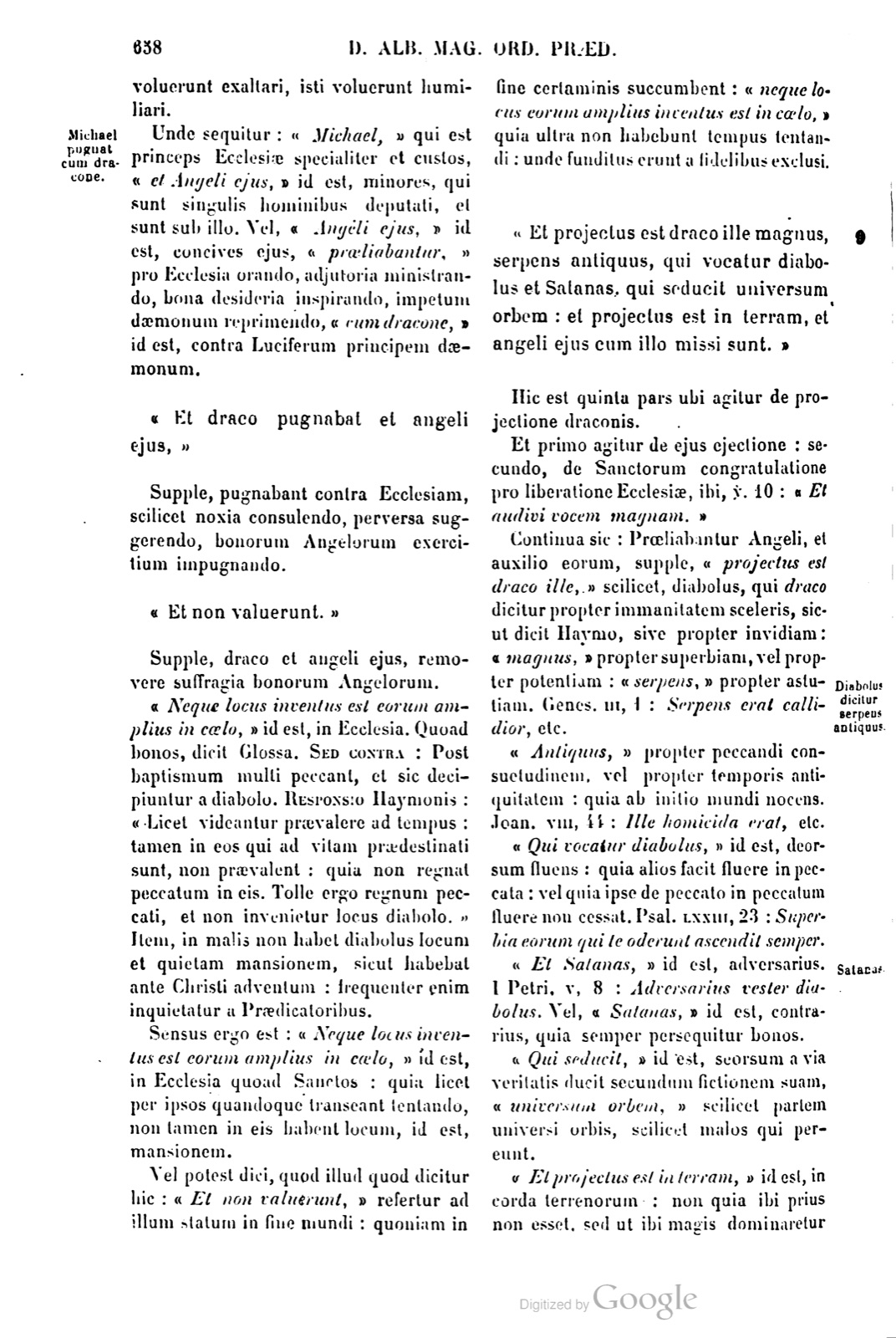
irreparabiliter. Vel, « Cecidit. » Glossa, in poenas, vel de Ecclesia.
« Et occisa sunt, » scilicet morte prima culpae, et secunda poenae, « in terraemotu, » scilicet supra dicto. Glossa: Omnino in infernum detrusi, et postea non resipuerunt. « Nomina hominum septem millia, » id est, omnes reprobi. Glossa: « Omnes perfecti in malitia. » Per nomen mali, per septem universi, per mille perfecti: unde omnes septem peccatis irretiti. Et dicit: « Nomina, » quia mali tantum habent nomen, non rem. Supra, III, 1: Nomen habes quod vivas, et mortuus es.
« Et reliqui, » id est, Sancti, « in timorem missi sunt, » id est, reverentiam Dei. Psal. XVIII, 10: Timor Domini sanctus, etc. Vel, « In timorem, » ne cadant in peccatis. I ad Corinth. X, 12: Qui se existimat stare, videat ne cadat.
« Et dederunt gloriam Deo caeli, » id est, agentes gratias de evasione poenarum, de exaltatione humilium, de depressione superborum. Luc. I, 46 et 52: Magnificat anima mea Dominum, etc. Quare? quia deposuit potentes de sede, et exaltavit humiles.
Vel, « Dederunt gloriam Deo caeli. » Glossa: « Nihil sibi appropriantes. » Psal. CXIII, 1: Non nobis, Domine, non nobis.
« Vae secundum abiit, etc. »
« Vae secundum, » id est, tribulatio inferenda Sanctis tempore Antichristi, « abiit, » in narratione. Vel, « Abiit, » id est, transibit celeriter.
« Et ecce vae tertium, » id est, pavor et tribulatio judicii futuri, « veniet cito, » quia post mortem illorum instabit judicium.
15. « Et septimus Angelus tuba cecinit: et factae sunt voces magnae in caelo, dicentes: Factum est regnum hujus mundi, Domini nostri et Christi ejus, et regnabunt in saecula saeculorum. Amen.
16. Et viginti quatuor seniores, qui in conspectu Dei sedent in sedibus suis, ceciderunt in facies suas, et adoraverunt Deum, dicentes:
17. Gratias agimus tibi, Domine Deus omnipotens, qui es, et qui eras, et qui venturus es. »
Hic determinatur de septima tuba, quae secundum Bedam judicium signat quo Deus mercedem suis reddet et poenam reprobis.
Et dicuntur duo hic. Primo, ostenditur de manifestatione regni Christi Sanctorum exsultatio. Secundo, majorum Sanctorum de adventu judicii gratiarum actio, ibi, V. 16: « Et viginti quatuor seniores. »
Dicit ergo: « Et septimus Angelus, » id est, septimus ordo Praedicatorum, « tuba cecinit, » id est, canet, vel praedicabit.
Sed quaeritur hic, Cum in diebus septimi Angeli fiet consummatio mundi, sicut dictum est supra, X, 7, quomodo dicitur tuba canere, id est, praedicare? Haymo: « Dicitur septimus Angelus tuba canere, non jam populis praedicans, sed in conspectu sui Creatoris consistens, misericordiam et judicium decantans. » Psal. C, 1: Misericordiam et judicium, etc.
« Et factae sunt voces magnae, » quia de rebus magnis magnum exoritur desiderium et gaudium, « in caelo, » id est, Ecclesia electorum, quae dicitur caelum propter altitudinem vitae, luminositatem virtutum, distinctionem diversarum gratiarum, sicut caelum stellis est distinctum.
irreparably. Or, “It fell.” The Gloss says: into punishments, or from the Church.
“And there were slain,” namely with the first death of fault and the second of punishment, “in the earthquake,” namely the one mentioned above. The Gloss says: They were wholly thrust down into hell, and afterward did not recover wisdom. “The names of men, seven thousand,” that is, all the reprobate. The Gloss says: “All who are perfect in malice.” By “name” the evil are meant, by “seven” all, by “thousand” the perfect; hence all who are entangled in the seven sins. And he says “names,” because the evil have only the name, not the reality. Above, III, 1: You have the name that you live, and you are dead.
“And the rest,” that is, the Saints, “were sent into fear,” that is, into reverence of God. Psalm XVIII, 10: The fear of the Lord is holy, etc. Or, “into fear,” lest they fall into sins. I Corinthians X, 12: He who thinks himself to stand, let him see lest he fall.
“And they gave glory to the God of heaven,” that is, giving thanks for escape from punishments, for the exaltation of the humble, and for the casting down of the proud. Luke I, 46 and 52: My soul magnifies the Lord, etc. Why? because he has put down the mighty from their seat, and has exalted the humble.
Or, “They gave glory to the God of heaven.” The Gloss says: “Appropriating nothing to themselves.” Psalm CXIII, 1: Not to us, O Lord, not to us.
“The second woe has passed, etc.”
“The second woe,” that is, the tribulation to be brought upon the Saints in the time of Antichrist, “has passed,” in the narration. Or, “has passed,” that is, it will pass swiftly.
“And behold the third woe,” that is, the terror and tribulation of the future judgment, “will come quickly,” because after their death the judgment will press on.
15. “And the seventh Angel sounded the trumpet; and great voices were made in heaven, saying: The kingdom of this world has become of our Lord and of his Christ, and they shall reign unto ages of ages. Amen.
16. And the twenty-four elders, who sit in their seats in the sight of God, fell on their faces and adored God, saying:
17. We give thanks to you, Lord God almighty, who are, and who were, and who are to come.”
Here he determines concerning the seventh trumpet, which according to Bede signifies the judgment by which God will render reward to his own and punishment to the reprobate.
And two things are said here. First, the exultation of the Saints over the manifestation of Christ’s kingdom is shown. Second, the thanksgiving of the greater Saints concerning the advent of judgment, there, V. 16: “And the twenty-four elders.”
Therefore he says: “And the seventh Angel,” that is, the seventh order of Preachers, “sounded the trumpet,” that is, will sound, or will preach.
But here it is asked: Since in the days of the seventh Angel the consummation of the world will occur, as was said above, X, 7, how is he said to sound the trumpet, that is, to preach? Haymo says: “The seventh Angel is said to sound the trumpet, not now preaching to peoples, but standing in the sight of his Creator, singing mercy and judgment.” Psalm C, 1: Mercy and judgment, etc.
“And great voices were made,” because from great things a great desire and joy arise, “in heaven,” that is, in the Church of the elect, which is called heaven on account of loftiness of life, brightness of virtues, and distinction of diverse graces, just as heaven is marked out by stars.
« Dicentes: Factum est, » scilicet, per manifestationem quod prius per veritatem erat. Sicut enim dicit Ambrosius: « Tunc dicitur res fieri, quando innotescit. »
« Regnum hujus mundi, » scilicet, cui hostis antiquus prius videbatur dominari. Joan. XIV, 30: Venit enim princeps mundi hujus, etc. Nota, quod mundus tripliciter accipitur. Primo, pro mundi fabrica, cujus Deus est creator. Joan. I, 10: In mundo erat, et mundus per ipsum factus est. Secundo, pro universali Ecclesia cujus Deus salvator. Joan. III, 16: Sic enim Deus dilexit mundum, etc. Tertio, pro saeculi concupiscentia, cujus diabolus est rector. I Joannis, II, 15: Nolite diligere mundum, etc.
« Domini nostri et Christi ejus, » id est, Filii, cui data est omnis potestas in caelo et in terra 1. Ab his non separatur Spiritus sanctus: quia trium est unum regnum, et una potestas: ad quod innuendum dicit singulariter: « Et regnabit 2 in saecula saeculorum, » id est, in aeternum. Aliqui habent: « Amen, » sed non est de textu.
« Et viginti quatuor seniores, »
Id est, omnes Praedicatores, qui viginti quatuor dicuntur propter patres Veteris et Novi Testamenti. « Et viginti quatuor seniores. » Glossa, non tantum minores ita glorificabant Deum, sed et majores, « qui in conspectu Dei sedent, » scilicet, ut judices. Glossa, id est, judicant quod est in praesenti. Vel sic: « Qui in conspectu Dei sedent, » id est, quorum facta a Domino approbantur, « in sedibus suis. » Vel sic: « Qui in conspectu Dei sedent, » id est, qui active semper attendunt quod Deo placet. Haymo: « In cunctis quae agunt, Deum sibi praesentem attendunt, in conscientiis, vel officiis suis. » Vel, « Sedent, » id est, sedebunt, « in sedibus suis, » id est, in potestate judiciaria secundum Haymonem, quae thronus dicitur 3. Et, Matth. XIX, 28: Sedebitis et vos super sedes duodecim.
« Ceciderunt in facies suas, » id est, humiliaverunt se, omnia illi attribuendo a quo se talia posse praesumunt. Vel, « Ceciderunt in facies suas, » id est, intus facies suas considerantes, se humiliaverunt: « et adoraverunt Deum, » reverentiam exhibendo, « dicentes » corde, ore, et opere:
« Gratias agimus tibi. »
« Tibi, » cui soli debetur honor et gloria. I ad Timoth. VI, 16: Regi saeculorum immortali, etc.
« Domine, » cujus servi sumus, « Deus, » quem colimus, « omnipotens, » quem timemus. Vel, « Domine, » qui regis omnia per bonitatem, « Deus, » qui vides omnia per sapientiam, « omnipotens, » qui judicas omnia per potentiam. Vel, « Domine, » qui nos liberasti, « Deus, » qui nos creasti, « omnipotens, » qui nos judicabis.
“Saying: It has become,” namely by manifestation what before was by truth. For as Ambrose says: “A thing is said to be made when it becomes known.”
“The kingdom of this world,” namely the world over which the ancient enemy previously seemed to have dominion. John XIV, 30: For the prince of this world comes, etc. Note that “world” is taken in three ways. First, for the fabric of the world, whose creator is God. John I, 10: He was in the world, and the world was made through him. Second, for the universal Church, whose savior is God. John III, 16: For God so loved the world, etc. Third, for the concupiscence of the age, whose ruler is the devil. I John II, 15: Do not love the world, etc.
“Of our Lord and of his Christ,” that is, of the Son, to whom all power has been given in heaven and on earth 1. The Holy Spirit is not separated from these, because of the three there is one kingdom and one power; to intimate this he says in the singular: “And he shall reign 2 unto ages of ages,” that is, eternally. Some have “Amen,” but it is not of the text.
“And the twenty-four elders,”
That is, all Preachers, who are called twenty-four because of the fathers of the Old and New Testament. “And the twenty-four elders.” The Gloss says: not only the lesser ones were thus glorifying God, but also the greater, “who sit in the sight of God,” namely as judges. The Gloss says: that is, they judge what exists in the present. Or thus: “Who sit in the sight of God,” that is, whose deeds are approved by the Lord, “in their seats.” Or thus: “Who sit in the sight of God,” that is, who actively always attend to what pleases God. Haymo says: “In all the things that they do, they attend to God as present to them, in their consciences or in their offices.” Or, “They sit,” that is, they will sit, “in their seats,” that is, in judicial power according to Haymo, which is called a throne 3. And, Matthew XIX, 28: You also shall sit upon twelve seats.
“They fell on their faces,” that is, they humbled themselves, attributing all things to him from whom they presume that they can have such things. Or, “They fell on their faces,” that is, considering their faces within, they humbled themselves; “and adored God,” by showing reverence, “saying” in heart, mouth, and work:
“We give thanks to you.”
“To you,” to whom alone honor and glory are owed. I Timothy VI, 16: To the immortal King of ages, etc.
“Lord,” whose servants we are, “God,” whom we worship, “almighty,” whom we fear. Or, “Lord,” who rules all things through goodness, “God,” who sees all things through wisdom, “almighty,” who judges all things through power. Or, “Lord,” who have freed us, “God,” who have created us, “almighty,” who will judge us.
« Qui es, » immutabilis, Jacobi, I, 17: Apud quem non est transmutatio.
« Et qui eras. » Glossa: « Olim quasi despiciebaris. » Vel, « Qui eras, » in aeternitate ante mundi creationem. Dicitur etiam: « Et qui venturus es, » quia hic agitur de fine mundi, quando statim jam venturus est. Expositor: « Praesentem jam demonstrant, quem venturum esse minime dubitant. »
« Quia accepisti virtutem tuam magnam, et regnasti.
18. Et iratae sunt Gentes. »
Hic ponitur causa quare sancti referunt gratias Christo.
Et dicuntur hic duo. Primo, referunt ei gratias pro his quae fecit in primo adventu. Secundo, pro his quae fient in secundo adventu, ibi, « Et advenit. »
In primo adventu tria fecit. Primum est, quod per virtutem propriam resurrexit. Secundum, quod Sanctos liberavit. Tertium, quod furor gentes arripuit. Primum, ibi, « Quia accepisti. » Secundum, ibi, « Et regnasti. » Tertium, ibi, V. 18: « Et iratae sunt. »
Dicit ergo: Gratias agimus, et merito, quia dignus es, « quia accepisti. » Glossa, resurgendo, « virtutem tuam, » non alienam, vel usurpatam, ut Antichristus: « magnam, » quoniam omnium quae in caelo, et quae in terra sunt. Vel sic: « Quia accepisti virtutem tuam magnam, » Ecclesiam congregando, a morte resurgendo, malos damnando, bonos glorificando.
« Et regnasti, » tuos a diabolo eripiendo, et eos tuo imperio subjiciendo, et tuos ab impugnantibus defendendo.
« Et iratae gentes, »
Id est, gentiliter viventes, videntes culturam suam ad nihilum redigi. Psal. XCVI, 1: Dominus regnavit, irascantur populi.
« Et advenit ira tua, et tempus mortuorum judicari, et reddere mercedem servis tuis prophetis, et sanctis, et timentibus nomen tuum, pusillis et magnis, et exterminandi eos qui corruperunt terram. »
Hic referunt sancti gratias Christo pro his quae fient in secundo adventu. Et sunt hic duo. Unum est remuneratio justorum: aliud est damnatio impiorum.
Et primo, praemittitur opportunitas temporis quo haec debent fieri, ibi, « Et advenit ira tua. » Secundo, quod in illo debent reddi praemia justis, ibi, « Et reddere mercedem. » Tertio, quod supplicia injustis, ibi, « Et exterminandi eos. »
Quasi dicat: Gratias agimus, « quia advenit ira tua, » id est, tempus vindictae tuae. De hac ira, Matth. III, 7: Progenies viperarum, quis demonstravit vobis fugere a ventura ira? Hic opponitur, Sapient. XII, 18: Tu autem, dominator virtutis, cum tranquillitate judicas: ergo non debent Sancti dicere pro judicii die, advenit ira tua. Responsio. Ira non dicit hic mentis perturbationem, sed importat vindictam quae in hominibus est ab ira, vel cum ira frequenter, vel semper, in Deo autem numquam. Vel, dicendum, quod Deus in se non erit iratus, sed malis apparebit iratus, bonis autem benignus.
“Who are,” immutable, James I, 17: With whom there is no change.
“And who were.” The Gloss says: “Formerly you were as though despised.” Or, “Who were,” in eternity before the creation of the world. He is also said to be “the one who is to come,” because here the end of the world is being treated, when now he is immediately about to come. The Expositor says: “They now show as present him whom they have no doubt is going to come.”
“Because you have received your great power and have reigned.
18. And the Gentiles were angry.”
Here is placed the cause why the saints give thanks to Christ.
And two things are said here. First, they give thanks to him for the things he did in the first advent. Second, for the things that will be done in the second advent, there, “And there has come.”
In the first advent he did three things. The first is that he rose again by his own power. The second, that he freed the Saints. The third, that fury seized the Gentiles. The first is there, “Because you have received.” The second, there, “And you have reigned.” The third, there, V. 18: “And the Gentiles were angry.”
Therefore he says: We give thanks, and deservedly, because you are worthy, “because you have received.” The Gloss says, by rising again, “your power,” not another’s, nor usurped power as Antichrist’s: “great,” because it is of all the things that are in heaven and that are on earth. Or thus: “Because you have received your great power,” by gathering the Church, by rising from death, by condemning the evil, and by glorifying the good.
“And you have reigned,” by snatching your own from the devil, by subjecting them to your command, and by defending your own from those who attack them.
“And the Gentiles were angry,”
That is, those living in Gentile fashion, seeing their worship brought to nothing. Psalm XCVI, 1: The Lord has reigned; let the peoples be angry.
“And there has come your wrath, and the time for the dead to be judged, and for reward to be rendered to your servants the prophets, and to the saints, and to those fearing your name, small and great, and for exterminating those who corrupted the earth.”
Here the saints give thanks to Christ for the things that will be done in the second advent. And there are two things here. One is the remuneration of the just; the other is the damnation of the impious.
And first, the suitable time in which these things must happen is set before us, there, “And there has come your wrath.” Second, that in that time rewards must be rendered to the just, there, “And to render reward.” Third, that punishments must be rendered to the unjust, there, “And for exterminating them.”
As if he were saying: We give thanks, “because your wrath has come,” that is, the time of your vengeance. Concerning this wrath, Matthew III, 7: Offspring of vipers, who has shown you to flee from the wrath to come? Here an objection is raised, Wisdom XII, 18: But you, ruler of power, judge with tranquility; therefore the Saints ought not to say concerning the day of judgment, your wrath has come. Response. Here wrath does not name a disturbance of mind, but imports vengeance, which in human beings is frequently or always from wrath or with wrath, but in God never. Or, it must be said that God in himself will not be angry, but to the evil he will appear angry, and to the good benign.
« Et tempus mortuorum judicari, » ut dividantur boni a malis. Vel, « Tempus mortuorum judicari, » id est, in quo judicabuntur. Eccli. III, 17: Justum et impium judicabit Dominus. Vel secundum Glossam: « Tempus mortuorum judicari, » id est, ut judices.
« Et reddere mercedem, » id est, tempus advenit ut reddas mercedem. Sapient. X, 17: Reddet Deus mercedem justis, etc.
« Servis tuis prophetis, et sanctis, et timentibus nomen tuum. » Nota: Servitium Domini hic triplex ostenditur: duplex in operatione boni: quorum primum est veritatis manifestatio: secundum est boni confirmatio: « Et sanctis. » Tertium est in exterminatione mali: « et timentibus nomen tuum. »
Unde dicit: « Servis tuis prophetis, » id est, veritatem aliis manifestantibus, « et sanctis, » id est, in bono confirmatis, « et timentibus nomen tuum, » id est, per timorem tui nominis a malo recedentibus. Proverb. XV, 27: Per timorem autem Domini declinat omnis a malo.
Vel, « Servis tuis prophetis, » propter contemplationem bonitatis divinae, « et sanctis, » propter amorem veritatis, « et timentibus nomen tuum, » propter reverentiam potestatis immensae. Et sic refertur confirmatio ad Trinitatem.
« Pusillis et magnis, » quia in omni gradu sunt majores, et minores. Vel, hoc dixit, quia hoc fiet sine personarum acceptione. Sapient. VI, 8: Pusillum et magnum ipse fecit, et aequaliter cura est illi de omnibus.
« Et, » supple, tempus advenit « exterminandi eos, » id est, extra terminum regni caelestis ponendi, « qui corruperunt terram, » id est, seipsos per opera terrena, et alios per mala exempla. Vel, « Qui corruperunt terram, » id est, corpus suum, male vivendo, et aliis malum exemplum dando.
Hoc est ergo tubicinium septimi Angeli, scilicet, exterminium malorum in die judicii 4.
Hic sunt dubitabilia.
Primo super illo verbo V. 1: « Surge, et metire templum Dei, » quaeritur, Quare Ecclesia Dei jubetur mensurari, cum Ecclesia malignantium numerata sit, supra, IX, 16: « Et numerus exercitus equestris, » et non mensurata?
Responsio. Quia Ecclesia continuatur Christo per unum mandatum charitatis: continui vero est mensurari: ideo Ecclesia fidelium mensuratur: sed regnum diaboli divisum est: divisorum autem est numerari: et ideo regnum diaboli numeratum est, non mensuratum. Daniel. V, 25 et seq.: Mane, Thecel, Phares. id est, regnum tuum numeratum est, appensum est, divisum est, etc.
Secundo, super illo verbo V. 9: « Et corpora eorum non sinent poni in monumentis, » quaeritur, Cum terra facta sit calida valde, utrum corpora illa putrefient quae per tantum tempus erunt inhumata?
“And the time for the dead to be judged,” so that the good may be divided from the evil. Or, “The time for the dead to be judged,” that is, in which they will be judged. Ecclesiasticus III, 17: The Lord will judge the just and the impious. Or according to the Gloss: “The time for the dead to be judged,” that is, so that you may judge.
“And to render reward,” that is, the time has come that you may render reward. Wisdom X, 17: God will render reward to the just, etc.
“To your servants the prophets, and to the saints, and to those fearing your name.” Note: A threefold service of the Lord is shown here: twofold in the operation of good, of which the first is the manifestation of truth; the second is confirmation in good: “And to the saints.” The third is in the extermination of evil: “and to those fearing your name.”
Hence he says: “To your servants the prophets,” that is, to those manifesting truth to others, “and to the saints,” that is, to those confirmed in good, “and to those fearing your name,” that is, to those withdrawing from evil through fear of your name. Proverbs XV, 27: But through fear of the Lord everyone turns aside from evil.
Or, “To your servants the prophets,” on account of contemplation of divine goodness, “and to the saints,” on account of love of truth, “and to those fearing your name,” on account of reverence for immeasurable power. And thus confirmation is referred to the Trinity.
“To the small and great,” because in every rank there are greater and lesser. Or, he said this because this will happen without acceptance of persons. Wisdom VI, 8: He himself made the small and the great, and he has equal care for all.
“And,” supply, the time has come “for exterminating them,” that is, for placing outside the boundary of the heavenly kingdom “those who corrupted the earth,” that is, themselves by earthly works and others by evil examples. Or, “Those who corrupted the earth,” that is, their own body, by living badly and by giving an evil example to others.
This therefore is the trumpet-sound of the seventh Angel, namely the extermination of the evil on the day of judgment 4.
Here there are doubtful points.
First, on that word V. 1, “Rise, and measure the temple of God,” it is asked: Why is the Church of God ordered to be measured, when the Church of the malignant has been numbered, above, IX, 16: “And the number of the equestrian army,” and not measured?
Response. Because the Church is joined continuously to Christ through the one commandment of charity; but what is continuous belongs to being measured. Therefore the Church of the faithful is measured. But the kingdom of the devil is divided; and things divided belong to being numbered. And therefore the kingdom of the devil has been numbered, not measured. Daniel V, 25 and following: Mane, Thecel, Phares, that is, your kingdom has been numbered, weighed, divided, etc.
Second, on that word V. 9, “And they will not permit their bodies to be placed in tombs,” it is asked: Since the earth has been made very hot, whether those bodies that will be unburied for so great a time will putrefy?
Responsio. Non putrefient illa corpora quae solidata erant propter esum ligni vitae quo utuntur: tamen tandiu possent ibi esse, quod putrefierent. Vel dicendum, quod non putrescent illa corpora, conservante divina virtute, ut sic eorum bonitas magis appareat, et cognoscatur quando resurrexerint.
Tertio, super illo verbo V. 11: « Post dies tres et dimidium. » Glossa: « Post tres annos et dimidium post mortem Antichristi. » Contra: Post eorum mortem non regnabit tantum.
Responsio. Quarta die post mortem resurgent. Et quod objicitur de Glossa, dicendum, quod illi tres anni et dimidius non computantur a morte eorum, nec a morte Antichristi, sed a principio suae praedicationis, vel a tempore potestatis Antichristi. Unde sensus est Glossae: Post tres annos et dimidium, scilicet, ab eorum praedicatione, vel Antichristi potestate quae terminabitur morte.
Quarto, super illo verbo V. 11: « Spiritus vitae a Deo intravit, etc., » quaeritur, Utrum illa resurrectio erit gloriosa an non? Si gloriosa. Contra: Ad Hebr. XI, 39 et 40: Non acceperunt repromissionem, Deo pro nobis melius aliquid providente, ut non sine nobis consummarentur. Si non fuit gloriosa, tunc iterum morientur, et videtur eis fieri injuria.
Responsio. Erit gloriosa eorum resurrectio. Et quod opponitur de Paulo, dicendum quod istis fiet privilegium speciale propter quod occidentur: Paulus vero loquitur secundum legem communem.
Quinto, super illo verbo V. 17: « Quia accepisti virtutem tuam. » Contra: Daniel. VII, 14: Potestas ejus, potestas aeterna, quae non auferetur.
Responsio. Accepit virtutem in humanitate, quae est aeterna et indeficiens in divinitate.
Sexto, super illo verbo VV. 17 et 18: « Gratias agimus tibi, Domine, etc..., quia... advenit ira tua, » quaeritur, Quomodo Sancti referunt gratias de adventu irae in reprobos, cum Deus praecipiat illos diligi, Matth. V, 44: Diligite inimicos vestros, etc.?
Responsio. Non gaudebunt de eorum damnatione, sed de justitiae exsecutione. Psal. LVII, 11: Laetabitur justus cum viderit vindictam.
Septimo, super illo verbo V. 18: « Reddere mercedem servis suis. » Contra: Ad Roman. VI, 23: Gratia Dei, vita aeterna: ergo non reddet mercedem, sed dabit gratis.
Responsio. In merito sunt duo consideranda: radicem, et ea quae ex radice eliciuntur cum libero arbitrio. Quoad primum dicitur gratia Dei vita aeterna. Quoad secundum debetur ex justitia. Respiciendo gratiam quae informat opera, dicitur gratia vita aeterna: sed respiciendo opera meritoria, reddetur ex justitia. II ad Timoth. IV, 8: In reliquo reposita est mihi corona justitiae, quam reddet mihi justus judex, etc.
Response. Those bodies that had been strengthened because of the eating of the tree of life, which they use, will not putrefy; nevertheless they could be there so long that they would putrefy. Or it must be said that those bodies will not putrefy, divine power preserving them, so that thus their goodness may appear more and be known when they have risen.
Third, on that word V. 11, “After three days and a half.” The Gloss says: “After three years and a half after the death of Antichrist.” On the contrary: after their death he will not reign for so long.
Response. They will rise on the fourth day after death. And as for what is objected from the Gloss, it must be said that those three years and a half are not counted from their death, nor from the death of Antichrist, but from the beginning of their preaching, or from the time of Antichrist’s power. Hence the sense of the Gloss is: After three years and a half, namely from their preaching, or from Antichrist’s power, which will be ended by death.
Fourth, on that word V. 11, “The spirit of life from God entered into them, etc.,” it is asked whether that resurrection will be glorious or not. If glorious, on the contrary, Hebrews XI, 39 and 40: They did not receive the promise, God providing something better for us, that they should not be consummated without us. If it was not glorious, then they will die again, and injury seems to be done to them.
Response. Their resurrection will be glorious. And as for what is opposed from Paul, it must be said that a special privilege will be made for these, on account of which they will be killed; but Paul speaks according to the common law.
Fifth, on that word V. 17, “Because you have received your power.” On the contrary, Daniel VII, 14: His power is an eternal power, which will not be taken away.
Response. He received power in his humanity, which is eternal and unfailing in the divinity.
Sixth, on that word VV. 17 and 18, “We give thanks to you, Lord, etc...., because... your wrath has come,” it is asked: How do the Saints give thanks for the advent of wrath upon the reprobate, when God commands that they be loved, Matthew V, 44: Love your enemies, etc.?
Response. They will not rejoice over their damnation, but over the execution of justice. Psalm LVII, 11: The just one will rejoice when he has seen vengeance.
Seventh, on that word V. 18, “To render reward to his servants.” On the contrary, Romans VI, 23: The grace of God is eternal life; therefore he will not render reward, but will give freely.
Response. In merit two things must be considered: the root, and those things which are elicited from the root with free choice. With respect to the first, eternal life is called the grace of God. With respect to the second, it is owed from justice. Looking to the grace that informs works, eternal life is called grace; but looking to meritorious works, it will be rendered from justice. II Timothy IV, 8: For the rest there is laid up for me a crown of justice, which the just judge will render to me, etc.
Notes
- Matthew XXVIII, 18. (Matth. XXVIII, 18.) ↩
- The Vulgate has, “they shall reign.” (Vulgata habet, regnabunt.) ↩
- Above, V, 1. (Supra, V, 1.) ↩
- Verse 19 of this chapter XI is explained at the beginning of the following chapter, as belonging to the fourth vision and making one context with the following things. (Versiculus 19 hujusce capitis XI exponitur in principio capitis sequentis, utpote pertinens ad visionem quartam et fidem faciens cum sequentibus.) ↩
If a page does not appear, its photograph has not been uploaded yet.