Works › Commentary on the Apocalypse of Blessed John
Volume 38 · pp. 643–644
Chapter XI: death, resurrection, and glory of the witnesses
A marker with ≈ is an approximate page boundary, placed by measure of the text; the page photographs remain the authority. In the paired views, clicking a page marker brings that page into view.
« Magnae. » Glossa: Olim in virtutibus, modo in malitia. Et dicit: « In plateis, » quia in plateis interficientur: vel quia de una platea transferentur in aliam, ut homines videntes illos timeant imitari.
« Quae spiritualiter vocatur Sodoma, » quia muta a laude Dei. Vel, propter abominationes quae fient ibi, propter quas Sodomae comparatur. Isa. I, 10: Audite verbum Domini, principes Sodomorum, etc.
« Et Aegyptus, » id est, tenebrosa, et sine cognitione Dei. Sapient. XVII, 17: Una catena tenebrarum omnes erant colligati.
« Ubi et Dominus eorum, » id est, Christus, qui Dominus dicitur et jure creationis, et redemptionis, eorum, scilicet Henoch et Eliae, « crucifixus est, » in se corporaliter. Joan. XIX, 20: Prope civitatem erat locus ubi crucifixus est Jesus. Vel, in suis membris spiritualiter. Matth. XXV, 40: Quamdiu fecistis uni ex his fratribus meis minimis, mihi fecistis.
« Et videbunt de tribubus, et populis, etc. »
« Et videbunt, » scilicet, quidam oculis, quidam fama, « de populis, et tribubus, et linguis, et gentibus, » id est, multi de istis, « corpora eorum per tres dies et dimidium, » scilicet, jacere super terram: quod fiet, ut magis terreantur homines ne eis acquiescant.
Sed quare permittit Dominus, ut tam crudeliter et inhumane tractentur?
Responsio. Ut major sit eorum gloria, et ut evidentior eorum resurrectio fiat: quia si sepulti essent, non esset ita clarum de eorum resurrectione.
« Et corpora eorum non sinent poni in monumentis. » Glossa, ne eorum memoria habeatur, vel alii magis terreantur.
Nota: Corpora eorum plus jacebunt super terram, quam Christus in sepulcro: ut sic ostendatur quod mors non tantam habuit potestatem super Christum, quantam in ipsis.
« Et inhabitantes terram gaudebunt super illos, »
Scilicet gaudio interiori, « et jucundabuntur, » laetitia exteriori. Glossa: « Justorum afflictio, impiorum est epulatio. »
« Et munera mittent invicem. » Ad litteram in signum gaudii: putabunt enim se bonos, illis occisis qui vitae eorum contradicebant.
« Quoniam hi duo Prophetae, » scilicet, Henoch et Elias, « cruciaverunt eos, » scilicet, malos, damnationem eorum praedicando, et ita erunt eis odiosi: vel malitiae eorum contradicendo. Sapient. II, 15: Gravis est nobis etiam ad videndum. Vel, audacter corripiendo. Proverb. XV, 12: Non amat pestilens eum qui se corripit.
« Qui habitabant super terram, » id est, terrena amantes quae illi contemnebant.
11. « Et post dies tres et dimidium spiritus vitae a Deo intravit in eos. Et steterunt super pedes suos, et timor magnus cecidit super eos qui viderunt eos. »
Hic est quarta pars, in qua agitur de resurrectione et gloria eorum.
Et primo, de resurrectione. Secundo, de gloria, ibi, V. 12: « Et audierunt vocem. »
In prima, tangitur primo resurrectionis tempus. Secundo, resurrectio, ibi, « Spiritus vitae a Deo. » Tertio, ejus manifestatio, ibi, « Et steterunt. » Quarto, videntibus timoris incussio, ibi, « Et timor magnus. »
Dicit ergo: « Et post dies tres et dimidium, » id est, post tres annos et dimidium post mortem Antichristi: et sic sumitur dies pro anno: et sic intelligunt illud de generali resurrectione: sed probabilius videtur, quod quarto die resurgunt a sua interfectione, sicut alii exponunt.
“Great.” The Gloss says: Formerly in virtues, now in malice. And he says, “in the streets,” because they will be killed in the streets; or because they will be transferred from one street to another, so that human beings seeing them may fear to imitate them.
“Which is spiritually called Sodom,” because mute from the praise of God. Or, because of the abominations that will happen there, on account of which it is compared to Sodom. Isaiah I, 10: Hear the word of the Lord, princes of Sodom, etc.
“And Egypt,” that is, darksome and without the knowledge of God. Wisdom XVII, 17: All were bound by one chain of darknesses.
“Where also their Lord,” that is, Christ, who is called Lord both by right of creation and of redemption, “their” Lord, namely of Enoch and Elijah, “was crucified,” in himself bodily. John XIX, 20: The place where Jesus was crucified was near the city. Or, spiritually in his members. Matthew XXV, 40: As long as you did it to one of the least of these my brothers, you did it to me.
“And they will see from the tribes and peoples, etc.”
“And they will see,” namely some with their eyes, some by report, “from peoples and tribes and tongues and nations,” that is, many from these, “their bodies for three and a half days,” namely lying upon the earth. This will happen so that human beings may be more terrified lest they agree with them.
But why does the Lord permit them to be treated so cruelly and inhumanely?
Response. So that their glory may be greater and so that their resurrection may become more evident, because if they had been buried, it would not be so clear concerning their resurrection.
“And they will not allow their bodies to be placed in tombs.” The Gloss says: lest their memory be held, or so that others may be more terrified.
Note: Their bodies will lie upon the earth longer than Christ lay in the tomb, so that thus it may be shown that death did not have as much power over Christ as over them.
“And those inhabiting the earth will rejoice over them,”
Namely with inward joy, “and they will be made glad,” with outward gladness. The Gloss says: “The affliction of the just is the feasting of the impious.”
“And they will send gifts to one another.” Literally, as a sign of joy; for they will think themselves good when those who contradicted their life have been killed.
“Because these two Prophets,” namely Enoch and Elijah, “tormented them,” namely the evil, by preaching their damnation, and thus they will be hateful to them; or by contradicting their malice. Wisdom II, 15: He is grievous to us even to see. Or, by boldly correcting. Proverbs XV, 12: A pestilent person does not love the one who corrects him.
“Who dwelt upon the earth,” that is, loving earthly things, which those men contemned.
11. “And after three and a half days the spirit of life from God entered into them. And they stood upon their feet, and great fear fell upon those who saw them.”
This is the fourth part, in which there is treatment of their resurrection and glory.
And first, of the resurrection. Second, of the glory, there, V. 12: “And they heard a voice.”
In the first, first the time of resurrection is touched upon. Second, the resurrection, there, “The spirit of life from God.” Third, its manifestation, there, “And they stood.” Fourth, the striking of fear into those seeing, there, “And great fear.”
Therefore he says: “And after three and a half days,” that is, after three and a half years after the death of Antichrist; and thus day is taken for year, and thus they understand that concerning the general resurrection. But it seems more probable that on the fourth day they rise again from their killing, as others expound.
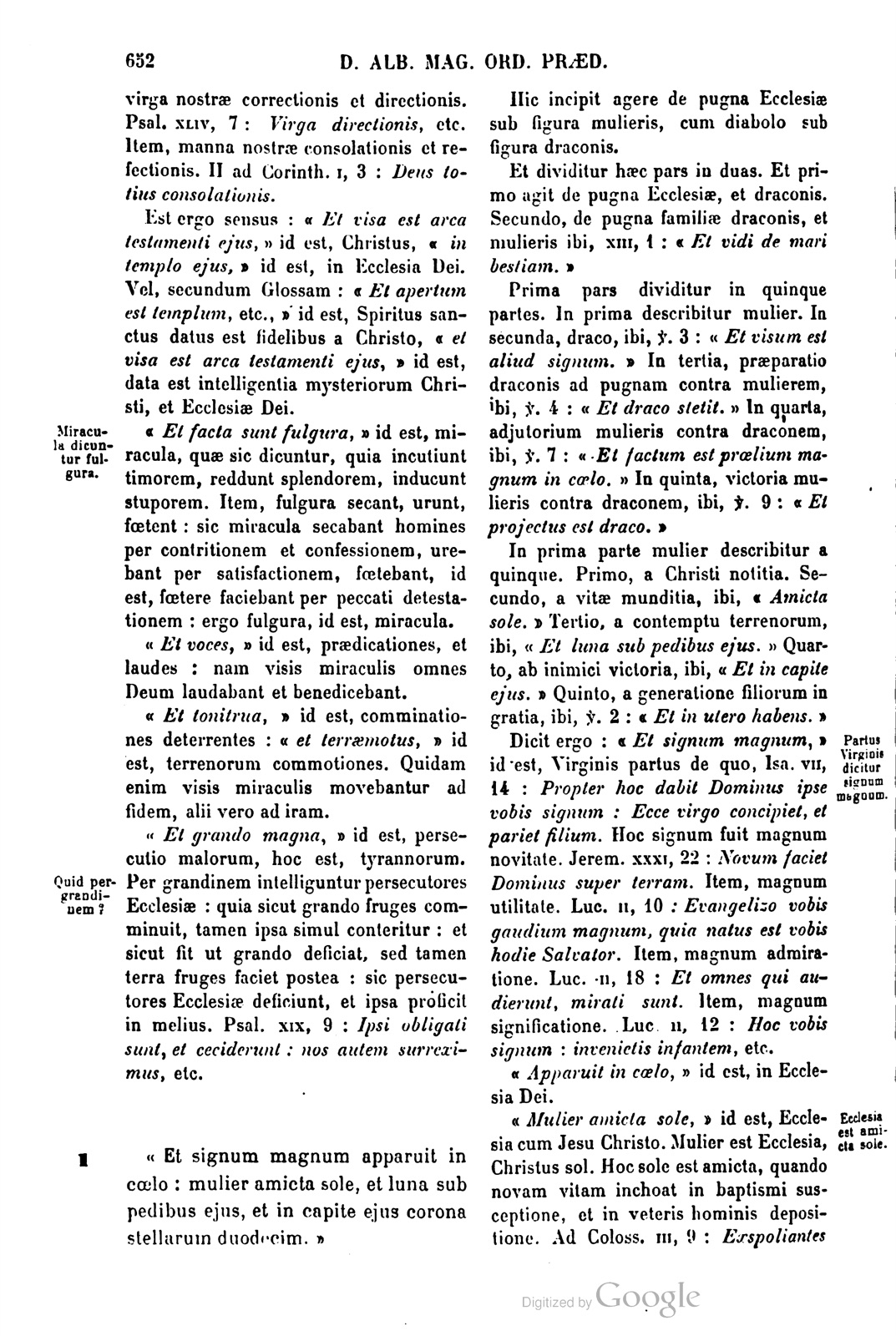
« Spiritus vitae, » id est, anima corpus vivificans, « a Deo, » scilicet missus, vel virtute divina, « intravit in eos, » Haymo: « Non alienus spiritus ingredietur in eos: sed unusquisque homo animam suam recipiet. »
« Et steterunt super pedes suos, »
Id est, stabunt immortales, et impassibiles, ut dicit Glossa. « Et timor magnus, » scilicet, ex perspecta eorum resurrectione, vel infernalis poenae, « cecidit super eos, » id est, cadet sicut pondus opprimens, « qui viderunt eos, » id est, videbunt tam gloriose resurrexisse.
Hic quaeritur, Quomodo videbunt oculis non glorificatis corpora glorificata?
Responsio Gregorii in homilia Paschali: « Corpus glorificatum palpabile est per veritatem naturae, subtile vero per effectum spiritualis potentiae. » Unde possunt uti palpabilitate vel subtilitate ad voluntatem spiritus. Tamen quidam dicunt, quod hoc est per miraculum.
12. « Et audierunt vocem magnam de caelo, dicentem eis: Ascendite huc. Et ascenderunt in caelum in nube, et viderunt illos inimici eorum.
13. Et in illa hora factus est terraemotus magnus, et decima pars civitatis cecidit, et occisa sunt in terraemotu nomina hominum septem millia, et reliqui in timorem sunt missi, et dederunt gloriam Deo caeli.
14. Vae secundum abiit, et ecce vae tertium veniet cito. »
Hic agitur de gloria eorum.
Et primo, notatur vocatio eorum ad susceptionem coronae. Secundo, susceptio, ibi, « Et ascenderunt. » Tertio, ex visione reproborum afflictio, ibi, « Et viderunt illos. »
Dicit ergo: « Et audierunt, » scilicet, Henoch et Elias, « vocem magnam, » id est, magnae potestatis indicativam. Psal. LXVI, 34: Dabit voci suae vocem virtutis. Vel, « Magnam, » id est, omnibus audibilem, « de caelo, » id est, de Christo, vel Archangelo, ut dicit Glossa. « Dicentem. » Glossa, id est, hoc operantem, « illis, » scilicet, Henoch et Eliae: « Ascendite huc, » id est, vos qui fuistis in descensu humilitatis ad sublimationem gloriae et societatem Sanctorum.
« Et ascenderunt, » scilicet in medio hominum impiorum, « in caelum » empyreum, « in nube, » scilicet eos obumbrante et malos terrente, sicut Christus 1. I ad Thessal. IV, 17: Rapiemur cum illis in nubibus obviam Christo in aera.
« Et viderunt illos inimici eorum, » ut sic qui gaudebant de morte, magis doleant de glorificatione. Sapient. V, 2: Videntes turbabuntur timore horribili, etc.
« Et in illa hora factus est terraemotus magnus, etc. »
« Et in illa hora, » scilicet ascensionis illorum, vel statim post, « factus est terraemotus magnus, » ad litteram. Luc. XXI, 11: Terraemotus magni erunt. Vel, « Terraemotus magnus, » id est, terrenorum commotio.
« Et decima pars civitatis, cecidit. » Per civitatem intelligitur gaudium paradisi, de quo corruerunt Angeli, et facti sunt daemones: et cum essent novem ordines Angelorum, tot ceciderunt de ipsis quod posset fieri ordo decimus. Vel, « Decima pars civitatis, » id est, omnes reprobi qui transgressi sunt decalogum, « cecidit, » id est, cadet in infernum, et
“The spirit of life,” that is, the soul vivifying the body, “from God,” namely sent, or by divine power, “entered into them.” Haymo says: “No alien spirit will enter into them, but each human being will receive his own soul.”
“And they stood upon their feet,”
That is, they will stand immortal and impassible, as the Gloss says. “And great fear,” namely from the sight of their resurrection, or of infernal punishment, “fell upon them,” that is, will fall like an oppressive weight, “who saw them,” that is, they will see them to have risen so gloriously.
Here it is asked: How will they see glorified bodies with eyes not glorified?
Response of Gregory in a Paschal homily: “A glorified body is touchable through the truth of nature, but subtle through the effect of spiritual power.” Hence they can use touchability or subtlety according to the will of the spirit. Yet some say that this is through a miracle.
12. “And they heard a great voice from heaven saying to them: Ascend here. And they ascended into heaven in a cloud, and their enemies saw them.
13. And in that hour a great earthquake occurred, and the tenth part of the city fell, and in the earthquake the names of seven thousand human beings were killed; and the rest were sent into fear and gave glory to the God of heaven.
14. The second woe has gone away, and behold, the third woe will come quickly.”
Here there is treatment of their glory.
And first, their calling to the reception of the crown is noted. Second, the reception, there, “And they ascended.” Third, from the vision, the affliction of the reprobate, there, “And they saw them.”
Therefore he says: “And they heard,” namely Enoch and Elijah, “a great voice,” that is, indicative of great power. Psalm LXVI, 34: He will give to his voice the voice of power. Or, “great,” that is, audible to all, “from heaven,” that is, from Christ, or from an Archangel, as the Gloss says. “Saying.” The Gloss says: that is, causing this, “to them,” namely to Enoch and Elijah: “Ascend here,” that is, you who were in the descent of humility, to the sublimation of glory and the fellowship of the Saints.
“And they ascended,” namely in the midst of impious human beings, “into heaven,” the empyrean, “in a cloud,” namely overshadowing them and terrifying the evil, as Christ did 1. 1 Thessalonians IV, 17: We will be caught up with them in the clouds to meet Christ in the air.
“And their enemies saw them,” so that those who rejoiced over their death may grieve more over their glorification. Wisdom V, 2: Seeing, they will be troubled with horrible fear, etc.
“And in that hour a great earthquake occurred, etc.”
“And in that hour,” namely of their ascension, or immediately after, “a great earthquake occurred,” literally. Luke XXI, 11: There will be great earthquakes. Or, “a great earthquake,” that is, the commotion of earthly persons.
“And the tenth part of the city fell.” By the city is understood the joy of paradise, from which the Angels fell and were made demons; and since there were nine orders of Angels, so many fell from them that a tenth order could be made. Or, “the tenth part of the city,” that is, all the reprobate who have transgressed the decalogue, “fell,” that is, will fall into hell, and
Notes
- Compare Acts I, 9. (Cf. Act. I, 9.) ↩
If a page does not appear, its photograph has not been uploaded yet.