Works › Commentary on the Apocalypse of Blessed John
Volume 38 · pp. 629–631
Chapter X: the open little book, thunders, and sealing
A marker with ≈ is an approximate page boundary, placed by measure of the text; the page photographs remain the authority. In the paired views, clicking a page marker brings that page into view.
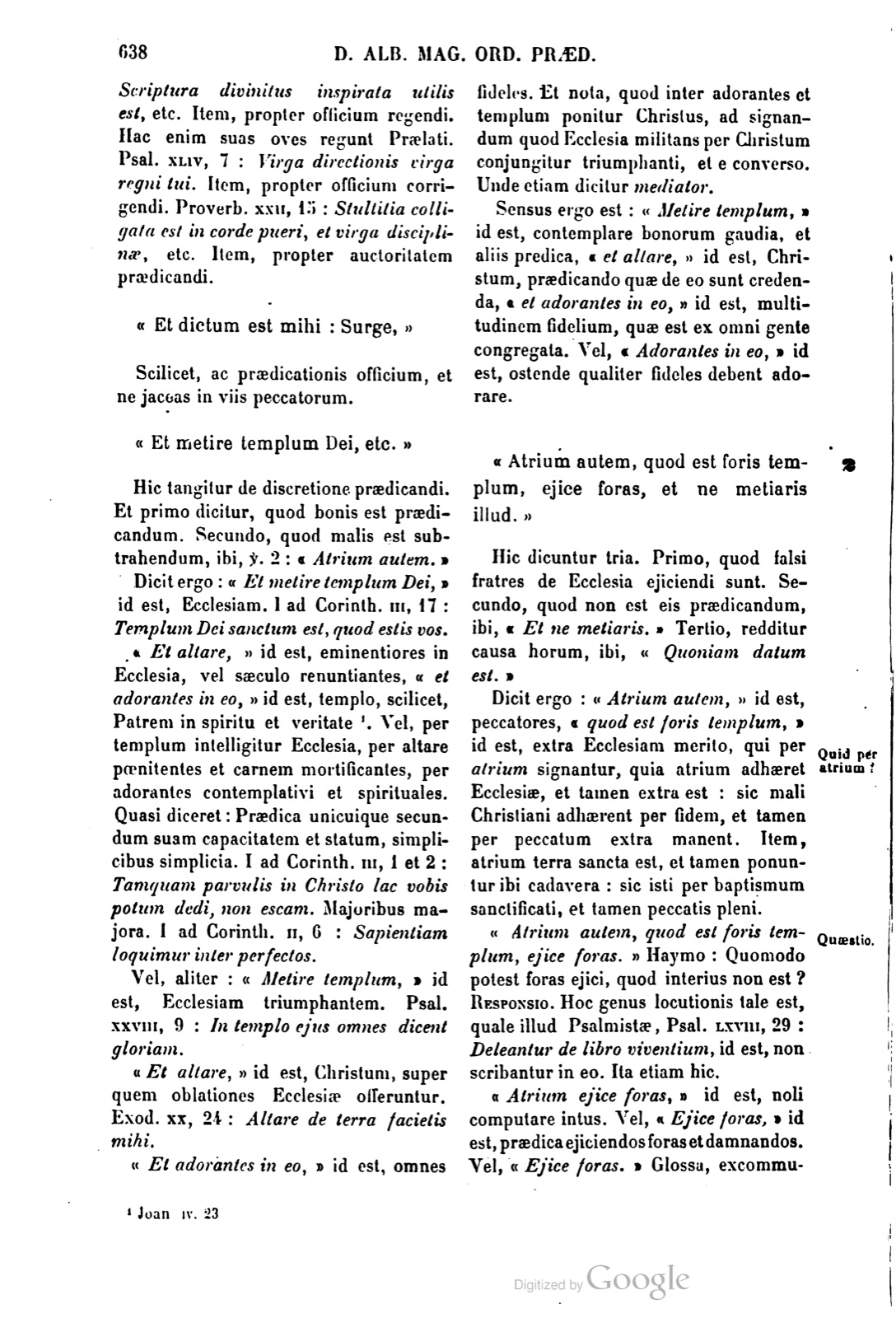
2. « Et habebat in manu sua libellum apertum: et posuit pedem suum dextrum supra mare, sinistrum autem supra terram:
3. Et clamavit voce magna, quemadmodum cum leo rugit: et cum clamasset, locuta sunt septem tonitrua voces suas.
4. Et cum locuta fuissent septem tonitrua voces suas, ego scripturus eram. »
Hic ostenditur, quod per ipsum facta est veritatis manifestatio.
Et dicuntur hic quatuor. Primo, quod per Christum obscuritas Scripturarum est reserata. Secundo, quod per ipsum est ubique manifestata, ibi, « Et posuit pedem. » Tertio, quod prius veritatem manifestavit, ibi, V. 3: « Et clamavit. » Quarto, quod ad similitudinem istius ordo Praedicatorum exiit ad praedicandum, ibidem, « Et cum clamasset. »
Dicit ergo: « Et habebat in manu sua. » Nota, quod Joannes supra, quinto capitulo, vidit librum signatum sigillis septem 1, per quem Vetus Testamentum significabatur plenum multa obscuritate, hic per librum apertum, Novum Testamentum significatur quod est apertum in manu Christi, id est, in ejus operatione.
Unde sensus est: « Et habebat in manu sua, » id est, in operatione sua et potestate, « libellum apertum, » id est, Novum Testamentum: quod apertum dicitur, quia illa quae latebant in Veteri Testamento secreta, in Novo Testamento sunt aperta. Et, sicut dicit Beda, libellus appellatur: quia agit de Christi humanitate per quam venitur ad legis intentionem.
« Et posuit pedem suum dextrum super mare, sinistrum autem super terram. » In quo signatur, quod veritas Evangelii est divulgata in mari et in terra. Et nota, quod per pedem dextrum firmiores Praedicatores, et per sinistrum debiliores, per mare signatur gentilitas habens amaritudinem infidelitatis, per terram duritia Judaeorum quae frequenter arata praedicatione Prophetarum, modicum fructum reddidit.
Est ergo sensus: « Et posuit pedem suum dextrum, » id est, firmiores Praedicatores, « super mare, » id est, super Gentiles qui erant magis rebelles: « et sinistrum, » id est, minores Praedicatores, « super terram, » id est, Judaeam duram.
Vel sic: Per pedem dextrum signatur vita aeterna, per sinistrum poena aeterna. Est ergo sensus: « Et posuit pedem suum dextrum super mare, » cum gentilitatem convertit ad fidem, et ad beatitudinem disposuit, « sinistrum autem super terram, » id est, Judaeos, cum propter sua scelera excaecari permisit. Ad Roman. XI, 25: Caecitas ex parte contigit in Israel, donec plenitudo gentium intraret.
2. “And he had in his hand an open little book; and he set his right foot upon the sea, but the left upon the earth:
3. And he cried with a great voice, as when a lion roars; and when he had cried out, seven thunders spoke their voices.
4. And when the seven thunders had spoken their voices, I was about to write.”
Here it is shown that through him the manifestation of truth was made.
And four things are said here. First, that through Christ the obscurity of the Scriptures has been unlocked. Second, that through him it was manifested everywhere, there, “And he set his foot.” Third, that he first manifested truth, there, V. 3: “And he cried.” Fourth, that after the likeness of him the order of Preachers went forth to preach, in the same place, “And when he had cried.”
Therefore he says: “And he had in his hand.” Note that John above, in the fifth chapter, saw a book sealed with seven seals 1, by which the Old Testament was signified, full of much obscurity; here by the open book the New Testament is signified, which is open in the hand of Christ, that is, in his operation.
Hence the sense is: “And he had in his hand,” that is, in his operation and power, “an open little book,” that is, the New Testament; it is called open because those secret things that lay hidden in the Old Testament are open in the New Testament. And, as Bede says, it is called a little book because it treats of Christ’s humanity, through which one comes to the intention of the law.
“And he set his right foot upon the sea, but the left upon the earth.” In this it is signified that the truth of the Gospel was spread abroad in the sea and on the earth. And note that by the right foot are signified the stronger Preachers, and by the left the weaker; by the sea is signified Gentility having the bitterness of unbelief, and by the earth the hardness of the Jews, which, often plowed by the preaching of the Prophets, yielded little fruit.
Therefore the sense is: “And he set his right foot,” that is, the stronger Preachers, “upon the sea,” that is, upon the Gentiles, who were more rebellious; “and the left,” that is, the lesser Preachers, “upon the earth,” that is, hard Judea.
Or thus: By the right foot eternal life is signified, by the left eternal punishment. Therefore the sense is: “And he set his right foot upon the sea,” when he converted Gentility to faith and disposed it to beatitude; “but the left upon the earth,” that is, upon the Jews, when because of their crimes he permitted them to be blinded. Romans XI, 25: Blindness has happened in part in Israel until the fullness of the Gentiles should enter.
Nota: In his verbis describitur Christus in novem conditionibus quas debet Praelatus habere. Prima est puritas, cum dicit: « Angelum. » Joan. I, 31: Qui de caelo venit, super omnes est. Secunda est charitas per quam dulciter et fortiter animam suam posuit, cum dicit: « Fortem. » Cantic. VIII, 6: Fortis est ut mors dilectio. Tertia est humilitas, cum dicit: « Descendentem. » Ad Philip. II, 7: Semetipsum exinanivit, etc. Quarta, pietas et clementia, cum dicit: « Amictum nube. » Eccli. XXIV, 7: Thronus meus in columna nubis. Quinta est justitia, cum dicit: « Et iris in capite ejus. » Psal. LXXXIV, 14: Justitia ante eum ambulabit. Sexta, sapientia, cum dicit: « Et facies ejus sicut sol. » Septima, affectionum recta ordinatio, cum dicit: « Et pedes ejus, etc. » Octava, doctrinae impletio, cum dicit: « Et habebat libellum in manu sua. » Act. I, 1: Coepit Jesus facere et docere. Nona, praedicationis discretio: quia alia et alia diversis praedicavit: aliter Judaeis, aliter obedientibus, aliter inobedientibus, ibi, « Et posuit pedem suum dextrum, etc. »
« Et clamavit voce magna, etc. »
Hic est tertium ubi dicit, quod primus praedicando veritatem manifestavit.
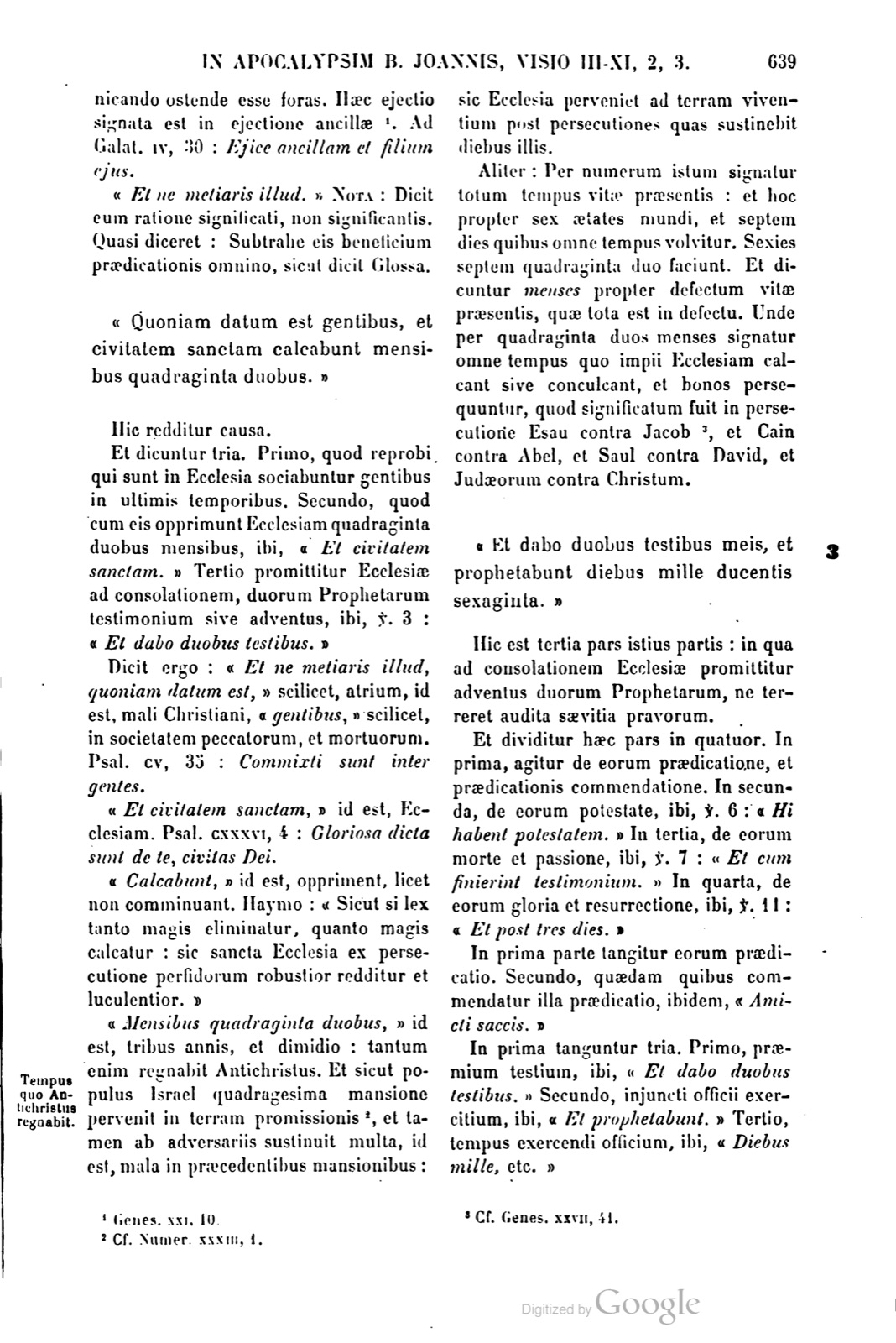
Dicit ergo: « Et clamavit, » scilicet, Christus, « voce magna, » id est, praedicatione aperte promittente magna, et comminante magna: promittente vitam aeternam, et comminante poenam aeternam. De primo, Joan. VII, 37: Si quis sitit, veniat ad me, et bibat. De secundo, Matth. VII, 19: Omnis arbor quae non facit fructum bonum, excidetur, etc.
« Quemadmodum cum leo rugit, » id est, audacter et terribiliter. Nota: Leo terret bestias omnes: sic Christus praedicando omnes malos homines.
Nota: Quadruplex est clamor Christi. Primus, in praedicatione. Psal. LXVIII, 4: Laboravi clamans. Secundus, in cruce. Matth. XXVII, 46: Clamavit voce magna dicens: Eli, etc. Tertius, in Lazari suscitatione. Joan. XI, 43: Haec cum dixisset, voce magna clamavit, etc. Quartus erit in judicii discussione. Isa. XLII, 13: Vociferabitur, et clamabit super inimicos suos.
Note: In these words Christ is described in nine conditions that a Prelate ought to have. The first is purity, when he says, “Angel.” John I, 31: He who comes from heaven is above all. The second is charity, through which he sweetly and strongly laid down his soul, when he says, “strong.” Song of Songs VIII, 6: Love is strong as death. The third is humility, when he says, “descending.” Philippians II, 7: He emptied himself, etc. Fourth, piety and clemency, when he says, “clothed with a cloud.” Ecclesiasticus XXIV, 7: My throne is in a pillar of cloud. Fifth is justice, when he says, “And a rainbow on his head.” Psalm LXXXIV, 14: Justice will walk before him. Sixth, wisdom, when he says, “And his face like the sun.” Seventh, the right ordering of affections, when he says, “And his feet, etc.” Eighth, the fulfillment of doctrine, when he says, “And he had a little book in his hand.” Acts I, 1: Jesus began to do and to teach. Ninth, discretion of preaching, because he preached different things to different persons: one way to Jews, another to the obedient, another to the disobedient, there, “And he set his right foot, etc.”
“And he cried with a great voice, etc.”
This is the third point where he says that he first manifested truth by preaching.
Therefore he says: “And he cried,” namely Christ, “with a great voice,” that is, by preaching openly promising great things and threatening great things: promising eternal life and threatening eternal punishment. Concerning the first, John VII, 37: If anyone thirsts, let him come to me and drink. Concerning the second, Matthew VII, 19: Every tree that does not bring forth good fruit will be cut down, etc.
“As when a lion roars,” that is, boldly and terribly. Note: The lion terrifies all beasts; so Christ, by preaching, terrifies all evil human beings.
Note: The cry of Christ is fourfold. The first was in preaching. Psalm LXVIII, 4: I labored crying out. The second, on the cross. Matthew XXVII, 46: He cried with a great voice saying: Eli, etc. The third, in the raising of Lazarus. John XI, 43: When he had said these things, he cried with a great voice, etc. The fourth will be in the examination of judgment. Isaiah XLII, 13: He will shout and cry out over his enemies.
« Et cum clamasset, etc. »
Hic dicitur quod ad similitudinem Christi alii exierunt ad praedicandum.
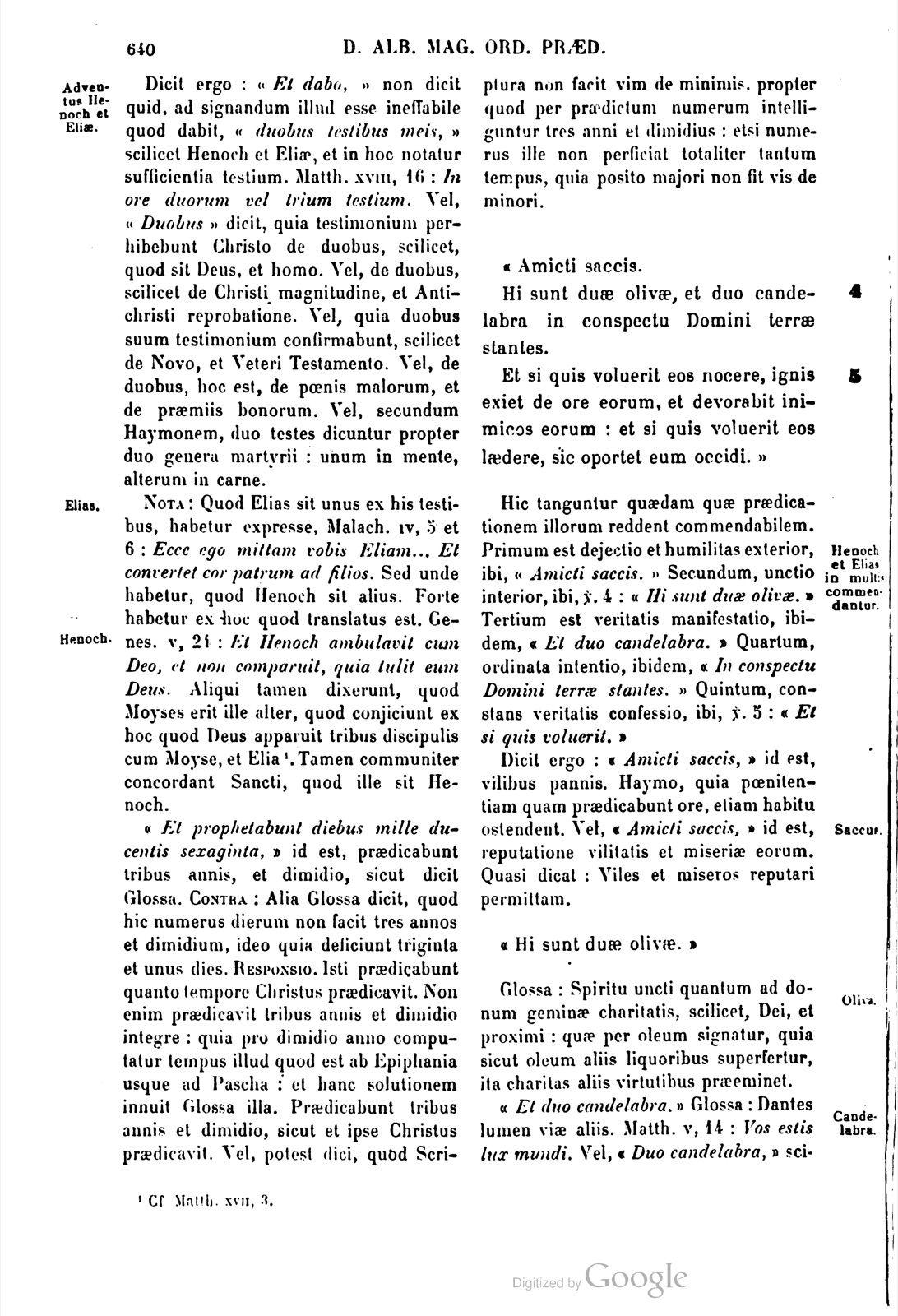
Unde dicit: « Et cum clamasset, » id est, cum Christus praedicasset et veritatem manifestasset, « locuta sunt septem tonitrua, » id est, universi Praedicatores, qui dicuntur septem, quia septiformi Spiritu repleti: tonitrua, quia terrorem cordibus incutiebant. Unde tonitruum dicitur tonus terrens.
« Voces suas. » Quasi diceret: non fabulas.
« Et cum locuta fuissent septem tonitrua, »
Id est, universi Praedicatores, « voces suas, » terribiles scilicet propter septem comminationes poenarum. Una est carentia aeternae haereditatis. Alia, carentia visionis Dei. Tertia, carentia Angelicae societatis. Quarta, carentia glorificationis corporis et animae. Quinta, vermis intus corrodens. Sexta, ignis extra affligens. Septima, sempiternus horror inhabitans 2.
Hic quaeritur, Quare dicit Christum clamare, et Praedicatores loqui?
Responsio. Quia ejus est comminari, cujus est publicare, ideo dicitur Christus clamare comminando: Praedicatorum autem est exhortari, et cum modestia aliquantulum proponere.
« Ego scripturus eram, » id est, paratus scribere: quia ipse, supra, I, 11, audierat: Quod vides, scribe in libro.
« Et audivi vocem de caelo dicentem mihi: Signa quae locuta sunt septem tonitrua, et noli ea scribere. »
Haec est secunda pars capituli, in qua veritas Evangelii signari praecipitur, id est, sigillari.
Unde dicit: « Et audivi, » id est, intellexi « vocem de caelo, » id est, inspirationem a Deo missam, vel admonitionem Angelicam, « dicentem mihi: Signa, » id est, sub sigillo claude, « quae locuta sunt septem tonitrua, » id est, universi Praedicatores, « et noli ea scribere, » id est, infidelibus manifestare. Signa ergo ut inimicis lateant, et ut amicis pateant.
“And when he had cried, etc.”
Here it is said that after the likeness of Christ others went out to preach.
Hence he says: “And when he had cried,” that is, when Christ had preached and manifested truth, “seven thunders spoke,” that is, all Preachers, who are called seven because they are filled with the sevenfold Spirit; thunders, because they struck terror into hearts. Hence thunder is said to be a terrifying sound.
“Their voices.” As if he were saying: not fables.
“And when the seven thunders had spoken,”
That is, all the Preachers, “their voices,” namely terrible voices because of the seven threats of punishments. One is the lack of the eternal inheritance. Another, the lack of the vision of God. The third, the lack of Angelic society. The fourth, the lack of the glorification of body and soul. The fifth, the worm gnawing within. The sixth, the fire afflicting from without. The seventh, the everlasting horror dwelling within 2.
Here it is asked: Why does he say that Christ cries, and the Preachers speak?
Response. Because it belongs to him whose task is to publish to threaten, therefore Christ is said to cry out by threatening; but it belongs to Preachers to exhort and to put something forward with modesty.
“I was about to write,” that is, prepared to write, because he had heard above, I, 11: What you see, write in a book.
“And I heard a voice from heaven saying to me: Seal the things that the seven thunders have spoken, and do not write them.”
This is the second part of the chapter, in which the truth of the Gospel is commanded to be signed, that is, sealed.
Hence he says: “And I heard,” that is, I understood “a voice from heaven,” that is, an inspiration sent by God, or an Angelic admonition, “saying to me: Seal,” that is, close under a seal, “the things that the seven thunders have spoken,” that is, all the Preachers, “and do not write them,” that is, do not manifest them to unbelievers. Therefore seal them so that they may lie hidden from enemies and may be open to friends.
If a page does not appear, its photograph has not been uploaded yet.