Works › Commentary on the Apocalypse of Blessed John
Volume 38 · pp. 589–590
Chapter VII: the sealing and the number of those sealed
A marker with ≈ is an approximate page boundary, placed by measure of the text; the page photographs remain the authority. In the paired views, clicking a page marker brings that page into view.
« Nolite nocere terrae et mari, neque arboribus, quoadusque signemus servos Dei nostri in frontibus eorum. »
Hic ponitur consolatio gratiae in praesenti.
Et dicuntur tria. Primo, prohibentur illi Angeli ne noceant. Secundo, determinatur tempus quo a nocumento abstinere debeant, ibi, « Quoadusque signemus. » Tertio, dicit se intellexisse qui hoc signo signari debeant, ibi, V. 4: « Et audivi numerum. »
Dicit ergo: « Nolite nocere. » Hic quaeritur, Cum datum sit eis nocere, quare nocere prohibentur? Responsio. Quia diabolus quantum est de voluntate sua potestatem suam desiderat semper ampliare: et ideo mala voluntas eorum cohibetur ne possint nocere quantum vellent.
« Nolite, » id est, ne attentetis, « nocere terrae et mari, » id est, peccatoribus quantum velletis, « neque arboribus, » id est, bonis qui dicuntur arbores: quia faciunt fructum bonorum operum, habent in medicinam folia verborum, radicantur in Christo per humilitatem, extendentes ramos per charitatem, operti cortice per vitae asperitatem, dantes umbram aliis per bonum exemplum, erecti per spem, sursum tendentes per aeternorum contemplationem, vivi per fidem.
« Quoadusque, » id est, nec ante, nec post. Simile habetur, Matth. I, 25: Et non cognoscebat eam, donec peperit filium, etc., id est, nec ante, nec post.
« Signemus. » Sed cum Joannes vidit unum Angelum, quare non dicit, quoadusque signem, sed utitur plurali dicens, signemus? Responsio. Sensus est: « Signemus, » scilicet, ego, et ministri mei: ego interius, et ministri mei exterius.
« Servos Dei nostri in frontibus eorum. » Glossa: « Signo crucis discernamus. » Hoc signum fideles in Ecclesia recipiunt intus in corde quod est frons interior, et exterius in frontem: unde baptizatus inungitur in pectore ut fidem cordis habeat, et in fronte ne fidem Christi erubescat confiteri. Ita tamen audacia proprie datur in sacramento confirmationis: et ideo dicit: « In frontibus eorum, » ut utramque frontem intelligamus, scilicet, exteriorem, et interiorem.
« Et audivi numerum signatorum, centum quadraginta quatuor millia signati, ex omni tribu filiorum Israel.
5. Ex tribu Juda duodecim millia signati, ex tribu Ruben duodecim millia signati, ex tribu Gad duodecim millia signati,
6. Ex tribu Aser duodecim millia signati, ex tribu Nephthali duodecim millia signati, ex tribu Manasse duodecim millia signati,
7. Ex tribu Simeon duodecim millia signati, ex tribu Levi duodecim millia signati, ex tribu Issachar duodecim millia signati,
8. Ex tribu Zabulon duodecim millia signati, ex tribu Joseph duodecim millia signati, ex tribu Benjamin duodecim millia signati. »
Hic dicit se intellexisse numerum illorum qui signandi erant illo signo.
Et primo sub quodam numero finito ponit numerum signatorum. Secundo, per partes probat numerum, ibi, V. 5: « Ex tribu Juda. »
Dicit ergo: « Et audivi, » id est, spiritualiter intellexi, « numerum, » scilicet signatorum, id est, signandorum, vel signatorum in praescientia, « centum quadraginta quatuor millia signati, ex omni tribu filiorum Israel. » Sicut dicit Haymo, in hoc loco ponitur numerus finitus pro infinito: nec pertinet solum ad duodecim tribus filiorum Israel, sed ad omnem Ecclesiam quae in suis comprehenditur electis, quod ostenditur sic: Ternarius signat Trinitatem sanctam: quaternarius quatuor mundi partes, vel quatuor virtutes, vel quatuor Evangelia. Si ergo ducatur ternarius in quaternarium, vel e converso, resultat duodenarius numerus qui est numerus sacratus: quia per ipsum omnes illi signantur qui in quatuor mundi partibus fidem tenent sanctae Trinitatis, vel habent quatuor virtutes in fide Trinitatis fundatas. Mille signat perfectionem, vel unitatem. Quia ergo Ecclesia per Trinitatis notitiam in quatuor mundi partibus, et universis generationibus aggregatur, in duodenis millibus figuratur. Item, quia civitas in quadro posita est, sicut dicitur, infra, XXI, 16, ideo duodecim millia multiplicando per quatuor, fiunt quadraginta et octo millia, et sic perficitur in eo quod credit. Ut autem perveniat ad illud, id est, ad contemplationem Trinitatis multiplicando quadraginta octo millia per ternarium, fiunt centum quadraginta quatuor millia, per quem numerum designatur universitas Sanctorum.
“Do not harm the earth and the sea, nor the trees, until we seal the servants of our God on their foreheads.”
Here the consolation of grace in the present is set down.
And three things are said. First, those Angels are forbidden to harm. Second, the time during which they ought to abstain from harm is determined, there, “Until we seal.” Third, he says that he understood who ought to be sealed with this sign, there, V. 4: “And I heard the number.”
Therefore he says: “Do not harm.” Here it is asked: Since it has been given to them to harm, why are they forbidden to harm? Response. Because the devil, as far as concerns his own will, always desires to enlarge his power; and therefore their evil will is restrained so that they cannot harm as much as they would wish.
“Do not,” that is, do not attempt, “to harm the earth and the sea,” that is, sinners as much as you would wish, “nor the trees,” that is, the good, who are called trees, because they make the fruit of good works, have the leaves of words for medicine, are rooted in Christ through humility, extend branches through charity, are covered with bark through austerity of life, give shade to others through good example, are upright through hope, tend upward through contemplation of eternal things, and are alive through faith.
“Until,” that is, neither before nor after. A similar thing is found in Matthew I, 25: And he did not know her until she bore a son, etc., that is, neither before nor after.
“We seal.” But since John saw one Angel, why does he not say, until I seal, but uses the plural, saying, we seal? Response. The sense is: “We seal,” namely, I and my ministers: I inwardly, and my ministers outwardly.
“The servants of our God on their foreheads.” The Gloss says: “Let us distinguish them with the sign of the cross.” The faithful in the Church receive this sign inwardly in the heart, which is the interior forehead, and outwardly on the forehead; hence the baptized person is anointed on the breast so that he may have faith of heart, and on the forehead so that he may not blush to confess the faith of Christ. Yet boldness is properly given in the sacrament of confirmation; and therefore he says, “on their foreheads,” so that we may understand each forehead, namely the exterior and the interior.
“And I heard the number of the sealed: one hundred forty-four thousand sealed from every tribe of the children of Israel.
5. From the tribe of Judah, twelve thousand sealed; from the tribe of Reuben, twelve thousand sealed; from the tribe of Gad, twelve thousand sealed.
6. From the tribe of Asher, twelve thousand sealed; from the tribe of Naphtali, twelve thousand sealed; from the tribe of Manasseh, twelve thousand sealed.
7. From the tribe of Simeon, twelve thousand sealed; from the tribe of Levi, twelve thousand sealed; from the tribe of Issachar, twelve thousand sealed.
8. From the tribe of Zebulun, twelve thousand sealed; from the tribe of Joseph, twelve thousand sealed; from the tribe of Benjamin, twelve thousand sealed.”
Here he says that he understood the number of those who were to be sealed with that sign.
And first, under a certain finite number, he sets down the number of those sealed. Second, he proves the number by its parts, there, V. 5: “From the tribe of Judah.”
Therefore he says: “And I heard,” that is, I understood spiritually, “the number,” namely of those sealed, that is, of those to be sealed, or of those sealed in foreknowledge, “one hundred forty-four thousand sealed from every tribe of the children of Israel.” As Haymo says, in this place a finite number is set down for an infinite one; nor does it pertain only to the twelve tribes of the children of Israel, but to the whole Church, which is comprised in its elect, and this is shown thus: three signifies the holy Trinity; four signifies the four parts of the world, or the four virtues, or the four Gospels. Therefore if three is multiplied by four, or conversely, the number twelve results, which is a sacred number, because through it are signified all those who in the four parts of the world hold the faith of the holy Trinity, or have the four virtues founded in faith of the Trinity. A thousand signifies perfection or unity. Therefore because the Church is gathered through knowledge of the Trinity in the four parts of the world and in all generations, it is figured in twelve thousands. Likewise, because the city is set in a square, as is said below, XXI, 16, therefore by multiplying twelve thousand by four, forty-eight thousand are made, and thus it is perfected in what it believes. But so that it may come to that, that is, to contemplation of the Trinity, by multiplying forty-eight thousand by three, one hundred forty-four thousand are made; through this number the universality of the Saints is designated.
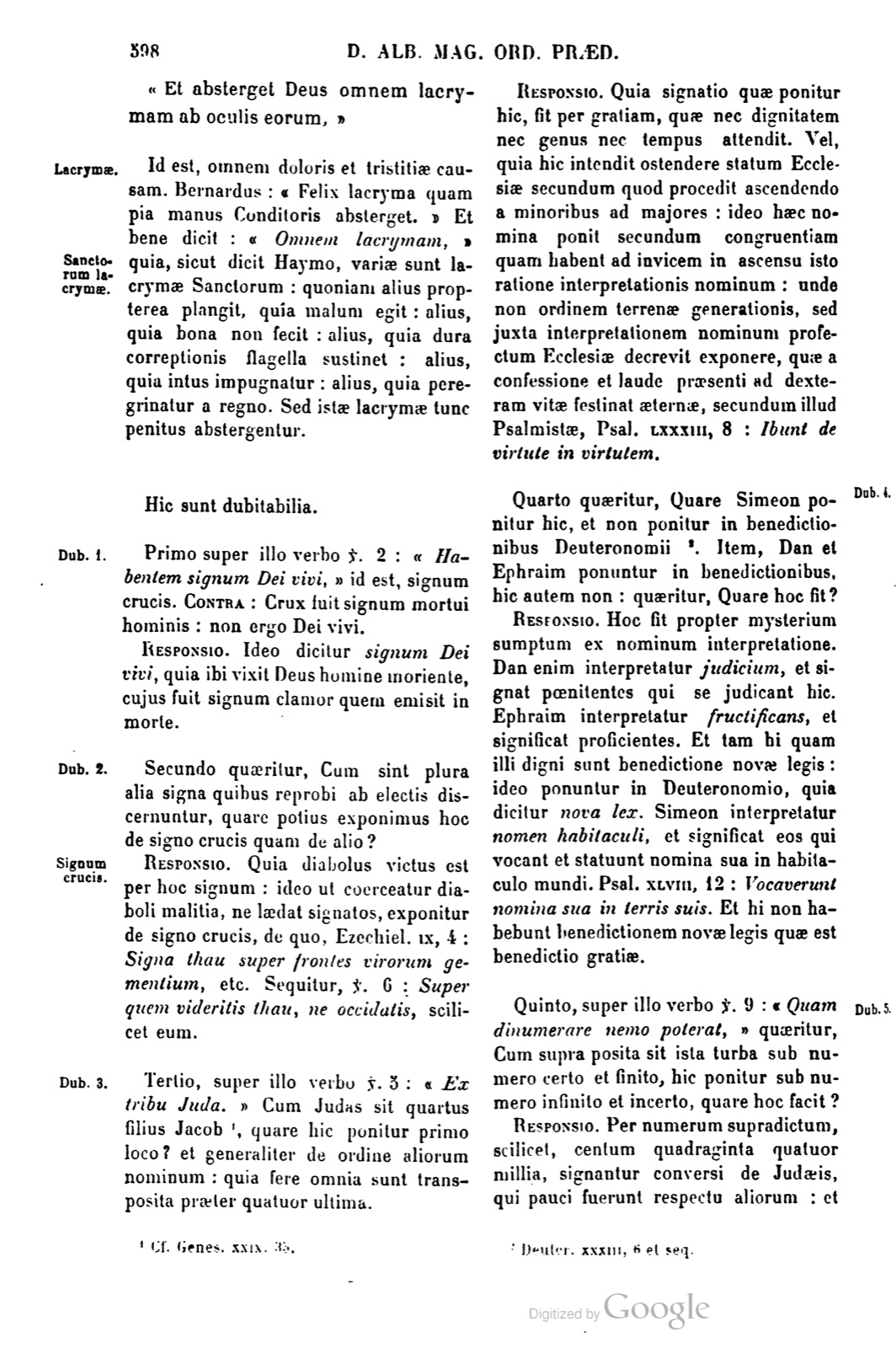
Aliter: Omnes electi signantur per talem numerum secundum quadruplicem statum. Per centum signantur omnes quibus debetur fructus centesimus, sicut virgines. Per quadraginta qui est numerus poenitentiae, signantur illi quibus debetur fructus sexagesimus, ut continentes. Per quatuor, illi quibus debetur fructus trigesimus, scilicet, conjugati: et recte per talem numerum signantur, quia quatuor est primus numerus divisibilis in numeros: conjugati vero divisi sunt. I ad Corinth. VII, 33: Qui cum uxore est, sollicitus est quae sunt mundi, quomodo placeat uxori: et divisus est. Et omnes isti dicuntur mille: quia iste numerus cubitus, id est, solidus est: habet enim trinam dimensionem, scilicet, decem multiplicatum per decem iterum multiplicatum per decem. Et omnes illi servant decalogum ad honorem Trinitatis, Patris, et Filii, et Spiritus sancti: vel cum fide, spe, et charitate.
« Ex omni tribu filiorum Israel, » id est, ex omnibus cujuscumque sint nationis fidem Patriarchae imitantibus.
« Et audivi numerum signatorum centum quadraginta quatuor millia. » Nota: In hoc numero ponuntur quatuor genera numerorum: quadraginta, quatuor, centum, mille. Quadragenarius est numerus poenitentium: quia partes hujus numeri faciunt quinquagesimum, qui est numerus remissionis 1. Similiter poenitentia ducit ad remissionem peccatorum, et Dei reconciliationem, unde pertinet ad incipientes. Quaternarius est illorum qui in quatuor virtutibus proficiunt, et pertinet ad proficientes. Centenarius pertinet ad perfectos, qui decalogum perfecte servaverunt. Millesimus qui est ultimus numerorum, pertinet ad perseverantes: quia perseverantia est perfectio virtutum, et sic ad haec quatuor potest reduci omnis numerus salvandorum.
Nota etiam, quod tria prima nomina quae subduntur: « Ex tribu Juda, etc., » pertinent ad statum incipientium, tria alia ad statum proficientium, tria sequentia ad statum perfectorum, tria ultima ad statum perseverantium.
Unde dicit:
Otherwise: All the elect are signed by such a number according to the fourfold state. By one hundred are signified all to whom the hundredfold fruit is owed, such as virgins. By forty, which is the number of penance, are signified those to whom the sixtyfold fruit is owed, such as the continent. By four, those to whom the thirtyfold fruit is owed, namely the married; and rightly they are signified by such a number, because four is the first number divisible into numbers; but married people are divided. 1 Corinthians VII, 33: He who is with a wife is concerned about the things of the world, how he may please his wife, and he is divided. And all these are called a thousand, because that number is cubed, that is, solid; for it has three dimensions, namely ten multiplied by ten and again multiplied by ten. And all those keep the decalogue to the honor of the Trinity, the Father and the Son and the Holy Spirit; or with faith, hope, and charity.
“From every tribe of the children of Israel,” that is, from all of whatever nation who imitate the faith of the Patriarch.
“And I heard the number of those sealed, one hundred forty-four thousand.” Note: In this number there are four kinds of numbers: forty, four, one hundred, and one thousand. Forty is the number of penitents, because the parts of this number make fifty, which is the number of remission 1. Similarly, penance leads to the remission of sins and the reconciliation of God; hence it pertains to beginners. Four belongs to those who advance in the four virtues, and pertains to the advancing. One hundred pertains to the perfect, who have kept the decalogue perfectly. One thousand, which is the last of the numbers, pertains to the persevering, because perseverance is the perfection of the virtues; and so every number of those to be saved can be reduced to these four.
Note also that the first three names which are added, “From the tribe of Judah, etc.,” pertain to the state of beginners, the other three to the state of the advancing, the following three to the state of the perfect, and the last three to the state of the persevering.
Hence he says:
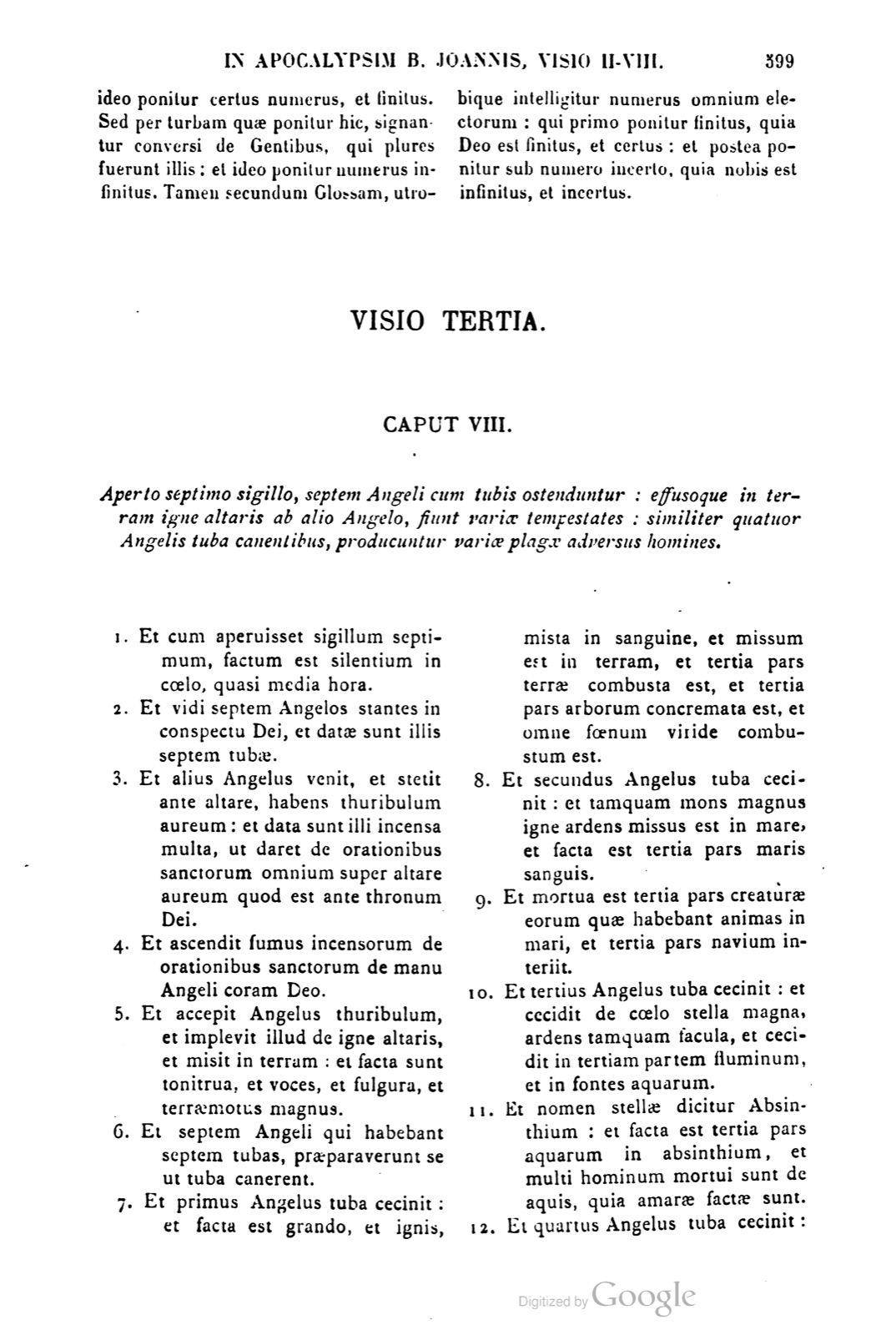
Notes
- Compare Leviticus XXV, 10. (Cf. Levit. XXV, 10.) ↩
If a page does not appear, its photograph has not been uploaded yet.