Works › Commentary on the Apocalypse of Blessed John
Volume 38 · pp. 586–589
Chapter VII: lemma and the four Angels
A marker with ≈ is an approximate page boundary, placed by measure of the text; the page photographs remain the authority. In the paired views, clicking a page marker brings that page into view.
CAPUT VII.
Dum punienda est terra, jubentur absque nocumento servari signum in fronte gerentes, qui describuntur tam ex Judaeis quam ex gentibus, benedicentes Deum: et de his qui amicti erant stolis albis.
1. Post haec vidi quatuor Angelos stantes super quatuor angulos terrae, tenentes quatuor ventos terrae, ne flarent super terram, neque super mare, neque in ullam arborem.
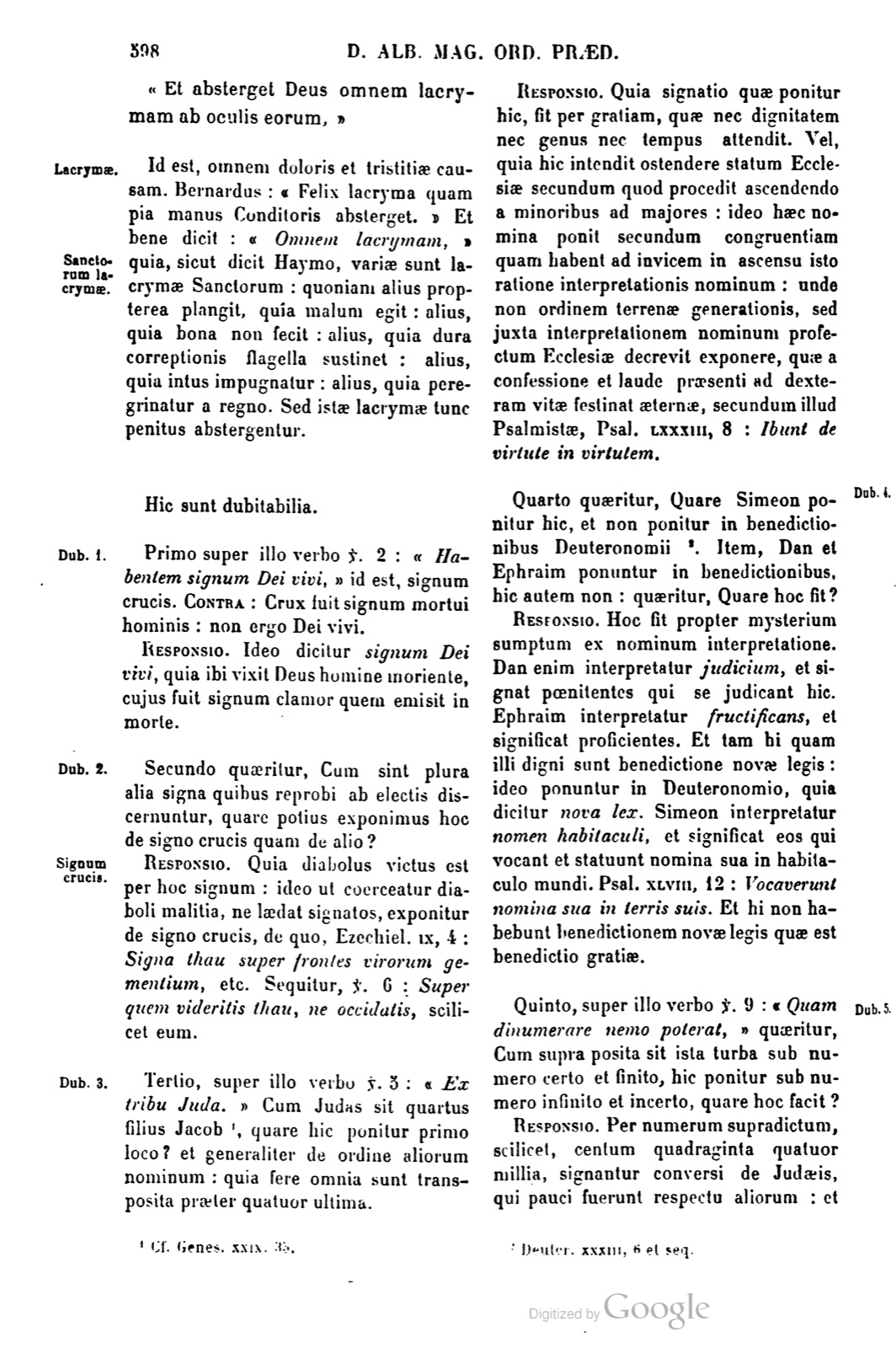
2. Et vidi alterum Angelum ascendentem ab ortu solis, habentem signum Dei vivi: et clamavit voce magna quatuor Angelis, quibus datum est nocere terrae et mari,
3. Dicens: Nolite nocere terrae et mari, neque arboribus, quoadusque signemus servos Dei nostri in frontibus eorum.
4. Et audivi numerum signatorum, centum quadraginta quatuor millia signati, ex omni tribu filiorum Israel.
5. Ex tribu Juda duodecim millia signati, ex tribu Ruben duodecim millia signati, ex tribu Gad duodecim millia signati,
6. Ex tribu Aser duodecim millia signati, ex tribu Nephthali duodecim millia signati, ex tribu Manasse duodecim millia signati.
7. Ex tribu Simeon duodecim millia signati, ex tribu Levi duodecim millia signati, ex tribu Issachar duodecim millia signati,
8. Ex tribu Zabulon duodecim millia signati, ex tribu Joseph duodecim millia signati, ex tribu Benjamin duodecim millia signati.
9. Post haec vidi turbam magnam, quam dinumerare nemo poterat, ex omnibus gentibus, et tribubus, et populis, et linguis: stantes ante thronum et in conspectu Agni, amicti stolis albis, et palmae in manibus eorum:
10. Et clamabant voce magna, dicentes: Salus Deo nostro, qui sedet super thronum, et Agno.
11. Et omnes Angeli stabant in circuitu throni, et seniorum, et quatuor animalium: et ceciderunt in conspectu throni in facies suas, et adoraverunt Deum,
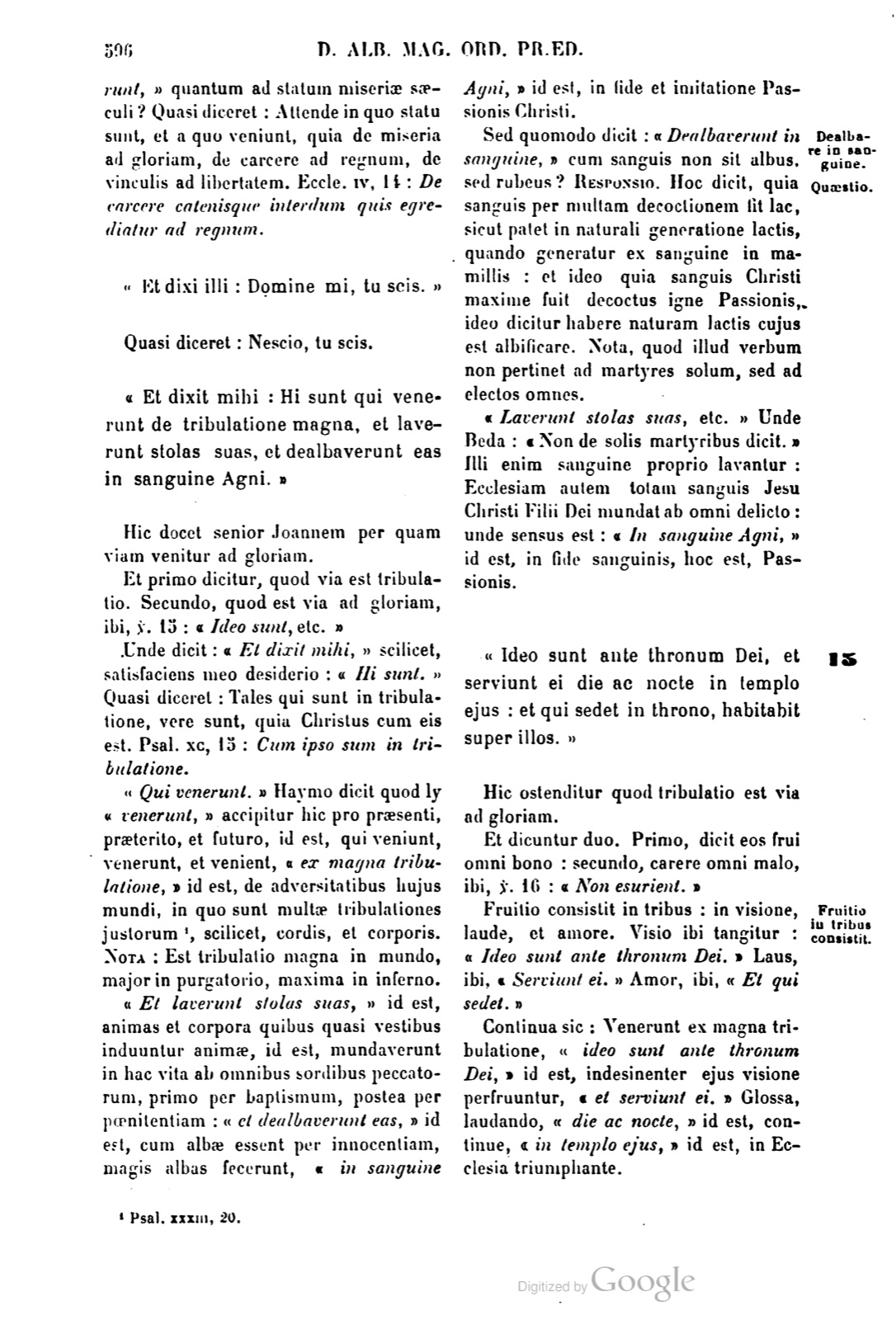
12. Dicentes: Amen. Benedictio, et claritas, et sapientia, et gratiarum actio, honor, et virtus, et fortitudo Deo nostro, in saecula saeculorum. Amen.
13. Et respondit unus de senioribus, et dixit mihi: Hi qui amicti sunt stolis albis, qui sunt? et unde venerunt?
14. Et dixi illi: Domine mi, tu scis. Et dixit mihi: Hi sunt qui venerunt de tribulatione magna, et laverunt stolas suas, et dealbaverunt eas in sanguine Agni.
15. Ideo sunt ante thronum Dei, et serviunt ei die ac nocte in templo ejus: et qui sedet in throno, habitabit super illos.
CHAPTER VII.
While the earth is to be punished, those bearing the sign on the forehead are commanded to be preserved without harm; they are described both from the Jews and from the Gentiles, blessing God; and concerning those who were clothed in white robes.
1. After these things I saw four Angels standing upon the four corners of the earth, holding the four winds of the earth, lest they blow upon the earth, nor upon the sea, nor upon any tree.
2. And I saw another Angel ascending from the rising of the sun, having the sign of the living God; and he cried with a great voice to the four Angels, to whom it was given to harm the earth and the sea,
3. Saying: Do not harm the earth and the sea, nor the trees, until we seal the servants of our God on their foreheads.
4. And I heard the number of the sealed: one hundred forty-four thousand sealed from every tribe of the children of Israel.
5. From the tribe of Judah, twelve thousand sealed; from the tribe of Reuben, twelve thousand sealed; from the tribe of Gad, twelve thousand sealed.
6. From the tribe of Asher, twelve thousand sealed; from the tribe of Naphtali, twelve thousand sealed; from the tribe of Manasseh, twelve thousand sealed.
7. From the tribe of Simeon, twelve thousand sealed; from the tribe of Levi, twelve thousand sealed; from the tribe of Issachar, twelve thousand sealed.
8. From the tribe of Zebulun, twelve thousand sealed; from the tribe of Joseph, twelve thousand sealed; from the tribe of Benjamin, twelve thousand sealed.
9. After these things I saw a great crowd, which no one could number, from all nations and tribes and peoples and tongues, standing before the throne and in the sight of the Lamb, clothed in white robes, and palms in their hands.
10. And they cried with a great voice, saying: Salvation to our God, who sits upon the throne, and to the Lamb.
11. And all the Angels stood around the throne, and the elders, and the four living creatures; and they fell in the sight of the throne upon their faces and adored God,
12. Saying: Amen. Blessing and brightness and wisdom and thanksgiving, honor and virtue and fortitude to our God forever and ever. Amen.
13. And one of the elders answered and said to me: These who are clothed in white robes, who are they? And from where have they come?
14. And I said to him: My lord, you know. And he said to me: These are the ones who have come from great tribulation, and have washed their robes and made them white in the blood of the Lamb.
15. Therefore they are before the throne of God, and they serve him day and night in his temple; and the one who sits upon the throne will dwell over them.
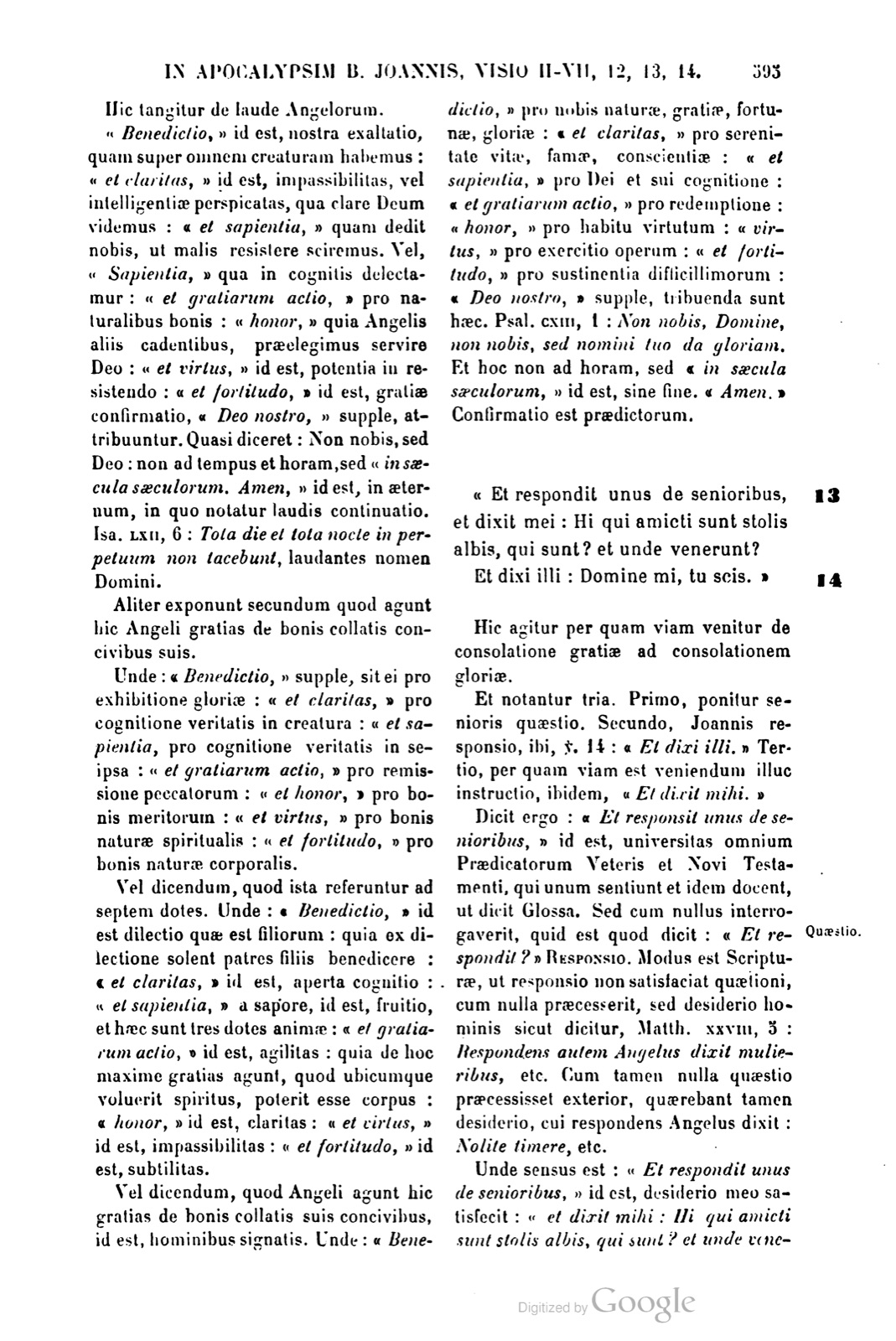
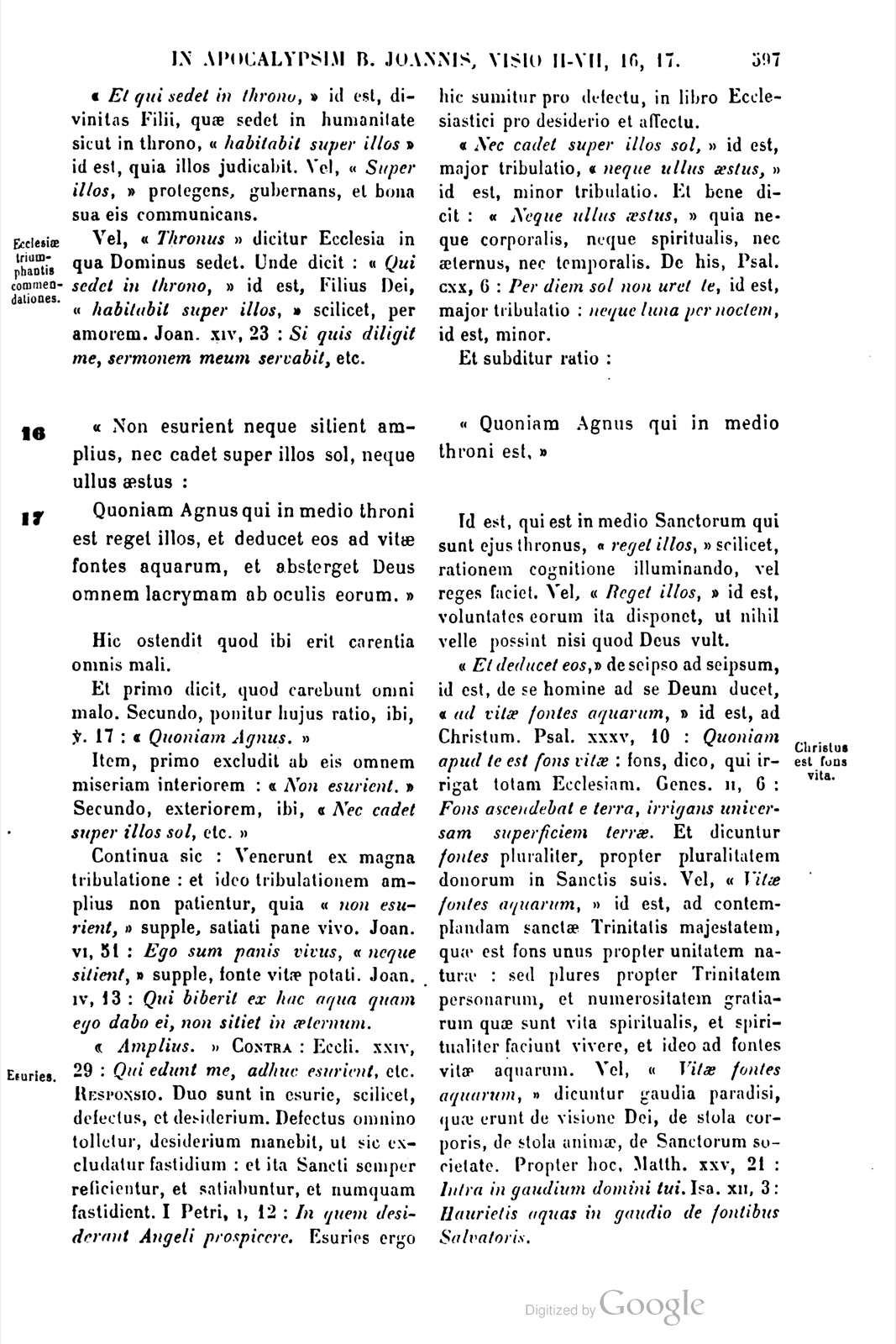
16. Non esurient, neque sitient amplius, nec cadet super illos sol, neque ullus aestus 1:
17. Quoniam Agnus qui in medio throni est reget illos, et deducet eos ad vitae fontes aquarum, et absterget Deus omnem lacrymam ab oculis eorum 2.
IN CAPUT VII APOCALYPSIS
ENARRATIO.
1. « Post haec vidi quatuor Angelos stantes super quatuor angulos terrae, tenentes quatuor ventos terrae, ne flarent super terram, neque super mare, neque in ullam arborem. »
Supra dictum est in parte praecedenti, quod tanta erit tribulatio tempore Antichristi, quod fiet immutatio in Ecclesia secundum omnem statum in bonis et in malis: hic ostendit, quod tanta erit, quod impedietur praedicatio nominis Christi.
Et dicuntur hic duo. Primo dicit, quod vidit quatuor Angelos tenentes quatuor ventos. Secundo, ostendit causam quare tenebant eos, ibi, « Ne flarent supra terram. »
Dicit ergo: « Post haec vidi quatuor Angelos, » id est, quatuor daemones. Diabolus enim dicitur hic Angelus, missus et a Deo ad probationem bonorum, et a principe diabolo ad subversionem cunctorum.
Nota: Sicut dicit Haymo, Angeli stantes super quatuor partes terrae sunt daemones praepositi quatuor regnis principalibus, scilicet, Assyriorum, Medorum, Persarum, Graecorum, et Romanorum. Per quatuor ventos intelligitur quadruplex praedicatio ad convertendum terrenos. Una est recolendo beneficia gratiae, quae nobis continue oriuntur, et signantur per ventum Orientis. Alia est recolendo beneficia gloriae, quae dabuntur in futuro quae signantur per ventum Australem. Tertia est recolendo multiplicem lapsum peccati, et signatur per ventum Occidentis. Quarta est recolendo acerbitatem poenae et durationem ejus, et signatur per ventum Aquilonis.
Est ergo sensus talis: « Post haec vidi. » Illud post non notat diversitatem visionum, sed ordinem visorum juxta ostensionem Angeli, et narrationem Joannis. « Quatuor Angelos, » id est, quatuor daemones praepositos aliis: vel daemones universos, qui bene per quatuor signantur: quia numerus iste maxime divisibilis est, et ipsi intendunt facere divisionem. Vel, dicuntur quatuor, quia quatuor Evangelia annihilare intendunt.
« Stantes super quatuor angulos terrae, » id est, in quatuor principalibus regnis commorantes. Vel, « Super quatuor angulos terrae, » id est, super cupiditatem, et vanitatem, libidinem, et voluptatem. Vel, « Super quatuor angulos, » quia laborant ut ponant hominem in angulo, id est, in sordibus, vel in angulo duplicitatis.
16. They will not hunger nor thirst any more, nor will the sun fall upon them, nor any heat 1.
17. For the Lamb who is in the midst of the throne will rule them and will lead them to the fountains of the waters of life, and God will wipe away every tear from their eyes 2.
ON CHAPTER VII OF THE APOCALYPSE
EXPOSITION.
1. “After these things I saw four Angels standing upon the four corners of the earth, holding the four winds of the earth, lest they blow upon the earth, nor upon the sea, nor upon any tree.”
It was said above in the preceding part that the tribulation in the time of Antichrist will be so great that a change will occur in the Church according to every state among the good and among the wicked; here he shows that it will be so great that the preaching of the name of Christ will be impeded.
And two things are said here. First he says that he saw four Angels holding the four winds. Second, he shows the cause why they held them, there, “Lest they blow upon the earth.”
Therefore he says: “After these things I saw four Angels,” that is, four demons. For the devil is here called an Angel, sent both by God for the testing of the good and by the prince of the devil for the subversion of all.
Note: As Haymo says, the Angels standing upon the four parts of the earth are demons set over the four principal kingdoms, namely those of the Assyrians, Medes, Persians, Greeks, and Romans. By the four winds is understood a fourfold preaching for converting earthly people. One is by recalling the benefits of grace, which continually arise for us, and these are signified by the east wind. Another is by recalling the benefits of glory, which will be given in the future, and these are signified by the south wind. The third is by recalling the manifold fall of sin, and it is signified by the west wind. The fourth is by recalling the bitterness of punishment and its duration, and it is signified by the north wind.
Therefore the sense is this: “After these things I saw.” That word after does not mark a diversity of visions, but the order of the things seen according to the showing of the Angel and the narration of John. “Four Angels,” that is, four demons set over others; or all demons, who are well signified by four, because that number is especially divisible, and they intend to make division. Or they are called four because they intend to annihilate the four Gospels.
“Standing upon the four corners of the earth,” that is, dwelling in the four principal kingdoms. Or, “upon the four corners of the earth,” that is, upon covetousness and vanity, lust and pleasure. Or, “upon the four corners,” because they labor to place the human being in a corner, that is, in filth, or in the corner of duplicity.
« Tenentes quatuor ventos terrae, » id est, Praedicatores, qui quadruplicem praedicationem debent praedicare: peccata quae debemus fugere, bona quae debemus facere, poenas quas debemus timere, et gaudia quae debemus sperare vel appetere. Vel dicuntur quatuor, quia de fontibus Salvatoris, id est, de quatuor Evangeliis debent quidquid praedicant haurire. Genes. II, 10: Fluvius egrediebatur de loco voluptatis. Vel, quia debent habere quatuor virtutes. Vel, quia debent praedicare per quatuor climata mundi.
« Ne flarent super terram, » id est, terrenorum amatores qui peccant concupiscentia oculorum, « neque super mare, » id est, superbos qui peccant per superbiam vitae, « neque in ullam arborem, » id est, luxuriosos qui peccant per concupiscentiam carnis: et tales dicuntur arbores, quia trahunt humorem suum a terra, ut arbores.
2. « Et vidi alterum Angelum ascendentem ab ortu solis, habentem signum Dei vivi: et clamavit voce magna quatuor Angelis, quibus datum est nocere terrae et mari, 3. Dicens. »
Supra ostendit tribulationem Ecclesiae quae erit tempore Antichristi, hic ostenditur consolatio Ecclesiae.
Et dividitur pars ista in tres. In prima ponitur consolatio gratiae in praesenti. Secundo, consolatio gratiae in futuro, ibi, V. 11: « Post haec vidi turbam magnam, etc. » Tertio, ostenditur via per quam venitur ad consolationem gloriae a consolatione gratiae, ibi, V. 13: « Et respondit unus de senioribus. »
In prima parte dicuntur tria. Primo, videtur Christus hujus consolationis nuntius, ibi, « Et vidi alterum Angelum. » Secundo, auditur vox ipsius, ibidem, « Et clamavit voce magna. » Tertio, ponitur consolatio gratiae quae facta est ad clamorem ejus, ibi, V. 3: « Nolite nocere. »
Continua: Tanta erit tribulatio Ecclesiae: sed tamen non obliviscetur Deus misereri. Unde dicit: « Et vidi alterum Angelum, » id est, Christum qui bene vocatur Angelus, quia nova vitae gaudia mundo nuntiavit. « Alterum, » id est, valde a praedictis diversum. Priores enim venerant ad nocendum, iste ad salvandum. Joan. III, 17: Non misit Deus Filium suum in mundum, ut judicet mundum, sed ut salvetur mundus per ipsum.
“Holding the four winds of the earth,” that is, Preachers, who ought to preach a fourfold preaching: the sins that we ought to flee, the goods that we ought to do, the punishments that we ought to fear, and the joys that we ought to hope for or desire. Or they are called four because whatever they preach they ought to draw from the fountains of the Savior, that is, from the four Gospels. Genesis II, 10: A river went forth from the place of delight. Or, because they ought to have the four virtues. Or, because they ought to preach through the four climates of the world.
“Lest they blow upon the earth,” that is, lovers of earthly things, who sin by concupiscence of the eyes; “nor upon the sea,” that is, the proud, who sin by pride of life; “nor upon any tree,” that is, the lustful, who sin by concupiscence of the flesh; and such people are called trees because they draw their moisture from the earth, as trees do.
2. “And I saw another Angel ascending from the rising of the sun, having the sign of the living God; and he cried with a great voice to the four Angels, to whom it was given to harm the earth and the sea, 3. Saying.”
Above he showed the tribulation of the Church that will occur in the time of Antichrist; here the consolation of the Church is shown.
And this part is divided into three. In the first, the consolation of grace in the present is set down. Second, the consolation of grace in the future, there, V. 11: “After these things I saw a great crowd, etc.” Third, the way by which one comes from the consolation of grace to the consolation of glory is shown, there, V. 13: “And one of the elders answered.”
In the first part three things are said. First, Christ is seen as the messenger of this consolation, there, “And I saw another Angel.” Second, his voice is heard, in the same place, “And he cried with a great voice.” Third, the consolation of grace that was made at his cry is set down, there, V. 3: “Do not harm.”
The continuation is: So great will be the tribulation of the Church; but nevertheless God will not forget to have mercy. Hence he says: “And I saw another Angel,” that is, Christ, who is well called an Angel, because he announced to the world the new joys of life. “Another,” that is, very different from the aforesaid ones. For the former had come to harm, this one to save. John III, 17: God did not send his Son into the world to judge the world, but that the world might be saved through him.
« Ascendentem ab ortu solis, » scilicet, in nativitate, quae ortui solis comparatur. Malach. IV, 2: Orietur vobis timentibus nomen meum, etc. Ortus enim solis hujus inchoavit diem gratiae.
Hic quaeritur, Quomodo dicitur ascendere iste sol, vel Angelus? Responsio. Ascendere dicitur respectu nostrae nativitatis, quae descensus dicitur propter gravitatem culpae originalis. II Regum, XIV, 14: Omnes morimur, et quasi aquae dilabimur in terram. Vel, dicitur ascendere secundum Haymonem, quia tertia die resurrexit, et sua resurrectione totum mundum illuminavit, scilicet, per fidem resurrectionis. Psal. LXVII, 5: Qui ascendit super occasum, Dominus nomen illi.
Vel, « Ascendentem ab ortu solis. » Glossa, a Patre. Contra: Psal. XVII, 10: Inclinavit caelos et descendit. Responsio. Dicitur ascendere Christus: quia a Patre veniens, supra carnem quam assumpsit, ut Dominus fuit. Isa. XIX, 1: Dominus ascendet super nubem levem. Vel, « Ascendit » a Resurrectione in nominis exaltatione, vel etiam in Ascensione. Secundum hunc ascensum praecessit descensus humilitatis. Ad Ephes. IV, 10: Qui descendit, ipse est et qui ascendit, etc.
« Habentem signum Dei vivi, » id est, potestatem faciendi miracula, et dimittendi peccata, quod erat signum Dei vivi, quia utrumque solius Dei est. Matth. IX, 6: Ut sciatis quia Filius hominis habet potestatem in terra dimittendi peccata. Vel, « Signum Dei vivi, » id est, immunitatem peccati, quod est signum Dei. Deuter. XXXII, 4: Deus fidelis, et absque ulla iniquitate.
« Et clamavit voce magna quatuor Angelis. » Glossa: « Clamare Dei est facere. » Clamavit autem, cum magnae auctoritatis imperio daemones refraenando. Unde de eo dicitur, Amos, III, 8: Leo rugiet, quis non timebit?
« Quibus datum est, » id est, permissum, « nocere terrae, » id est, avaris, vel terrena amantibus, « et mari, » id est, superbis luxuriosis, vel etiam malis omnibus. Mare enim habet proprietates septem criminalium peccatorum: tumet, per quod signat superbos: livet, per quod invidos: fervet, per quod iracundos: absorbet, per quod avaros: stat, per quod acediosos: spumat, per quod luxuriosos: mergit, per quod gulosos signat.
“Ascending from the rising of the sun,” namely in his nativity, which is compared to the rising of the sun. Malachi IV, 2: For you who fear my name there shall arise, etc. For the rising of this sun began the day of grace.
Here it is asked: How is this sun, or Angel, said to ascend? Response. He is said to ascend in relation to our nativity, which is called a descent because of the heaviness of original fault. II Kings XIV, 14: We all die, and like waters we flow down into the earth. Or, according to Haymo, he is said to ascend because he rose on the third day and by his resurrection illuminated the whole world, namely through faith in the resurrection. Psalm LXVII, 5: He who ascended over the setting, the Lord is his name.
Or, “ascending from the rising of the sun.” The Gloss says: from the Father. On the contrary: Psalm XVII, 10: He bowed the heavens and descended. Response. Christ is said to ascend because, coming from the Father, he was Lord over the flesh that he assumed. Isaiah XIX, 1: The Lord will ascend upon a light cloud. Or, “he ascended” from the Resurrection into the exaltation of his name, or also in the Ascension. This ascent was preceded by the descent of humility. Ephesians IV, 10: He who descended is himself also the one who ascended, etc.
“Having the sign of the living God,” that is, the power of working miracles and forgiving sins, which was the sign of the living God, because each belongs to God alone. Matthew IX, 6: That you may know that the Son of Man has power on earth to forgive sins. Or, “the sign of the living God,” that is, immunity from sin, which is the sign of God. Deuteronomy XXXII, 4: God is faithful and without any iniquity.
“And he cried with a great voice to the four Angels.” The Gloss says: “For God to cry is to act.” Now he cried when he restrained demons by the command of great authority. Hence it is said of him, Amos III, 8: The lion will roar; who will not fear?
“To whom it was given,” that is, permitted, “to harm the earth,” that is, the covetous, or those loving earthly things, “and the sea,” that is, the proud and lustful, or even all the wicked. For the sea has the properties of the seven criminal sins: it swells, by which it signifies the proud; it turns livid, by which the envious; it boils, by which the wrathful; it swallows, by which the covetous; it stands still, by which the slothful; it foams, by which the lustful; it sinks, by which it signifies the gluttonous.
If a page does not appear, its photograph has not been uploaded yet.