Works › The Mariale: Questions on “Missus est”
Volume 37 · pp. 275–276
Question 188. How does she comprehend in herself the blessing of Joseph?
A marker with ≈ is an approximate page boundary, placed by measure of the text; the page photographs remain the authority. In the paired views, clicking a page marker brings that page into view.
QUAESTIO CLXXXVIII. Qualiter comprehendat in se benedictionem Joseph?
Sequitur, Deuteron. XXXIII, 13 et seq.: Joseph quoque ait: De benedictione Domini terra ejus, de pomis caeli, et rore, atque abysso subjacente: de pomis fructuum solis et lunae: de vertice antiquorum montium, de pomis collium aeternorum: et de frugibus terrae, et de plenitudine ejus. Benedictio illius qui apparuit in rubo, veniat super caput Joseph, et super verticem Nazaraei inter fratres suos.
Benedictio Joseph in octo consistit. Primum est dulcedinis divinae praegustatio, et hoc est: De pomis caeli, et rore. Ros in quantum illuminat intellectum, pomum inquantum reficit affectum. Secundum est in humanitate Christi delectatio, et hoc est: Atque abysso subjacente. Tertium in operibus Christi refectio, et hoc est: De pomis fructuum solis. Quartum est de gratiis Ecclesiae jucundatio, et hoc est: Et lunae. Quintum est de gratiis et virtutibus antiquorum patrum exsultatio, et hoc est: De vertice antiquorum montium. Sextum est modernorum perfectorum congratulatio, et hoc est: De pomis collium aeternorum. Septimum est de gloria Ecclesiae triumphantis exsultatio, et hoc est: De frugibus terrae, et de plenitudine ejus. Octavum est de gloria hominis Christi participatio, et hoc est: Benedictio illius qui apparuit in rubo, etc.
Hujusmodi benedictionis sufficientia sumitur in hunc modum: Vel est pertinens ad statum patriae, vel ad statum viae, vel est purgatio, vel est delectatio illorum quorum est purgatio. Si primo modo, vel est de capite, vel de membris. Si de capite, vel quantum ad substantiam, et sic est de humanitate Christi refectio. Si autem de membris, vel est in genere, et sic est de gratiis Ecclesiae jucundatio: vel specialiter, et tunc vel sunt antiqui, sic est de virtutibus montium antiquorum exsultatio: vel sunt moderni, et tunc est perfectorum modernorum congratulatio. Si autem pertinet ad statum patriae, vel est quantum ad membrum, et sic est de gloria triumphantis Ecclesiae exsultatio: vel quantum ad caput, et sic est gloriae Christi communicatio.
QUESTION 188. How does she comprehend in herself the blessing of Joseph?
There follows Deuteronomy 33:13 and following: He also said to Joseph: From the blessing of the Lord is his land, from the fruits of heaven and dew and the abyss lying beneath; from the fruits of the sun and moon; from the peak of the ancient mountains, from the fruits of the eternal hills; and from the fruits of the earth and its fullness. May the blessing of him who appeared in the bush come upon the head of Joseph and upon the crown of the Nazirite among his brothers.
The blessing of Joseph consists in eight things. The first is a foretaste of divine sweetness, and this is: From the fruits of heaven and dew. Dew insofar as it illumines the intellect, fruit insofar as it refreshes the affection. The second is delight in the humanity of Christ, and this is: And the abyss lying beneath. The third is refreshment in the works of Christ, and this is: From the fruits of the sun. The fourth is rejoicing concerning the graces of the Church, and this is: And of the moon. The fifth is exultation concerning the graces and virtues of the ancient fathers, and this is: From the peak of the ancient mountains. The sixth is congratulation concerning modern perfect persons, and this is: From the fruits of the eternal hills. The seventh is exultation concerning the glory of the Church triumphant, and this is: From the fruits of the earth and its fullness. The eighth is participation in the glory of the man Christ, and this is: The blessing of him who appeared in the bush, etc.
The sufficiency of this sort of blessing is taken in this way: either it pertains to the state of the homeland or to the state of the way, or it is purification, or it is the delight of those whose purification it is. If in the first way, it is either concerning the head or concerning the members. If concerning the head, either as regards substance, and thus it is refreshment concerning the humanity of Christ. But if concerning the members, either it is in general, and thus it is rejoicing concerning the graces of the Church; or specially, and then either they are ancient, and thus it is exultation concerning the virtues of the ancient mountains; or they are modern, and then it is congratulation concerning modern perfect persons. But if it pertains to the state of the homeland, either it is as regards a member, and thus it is exultation concerning the glory of the Church triumphant; or as regards the head, and thus it is communication of the glory of Christ.
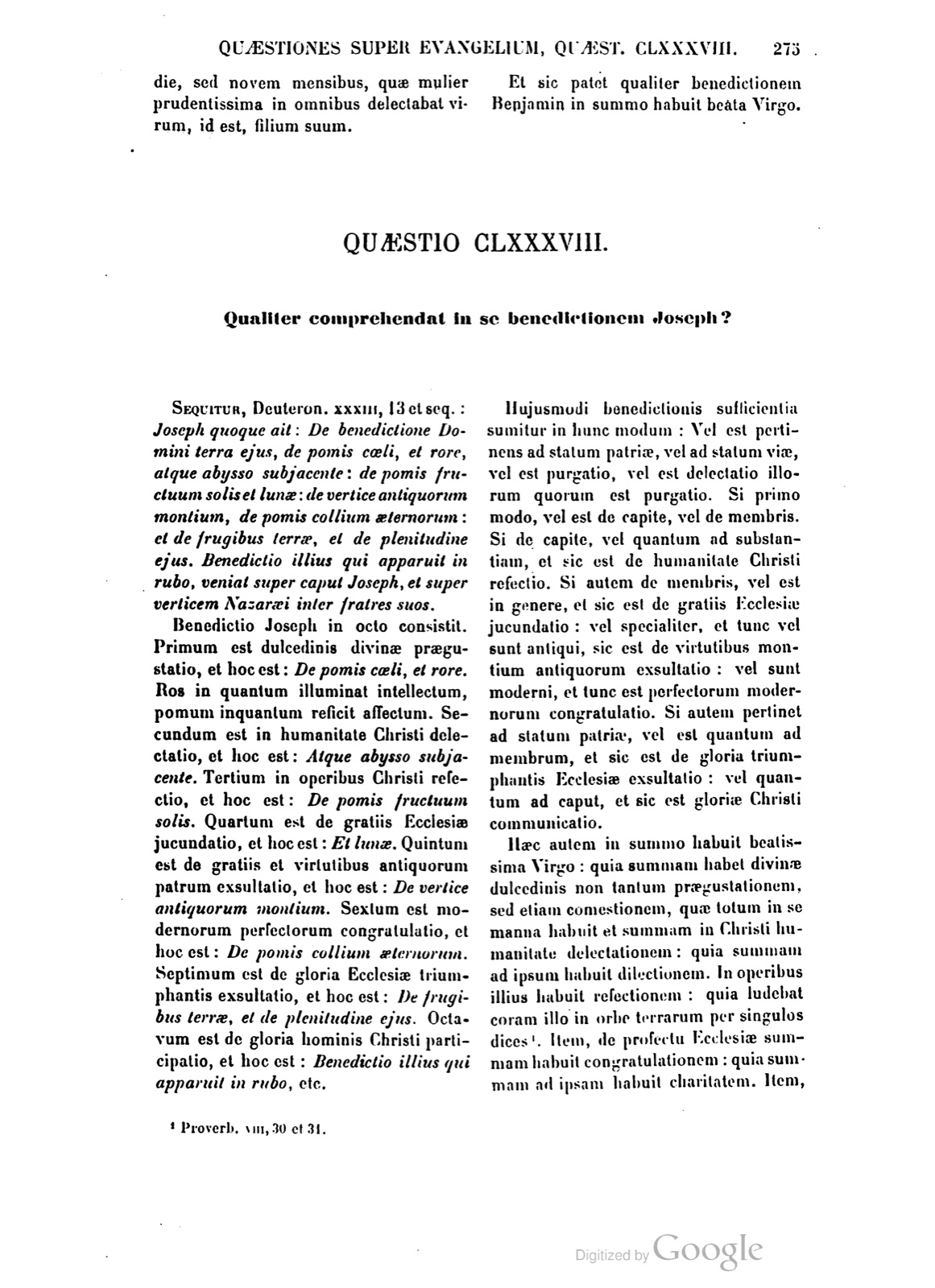
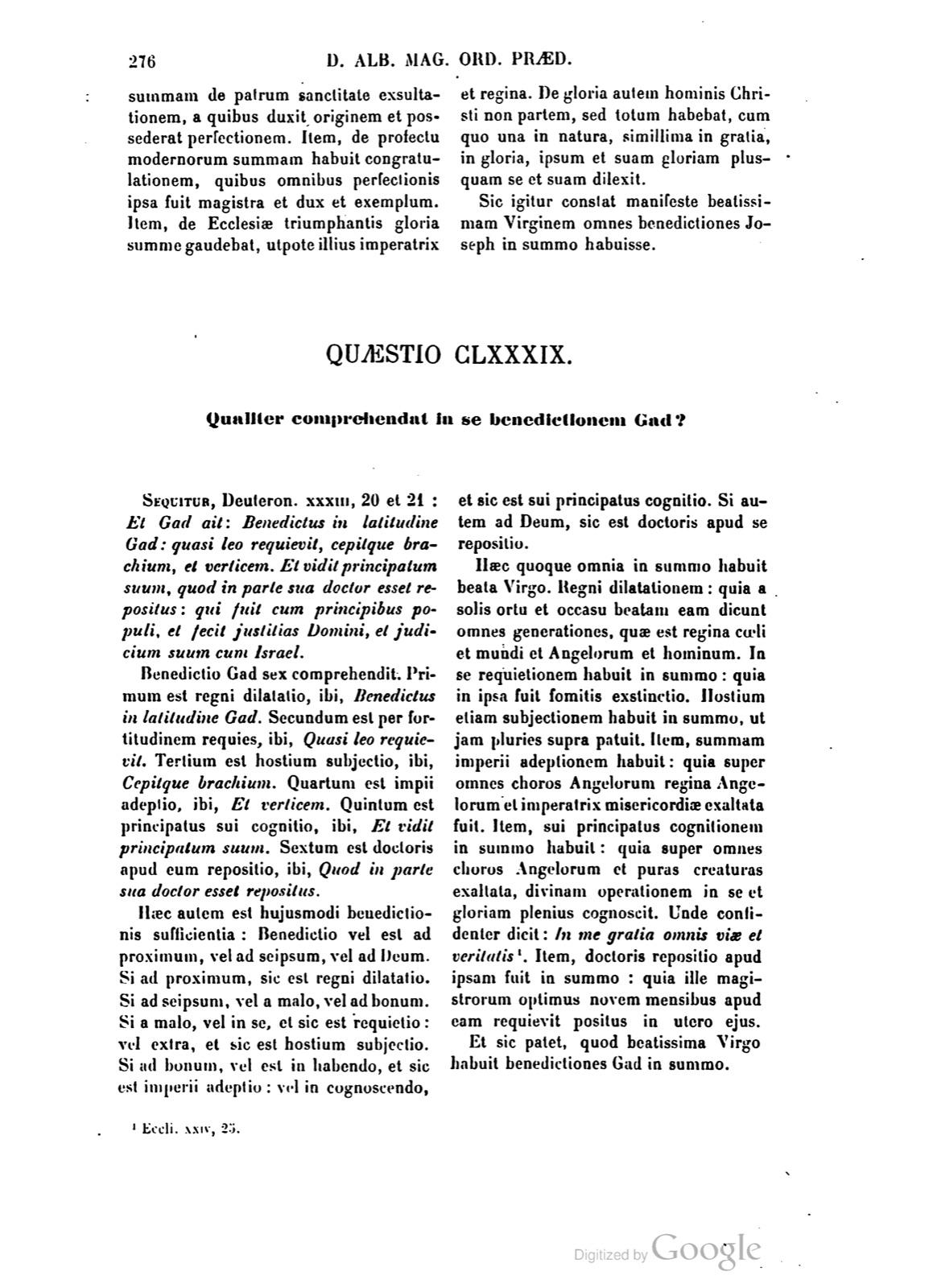
Haec autem in summo habuit beatissima Virgo: quia summam habet divinae dulcedinis non tantum praegustationem, sed etiam comestionem, quae totum in se manna habuit et summam in Christi humanitate delectationem: quia summam ad ipsum habuit dilectionem. In operibus illius habuit refectionem: quia ludebat coram illo in orbe terrarum per singulos dies 1. Item, de profectu Ecclesiae summam habuit congratulationem: quia summam ad ipsam habuit charitatem. Item, summam de patrum sanctitate exsultationem, a quibus duxit originem et possederat perfectionem. Item, de profectu modernorum summam habuit congratulationem, quibus omnibus perfectionis ipsa fuit magistra et dux et exemplum. Item, de Ecclesiae triumphantis gloria summe gaudebat, utpote illius imperatrix et regina. De gloria autem hominis Christi non partem, sed totum habebat, cum quo una in natura, simillima in gratia, in gloria, ipsum et suam gloriam plusquam se et suam dilexit.
Sic igitur constat manifeste beatissimam Virginem omnes benedictiones Joseph in summo habuisse.
But the most blessed Virgin had these things in the highest degree, because she has not only the highest foretaste of divine sweetness but also eating, she who had the whole manna in herself and the highest delight in the humanity of Christ, because she had the highest love toward him. She had refreshment in his works, because she played before him in the world through single days 1. Likewise, she had the highest congratulation concerning the progress of the Church, because she had the highest charity toward it. Likewise, the highest exultation concerning the holiness of the fathers, from whom she drew origin and had possessed perfection. Likewise, she had the highest congratulation concerning the progress of modern persons, for all of whom she herself was mistress and leader and example of perfection. Likewise, she rejoiced supremely concerning the glory of the Church triumphant, as its empress and queen. But concerning the glory of the man Christ she had not a part, but the whole, since she was one with him in nature, most similar in grace and in glory, and loved him and his glory more than herself and her own.
Thus therefore it is manifestly agreed that the most blessed Virgin had all the blessings of Joseph in the highest degree.
Notes
- Proverbs 8:30 and 31. (Proverb. VIII, 30 et 31.) ↩
If a page does not appear, its photograph has not been uploaded yet.